TL;DR
Approach & Workflow
- First, break down NVIDIA's three computing platforms by layer: Vera Rubin / DSX in the data center, RTX Spark on personal devices, and Isaac / Cosmos / DRIVE in the physical world.
- Then distinguish the roles that truly control value in each layer: brand OEMs, ODM/JDMs, cloud and software, power and cooling, chassis and interconnects, and robot bodies and perception. Companies may appear repeatedly because the same Taiwanese group can simultaneously act as a manufacturer, systems vendor, and ecosystem investor.
- For Taiwan-listed companies, determine whether each is a "shipment-volume beneficiary" or a "position-holder with technology and pricing power
- ," and compare FY2025 revenue, net profit attributable to the parent, June 2026 market capitalization, and valuation on a consistent basis.
- Finally, drill further into the BOMs and upstream/downstream chains of these core companies to identify private cooling, power, chassis, vision, reducer, and edge-computing targets whose transaction sizes may be below US$200M.
Core conclusions:
- Taiwan's greatest strength is not a single product, but its mass-production and co-design capabilities spanning server motherboards, racks, power delivery, cooling, and edge devices. In NVIDIA's list, ODM/Compute Systems is almost entirely Taiwan's home field.
- But revenue scale does not equal pricing power. Hon Hai, Quanta, Wistron, and Wiwynn capture the greatest shipment volume, yet margins remain constrained by the ODM model; Delta's power and thermal management, Techman's collaborative robots, and more upstream cooling, power, and perception companies have higher unit value and greater strategic scarcity.
- In the secondary market, Delta, Quanta, Wiwynn, Hon Hai, and Wistron are the main AI-infrastructure plays; ASUS, GIGABYTE, MSI, and Acer provide more RTX/brand and channel exposure; Techman Robot is a relatively pure Physical AI target, but with a valuation that is significantly front-loaded.
- In the private market, Dynatron, LIPS, and Cincoze are more likely to fall within US$200M; after narrowing Compuware through related-party procurement disclosed in SMCI's 10-K (FY2025 US$328.3M), it almost certainly exceeds the ceiling; Ablecom has complex scale and related-party transactions and cannot be treated as an ordinary controlling acquisition. The second drill-down added candidates including Li-Ming Machinery (harmonic + RV reducers), Castec (semiconductor-fab AMRs, Pre-IPO), Allion Labs (third-party server testing), Touché Solutions (robotics touch), and Power Logic (graphics-card fans); it also confirmed that high-quality Taiwanese supply-chain assets are securitized extremely quickly, the "private-company window" is closing, and small-cap public-company privatizations (the Delta-VIVOTEK path) should be compared in the same pool as private acquisitions. All private-company financials must be verified after an NDA.
Vera Rubin
Full Production
Tier-1 OEMs (major complete-system brands)
| Company | Listing status | Country |
|---|---|---|
| Dell Technologies | Public · NYSE:DELL | United States |
| HPE | Public · NYSE:HPE | United States |
| Lenovo | Public · HKEX:0992 | China / Hong Kong |
| Supermicro | Public · NASDAQ:SMCI | United States |
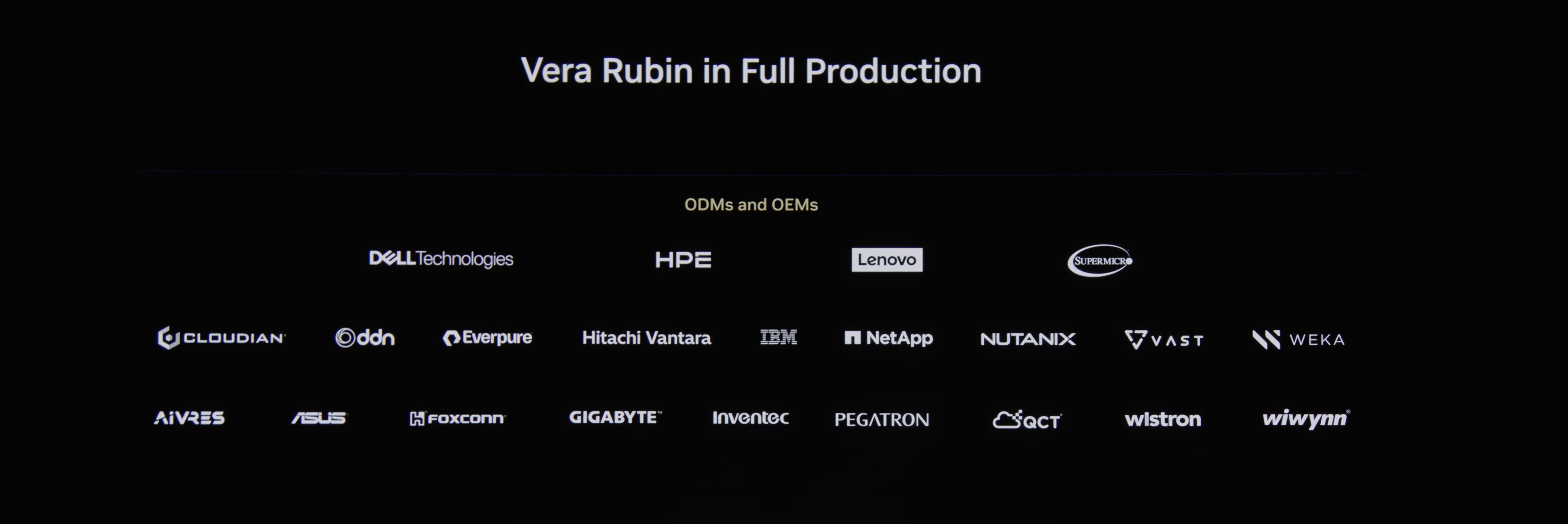
Market structure and competition. These four represent the brand and complete-system gateways for enterprise servers, but not the entire market. Latest-fiscal-year figures show that AI has reshaped their revenue mix: Dell FY2026 (ended 2026-01) shipped more than US$25B of AI servers for the full year, accumulated orders of US$64B+, ended with backlog of about US$43B, and shipped US$9B of AI systems in Q4 alone (+342% YoY); HPE had accumulated about US$16.4B of AI-system orders through FY2026 Q2; Lenovo ISG generated about US$19.2B of full-year revenue and returned to profitability, with annual liquid-cooled-rack capacity above 11,000 racks; on a FY2025 revenue base of about US$22B, Supermicro guided to "at least US$40B" for FY2026, had more than US$13B of Blackwell Ultra orders on hand, and launched a US$7B capital raise to digest about US$39B of AI orders. Meanwhile, cloud vendors increasingly bypass brand OEMs and order directly from Taiwanese ODM/JDMs: by IDC's measure, ODM-direct already represented 59.4% of global server-market revenue in 2025 Q3, and Omdia forecasts Hon Hai will become the world's largest server manufacturer. OEM moats therefore lie mainly in enterprise channels, software services, and accountability for delivery, rather than simple assembly; competition has shifted from "selling one server" to the ability to deliver complete racks, networking, cooling, power, and lifecycle services.
Storage / Data Platforms
| Company | Listing status | Country |
|---|---|---|
| Cloudian | Private (Series F, ~$233M raised) | United States (Japanese roots) |
| DDN (DataDirect Networks) | Private | United States |
| Everpure (formerly Pure Storage, renamed 2026-02; ticker unchanged) | Public · NYSE:PSTG | United States |
| Hitachi Vantara | Subsidiary · Parent Hitachi TSE:6501 | Japan (headquartered in Santa Clara, USA) |
| IBM | Public · NYSE:IBM | United States |
| NetApp | Public · NASDAQ:NTAP | United States |
| Nutanix | Public · NASDAQ:NTNX | United States |
| VAST (VAST Data) | Private | United States (founded in Israel) |
| WEKA | Private | United States (founded in Israel) |
Market structure and competition. AI storage is not a single category: NetApp, IBM, Hitachi Vantara, and Everpure are stronger in mature enterprise customers and all-flash arrays—NetApp FY2026 all-flash revenue was about US$4.18B (+11%); Everpure (announced on 2026-02-23 that Pure Storage would be renamed Everpure, Inc., repositioning as an "enterprise data cloud," while retaining NYSE ticker PSTG) generated about US$3.7B of FY2026 revenue, won adoption of a hyperscale flash design by Meta, and delivered about 2 EB within one year. DDN has the deepest accumulation in HPC parallel file systems; it received a US$300M investment from Blackstone at a US$5B valuation in 2025-01 and supports more than 500,000 GPUs. VAST, WEKA, and Cloudian enter AI-native workloads through scale-out, object storage, and GPU data pipelines—VAST raised about US$1B in 2026 at a US$30B valuation (with NVIDIA participating), with cumulative orders above US$4B and committed ARR above US$500M; WEKA's latest-round valuation was US$1.6B (NVIDIA participated repeatedly); Cloudian has raised about US$233M, and HyperStore has received NVIDIA-Certified Storage certification. The market remains highly fragmented, and customers often procure file, object, cache, and training-data platforms simultaneously; the real competitive metrics are not raw capacity, but GPU utilization, metadata performance, checkpoint recovery speed, and whether expensive GPU waiting time for data can be reduced. This group has no independent Taiwanese vendor. Taiwan's opportunities lie mainly upstream in hardware: Phison (TPEx:8299) enterprise SSDs have received OCP Inspired™ certification, while Silicon Motion (NASDAQ:SIMO) designs controllers to the OCP Datacenter NVMe specification; chassis, rails, and high-speed interconnects are supplied by Chenbro, King Slide, LOTES, and others (see the M&A map at the end).
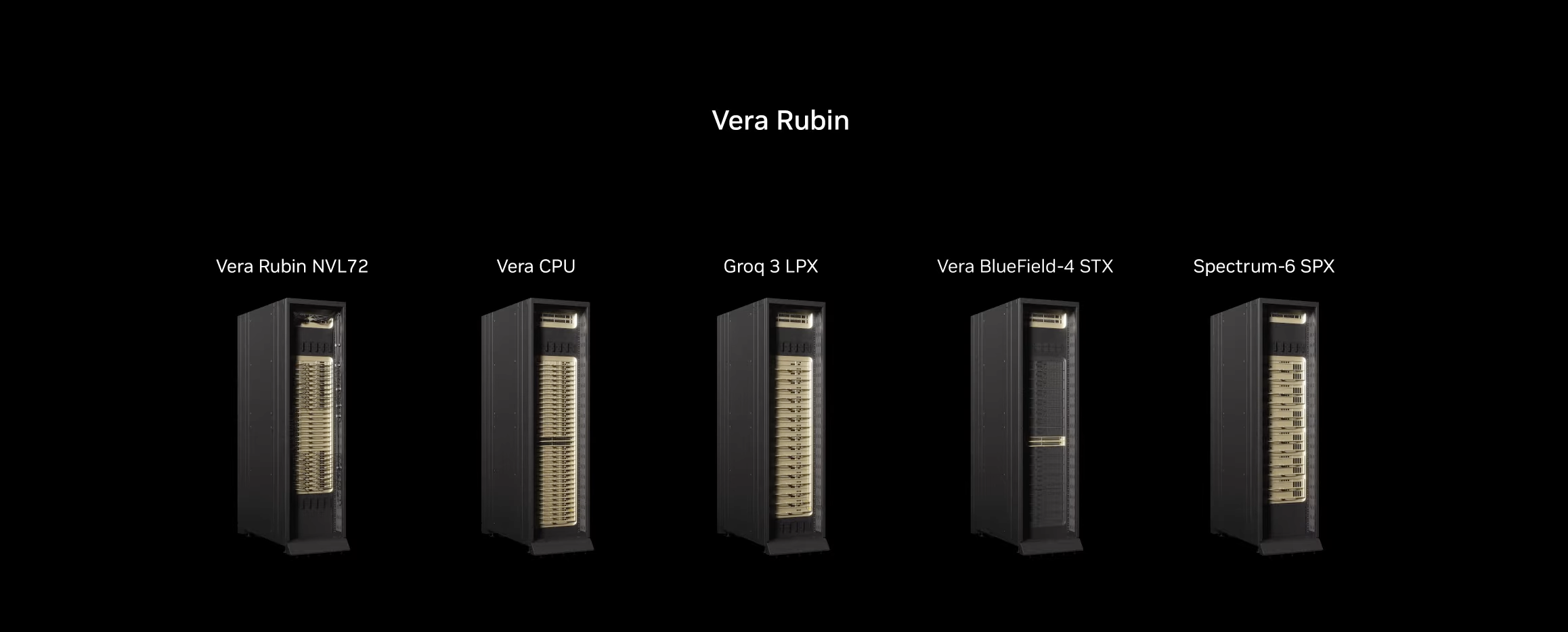
ODMs (contract manufacturing / systems vendors)
| Company | Listing status | Country |
|---|---|---|
| AIVRES | Subsidiary · Parent Inspur SZSE:000977 | United States (renamed from Inspur Systems in 2023; parent added to the US Entity List in 2025-03, while AIVRES, as a US legal entity, is not on the list) |
| ASUS | Public · TWSE:2357 | Taiwan |
| Foxconn (Hon Hai) | Public · TWSE:2317 | Taiwan |
| GIGABYTE | Public · TWSE:2376 | Taiwan |
| Inventec | Public · TWSE:2356 | Taiwan |
| Pegatron | Public · TWSE:4938 | Taiwan |
| QCT (Quanta Cloud Technology) | Subsidiary · Parent Quanta TWSE:2382 | Taiwan |
| Wistron | Public · TWSE:3231 | Taiwan |
| Wiwynn | Public · TWSE:6669 | Taiwan |
Market structure and competition. This is the layer where Taiwan has the strongest control in NVIDIA's ecosystem. Quanta/QCT, Wistron, Wiwynn, Hon Hai, Inventec, Pegatron, and GIGABYTE cover everything from motherboards, nodes, and racks to liquid-cooling integration. Competition falls into two models: one is JDM/ODM for hyperscalers, winning through co-design, production yield, and global capacity; the other is the brand-plus-systems model of GIGABYTE, ASUS, and others, using product portfolios and channels to raise gross margins. GB200/GB300 full-rack shipments were about 29,000 racks in 2025 and are expected to reach 70,000-80,000 in 2026 (TrendForce: overall AI-server shipments +28% in 2025 and another +20%-28% in 2026), of which Hon Hai accounted for about 52%, Wistron about 21%, and Quanta about 19% (breakdown of monthly rack shipments in 2025-11). Industry concentration is high, but customers are also extremely concentrated, and major customers such as Meta, Microsoft, AWS, and Google have strong bargaining power. FY2025's revenue surge proves that Taiwan absorbed AI-server mass production, but most ODM net margins remain only in the low single digits, showing that the value content is large while the profit pool flows more toward GPUs, networking, critical components, and upstream materials.
Positioning of Taiwanese companies (quantified). Company financials, valuations, and private supply-chain targets are detailed in the "Taiwan Company Investment and M&A Map" at the end; here are their roles and latest scale in the context of this table:
- Hon Hai: The manufacturer taking on about 60% of NVIDIA AI-server output, with about 52% share of GB200/GB300 racks; weekly AI-rack capacity of 1,000+ racks, targeting 2,000 racks/week by the end of 2026; its Houston plant began mass-producing GB300 in 2026 Q1 (and deployed internally developed humanoid robots), while Vera Rubin will begin launch mass production there from 2H26; it is also co-building Taiwan's fastest supercomputer with NVIDIA in Kaohsiung.
- Quanta/QCT: AI servers already account for more than 75% of server revenue; 2026 Q1 revenue reached a record NT$809.2B (+66.6%), and management guided to triple-digit AI-server revenue growth in 2026; customers include Meta/AWS/Google, with a transition to the VR200 (Vera Rubin) platform beginning in Q4 2026. QCT is the wholly owned subsidiary spun out by Quanta in 2012.
- Wistron: AI infrastructure rose from 46% of revenue in 2024 to 71% in 2025 and 79% in 2026 Q1; it mainly handles GB-series compute boards/front-end production (about 21% rack share); 2025 revenue doubled YoY to NT$2.19T, and capacity in Dallas, Texas and Fremont/San Jose, California will ship within 2026.
- Wiwynn: FY2025 revenue of NT$950.7B (+163.7%), with AI products above half; customers are extremely concentrated among hyperscalers (Meta accounts for more than half of revenue, with Microsoft/AWS also customers), making it representative of the "pure hyperscaler white-box" model; OCP Platinum member.
- Inventec: Positioned mainly in L6 server motherboards and extending into full racks; 2026 Q1 revenue of NT$200.3B (+27.6%) set a record and servers exceeded half, but Chinese customers account for 50%+ of its AI-server sales, a customer mix clearly different from peers; 2026 shipment guidance is about +20%.
- Pegatron: An AI-server catch-up player; management expects AI-server revenue to grow tenfold in 2026; it has released a GB300 NVL72 model (with an internally developed 310kW CDU) and is working with Together AI and 5C to manufacture and deploy in Texas.
- GIGABYTE: Servers rose from 62% of revenue in 2025 to about 70% in 2026 Q1, with AI servers accounting for about 80%-90% of server revenue; reports say subsidiary Giga Computing plans a separate listing.
- ASUS: The enterprise segment (including AI servers) grew about 85% in 2025; an independent infrastructure business group was established in 2026-03, making ASUS the most aggressive server-transition player among brand vendors.
DSX AI Factory Ecosystem
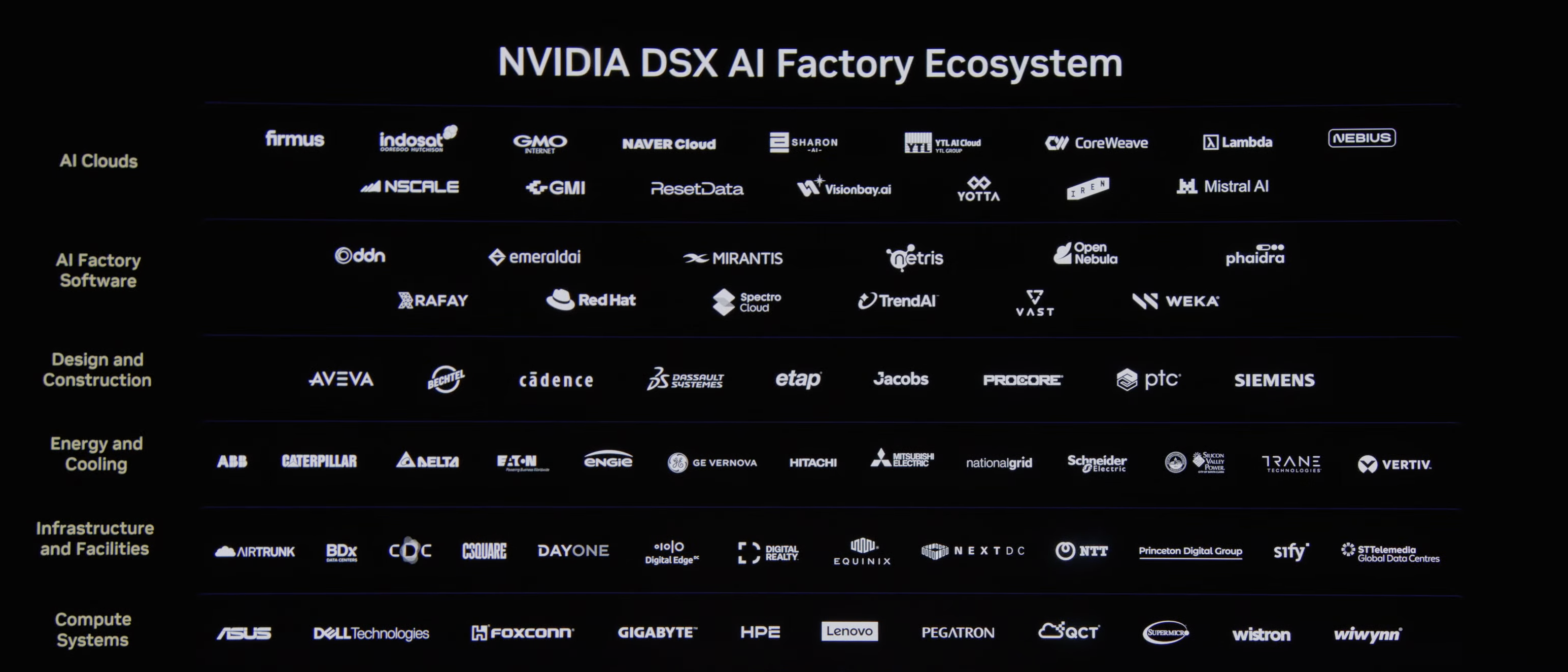
AI Clouds
| Company | Listing status | Country |
|---|---|---|
| Firmus (Sustainable Metal Cloud) | Private | Singapore / Australia (founded in Australia; operated in Singapore by Firmus Technologies) |
| Indosat Ooredoo Hutchison | Public · IDX:ISAT | Indonesia |
| GMO Internet | Public · TSE:4784 (GMO Internet, Inc., the GPU-cloud entity; parent GMO Internet Group TSE:9449) | Japan |
| NAVER Cloud | Subsidiary · Parent NAVER KRX:035420 | South Korea |
| Sharon AI | Public · NASDAQ:SHAZ (completed merger with Roth CH SPAC in 2025-12; listed on Nasdaq and raised US$125M in 2026-02) | Australia (US-listed) |
| YTL AI Cloud | Subsidiary · Parent YTL Power KLSE:6742 | Malaysia |
| CoreWeave | Public · NASDAQ:CRWV | United States |
| Lambda | Private (Series E ~US$1.5B @ ~US$6B; planning a 2H 2026 IPO, with no public filing seen as of 2026-06) | United States |
| Nebius | Public · NASDAQ:NBIS | Netherlands (US-listed, with Yandex roots) |
| Nscale | Private | United Kingdom (data center in Norway) |
| GMI Cloud | Private (Series A cumulative ~US$93M, 2024-10; CEO says an IPO may be considered in 2-3 years) | United States (heavy Taiwan exposure) |
| ResetData | Private (Centuria ASX:CNI holds 50%) | Australia |
| Visionbay.ai | Business unit · AI cloud under Hon Hai TWSE:2317 (NVIDIA Cloud Partner) | Taiwan |
| Yotta | Private (Hiranandani Group) | India |
| IREN | Public · NASDAQ:IREN | Australia (formerly Iris Energy) |
| Mistral AI | Private | France |
Market structure and competition. The upper layer of AI Cloud is controlled by hyperscalers such as AWS, Azure, Google Cloud, and Oracle, but NVIDIA deliberately highlights regional neocloud and sovereign-AI operators here. Neocloud market revenue exceeded US$25B in 2025, and Synergy forecasts it will approach US$400B in 2031 (CAGR ~58%). The leaders have already opened a wide gap: CoreWeave FY2025 revenue was US$5.13B (+168%), with backlog of US$99.4B at the end of 2026 Q1 (OpenAI cumulative up to US$22.4B, Meta cumulative about US$35B, a multiyear Anthropic agreement, and Jane Street's US$6B contract + US$1B equity investment); Nebius 2026 Q1 ARR was US$1.92B (+671%), with FY26 revenue guidance of US$3.0-3.4B (Microsoft up to US$19.4B, Meta up to US$27B); Nscale entered the first tier through an order from Microsoft for about 200,000 GB300s (~US$14B); IREN signed a five-year US$9.7B AI-cloud contract with Microsoft. NAVER, YTL, Yotta, and Indosat rely on local regulation, government orders, and data sovereignty to form regional barriers—NAVER has announced that it will co-build with NVIDIA a Korean sovereign AI factory starting at 55MW and moving toward GW scale (DSX platform). The industry grows quickly but is capital-intensive; depreciation, power procurement, customer concentration, and long-term GPU leases determine real returns.
Taiwanese company: Visionbay.ai (Hon Hai). Visionbay.ai is Hon Hai Group's AI supercomputing and cloud-operations business unit (NVIDIA Cloud Partner), not a known independent legal entity, and public information is insufficient to treat it as an independent, valu-able Taiwanese cloud company. But its physical actions are accelerating: it is investing about US$1.4B to build Taiwan's largest GPU cluster (about 10,000 Blackwell Ultra/GB300 NVL72 units, positioned as "Taiwan's first sovereign AI supercomputing center," entering operation in 1H 2026), with Netris selected for network automation. For investors, Visionbay signals Hon Hai's extension from "contract manufacturing AI servers" into "operating AI compute," and should be incorporated into Hon Hai's valuation narrative; see the Hon Hai entry at the end.
AI Factory Software
| Company | Listing status | Country |
|---|---|---|
| DDN (DataDirect Networks) | Private | United States |
| Emerald AI | Private (NVIDIA NVentures investment) | United States |
| Mirantis | Private | United States |
| Netris | Private | United States |
| OpenNebula | Private | Spain |
| Phaidra | Private | United States |
| Rafay (Rafay Systems) | Private | United States |
| Red Hat | Subsidiary · Parent IBM NYSE:IBM | United States |
| Spectro Cloud | Private | United States |
| TrendAI | Brand/business unit · Parent Trend Micro TYO:4704 (2025 privatization bidding rumors did not result in a transaction; still public) | Japan |
| VAST (VAST Data) | Private | United States (founded in Israel) |
| WEKA | Private | United States (founded in Israel) |
Market structure and competition. This layer turns expensive GPU clusters into schedulable, observable, operable production systems. Red Hat and Mirantis enter through containers and enterprise Linux; Rafay, Spectro Cloud, Netris, and OpenNebula solve multi-cluster and network orchestration—Netris says ARR grew 622% in 10 months, it has about 12% of global neocloud network automation, and Hon Hai Visionbay.ai selected it as the network-automation foundation for Taiwan's largest GPU cluster; Phaidra and Emerald AI lean toward facility and power optimization (Emerald AI raised a cumulative US$68M in 16 months, with NVentures, Eaton, GE Vernova, and Siemens all participating, and aims to turn data centers into flexible grid assets—the same narrative as DSX Flex); VAST (US$30B valuation), WEKA, and DDN connect the data layer. No single control point has yet formed, and customers often combine open-source Kubernetes, Slurm, commercial operations tools, and internally developed platforms. NVIDIA's opportunity is to become the common foundation through interfaces such as DSX, Base Command, and Dynamo; startup risk is that functionality is absorbed by cloud vendors, Red Hat, or NVIDIA itself. TrendAI is the enterprise agentic-security brand launched in 2026 by Trend Micro (founded in Taiwan, listed in Tokyo), centered on TrendAI Vision One and jointly launched with NVIDIA during GTC 2026; it is not an independent subsidiary.
Design and Construction
| Company | Listing status | Country |
|---|---|---|
| AVEVA | Subsidiary · Parent Schneider Electric EPA:SU (delisted in 2023) | United Kingdom |
| Bechtel | Private (one of the largest private US engineering companies) | United States |
| Cadence (Cadence Design Systems) | Public · NASDAQ:CDNS | United States |
| Dassault Systèmes | Public · EPA:DSY | France |
| ETAP | Subsidiary · Parent Schneider Electric EPA:SU | United States |
| Jacobs (Jacobs Solutions) | Public · NYSE:J | United States |
| Procore (Procore Technologies) | Public · NYSE:PCOR | United States |
| PTC (PTC Inc.) | Public · NASDAQ:PTC | United States |
| Siemens | Public · ETR:SIE | Germany |
Market structure and competition. This group spans two markets: Bechtel and Jacobs are engineering, construction, and project-management providers; Cadence, Dassault, Siemens, PTC, AVEVA, and ETAP provide chip, factory, electrical, and digital-twin software. Construction of a large AI Factory requires joint simulation of electrical systems, thermal management, networking, and civil works—ETAP and Schneider released an NVIDIA Omniverse-based AI-factory power digital twin from grid to chip level in 2025-03, precisely the vendor-side implementation of the DSX Sim narrative. Software vendors control design processes and data formats, while engineering firms control actual delivery. The market is concentrated among a few giants with industry certifications and longstanding customer relationships; new entrants cannot directly replace them and can only enter through energy optimization, construction automation, or AI-assisted design. Equity relationships: Schneider completed its acquisition of AVEVA in 2023 and delisted it from the London Stock Exchange; ETAP (headquartered in Irvine, USA) joined Schneider in 2021 but continues to operate as an independent brand.
Energy and Cooling
| Company | Listing status | Country |
|---|---|---|
| ABB | Public · SIX:ABBN | Switzerland |
| Caterpillar | Public · NYSE:CAT | United States |
| Delta Electronics | Public · TWSE:2308 | Taiwan |
| Eaton | Public · NYSE:ETN | Ireland / United States |
| ENGIE | Public · EPA:ENGI | France |
| GE Vernova | Public · NYSE:GEV | United States |
| Hitachi | Public · TSE:6501 | Japan |
| Mitsubishi Electric | Public · TSE:6503 | Japan |
| National Grid | Public · LSE:NG | United Kingdom |
| Schneider Electric | Public · EPA:SU | France |
| Silicon Valley Power | Not a company · Municipal utility (owned by the City of Santa Clara) | United States |
| Trane Technologies | Public · NYSE:TT | Ireland / United States |
| Vertiv | Public · NYSE:VRT | United States |
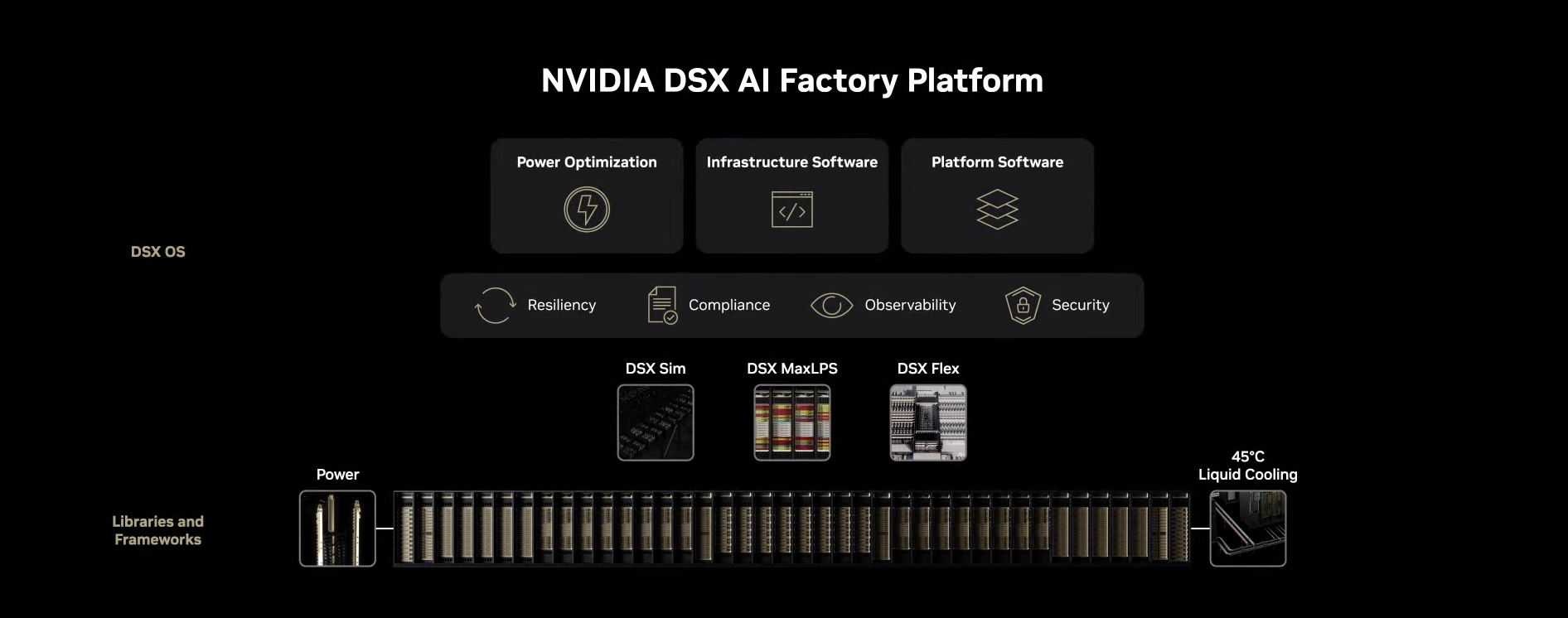
Market structure and competition. AI data centers are shifting competition from individual products such as UPS, power distribution, and chillers toward megawatt-scale system coordination. Demand intensity can be read directly from the latest quarterly reports: Vertiv 2026 Q1 net sales +30% (Americas +44%) and full-year guidance raised to US$13.5-14B; Eaton 2026 Q1 Electrical Americas data-center orders about +240% YoY and data-center revenue about +50%; Schneider 2026 Q1 organic growth +11.2%, including +16% in systems business (mainly data-center solutions). Schneider, Vertiv, Eaton, ABB, GE Vernova, and Trane control global channels, certifications, and large-project delivery; Caterpillar is working with Nscale/Microsoft on power generation for a 1.35GW Vera Rubin campus in West Virginia. Market share is calculated separately for subcategories such as UPS, power distribution, cooling, and CDU, and cannot be summarized with one number; directionally, 800VDC/HVDC, liquid cooling, heat recovery, and grid interaction are increasing systems vendors' influence.
**Taiwanese company:
Delta Electronics (TWSE:2308). Delta is the only Taiwanese vendor in this table and one of the few players with capabilities spanning power electronics, rack-level power delivery, fans, liquid-cooling CDUs, and energy management: its data-center product line covers HVDC/800VDC power racks (90/110kW, stackable to 660kW In-Row), a 33kW 1OU ORv3 Power Shelf (a named product in the OCP product library), and megawatt-class CDUs (L2L 2,000kW / L2A 300kW), and it exhibited a 1.1MW AI Power Cube with NVIDIA at OCP Summit 2025. 2026 Q1 revenue was NT$159.4B (+36%) and gross margin reached a record high of about 37%, confirming that rising "AI power content" is improving its earnings mix. Delta's advantage is power-electronics efficiency and vertically integrated manufacturing; its weakness is a global service network and facility prime-contracting capability weaker than Schneider/Vertiv. See Delta's entry at the end for its supply-chain drill-down and M&A perspective.**
Infrastructure and Facilities
| Company | Listing status | Country |
|---|---|---|
| AirTrunk | Private (held by Blackstone + CPP) | Australia |
| BDx (BDx Data Centers) | Private | Singapore |
| CDC (Canberra Data Centres) | Private (Infratil NZX/ASX:IFT holds 49.75%) | Australia |
| CSquare (Centersquare) | Private (Brookfield; Evoque+Cyxtera merger; confidentially filed for IPO in 2026-04) | United States |
| DayOne | Private (Series C cumulative ~US$4.5B; planning a US/Singapore dual listing raising $5B at a ~$20B valuation) | Singapore (spun out of China's GDS) |
| Digital Edge | Private (backed by Stonepeak) | Singapore |
| Digital Realty | Public · NYSE:DLR (REIT) | United States |
| Equinix | Public · NASDAQ:EQIX (REIT) | United States |
| NEXTDC | Public · ASX:NXT | Australia |
| NTT | Public · TSE:9432 | Japan |
| Princeton Digital Group (PDG) | Private | Singapore |
| Sify (Sify Technologies) | Public · NASDAQ:SIFY | India |
| ST Telemedia Global Data Centres (STT GDC) | Private (ST Telemedia / Temasek) | Singapore |
Market structure and competition. This is the market for land, power access, financing, and data-center operations. Equinix, Digital Realty, and NTT are global platform operators—Equinix recorded a record US$378M in annualized gross bookings in 2026 Q1, with eight of the top ten AI model companies and four of the top five neoclouds expanding on its platform; Digital Realty's backlog reached a record US$1.8B in the same quarter, while its construction pipeline grew 50% QoQ to 1.2GW with 61% pre-leasing. AirTrunk (acquired by Blackstone+CPP for about A$24B in 2024-12, the largest data-center transaction ever), NEXTDC, PDG, STT GDC, and DayOne are expanding regionally in Asia-Pacific; DayOne has raised about US$4.5B cumulatively in Series C and is advancing a US/Singapore dual listing. The truly scarce resources in this industry are not servers, but timely access to power, land, interconnection permits, and pre-leased customers. Scaled companies have low financing costs and can lock in long-term power contracts, while new projects bear construction-delay and customer-concentration risk. Taiwanese companies are absent from this table, reflecting that Taiwan's local advantages lie mainly in equipment manufacturing rather than global data-center real estate and capital operations.
Compute Systems
| Company | Listing status | Country |
|---|---|---|
| ASUS | Public · TWSE:2357 | Taiwan |
| Dell Technologies | Public · NYSE:DELL | United States |
| Foxconn (Hon Hai) | Public · TWSE:2317 | Taiwan |
| GIGABYTE | Public · TWSE:2376 | Taiwan |
| HPE | Public · NYSE:HPE | United States |
| Lenovo | Public · HKEX:0992 | China / Hong Kong |
| Pegatron | Public · TWSE:4938 | Taiwan |
| QCT (Quanta Cloud Technology) | Subsidiary · Parent Quanta TWSE:2382 | Taiwan |
| Supermicro | Public · NASDAQ:SMCI | United States |
| Wistron | Public · TWSE:3231 | Taiwan |
| Wiwynn | Public · TWSE:6669 | Taiwan |
Market structure and competition. Compared with the ODM table above, this list further shows that NVIDIA's compute-systems ecosystem relies on Taiwanese mass production: seven of 11 companies are Taiwanese companies or subsidiaries of Taiwanese groups. Dell, HPE, Lenovo, and Supermicro handle branding, channels, and ultimate customer accountability; Taiwanese vendors handle motherboards, nodes, racks, cooling, and manufacturing. Competition is shifting from individual-machine BOMs to rack-scale co-design—the Vera Rubin generation replaces in-rack cabling with a PCB midplane (reducing assembly from two hours to five minutes), uses a 5,000+ amp liquid-cooled busbar and third-generation MGX racks, meaning greater design coupling among mechanical parts, busbars, and cold plates. Vendors that complete power and liquid-cooling validation first and establish US capacity (Hon Hai in Houston/Wisconsin, Wistron in Texas/California, Pegatron in Texas) are more likely to win next-generation orders. The main risks for Taiwanese vendors are not demand, but customer concentration, capital expenditure, inventory, and low margins; see "Positioning of Taiwanese companies (quantified)" in the ODM table above for roles and figures, and the map at the end for financial and M&A perspectives.
Regional Neocloud
| Neocloud | Region | Representative customers (top layer) | Proprietary platform stack (middle layer) |
|---|---|---|---|
| CoreWeave | United States | Cohere, Cursor, Jane Street, Anthropic, OpenAI, Mistral AI, Runway | W&B Models/Training/Inference/Weave (acquired Weights & Biases) + CoreWeave Inference / Slurm-on-K8s / Kubernetes Service / Compute / Storage / Mission Control |
| Nebius | Netherlands / Europe | Cursor, Black Forest Labs, World Labs, Revolut, Shopify | Nebius Token Factory, Multi-Tenant AI Cloud, Tavily (Agentic Search, acquired for ~US$275M in 2026-02) |
| Nscale | United Kingdom / Europe | BT, Google, Thinking Machines | Only labeled "Training and Inference" (general-purpose) |
| NAVER Cloud | South Korea | Bank of Korea, Korea Hydro & Nuclear Power, Ministry of Science and ICT, Hyundai Motor Group, HD Hyundai, Hanwha Aerospace | HyperCLOVA X (Korean sovereign LLM), NAVER World Model, NAVER Cloud Platform, NAVER Cloud AI Factory, Data Center GAK |
| Firmus | Singapore / Australia | together.ai, A*STAR, HTX, AI Singapore | Only "Training and Inference" |
| Yotta | India | BharatGen, Baseten, together.ai, Sarvam, Bhashini | Shakti Cloud / Shakti Studio, Drishticam, Sudarshan, Suraksha (cybersecurity), Urja, yColo, yntraa Cloud |
| Indosat Ooredoo Hutchison | Indonesia / Southeast Asia | AMP pending verification, Baseten, Sahabat-AI, Malaysian sovereign-AI entity pending verification |
Only "Training and Inference" |
| GMI | United States / Taiwan | TrendAI, Fireworks AI, Reflection, Wistron | GMI Model Garden / Model Fine Tuning / Prime Inference / Dedicated Endpoints + Agent Execution Infra / Agent Dedicated Isolation / Agent Distribution Ecosystem + GMI Compute / Hybrid Clusters / Kubernetes Control (bottom band says "System Builders and OEMs") |
Market structure and competition. The commercial essence of neoclouds is to "use more specialized GPU infrastructure and software experience to compete for training and inference demand not yet fully satisfied by hyperscalers." CoreWeave and Nebius have moved toward platforms (CoreWeave completed its acquisition of Weights & Biases in 2025-05; Nebius acquired Tavily in 2026-02), while Nscale, Firmus, and Indosat remain closer to compute rental, and NAVER and Yotta use local models and government customers as barriers. The customer lists include model companies, inference platforms, and government agencies simultaneously, showing that compute can be resold through multiple layers; the ultimate risk is concentrated in long-term leases, GPU residual values, and a handful of large customers. The customer matrix is not uniformly credible: Anthropic (multiyear agreement in 2026-04), OpenAI (cumulative up to $22.4B), Jane Street ($6B contract + $1B equity investment), Cohere/Cursor/Mistral/Runway in the CoreWeave row all have public corroboration; TrendAI/Fireworks/Reflection/Wistron in the GMI row are also all verifiable (Wistron is both a Series A strategic shareholder and one of the first Taiwanese customers); but no public corroboration was found for Google and Thinking Machines in the Nscale row, together.ai and A*STAR in the Firmus row, or Baseten in the Yotta/Indosat rows, making them slide-only information. GMI's Taiwan connections mainly lie in supply chain, shareholders, and deployment (early Taipei AI Factory customers include TECO, Wistron, and Trend Micro; it is building a $500M flagship facility with 7,000 GB300s), but its headquarters is in San Jose, USA, and the "USA/Taiwan" label alone cannot establish it as an acquirable Taiwanese company; legal entity, shareholders, revenue geography, and asset ownership must first be verified.
- Global regional division of sovereign AI: NVIDIA supports one neocloud in each region, with highly localized customers—South Korea (NAVER) = government + chaebol; Singapore (Firmus) = A*STAR/HTX/AI Singapore; India (Yotta) = domestic LLMs (BharatGen/Sarvam) + government (Bhashini); Indonesia (Indosat) = Sahabat-AI. Demand is spread toward each country's sovereign-AI budget.
- Customers have three layers and are "nested": ① frontier labs (Anthropic/OpenAI/Mistral/Cohere/Thinking Machines/World Labs/Black Forest Labs) cluster in premium Western providers CoreWeave/Nscale/Nebius; ② inference/development platforms (together.ai/Baseten/Fireworks AI) are themselves "customers' customers," reselling inference on neoclouds—compute is subleased layer by layer; ③ government + government-related enterprises (Bank of Korea/Hyundai/Hanwha/Bhashini/A*STAR) are the real payers for sovereign AI.
- The middle layer exposes neocloud maturity: thickest stacks = CoreWeave (full W&B suite), GMI (agent-native full stack), Yotta, NAVER (its own sovereign LLM HyperCLOVA X, now training HyperCLOVA X Next with Nemotron 3 Ultra and co-building a 55MW→1GW sovereign AI factory with NVIDIA); Nscale/Firmus/Indosat, labeled only "Training and Inference," remain at "general-purpose compute rental," with weak software differentiation—directly corresponding to their ability to command valuation premiums.
- Verification results for
pending verificationitems: The AMP in the Indosat row has no corresponding entity in any public channel (NVIDIA official live blog or Indosat/Lintasarta news), so it remainspending verification; the Malaysia flower-shaped logo most likely refers to a Malaysian government-level sovereign AI program (the 2026 budget allocated RM2 billion to build a sovereign AI cloud), rather than YTL (which has a separate entry in the AI Clouds table), and likewise remainspending verification. - Publicly investable: CoreWeave (NASDAQ:CRWV), Nebius (NASDAQ:NBIS), Indosat (IDX:ISAT); NAVER Cloud through parent NAVER (KRX:035420).
- Still private (primary market): Nscale, Firmus, Yotta, GMI.
- Customers themselves form a primary-market target pool: Many frontier labs and inference platforms in the figure are popular private-market targets—Anthropic, OpenAI, Mistral, Cohere, Thinking Machines, World Labs, Black Forest Labs, Cursor, Together AI, Baseten, Fireworks AI, Sarvam, Reflection.
Agentic upon Nemotron 3 Ultra
"Announcing NVIDIA Nemotron 3 Ultra"
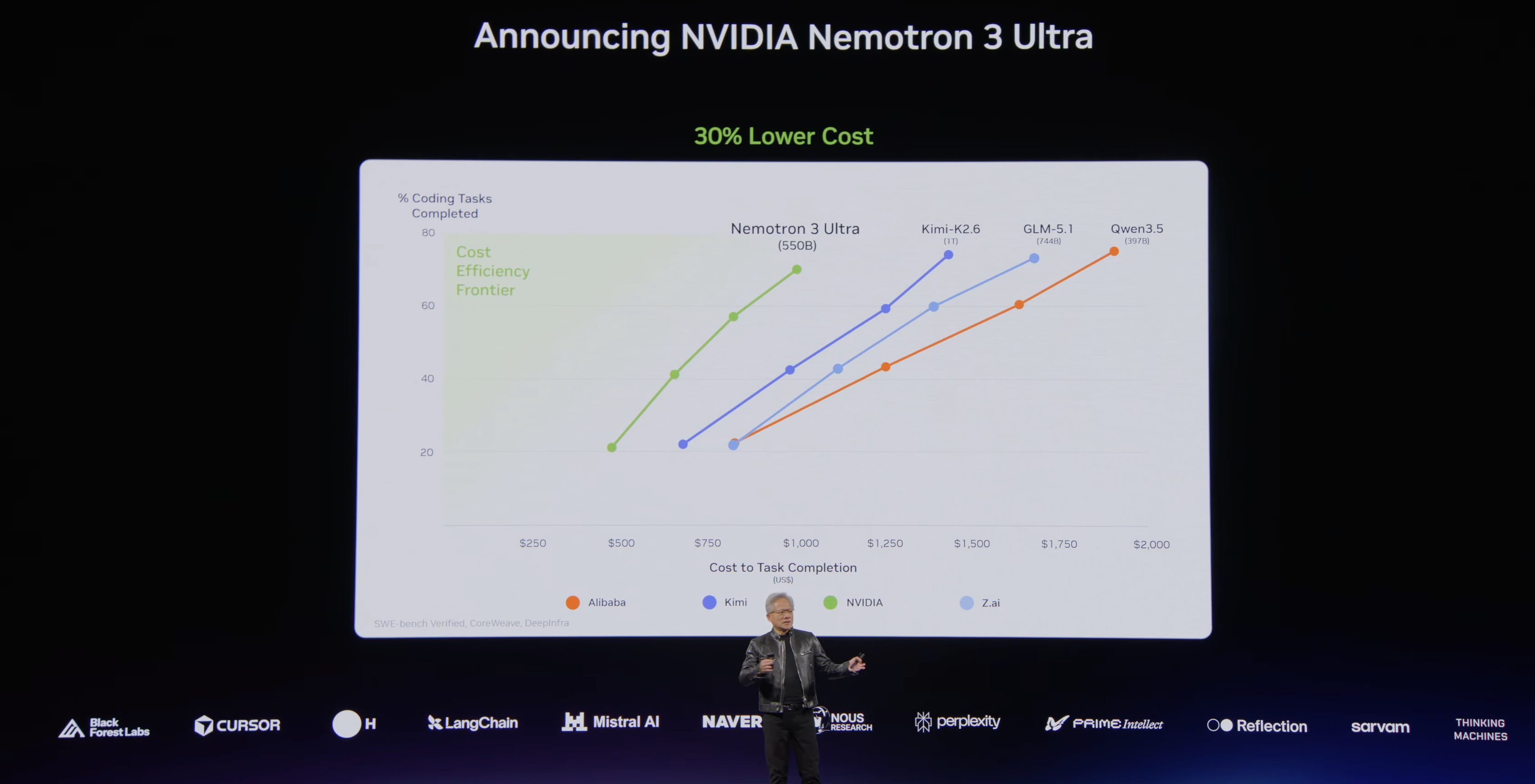
- Claims 30% Lower Cost; X axis = Cost to Task Completion ($500→$2,000), Y axis = % Coding Tasks Completed; the green area is labeled "Cost Efficiency Frontier" (Nemotron lies on the frontier—lower cost at the same task-completion rate).
- Models / vendors compared:
| Model | Vendor | Country | Listing status |
|---|---|---|---|
| Nemotron 3 Ultra (550B total parameters / 55B active) | NVIDIA | United States | Public · NASDAQ:NVDA |
| Kimi-K2.6 (1T total parameters / 32B active, released 2026-04) | Moonshot AI | China | Private (raised $2B @ $20B in 2026-05; discussing a new round at $30B) |
| GLM-5.1 (754B total parameters / 40B active, released 2026-04) | Zhipu AI / Z.ai | China | Public · HKEX:2513 (listed 2026-01-08); STAR Market return listing under registration (proposed raise ≤¥15B) |
| Qwen3.5 (397B total parameters / 17B active, released 2026-02) | Alibaba / Qwen | China | Public · NYSE:BABA / HKEX:9988 |
Market structure and competition. Competition in open models is not a single benchmark ranking, but a combination of capability, inference cost, licensing, ecosystem, and hardware optimization. Moonshot, Zhipu, and Alibaba Qwen represent the rapid iteration of Chinese open-weight models—the Qwen family has accumulated ~1 billion downloads on Hugging Face, more than 50% of global open-source-model downloads, with 110,000+ derivative models; the Nemotron family has accumulated about 50 million downloads over the past year, a roughly 20-fold difference in scale. NVIDIA officially positions Nemotron 3 Ultra around cost efficiency (its official page claims throughput advantages of 5.9x over GLM-5.1, 4.8x over Kimi-K2.6, and 1.6x over Qwen3.5). It is fundamentally a hardware-demand generator and an enterprise-controllable model solution, rather than an independent attempt to win consumer mindshare. Its advantage is joint optimization with NeMo, TensorRT-LLM, Dynamo, and GPU systems; its weakness is adoption volume and developer brand, which still trail leading open-source models. There are almost no Taiwanese software companies here; Taiwan benefits mainly through the hardware demand generated by model training and inference.
-
Observation: The competitors selected by NVIDIA are all frontier Chinese open-source models—further confirming that Nemotron's real comparison set is Chinese open source ("America's strongest vs. China's frontier"), and that it competes on the cost-efficiency axis, not the capability axis.
-
Bottom partner/adoption logo strip (Nemotron Alliance): Verified through a high-definition frame + NVIDIA AI's official X post + Prime Intellect's official blog, the 12 companies are Black Forest Labs, Cursor, H Company (French agent startup, European-record $220M seed round in 2024, products Runner H/Surfer H/Holo series—the white circular "H" logo previously marked
pending verification), LangChain, Mistral AI, NAVER, Nous Research, Perplexity, Prime Intellect (United States, decentralized training/RL environments, cumulative funding ~$70M; previously misidentified as Baseten), Reflection, Sarvam, and Thinking Machines. The alliance launched at GTC in 2026-03 and announced expansion at GTC Taipei; its output will feed Nemotron 4 training. Except for NAVER (through parent KRX:035420), all are private-market targets.
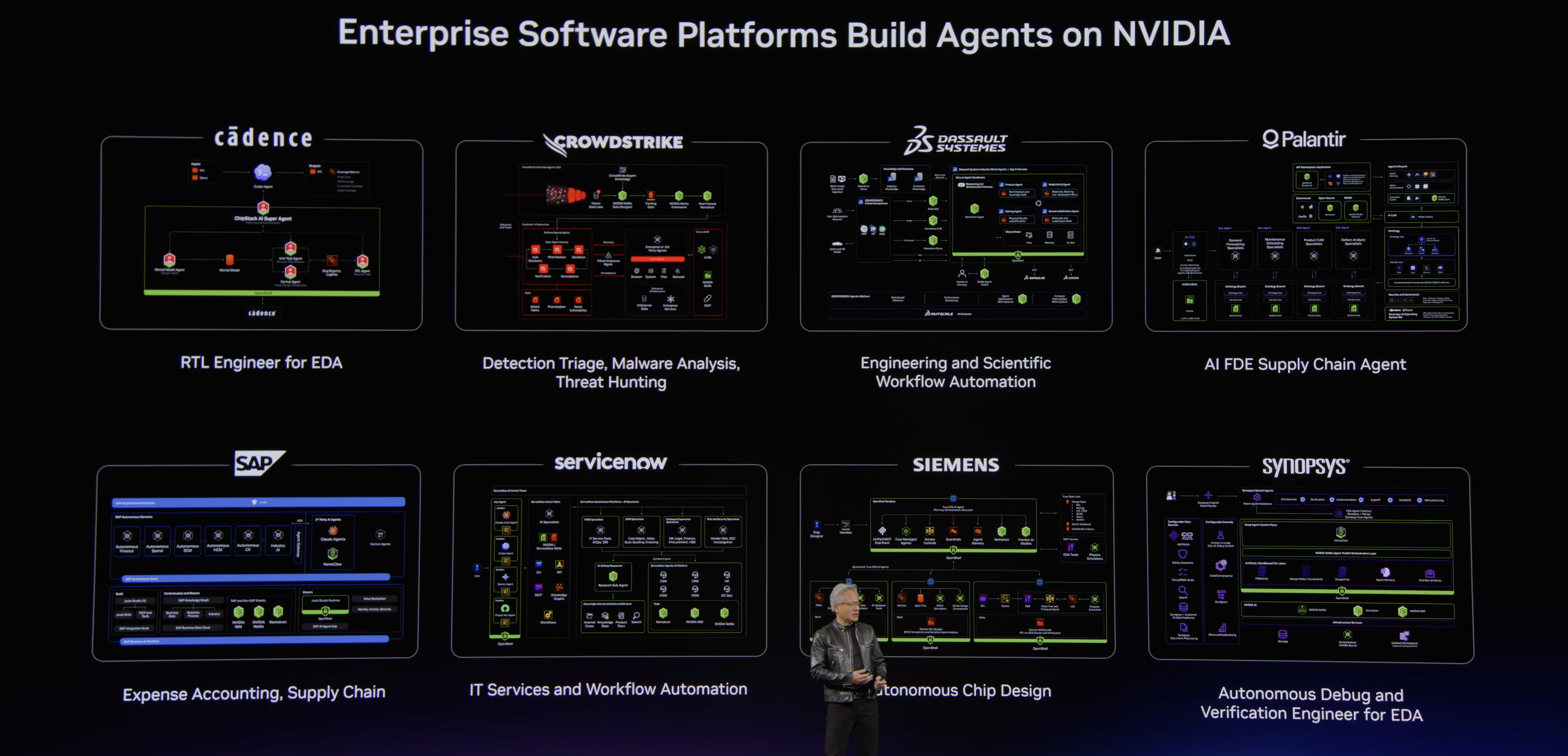
Enterprise Software Platforms Build Agents on NVIDIA
| Company | Agent use case | Listing status | Country |
|---|---|---|---|
| Cadence | RTL Engineer for EDA | Public · NASDAQ:CDNS | United States |
| CrowdStrike | Detection Triage / Malware Analysis / Threat Hunting | Public · NASDAQ:CRWD | United States |
| Dassault Systèmes | Engineering and Scientific Workflow Automation | Public · EPA:DSY | France |
| Palantir | AI FDE Supply Chain Agent | Public · NASDAQ:PLTR | United States |
| SAP | Expense Accounting, Supply Chain | Public · ETR:SAP (primary listing) / NYSE:SAP ADR | Germany |
| ServiceNow | IT Services and Workflow Automation | Public · NYSE:NOW | United States |
| Siemens | Autonomous Chip Design | Public · ETR:SIE | Germany |
| Synopsys | Autonomous Debug and Verification Engineer for EDA | Public · NASDAQ:SNPS | United States |
Market structure and competition. Enterprise agents will not form a completely independent software category; they will be embedded in existing workflows. Cadence, Synopsys, and Siemens control data formats, verification processes, and customer lock-in in EDA; SAP, ServiceNow, and Palantir control enterprise data and operating workflows; CrowdStrike controls security telemetry. NVIDIA supplies models, inference, and secure runtimes, but final application distribution remains in the hands of these software platforms. For Taiwan, indirect benefits come from EDA demand, server procurement, and manufacturing automation; there is no directly comparable software-platform target.
- Observations:
- All eight are large-cap public companies (five US / two German / one French), covering core enterprise functions: security (CrowdStrike), supply chain/finance (Palantir/SAP), IT processes (ServiceNow), engineering simulation (Dassault), and chip design (Siemens/Cadence/Synopsys).
- All three EDA giants are present: Cadence (RTL engineer), Synopsys (autonomous debug/verification engineer), and Siemens (autonomous chip design)—all are using agents to remake chip-design workflows, echoing NemoClaw's EDA entry point + NVIDIA "using Cadence agents to accelerate its own chip design."
- This group is Jensen's evidence for "agents will not disrupt these markets; instead, they are the greatest opportunity," and they are also flagship enterprise customers for NemoClaw/Nemotron (Cadence/Siemens/Dassault also appear on the NemoClaw adoption list).
- Investment angle: all are publicly investable and serve as cash-flow-stable proxies for the "enterprise agentification" theme (EDA: CDNS/SNPS; enterprise software: NOW/SAP/PLTR/CRWD).
RTX for Customers
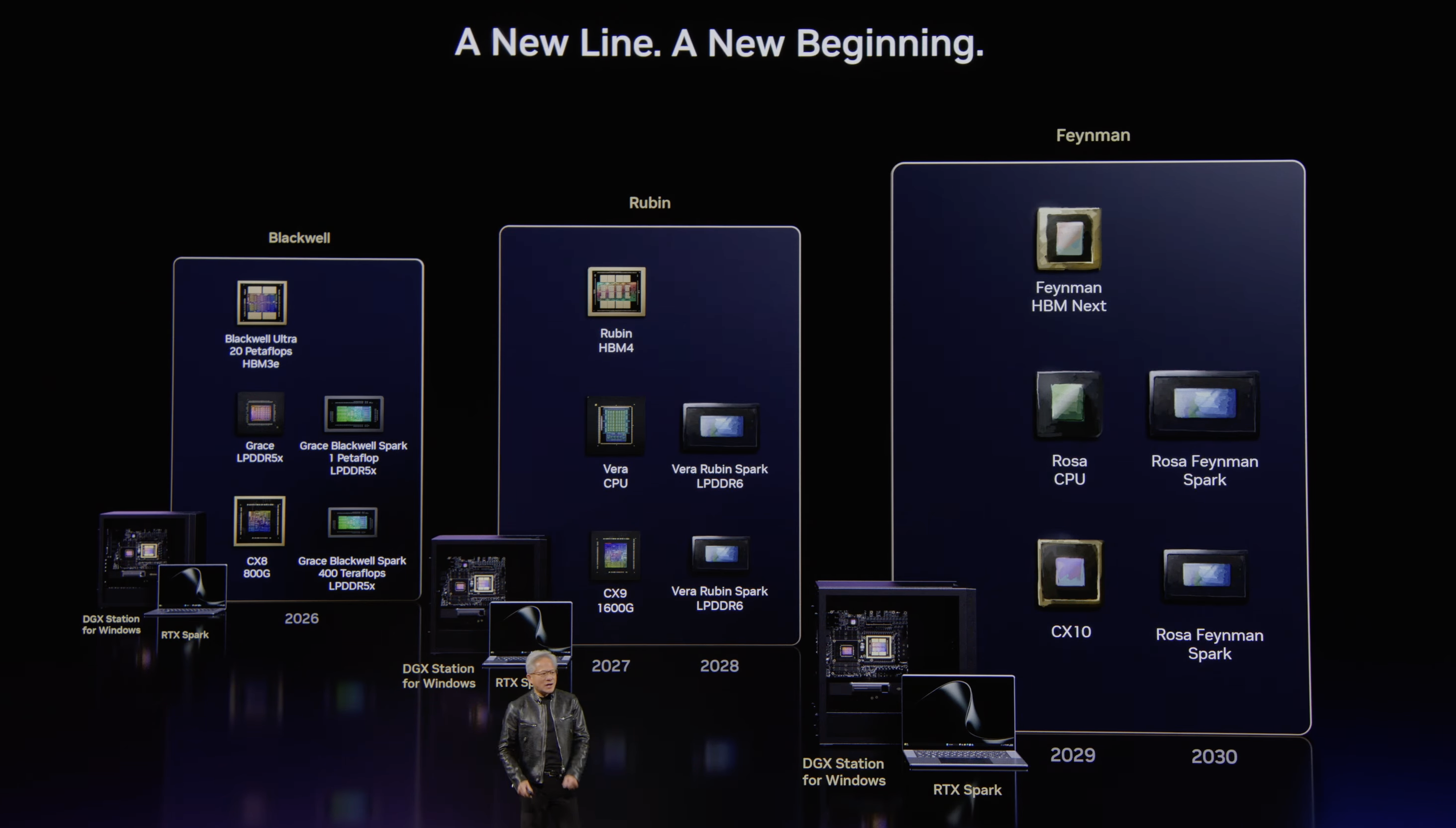
RTX Spark Laptops
| OEM | Listing status | Country |
|---|---|---|
| Acer | Public · TWSE:2353 | Taiwan |
| ASUS (including ProArt sub-brand) | Public · TWSE:2357 | Taiwan |
| Dell | Public · NYSE:DELL | United States |
| GIGABYTE | Public · TWSE:2376 | Taiwan |
| HP (HP Inc.) | Public · NYSE:HPQ | United States |
| Lenovo | Public · HKEX:0992 | China / Hong Kong |
| Microsoft (Surface) | Public · NASDAQ:MSFT | United States |
| MSI | Public · TWSE:2377 | Taiwan |
Market structure and competition. The PC market is mature and highly concentrated overall: 284.7M global units shipped in 2025 (+8.1%, IDC), with shares of Lenovo 25.6% / HP 20.9% / Dell 14.4% / Apple 9.0% / ASUS 7.2%, and Acer in sixth place. The variable introduced by RTX Spark is not redistribution of traditional share, but whether it can create a new price band for high-memory local-inference workstations—the RTX Spark Superchip combines a Blackwell RTX GPU (6,144 CUDA cores, 1 PFLOP AI) + a 20-core Grace Arm CPU co-designed with MediaTek, NVLink-C2C interconnect, and up to 128GB of unified memory, can run 120B-parameter models locally, and will launch in fall 2026 (official first-wave vendors ASUS/Dell/HP/Lenovo/Surface/MSI, followed by Acer and GIGABYTE). A headwind must be noted: the memory supercycle has already led IDC/Gartner to cut 2026 PC-shipment forecasts to about -10% to -11% and raise average-price forecasts by 17%-18%; 128GB unified-memory models are hitting a cost peak, and the expected timing for "AI PCs exceeding half of shipments" has slipped from 2026 to 2028 (Gartner). ASUS and GIGABYTE span motherboards, graphics cards, workstations, and servers, giving them the strongest product synergy; MSI has advantages in gaming and creator channels; Acer has broad scale and channels, but weaker control of critical upstream components. Microsoft defines the software experience through Windows and Surface, while NVIDIA and MediaTek are trying to alter the hardware architecture long dominated by x86—this is also MediaTek's (TWSE:2454) key Taiwanese position in the narrative.
- All eight are major publicly listed consumer-PC companies; four are Taiwanese (Acer/ASUS/GIGABYTE/MSI).
- Critical distinction: HP here is HP Inc. (NYSE:HPQ, consumer PCs), not HPE (NYSE:HPE, enterprise/servers) in the earlier server/DSX lists—the two are separate companies split in 2015; do not confuse them.
- RTX Spark laptops bring the "personal AI PC" narrative to consumer endpoints, on the same main line as the consumer wall above and the RTX Spark chip. The OEM lineup overlaps with the data-center ODM/OEM section (Dell/Lenovo/ASUS/GIGABYTE/MSI), but these are consumer laptop brands here, not server ODM roles.
- Investability: all are publicly investable.
Software Ecosystem
AI Development Tools / Frameworks / Models
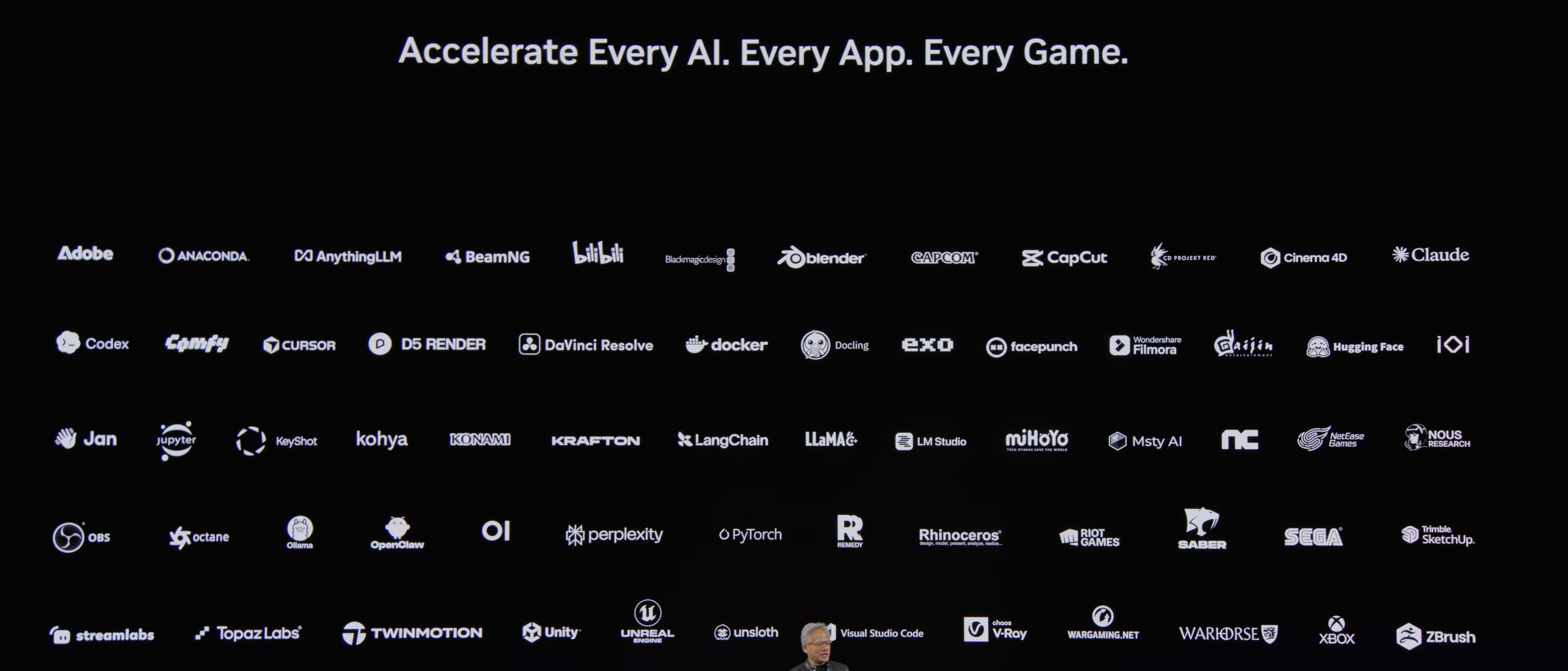
| Name | What it is | Status · Country |
|---|---|---|
| Adobe | Creative suite (including Firefly) | Public NASDAQ:ADBE · United States |
| Anaconda | Python/data-science distribution | Private · United States |
| AnythingLLM (Mintplex) | Local RAG/agent application | Private · United States |
| Claude (Anthropic) | Frontier model/agent | Private · United States |
| Codex (OpenAI) | Coding agent | Private · United States |
| ComfyUI (Comfy.org) | Node-based generative workflow | Private · United States |
| Cursor (Anysphere) | AI programming IDE | Private · United States |
| Docker | Containers | Private · United States |
| Docling (IBM) | Open-source document parsing | Open source (initiated by IBM Research Zurich, donated to Linux Foundation) |
| EXO (exo labs) | Open-source distributed inference | Private · United Kingdom (London, Oxford-background team) |
| Hugging Face | Model community | Private · United States |
| Jan (Menlo Research) | Local AI application | Private · Singapore (registered) / Vietnam (team) |
| Jupyter | Open-source notebook | Open source/nonprofit |
| kohya (kohya-ss) | LoRA training scripts | Open-source project |
| LangChain | Agent framework | Private · United States |
| llama.cpp | Open-source local inference (ggml) | Open-source project |
| LM Studio | Local LLM application | Private · United States |
| Msty AI | Local LLM application | Private · United States (Columbus, Ohio) |
| Nous Research | Open-source model (Hermes) | Private · United States |
| Ollama | Local model runtime | Private · United States |
| OpenClaw | Open-source agent harness (MIT) | Open-source project (moved to an independent foundation in 2026-02, sponsored by OpenAI; NemoClaw is its enterprise security distribution) |
| Open Interpreter (OI) | Open-source code-execution agent | Private · United States |
| Perplexity | AI search | Private · United States |
| PyTorch | Deep-learning framework | Open source (Linux Foundation/Meta) |
| unsloth | Open-source fine-tuning acceleration | Private · United States |
| Visual Studio Code | Editor | Parent Microsoft NASDAQ:MSFT · United States |
Market structure and competition. Local AI tools show a clear long tail: llama.cpp, Ollama, LM Studio, and others compete for the model-runtime entry point; the workflow layer includes ComfyUI (raised $30M at a ~$500M valuation in 2026-04), LangChain, and AnythingLLM; development entry points are controlled by VS Code, Cursor, Codex, and others. The item on this wall most worth calling out separately is OpenClaw: personally created by Peter Steinberger (Clawdbot→Moltbot→OpenClaw), the project moved to an independent foundation after the author joined OpenAI in 2026-02 (community governance, OpenAI sponsorship), and exceeded 250,000 GitHub stars in 2026-03 to take first place—NVIDIA's NemoClaw (released at GTC in 2026-03) is precisely the enterprise distribution of "OpenClaw + OpenShell security sandbox + local Nemotron model," and the keynote's agent stack is built directly on it. The abundance of open-source projects lowers switching costs and weakens the moat of any single tool; NVIDIA's advantage is making different tools all run on CUDA, TensorRT, and RTX (officially, more than 100 million RTX AI PCs are already installed and in use). Taiwanese companies barely participate in the software-control layer and mainly monetize demand through PCs, motherboards, graphics cards, and memory-capacity upgrades.
Creative Content / Professional Visualization / Engines
| Name | What it is | Status · Country |
|---|---|---|
| Blackmagic Design | Film/video hardware + software (including DaVinci Resolve) | Private · Australia |
| DaVinci Resolve | Color grading/editing (Blackmagic product) | See Blackmagic |
| Blender | Open-source 3D | Open source/nonprofit · Netherlands |
| Cinema 4D (Maxon) | 3D | Parent Nemetschek ETR:NEM · Germany |
| ZBrush (Maxon) | Digital sculpting | Same as above (Maxon/Nemetschek) |
| KeyShot (Luxion) | Rendering | Private · United States (Costa Mesa, California headquarters) / Denmark (Aarhus R&D) |
| Octane (OTOY) | Rendering | Private · United States |
| V-Ray (Chaos) | Rendering | Private · Germany (Karlsruhe headquarters after merger with Enscape) / Bulgaria (origin and R&D) |
| Rhinoceros (McNeel) | 3D CAD | Private · United States |
| Trimble SketchUp | 3D modeling | Parent Trimble NASDAQ:TRMB · United States |
| Twinmotion (Epic) | Real-time visualization | Parent Epic private (Tencent shareholder) · United States |
| D5 Render (Dimension5) | Real-time rendering | Private · China (Nanjing) |
| CapCut (ByteDance) | Video editing | Parent ByteDance private · China |
| Wondershare Filmora | Video editing | Public SZSE:300624 · China |
| Topaz Labs | AI image/video enhancement | Private · United States |
| Streamlabs | Livestreaming tool | Parent Logitech SIX:LOGN (primary) / NASDAQ:LOGI · United States/Switzerland |
| OBS Studio | Open-source livestreaming | Open source/nonprofit |
| Unity | Real-time 3D/game engine | Public NYSE:U · United States |
| Unreal Engine (Epic) | Game engine | Parent Epic private (Tencent shareholder) · United States |
Market structure and competition. Adobe controls general creative workflows; Autodesk/Trimble/McNeel/Maxon and others are deeply established in professional tools; Unity and Unreal control real-time 3D engines; Blender provides a powerful open-source alternative. Generative AI is reducing content-production costs, but plugin ecosystems, file formats, professional processes, and team collaboration still create lock-in. RTX acts as the common local-acceleration layer for these applications. Taiwanese hardware vendors can share in replacement cycles and high-end GPU demand, but have difficulty capturing the high margins of software subscriptions.
Games — Studios / Publishers / Platforms
| Name | Representative title | Status · Country |
|---|---|---|
| BeamNG | Driving simulation | Private · Germany |
| bilibili | Video/game platform | Public NASDAQ:BILI / HKEX:9626 · China |
| Capcom | Monster Hunter/Resident Evil | Public TSE:9697 · Japan |
| CD Projekt Red | The Witcher/Cyberpunk | Public WSE:CDR · Poland |
| Facepunch Studios | Rust | Private · United Kingdom |
| Gaijin Entertainment | War Thunder | Private · Hungary |
| IO Interactive (IOI) | Hitman | Private · Denmark |
| Konami | Winning Eleven/Metal Gear | Public TSE:9766 · Japan |
| KRAFTON | PUBG | Public KRX:259960 · South Korea |
| miHoYo / HoYoverse | Genshin Impact/Honkai | Private · China |
| NCSOFT (NC) | MMO (Lineage/Blade & Soul) | Public KRX:036570 · South Korea |
| NetEase Games | Multiple titles | Parent NetEase NASDAQ:NTES/HKEX:9999 · China |
| Remedy Entertainment | Control/Alan Wake | Public HEL:REMEDY · Finland |
| Riot Games | League of Legends | Parent Tencent HKEX:0700 (wholly owned) · United States |
| Saber Interactive | Multiple titles | Private · United States (sold by Embracer to Beacon Interactive for ~$247M in 2024) |
| SEGA (Sega Sammy) | Multiple titles | Public TSE:6460 · Japan |
| Wargaming | World of Tanks | Private · Cyprus |
| Warhorse Studios | Kingdom Come: Deliverance | Parent Embracer STO:EMBRAC-B (announced spin-off into Fellowship Entertainment in 2026-05, planned Stockholm listing in 2027) · Czech Republic |
| Xbox (Microsoft) | Gaming platform | Parent Microsoft NASDAQ:MSFT · United States |
Market structure and competition. Value in the gaming market is controlled by platforms, publishing, and strong IP, while the studio list is highly fragmented. RTX, DLSS, and neural rendering create GPU demand through image quality and performance, but NVIDIA does not control content distribution. Taiwan's ASUS, GIGABYTE, MSI, and Acer mainly compete for graphics cards, gaming PCs, and peripheral channels; competition is intense and brand premiums are affected by GPU supply, product cycles, and inventory. Compared with data-center ODMs, demand in this layer is more cyclical and more dependent on consumer confidence.
- This is the "full-stack" counterpart on the RTX/GeForce consumer side: data centers rely on DSX/Vera Rubin, while consumer/creation/gaming relies on RTX—"Accelerate Every AI, Every App, Every Game." CUDA/RTX lock-in extends from data centers all the way to every creative application, every local AI tool, and every AAA engine.
- Local AI tools cluster together (Ollama, LM Studio, Jan, Msty, llama.cpp, AnythingLLM, ComfyUI), echoing the keynote's RTX Spark / personal AI PC theme—run AI on one's own RTX PC.
- Framework independence extends to the consumer side: even competing AI agents such as Claude (Anthropic) and Codex (OpenAI) run on RTX—the same framework-independent strategy as OpenShell on the enterprise side.
- Investability: most of this wall consists of private studios/subsidiaries/open-source projects and is not directly investable. The few public targets are Adobe, Unity, Trimble, Logitech, Nemetschek (Maxon), Microsoft, IBM, Wondershare, and game stocks Capcom/CD Projekt/Konami/Krafton/NCSOFT/NetEase/Sega/Remedy/bilibili/Embracer. The wall's value is as a signal of "RTX ecosystem breadth," not as individual-stock selection.
Physical AI
World Model: Cosmos Coalition
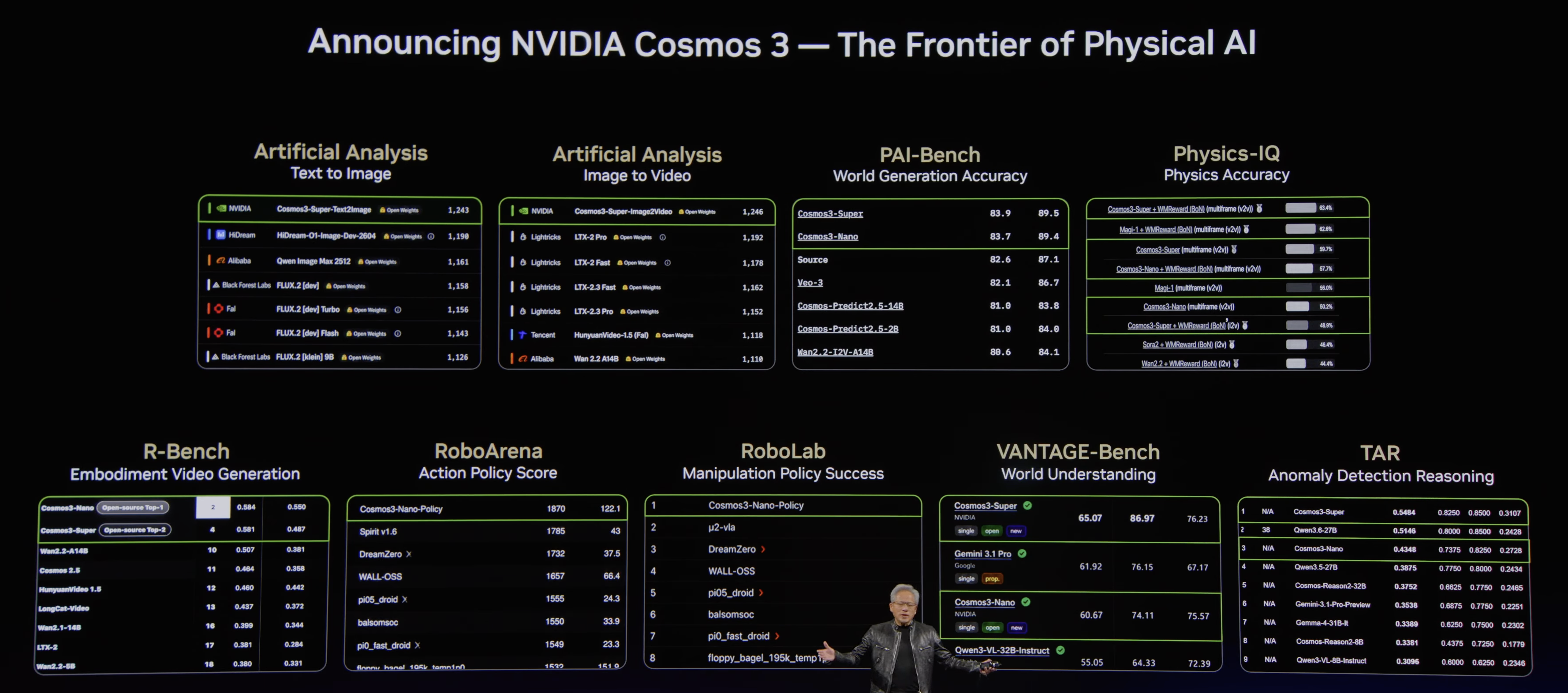
| Company | Focus | Listing status | Country |
|---|---|---|---|
| Agile Robots | Collaborative robots/robot arms | Private | Germany (Munich) |
| Black Forest Labs | Image/video generation (FLUX) | Private | Germany |
| Generalist (Generalist AI) | Robotics foundation model | Private | United States |
| LTX (Lightricks' AI-video entity, parent company being split) | Video generation (LTX-2 / LTX Studio) | Private | Israel |
| Runway | Video generation | Private | United States |
| Skild AI | Robotics foundation model ("robot brain") | Private | United States |
Market structure and competition. Cosmos Coalition places two kinds of companies together: video-generation models provide world content and synthetic data, while robotics foundation models provide actions and policies. The list exactly matches NVIDIA's official 2026-06-01 press release ("including Agile Robots, Black Forest Labs, Generalist, LTX, Runway and Skild AI"). The capital-market heat around the six can be quantified: Skild AI completed a $1.4B Series C in 2026-01 at a valuation above $14B (tripling in seven months); Generalist announced $400M @ $2B on 2026-06-04 (NVIDIA and Bezos Expeditions participated); Runway completed a $315M Series E @ $5.3B in 2026-02; Black Forest Labs completed a $300M Series B @ $3.25B in 2025-12; Agile Robots is a dual-headquartered Munich/Beijing unicorn (SoftBank-led Series C, shareholders include Fii and Xiaomi, acquired Franka Emika and released humanoid Agile ONE). Current world models remain in rapid iteration; benchmarks, closed-loop simulation, and transfer to real robots have not formed stable standards, and market share cannot be measured by traditional shipment volume. NVIDIA connects models, simulation, and hardware through Cosmos, Omniverse, and Isaac, while coalition members contribute model capability and application scenarios. No Taiwanese company is in this table, but the same Cosmos 3 official release names two Taiwanese adopters—vision-AI company Linker Vision (private, Kaohsiung smart-city project) and YUAN (TPEx:5474, video capture)—so Taiwan's opportunities lie more in robot bodies, vision, edge computing, and manufacturing deployment (see the new chapter at the end).
- This extends NVIDIA's platform strategy into "Physical AI / robotics": the next frontier after digital agents. Cosmos provides world models, and the coalition contains two types of players—robotics foundation models (Generalist, Skild AI, Agile Robots) + generative video/worlds (Black Forest Labs, Runway, LTX). Both use Cosmos because it generates "physically grounded video/world states," which can train robots and generate video.
- It is part of the same strategy as NVIDIA's robotics stack (Isaac / GR00T / Omniverse / Cosmos): NVIDIA supplies foundation models + platform, the coalition adopts them → driving NVIDIA hardware—structurally identical to the DSX / agent stack above.
- All six are private (primary market): Black Forest Labs and Runway already appeared among the earlier neocloud customers/Nemotron Alliance (cross-validation); the three robotics companies (Generalist, Skild AI, Agile Robots) are popular private Physical AI targets worth separate frontier-research tracking.
pending verification
General Industry
Robot Arms
| Company | Listing status | Country |
|---|---|---|
| FANUC | Public · TSE:6954 | Japan |
| KUKA | Subsidiary · controlled by Midea SZSE:000333 (privatized) | Germany |
| ABB Robotics | Parent ABB · SIX:ABBN (agreed in 2025-10 to sell the entire business to SoftBank for $5.375B, expected to close in mid-to-late 2026; original spin-off listing canceled) | Switzerland |
| Universal Robots | Subsidiary · Parent Teradyne NASDAQ:TER | Denmark |
| Techman Robot | Public · TWSE:4585 (listed on TWSE Main Board on 2025-09-26; controlling shareholder is Quanta-affiliated Quanta Storage) | Taiwan |
Market structure and competition. Industrial robot bodies have long been dominated by the "Big Four"—by revenue, FANUC about 17%, ABB about 13%, KUKA about 13%, and Yaskawa about 12%, together exceeding half; the structure is loosening: KUKA has been fully privatized by Midea, while ABB's robotics division switched course in 2025-10 to an outright sale to SoftBank ($5.375B, canceling the planned 2026 spin-off)—two of the "Big Four" have changed hands to Asian capital. Collaborative robots grow faster than traditional heavy-duty robot arms (market-size estimates vary widely: about $2.2B in 2024, with 2030 forecasts from $3.4B to $11.6B). UR ranks first globally (Taiwanese media estimate annual shipments of about 10,000 units and roughly 40% market share), but the market is more fragmented and Chinese vendors (AUBO, JAKA, Dobot) compete aggressively on price.
Taiwanese company: Techman Robot (TWSE:4585). Techman differentiates itself by integrating vision into collaborative robot arms and is the world's only cobot brand with native built-in vision; by shipment-volume estimates it ranks second globally (annual shipments about 3,000-4,000 units, cumulative 15,000-18,000; note: rankings from Interact Analysis and others are UR > AUBO > Techman > JAKA, and the claim of "second" refers to shipment/Taiwanese-media measures and must be qualified when cited). Its customer structure is deeply rooted in semiconductor and electronics manufacturing—semiconductor customers include NVIDIA, Samsung, SK hynix, and LG. It listed on the TWSE Main Board on 2025-09-26 at an underwriting price of NT$238 (832,000 public-subscription applicants, freezing about NT$198B and setting that year's IPO record); controlling shareholder is Quanta subsidiary Quanta Storage (more than 78% before the IPO), creating the grand-subsidiary structure "Quanta→Quanta Storage→Techman," and the second-largest shareholder is Omron Taiwan. At GTC 2026-03 it released Taiwan's first wheeled humanoid, TM Xplore I (Jetson Thor + Isaac GR00T training), extending into the full Physical AI stack. Its global channels, installed base, and service network still cannot match traditional giants; see the end for financials and valuation.
Automakers / Electronics / Industrial Giants (also making humanoids or factory robots)
| Company | Listing status | Country |
|---|---|---|
| Foxconn / Foxconn Fii (Hon Hai/Fii) | Public · TWSE:2317 / SSE:601138 | Taiwan/China |
| Hyundai (owns Boston Dynamics) | Public · KRX:005380 | South Korea |
| LG Electronics | Public · KRX:066570 | South Korea |
| Mercedes-Benz | Public · ETR:MBG | Germany |
| Nissan | Public · TSE:7201 | Japan |
| ZEEKR / BYD | See DRIVE Hyperion table | China |
Market structure and competition. What these companies have in common is not that "all are robotics companies," but that they own factories, vehicles, supply chains, and real deployment scenarios. Hyundai is positioning in humanoids through Boston Dynamics (80% ownership)—all 2026 electric Atlas capacity is allocated to Hyundai factories and Google DeepMind, with mass deployment planned from 2028 (supported by investment in 30,000 units of annual capacity); LG entered service robots by acquiring 51% of Bear Robotics, released household humanoid CLOiD at CES 2026, and is an adopter officially named by Cosmos 3; Mercedes is piloting Apptronik Apollo at its Berlin digital factory (with more than €100M invested in Apptronik); Nissan is undergoing deep restructuring (cutting ¥500B of costs before FY2026), and talks with Hon Hai to contract-manufacture EVs at the Oppama plant remain ongoing without a formal agreement. They own data and scenarios, but their robotics software usually relies on external platforms.
Taiwanese company: Hon Hai/Fii. Hon Hai is the player in this table with the most complete dual role of "scenario + manufacturing": at its 2025-11 Tech Day it released two internally developed humanoid robots (legged + wheeled), using NVIDIA Isaac GR00T + Jetson Thor + Isaac Sim, for deployment at its Houston AI-server plant (producing GB300), with a target of deployment beginning in 2026 Q1—forming the loop of "using NVIDIA's platform to make robots, then using robots to make NVIDIA servers"; at GTC Taipei 2026 it also announced Foxtron's L4 robotaxi deployment in Kaohsiung (DRIVE Hyperion). Its advantage is mass production and customer coverage; its weakness is that a cross-brand software platform has not yet become a de facto standard. See the group financials and M&A perspective at the end.
NVIDIA DRIVE Hyperion
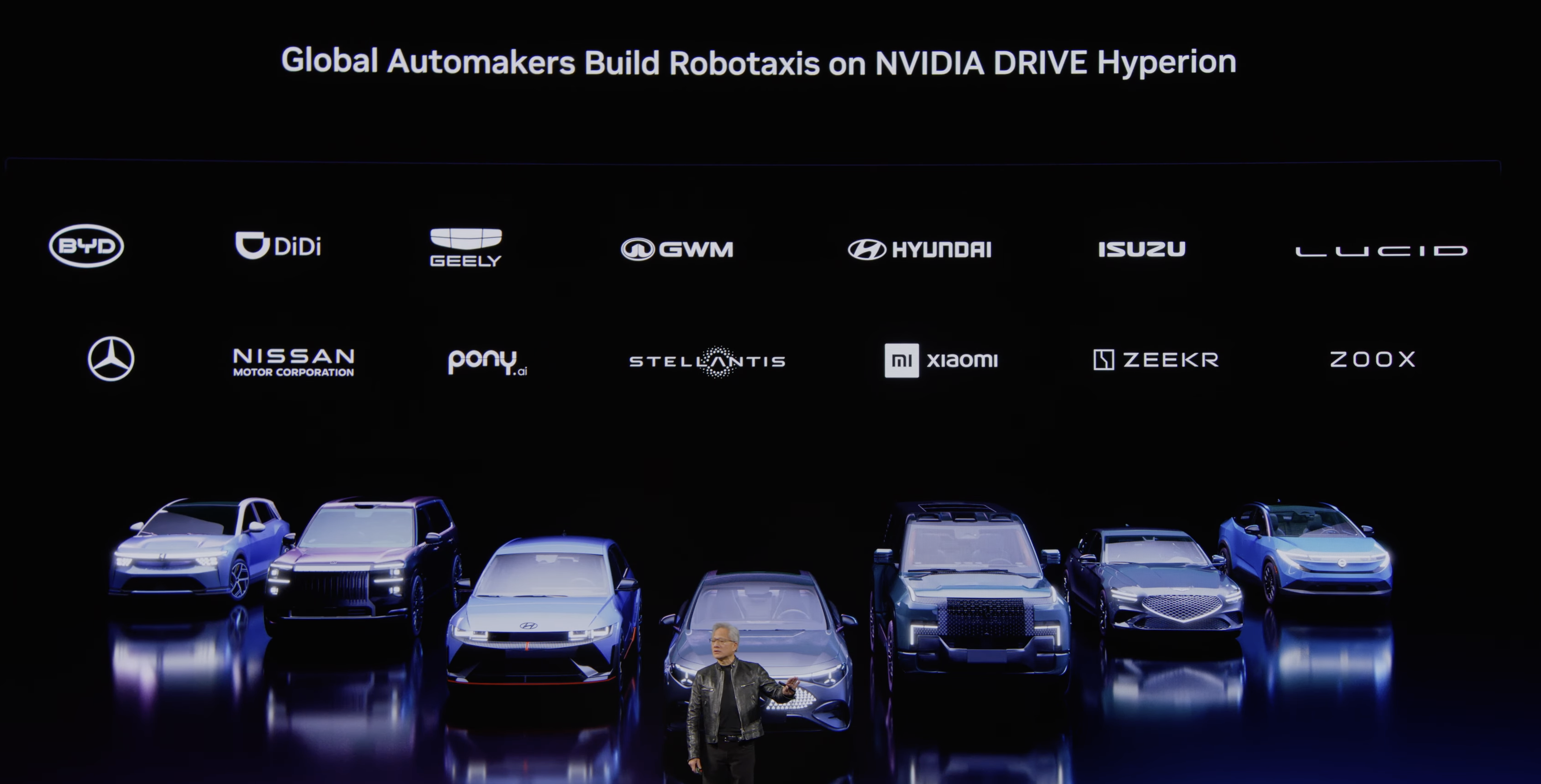
| Company | Type | Listing status | Country |
|---|---|---|---|
| BYD | Automaker (EV) | Public · HKEX:1211 / SZSE:002594 | China |
| DiDi | Ride-hailing + AV | Delisted from US→OTC:DIDIY; no Hong Kong filing as of 2026-06 (company says no timetable) | China |
| Geely | Automaker | Public · HKEX:0175 | China |
| GWM | Automaker | Public · HKEX:2333 / SSE:601633 | China |
| Hyundai | Automaker | Public · KRX:005380 | South Korea |
| Isuzu | Automaker (commercial vehicles) | Public · TSE:7202 | Japan |
| Lucid | Automaker (EV) | Public · NASDAQ:LCID (completed 1:10 reverse split in 2025-08) | United States |
| Mercedes-Benz | Automaker | Public · ETR:MBG | Germany |
| Nissan | Automaker | Public · TSE:7201 | Japan |
| Pony.ai | robotaxi/AV | Public · NASDAQ:PONY / HKEX:2026 (dual-primary listed in 2025-11) | China |
| Stellantis | Automaker (FCA+PSA) | Public · NYSE:STLA | Netherlands/multinational |
| Xiaomi | Automaker (EV) + consumer electronics | Public · HKEX:1810 | China |
| ZEEKR | Automaker (EV, Geely group) | Delisted—completed merger with Geely Auto (HKEX:0175) on 2025-12-22 and delisted from NYSE | China |
| Zoox | robotaxi | Subsidiary · Parent Amazon NASDAQ:AMZN | United States |
Market structure and competition. The autonomous-driving market divides by role into automakers, robotaxi technology companies, and mobility platforms. Waymo, Tesla, and others do not appear in this Hyperion partner table, showing that it is not a complete market-share ranking, but a list of NVIDIA platform adopters. The strength of official endorsement also varies: eight of the 14 can be directly supported by NVIDIA press releases (Stellantis/Lucid/Mercedes from the Hyperion 10 list at GTC DC 2025-10; BYD/Geely/Isuzu/Nissan/Hyundai from the L4 list at GTC 2026-03—Nissan using Wayve software, and Isuzu working with TIER IV on L4 buses), while the other six (DiDi/GWM/Pony.ai/Xiaomi/Zeekr/Zoox) are existing DRIVE ecosystem customers but were not named in those releases. Uber is the ecosystem's demand anchor: in 2025-10 it announced expansion to a 100,000-vehicle L4 fleet from 2027 (Hyperion 10 + jointly built data factory), and in 2026-03 further announced launches in LA/SF in 1H 2027 and coverage of 28 cities by 2028. NVIDIA's competitors include Mobileye, Qualcomm, Tesla's internal stack, and Chinese internally developed chips/algorithms; Hyperion's advantage is a unified compute, sensor, and software reference design, while the risk is large automakers gradually developing their own systems. No Taiwanese complete-vehicle brand appears in the table, but the official robotaxi release names Foxtron (the Hon Hai/Yulon joint venture) for L4 deployment in Kaohsiung, and NVIDIA's CES 2026 official blog lists Quanta as a DRIVE Hyperion tier-1 integration partner (alongside Bosch, Magna, Sony, and ZF)—Taiwan's opportunities lie in ECU/domain-controller contract manufacturing, sensors, connectors, thermal management, and wiring harnesses.
- The third Physical AI vertical of NVIDIA's platform strategy: the same logic—NVIDIA supplies the DRIVE Hyperion platform (compute + sensor reference design), global automakers/AV/ride-hailing companies adopt it → driving NVIDIA automotive chips (DRIVE Thor/next generation). Structurally identical to DSX, the agent stack, and Cosmos.
- Players fall into three groups: traditional/new-energy automakers (BYD/Geely/GWM/Hyundai/Isuzu/Lucid/Mercedes/Nissan/Stellantis/Xiaomi/Zeekr) + robotaxi/AV technology (Pony.ai, Zoox) + ride-hailing (DiDi).
- Chinese companies are nearly half (BYD/DiDi/Geely/GWM/Xiaomi/Zeekr/Pony.ai = 7/14)—confirming China as the most aggressive robotaxi/EV market; the remainder span South Korea (Hyundai), Japan (Isuzu/Nissan), United States (Lucid/Zoox), Germany (Mercedes), and Netherlands/multinational (Stellantis).
- Investment angle: most are publicly investable (automaker stocks + Pony.ai PONY/2026.HK + Lucid LCID); Zoox through parent Amazon (AMZN); DiDi only OTC:DIDIY (no Hong Kong filing), while Zeekr was merged into Geely Auto 0175 (delisted in 2025-12)—both
pending verificationitems have been resolved. This is the target pool for the "NVIDIA automotive/autonomous-driving" theme, but NVIDIA exposure in automaker stocks is thin (NVIDIA is only one supplier).
Humanoid Robots
| Company | Listing status | Country |
|---|---|---|
| 1X | Private | Norway/United States |
| Agility Robotics | Private | United States |
| Figure | Private | United States |
| Unitree | Private · STAR Market IPO approved, registration in progress (2026-06, proposed raise ¥4.2B, expected listing 2026-07) | China |
| NEURA Robotics | Private (announced Series C up to $1.4B @ ~$7B in 2026-06, led by Tether with NVIDIA participating) | Germany |
| Rainbow Robotics | Public · KOSDAQ:277810 (Samsung Electronics increased its stake to 35% in 2025, becoming the largest shareholder and consolidating it) | South Korea |
| AgiBot | Robot-body company private (planning 2026 Hong Kong IPO); controls A-share Swancor Advanced Materials SSE:688585 (63.6%) | China |
| Mentee Robotics | Acquired · Mobileye (NASDAQ:MBLY) acquired for $900M in 2026-01 | Israel |
| Persona AI | Private (working with HD Hyundai on shipyard-welding humanoids) | United States |
| Humanoid | Private | United Kingdom |
| Fauna Robotics | Acquired · Amazon (NASDAQ:AMZN) acquired in 2026-03 | United States |
| Enchanted Tools | Private | France |
| Familiar Machines & Magic | Private | United States |
| Disney Research | Parent Disney · NYSE:DIS | United States |
Market structure and competition. Humanoid robots have not formed stable market shares; today it is more appropriate to compare funding, prototype capability, actuator supply chains, mass-production plans, and real customer pilots. Both capital and shipments are rising steeply: the sector raised more than US$6B in 2025, and 1H 2026 already includes giant rounds such as Skild $1.4B (valuation above $14B), NEURA up to $1.4B, and Generalist $400M; valuation anchors include Figure's $39B Series C in 2025-09, 1X seeking ~$1B @ $10B+ (close not confirmed), and Agility $400M @ ~$1.75-2.1B. TrendForce expects global humanoid shipments to exceed 50,000 units in 2026 (about +700%, the first year of commercialization), with Unitree + AgiBot together accounting for nearly 80%; long-range estimates vary enormously—Goldman Sachs sees a $38B market/about 1.4M shipments in 2035, while Citi sees $7T/648M installed units in 2050. The table itself is also being reshaped by M&A: Mentee was acquired by Mobileye for $900M and Fauna by Amazon, making "being bought by a large platform" an important exit path for humanoid startups. NVIDIA is trying to become the cross-body platform through GR00T, Isaac, Cosmos, and Jetson Thor.
Taiwan perspective. Taiwan has no leading humanoid brand in the table, but has quantifiable positions at the component and systems layers: HIWIN (TWSE:2049) ranks first globally in precision ball-screw production and second in linear guides; estimates suggest humanoid screw usage rises from six to 40 per unit and harmonic reducers from 20 to 62, while its chairman says key humanoid parts have been sampled and shipments may multiply in 2026; Chieftek (TWSE:1597), one of the world's top three miniature linear-guide vendors, is shifting toward DD motors and humanoid joint modules; Solomon (TWSE:2359) has integrated NVIDIA Isaac into 3D vision (AccuPick + Isaac Manipulator increased path-planning speed eightfold); Hon Hai's internally developed humanoids have entered its Houston factory (see above). Among private targets, LIPS (3D perception) and Cincoze (rugged edge computing) represent perception- and deployment-side opportunities, respectively, but both must prove mass-production revenue rather than mere ecosystem compatibility—see the next chapter for diligence.
Taiwan Company Investment and M&A Map
Taiwan-Listed Companies: Secondary-Market Targets
The table below deduplicates Taiwanese companies appearing repeatedly throughout the report by independent listed entity. QCT is consolidated into Quanta (100% owned), and Visionbay.ai into Hon Hai (business unit); Techman Robot listed on the TWSE Main Board on 2025-09-26 and is counted separately.
| Company | Ticker | Position in NVIDIA industry | FY2025 revenue | FY2025 net profit attributable to parent | Net margin | Market cap 2026-06-11 | Research judgment |
|---|---|---|---|---|---|---|---|
| Delta Electronics | TWSE:2308 | AI Factory power, HVDC, Power Shelf, BBU, liquid cooling, and energy management | NT$554.9B | NT$60.1B | 10.8% | US$175.3B | Highest-quality facility-layer target, but valuation already fully reflects AI power and liquid-cooling expectations |
| Hon Hai | TWSE:2317 | AI servers, full racks, networking, manufacturing; Visionbay cloud service | NT$8,103.1B | NT$189.4B | 2.3% | US$112.8B | Largest scale and most complete manufacturing footprint; AI purity continues to rise, still constrained by low EMS margins |
| Quanta | TWSE:2382 | QCT, hyperscaler JDM, AI servers and racks | NT$2,123.7B | NT$75.0B | 3.5% | US$44.7B | Strong cloud design and customer relationships; core AI-infrastructure target |
| Wiwynn | TWSE:6669 | Hyperscaler data-center ODM/JDM, OCP systems | NT$950.7B | NT$51.1B | 5.4% | US$28.5B | Among the highest AI-server purity and growth, but customer concentration and high valuation require continuous monitoring |
| ASUS | TWSE:2357 | Enterprise servers, motherboards, graphics cards, RTX Spark PCs | NT$738.9B | NT$44.6B | 6.0% | US$18.2B | Strong brand, channel, and component synergy; AI exposure spans data center and personal devices |
| Wistron | TWSE:3231 | AI servers and racks; parent group of Wiwynn | NT$2,186.5B | NT$27.4B | 1.3% | US$15.2B | High revenue elasticity and thin margins; value of its Wiwynn stake should also be considered |
| Pegatron | TWSE:4938 | Servers, PCs, and electronics manufacturing | NT$1,117.2B | NT$14.4B | 1.3% | US$8.0B | AI-server share still trails leading ODMs; high transition upside but lower certainty |
| Inventec | TWSE:2356 | Servers, cloud hardware, notebook ODM | NT$691.2B | NT$8.7B | 1.3% | US$7.3B | Deep server experience, but product mix and customer concentration pressure margins |
| GIGABYTE | TWSE:2376 | Servers, motherboards, graphics cards, and RTX PCs | NT$336.9B | NT$12.2B | 3.6% | US$7.1B | Brand + server dual growth; smaller than ODM leaders, with a more balanced profit mix |
| MSI | TWSE:2377 | Gaming PCs, graphics cards, creator products, and RTX Spark | NT$230.2B | NT$5.75B | 2.5% | US$3.5B | Primarily a consumer RTX proxy, with high cyclicality and inventory sensitivity |
| Acer | TWSE:2353 | PC brand and RTX Spark endpoints | NT$275.6B | NT$3.8B | 1.4% | US$3.5B | Global channels retain value, but control over critical components and software is weaker |
| Techman Robot | TWSE:4585 | Collaborative robots, built-in vision, and factory automation | NT$1.82B | NT$136M | 7.5% | US$1.0B | One of the purest Physical AI Taiwan stocks; small revenue base and significantly front-loaded valuation |
Delta Electronics: The Infrastructure Profit Pool, Not Just a "Power-Supply Company"
Delta is the Taiwanese company with the highest business quality in this report. It covers server PSUs, rack Power Shelves, BBUs, HVDC/800VDC, liquid-cooling CDUs, fans, and energy management, directly benefiting from rising GPU power density. FY2025 was its strongest financial year ever: revenue NT$554.9B (+31.8%), net profit attributable to the parent NT$60.1B (up more than 70% YoY), EPS 23.14; infrastructure-segment revenue reached NT$182.0B (+82%), with profit rising more than fourfold to NT$28.4B, making it the largest growth engine—AI power-related products already exceed 20% of revenue, liquid cooling is about 9%, and institutional estimates put data-center-related revenue rising from about 46% in 2025 to about 62% in 2026. 2026 Q1 revenue was NT$159.4B (+36%), gross margin reached a record high of about 37%, and the 2026-05 shareholders' meeting confirmed AI data centers as the largest growth driver amid tight global capacity. Unlike pure ODMs, Delta owns power-electronics IP, certifications, efficiency curves, and system coordination, producing an FY2025 net margin of about 10.8%, far above server assemblers. The risk is that its roughly US$175B market capitalization already embeds high-growth expectations; in the secondary market it is better suited as a long-term core facility-layer asset than a low-valuation trade.
When searching for private companies upstream and downstream of Delta, the focus is not ordinary power-supply contract manufacturing, but high-power server power supplies, Power Shelves, BBUs, and liquid-cooling control. This drill-down produced a structural conclusion: most of the best assets in Delta's chain are not on the market—AI-server-grade magnetic components are made internally by Delta's wholly owned subsidiary Cyntec, while the main BBU/liquid-cooling/quick-connector players (SMP 6121, AES-KY 6781, Fushida 6805, Yulon 2233, etc.) are all listed. Among private candidates, Compuware remains the most relevant: about 1,400 employees and disclosed capacity of about 1.2M PSUs, with rough research estimates of US$250M-500M revenue and US$180M-450M EV, potentially above the US$200M ceiling; it also has deep customer and related-party ties to Supermicro, so non-related-customer revenue, change-of-control clauses, and true EBITDA must be verified first. A new watch item is GUS Technology (Emerging Stock Board 6940, Taiwan's first GWh-scale pouch-cell plant, already entering AI-data-center BBU modules, but its emerging-board status and thematic heat may push valuation above the limit). Delta itself is also an active buyer in the same arena: in 2025-12 it used a roughly NT$3.73B share exchange (16.8% premium) to acquire the remaining shares of VIVOTEK (3454), reaching 100% ownership and delisting it in 2026-03—the "control first, then fully privatize" path proves that acquiring and privatizing small-cap Taiwan-listed companies is a viable alternative, complementing this study's focus on private companies (corresponding to low-market-cap listed cooling targets such as Yen Sun 6275; see below).
Hon Hai: The Largest Scale, but AI Must Be Separated from Group Complexity
Hon Hai FY2025 revenue was about NT$8.10T (jumping from NT$6.86T in 2024), net profit attributable to the parent NT$189.4B, and EPS 13.61; both revenue and profit set records, making it the world's largest electronics-manufacturing platform. AI is already the main growth line: AI-server revenue exceeded NT$1T in the first three quarters of 2025; in 2026 Q1, AI servers exceeded half of total server revenue for the first time, and Q1 EPS of 3.56 was the best ever for the period; 2026 guidance calls for more-than-multiple growth in AI-rack shipments, potential doubling of revenue from 800G+ switches, multiple growth in ASIC servers, and more than 30% growth in full-year capital expenditure. Cloud & Networking has reached about 40% of group revenue and surpassed consumer electronics for the first time. Its roughly 2.3% net margin shows that revenue scale and bargaining power are not equivalent. Visionbay.ai is the group's AI-cloud business unit (NVIDIA Cloud Partner, building a "Taiwan's first sovereign AI supercomputing center" with 10,000 Blackwell Ultra units and about US$1.4B of investment); it should be treated as an option on Hon Hai's extension from manufacturing into compute operations, not as an independently valued target.
The worthwhile drill-down around Hon Hai is not another large EMS, but precision mechanicals, cooling, wiring harnesses, and vision. Among current candidates, Dynatron can add server cooling and CDUs, LIPS robot 3D perception, and Cincoze rugged edge computing. All three may be below US$200M, but none has audited public financials; for a platform buyer such as Hon Hai, strategic stakes, joint products, and staged acquisitions may be more realistic structures.
Quanta/QCT: Design Capability and Hyperscaler Relationships Matter Most
Through QCT (100%-owned subsidiary), Quanta participates deeply in cloud servers, OCP, and NVIDIA full racks. FY2025 revenue was about NT$2.12T and net profit attributable to the parent NT$75.0B; 2026 Q1 revenue reached NT$809.2B (+66.6%), with EPS 5.5 setting a period record. AI servers already exceed 75% of total server revenue; Quanta maintains guidance for "triple-digit percentage growth" for full-year 2026, with order visibility extending beyond 2027; 2026 capital expenditure is about NT$30B, AI-product capacity will double by year-end 2026 versus 2025, and the Vera Rubin (VR200) platform transition begins in Q4 2026. Its core is not low-cost assembly but co-design, rapid validation, and mass production with hyperscalers (it is an OCP Incubation Committee member, among the deepest governance participants of Taiwanese ODMs). Quanta also controls Techman Robot through Quanta Storage to position in factory automation, and NVIDIA officially lists it as a DRIVE Hyperion tier-1 integration partner. Competitive risks come from major-customer bargaining power, GPU-supply timing, and peer capacity expansion; a 3.5% net margin still shows the ODM model's profit ceiling.
Potential transaction directions upstream of Quanta include cooling, chassis, power, and cabling. Dynatron is a cooling candidate of a more suitable scale; Ablecom has chassis, tooling, and mass-production capability, but Supermicro procured about US$322M from it in FY2025, and that procurement constituted most of its sales, so the whole company may exceed the screening ceiling while equity and customer-consent issues are complex. Ablecom is better suited to product-line, factory-asset, or minority-equity transactions than an assumption that a controlling acquisition can be completed.
Wistron: Compound Value from a Manufacturing Platform Plus Its Wiwynn Stake
Wistron FY2025 revenue was about NT$2.19T (doubling YoY and exceeding NT$2T for the first time), with net profit attributable to the parent of NT$27.4B and a net margin of about 1.3%, making it a typical large-scale, low-margin ODM. AI infrastructure rose from 46% of revenue in 2024 to 71% in 2025 and 79% in 2026 Q1; GB300 surpassed GB200 as the mainstream shipment from 2026 Q1; 2026 guidance calls for high-double-digit AI-server revenue growth, and capital expenditure rises sharply to about NT$60B (capacity expansion in Hsinchu, Dallas, and Mexico). Wistron also holds 35.46% of Wiwynn (largest shareholder); at Wiwynn's US$28.5B market capitalization, that stake is worth about US$10B—roughly two-thirds of Wistron's own market capitalization, so valuation cannot consider only the parent's manufacturing profits. Competitive advantages are global capacity, server-engineering experience, and customer relationships; risks are customer concentration, capital expenditure, inventory, and AI-platform transitions. Supply-chain drill-down should prioritize verifying Dynatron's cold-plate/CDU design wins and whether Cincoze can fill factory and edge-deployment capabilities.
Wiwynn: A Purer Hyperscaler AI-Server Expression
Wiwynn FY2025 revenue was about NT$950.7B (+163.7%), net profit attributable to the parent NT$51.1B (+124.4%), and EPS 275.06 (earning more than 27 times paid-in capital in one year), for a net margin of about 5.4%, materially better than ordinary ODMs. The company focuses on hyperscaler data-center systems, OCP (Platinum member), and co-design: AI products were about half of 2025 revenue, of which ASIC projects accounted for about 90% of AI-server revenue (systems for CSP-developed chips from Meta, Microsoft, and others)—in practice, it is one of the purest Taiwan-stock exposures to the "CSP custom-ASIC wave," not merely an NVIDIA concept; Oracle was added as a GB200 customer in 2025 Q4, 2026 momentum is concentrated in the second half (GB300 and AWS Trainium 3 platform transitions), and order visibility extends into 2027. Main risks are concentration among a few major customers (Meta exceeds half of revenue), capital intensity, and order volatility. Potential private supply-chain targets remain cooling, rack power, and high-speed interconnects; Dynatron is a candidate with a more suitable transaction scale, while Compuware has stronger assets but may exceed US$200M.
ASUS: Three-Way Synergy Across Brand, Components, and Servers
ASUS FY2025 revenue was about NT$738.9B and net profit attributable to the parent NT$44.6B (EPS NT$60, +42.3%, record profit), for a net margin of about 6.0%, making it the Taiwanese PC brand with the strongest financial quality and product breadth. AI-server revenue exceeded NT$100B for the first time in 2025, while the enterprise segment grew about 85% YoY; 2026 guidance calls for 50%-100% server-revenue growth (4-5x YoY in Q1), GB200 is shipping, GB300 orders are in hand, and an independent infrastructure business group was established in 2026-03. ASUS simultaneously covers motherboards, graphics cards, workstations, enterprise servers, and RTX Spark (it already had the co-branded Ascent GX10 during the DGX Spark period), extending NVIDIA platforms from data centers to personal devices. Competitive pressure comes from Dell/Lenovo/HP enterprise channels and price competition from GIGABYTE/MSI in components and gaming. Potential M&A directions are industrial GPUs, vision, and edge systems; Cincoze and LIPS correspond to compute and perception, respectively, but both require verification of standardized products and recurring software revenue; Power Logic (private; see next chapter) is a hidden position in its graphics-card cooling-fan supply chain.
GIGABYTE: GIGA Computing and the Component Brand as Dual Engines
GIGABYTE FY2025 revenue was about NT$336.9B (+27%) and net profit attributable to the parent NT$12.2B (EPS 18.2, second highest ever), for a net margin of about 3.6%. Servers accounted for about 62% of 2025 revenue (rising to about 70% in 2026 Q1), with AI servers exceeding 80% of server revenue; 2026 guidance maintains triple-digit AI-business growth, and capital expenditure rises sharply from NT$1.12B to NT$2.0-2.5B (expanding AI-server capacity + building its own compute), while reports say GIGA Computing has a separate-listing plan. Motherboard, graphics-card, and gaming brands provide consumer channels, making the profit mix more balanced than a pure ODM. Risks are smaller scale than leading server ODMs and simultaneous exposure to enterprise-order volatility and consumer inventory cycles. To strengthen differentiation through acquisitions, Dynatron can add cooling systems and Cincoze industrial-edge products; merely adding homogeneous hardware capacity should be avoided.
MSI: High Consumer RTX Elasticity, Strong Cyclicality
MSI FY2025 revenue was about NT$230.2B and net profit attributable to the parent NT$5.75B, for a net margin of about 2.5%. Its advantages are concentrated in gaming PCs, graphics cards, creator devices, and global retail channels, making it a high-elasticity play on RTX penetration and replacement cycles; 2026 Q1 EPS was 4.04 (+217%, a 16-quarter high), gross margin recovered to 15%, and high-end gaming saw "lower volume, higher price" (15%-30% price increases). AI servers were only 3%-5% of 2025 revenue (customers mainly second- and third-tier CSPs), but management guides to potential doubling in 2026 and +50%-100% annually over the next 3-5 years—the enterprise narrative is a low base with a steep slope. Weaknesses are sensitivity to consumer demand, GPU supply, and inventory prices. M&A is better directed toward creator workstations, industrial GPUs, or professional vision applications; Cincoze's channels and rugged products offer some synergy but are not a supply-chain chokepoint.
Acer: Strong Channel Assets, Weak Control of Critical Technology
Acer FY2025 revenue was about NT$275.6B and net profit attributable to the parent NT$3.8B, for a net margin of about 1.4%; 2025 Q4 gross margin improved to 11.6%, operating profit grew 82.3% YoY, April 2026 PC revenue rose 82.8%, gaming revenue rose 107.5%, and non-PC subsidiaries are estimated to reach 34.4% of 2026 revenue. The company has a global PC brand and channels and can rapidly introduce RTX Spark, but critical chips, motherboards, and software platforms are mainly controlled by outside suppliers, leaving less bargaining power than ASUS and GIGABYTE; DRAM/SSD prices may rise about 130% by year-end 2026 versus 2025, squeezing margins on its mid/low-end products more directly than peers. The investment thesis depends more on whether AI PCs create a high-ASP new category than on changes in traditional share. Potential private targets should add industrial or professional scenarios rather than ordinary consumer assembly; Cincoze is a candidate for enterprise-edge expansion.
Inventec: Deep Server Experience, Margins Still Need Improvement
Inventec FY2025 revenue was about NT$691.2B (+7%) and net profit attributable to the parent NT$8.7B (EPS 2.42), for a net margin of about 1.3% and gross margin of 5.3%. The company has long operated server and notebook ODM businesses, positioned mainly in L6 server motherboards; 2026 guidance calls for total server revenue growth above 30%, potentially exceeding half of revenue, with AI exceeding half of server sales and solutions spanning NVIDIA, AMD, and ASIC. But its share and product purity in NVIDIA AI full racks trail Quanta, Wistron/Wiwynn, and Hon Hai, while Chinese customers exceed half of its AI-server sales, a clearly different customer mix from peers. Investment upside comes from rising orders; risks are customer mix, low margins, capital expenditure, and notebook-side memory inflation. If M&A is used to fill capability gaps, Dynatron's cooling is the best fit; Compuware's high-power supplies are more valuable, but scale and related-party ties make a transaction difficult.
Pegatron: Ample Manufacturing Capability, AI Transition Still Needs Order Proof
Pegatron FY2025 revenue was about NT$1.12T and net profit attributable to the parent NT$14.4B (EPS 5.39), for a net margin of about 1.3%. The company has large manufacturing scale and broad customer coverage, but AI servers are not yet a core valuation pillar as they are for Wiwynn—this is changing: management guides to "more than tenfold" AI-server revenue growth in 2026 (driven by NVIDIA GB series), has released a GB300 NVL72 model with an integrated 310kW CDU, and is working with Together AI and 5C on Texas deployment; 2026 capital expenditure of US$300M-350M focuses on North American lines. It must prove that full-rack engineering, liquid-cooling validation, and overseas capacity can convert into stable share. Potential acquisitions should prioritize technology rather than capacity: Dynatron for cooling, Compuware for power, and Ablecom for chassis; the latter two may exceed the price ceiling or require special structures.
Techman Robot: Taiwan's Public-Market Entry into Physical AI
Techman Robot moved from the Emerging Stock Board to the TWSE Main Board on 2025-09-26 (underwriting price NT$238, intraday first-day high NT$499.5, 832,000 public-subscription applicants setting the year's record), so it can no longer be described as an "unlisted Quanta subsidiary"—the accurate hierarchy is Quanta→Quanta Storage (TWSE:6188)→Techman; Quanta Storage held 78.29% before the IPO and about 75% after listing, while the second-largest shareholder is Omron Taiwan (11.11%). FY2025 revenue was about NT$1.82B and net profit attributable to the parent NT$136M; market capitalization was about US$1.0B on 2026-06-11, corresponding to a significantly front-loaded valuation of about 17x PS. Its differentiation is built-in vision in collaborative robot arms (the world's only cobot with native built-in vision, cumulative shipments about 18,000 arms), with growth driven by semiconductor adoption of cobots and AI-server assembly applications (semiconductor customers include NVIDIA, Samsung, SK hynix, LG); wheeled humanoid TM Xplore I (Jetson Thor + internally developed VLA) targets 2026 mass production and customer trials in automotive and semiconductor sectors from the second half. Compared with FANUC, ABB, Universal Robots, and Chinese cobot vendors, its global installed base, channels, and scale remain small.
Techman's best private-company capability additions are perception, end effectors, joint components, and edge control. LIPS has the highest industrial synergy: it has entered the NVIDIA Isaac/Jetson ecosystem, has about 71 employees, and research estimates revenue of US$5M-25M and EV of US$20M-80M; newly added Li-Ming Machinery (Taiwan's only producer mass-producing both harmonic and RV reducers), Touché Solutions (robot touch/e-skin, ITRI spin-off), and Castec (semiconductor-fab AMR/semi-humanoid, already public-issuing) all sit on the same Physical AI component chain (see below). A more reasonable transaction path is a joint solution, minority stake, and milestone-based increases rather than a one-time full acquisition before revenue and customers are verified.
Private Taiwanese Companies: Potential Acquisition Targets
Private companies have no public market capitalization. The "valuations" below are research-stage enterprise-value ranges, not completed transaction prices. Except for Ablecom and Compuware, whose revenue ranges can be inferred from related-party procurement disclosed in Supermicro's FY2025 10-K, public audited information is unavailable for the other companies' revenue, profit, and debt.
Supply-Chain Traceability
Discovery paths fall into three categories: (a) NVIDIA official ecosystem/partner directories; (b) upstream/downstream drill-down from listed Taiwanese companies; (c) disclosures by non-Taiwan-listed companies.
| Target | Path | Traceability explanation |
|---|---|---|
| Dynatron | (b) | Appears in no NVIDIA official material; retained after drilling into Quanta/Wistron/Wiwynn cooling BOMs and anchoring with clues from external lists |
| LIPS | (a)+(b) | The only one of the six with official NVIDIA ecosystem status (self-described Official Isaac Perceptor Camera Partner, LIPSedge certified through Isaac SDK, corroborated by joint AAEON news), but not on the GTC wall; also anchored through Techman/Physical AI perception-layer drill-down |
| Cincoze | (b) | No NVIDIA official-directory evidence (instead has a page in the Intel official partner directory); anchored by horizontal comparison in Physical AI edge computing (listed comparables: Neousys 6922, APLEX 6570) |
| Compuware | (c)+(b) | Found through related-party disclosures in Supermicro's (NASDAQ:SMCI, not Taiwan-listed) 10-K; also the Taiwanese private counterpart found by drilling into Delta's high-power-supply domain |
| Ablecom | (c) | Discovered entirely by reverse-mining Supermicro's 10-K related-party disclosures (procurement and family ownership both from SEC filings) |
| KSS | (b) | Originated from an external "hidden champion" list clue, with no verifiable intersection with NVIDIA's ecosystem; retained as a defensive asset |
This means the alpha in this list comes mainly from disclosure documents and supply-chain reasoning, not NVIDIA's official endorsement; conversely, except for LIPS, each company's "NVIDIA supply-chain identity" has not been confirmed by NVIDIA and must be verified with ODM procurement systems during diligence.
| Company | Industry position | Known scale | Annual revenue / net profit | Preliminary EV | Industry influence | Acquisition feasibility | Current conclusion |
|---|---|---|---|---|---|---|---|
| Dynatron (legal entity 86169272) | Server air cooling, liquid cooling, cold plates, CDU | Founded 1991; Taiwan registered capital only NT$20M, US subsidiary 11-50 people; Huizhou line monthly capacity about 500,000 units | Rough revenue estimate US$40M-120M (capital and headcount signals point to lower half); net profit US$2M-10M | US$30M-100M | Medium-high; engineering validation and customization form barriers | Medium-high | First-wave commercial diligence; after scale signals were revised downward it is more likely within the price ceiling, but liquid-cooling mass-production design wins require NDA verification (zero public news in 2025-26) |
| LIPS | Industrial 3D cameras, SDK, robot perception | 54-71 employees; paid-in capital NT$470M; NVIDIA Isaac Perceptor official camera partner | Rough revenue estimate US$5M-25M; unprofitable in 2025, targeting profitability in 2026 | US$20M-80M | Medium; value depends on calibration, software, and mass-production design wins | Higher than other candidates; advancing an Emerging Stock Board application (no fixed timetable) | Physical AI strategic investment priority, suitable for staged transactions; Emerging Stock Board progress is a timing-window variable |
| Cincoze (legal entity 54019104) | Rugged industrial computers, GPU Edge, machine vision | Founded 2012; registered capital only NT$15M; exports 98%, self-reported eight-year CAGR 40%; won MOEA Taiwan Mittelstand Award in 2024 | Rough revenue estimate US$35M-100M; net profit US$2M-10M | US$40M-150M | Medium; brand and channels stronger than foundational IP (page in Intel official partner directory, no NVIDIA official certification) | Medium | Can be acquired as an edge platform; NVIDIA/robotics revenue purity must be verified; original source for "nine overseas subsidiaries" is invalid (China/Germany/US can be verified) |
| Compuware (legal entity 27448539) | High-power server PSU, Power Shelf, BBU | About 1,400 employees; annual capacity about 1.2M PSUs; paid-in capital NT$724M; expanding in Malaysia | SMCI FY2025 procurement US$328.3M and most of its net sales → revenue narrowed to US$328M-657M; rough net profit US$20M-50M | US$230M-600M | High within Supermicro system; high-wattage AI/GPU supplies were 31% of 2023 shipments | Low to medium | Almost certainly above US$200M ceiling; customer concentration and related-party transactions are core risks |
| Ablecom (legal entity 97489483) | Server chassis, mechanical parts, tooling, and integration | Registered 1997; capital NT$1.351B; Bade, Taoyuan | SMCI FY2025 procurement US$321.9M (plus $23.7M design services and $18.7M fixed assets), most of net sales → revenue US$322M-644M; rough net profit US$8M-35M | US$120M-350M | Extremely high within Supermicro system | Low | Special-structure opportunity; prioritize assets, product lines, or minority equity |
| KSS (legal entity 72108944) | Cable ties, wiring ducts, fittings, and global channels | Founded 1969; capital NT$360M; Chiu-family business; 128 countries, 40,000+ customers | Undisclosed | Cannot be estimated reliably | High in wiring-accessory niche, but low AI purity (no evidence of data-center product line) | Low to medium | Mature hidden champion; first determine willingness to sell and data-center revenue |
First Priority: Dynatron
Dynatron's products cover CPU/GPU heatsinks, fans, Vapor Chambers, cold plates, Chillers, and 2U/4U CDUs, placing it closest to the structural demand created by rising AI-server power. This round identified its Taiwanese legal entity: Dynatron Corporation (company number 86169272, established 1991-08-14, chairman Lin Ying-Shih, Neihu, Taipei; Dynatron server-cooling + Top Motor fan brands; US subsidiary Dynatron Corporation in Union City, California, with 11-50 employees). Two new signals must be incorporated: first, Taiwanese registered capital is only NT$20M and total group headcount is probably in the low hundreds (including the Huizhou line), meaning scale may be in the lower half of the previous rough range—raising the probability of being "below US$200M" but lowering expected asset scale; second, the public record in 2025-2026 contains no new liquid-cooling/CDU product or customer news, and it appears in no NVIDIA official material, so liquid-cooling mass-production design wins must be a focus under NDA. Its advantages remain clear business boundaries, long operating history, customization and manufacturing capabilities, and no evidence of a single family-related customer like Compuware/Ablecom. Disambiguation: dynatron.com.tw is the EMS company "Deyang Electronics Industrial" and is completely unrelated to this target; diligence documents must distinguish them.
Before acquisition, obtain: three years of audited financials, gross margin split by product and customer, liquid-cooling revenue, top ten customers, platform certifications, warranty liabilities, capacity utilization, patents, and retention arrangements for key engineers. If EV is in the middle of the research range and liquid cooling has entered mass production, Dynatron is the most suitable controlling-acquisition target.
Strategic Priority: LIPS
LIPS's attraction is not camera hardware itself, but robot 3D calibration, SDKs, edge deployment, and Isaac/Jetson integration—it is the only one of the six targets with official NVIDIA ecosystem status (self-described Official Isaac Perceptor Camera Partner, with LIPSedge certified through Isaac SDK). Incremental facts from this round: paid-in capital NT$470M; 54 registered LinkedIn employees (same order of magnitude as about 71 on the website); founder Liu Ling-Wei came from Hon Hai (participated in Microsoft's Kinect project) and later was a visiting scholar at MIT CSAIL; since 2025-06 it has worked with an underwriter to advance an Emerging Stock Board application (no fixed timetable), remained unprofitable in 2025, and targets turning profitable in 2026 before listing—the Emerging Stock Board process is now a key timing-window variable. The distinction between contract-manufacturing chain and customers must also be clarified: its F110 edge-AI accelerator card is manufactured by Inventec, AR/VR lens modules by Hon Hai, and Samsung-sensor ToF modules by Quanta—Quanta/Hon Hai are manufacturing partners, not customers, so external-list claims that "ASUS/Foxconn are customers" should be corrected. The Physical AI perception layer faces Intel RealSense, Orbbec, Zivid, Stereolabs, and low-cost Chinese depth cameras; LIPS must prove that its software, precision, industrial reliability, and mass-production customers are irreplaceable. Public information still does not support definite figures such as "2025 revenue NT$1.02B" or "US$150M-250M valuation."
The most reasonable path is to validate orders through joint products and minority equity first, then set ownership-increase milestones based on robot mass-production projects, software revenue, and customer renewals. If it is only Jetson-compatible without proprietary algorithms and stable projects, acquisition value falls materially.
Platform Candidate: Cincoze
Cincoze has established rugged computing, GPU systems, machine vision, in-vehicle products, overseas subsidiaries, and distributor networks. Registration verification in this round: Cincoze Co., Ltd. (company number 54019104, established 2012-10-31, responsible person Chien Hsin-Te), registered capital only NT$15M/paid-in NT$11M; a 2023 report said its parent had originally been a "distributor of key industrial-computer components," but no specific name can be publicly confirmed, so it is treated as an independent private company controlled by its founding team. Positive signals: exports are 98%, self-reported near-eight-year CAGR is 40%, and it won the MOEA "Taiwan Mittelstand Award" in 2024-12 (eligibility itself is official supporting evidence of SME status). An old statement requires correction: the original official news page for "nine overseas subsidiaries" is no longer valid; the current website says "40+ countries, 50+ value-added partners," and subsidiaries in China (Shenzhen), Germany, and the United States can be verified; no specific figure supports "record 2025 sales." In ecosystem terms it has a page in the Intel official partner directory, with no NVIDIA official certification or directory entry—the acquisition thesis must rest on harsh-environment certifications, modular design, long-term customer design wins, and channel efficiency, not merely that "its products can install NVIDIA GPUs."
Key verification items include the share of Physical AI/GPU revenue, standard-product versus project revenue, top five customers, gross margin, inventory, overseas-subsidiary profitability, and new-factory capital expenditure. If financials are healthy and EV is below US$150M, it can serve as an industrial-edge platform; if most revenue still comes from general IPCs, bargaining power is limited.
Boundary Target: Compuware
Compuware (Compuware Technology Inc., company number 27448539, established 2004-09-20, paid-in capital NT$724M, responsible person Bill Liang, Zhonghe, New Taipei) holds positions in high-power server PSUs, Power Shelves, and BBUs—its website directly states "more than 1,400 employees worldwide and annual capacity of 1.2 million PSUs." Products include a 33kW ORv3 Power Shelf (CPR-3331), 33kW BBU Shelf (CBR-3332), and the world's first 6.6kW liquid-cooled PSU (CPR-6622, dual 54V+12V output); high-wattage AI/GPU supplies represented 31% of 2023 shipments, and it is building capacity near Supermicro's Malaysia campus. Financial-quality signals: ranked 244th in CommonWealth's 2025 Top 2000 Manufacturers (revenue growth 32.04%) and 46th in the same year's "Top 50 Operating Performance" list (which requires three consecutive years of revenue and after-tax-profit growth). The most important narrowing in this round comes from the SEC: Supermicro's FY2025 10-K disclosed US$328.3M of procurement from Compuware (FY2024 $280.8M, FY2023 $217.0M), explicitly saying that it constituted "a majority of its net sales"—therefore Compuware's FY2025 revenue range narrows to US$328M-657M, almost certainly above the US$200M ceiling (Compuware also acts as a non-exclusive SMCI distributor in Taiwan/China/Australia, with SMCI selling $30.2M back to it). A buyer must prove non-Supermicro revenue, continuity of orders after change of control, IP ownership, and independent customer acquisition; product-line investment, a joint venture, or minority equity is more realistic than a direct full acquisition.
Special Opportunity: Ablecom
Ablecom (Ablecom Technology Inc., company number 97489483, registered 1997-04-29, total capital = paid-in NT$1.351B, chairman Steve Liang, Bade, Taoyuan) controls server chassis, tooling, and mechanical integration and has a very strong position in the Supermicro system. Supermicro's FY2025 10-K disclosed US$321.9M of procurement from it (FY2024 $269.3M, FY2023 $167.8M), plus $23.7M for design services/tooling and $18.7M for fixed assets, while granting a $10M trade-credit line; that procurement "constituted a majority of Ablecom's net sales," placing revenue at US$322M-644M, so the whole company being below US$200M cannot be a base assumption. It is unrelated to listed Chenbro (8210) and AIC (3693)—both appear on the GTC ecosystem wall, while Ablecom does not. Ownership per the 10-K (as of 2025-06-30): Steve Liang and family about 35.0% (Steve is CEO and largest shareholder), Charles Liang and Sara Liu about 10.5%, and siblings of Wally Liaw about 11.7%; Ablecom also owns less than 50% of Compuware but has significant influence, and in 2023-10 Ablecom and Compuware together acquired about 30% of Leadtek (TWSE:2465), with the Liang family holding two of Leadtek's seven board seats. The division of roles among the four Liang brothers is key to understanding the ecosystem: Charles Liang (Supermicro) / Steve Liang (Ablecom) / Bill Liang (Compuware) / the fourth brother (ALTLED, shifted from LED into an Ablecom supplier). Before a transaction, core-customer consent must be obtained and tooling, factories, IP, related-party transactions, and customer-dedicated assets disentangled; product lines, factory assets, or minority equity are more feasible than a conventional controlling acquisition.
2026-03 criminal case (precise scope). On 2026-03-19, an indictment was unsealed in the Southern District of New York: the three defendants were Supermicro co-founder and then-director Yih-Shyan "Wally" Liaw (arrested, resigned as director on 3-20, pleaded not guilty on 4-01, US$5M bail), Taiwan sales manager Ruei-Tsang "Steven" Chang (fugitive), and contractor Ting-Wei "Willy" Sun (arrested, pleaded not guilty); charges were conspiracy to violate the Export Control Reform Act (maximum 20 years), conspiracy to smuggle, and conspiracy to defraud the United States. Prosecutors allege that during 2024-2025, false orders through Southeast Asian shell companies were used to repackage servers containing restricted NVIDIA GPUs through Taiwan and Southeast Asia and resell them to Chinese buyers, totaling about US$2.5B, while "dummy servers" misled SMCI's compliance team and export-control inspectors. Supermicro itself was not named as a defendant and is cooperating; it launched a board-led independent investigation in 2026-04, and in 2026-05 the CEO publicly said no one beyond the defendants was involved; Taiwanese prosecutors on 2026-05-21 also launched their first criminal enforcement against illegal AI-hardware exports (searching 12 locations and seeking detention of three people). The connection to the targets in this section comes only from one disclosure in SMCI's 10-K: one sibling of Wally Liaw owns about 11.7% of Ablecom and about 8.7% of Compuware; the indictment itself does not mention either company. The event cannot directly imply that Ablecom or Compuware participated in illegal conduct, but it materially raises the required intensity of export-control, end-customer, related-party, sanctions-screening, and reputational-risk review, and any transaction structure should reserve time for completion of a compliance investigation.
Defensive Hidden Champion: KSS
KSS (KAI SUH SUH Enterprise Co., Ltd., company number 72108944, capital NT$360M, chairman Chiu Chun-Hsiung—with directors and supervisors all from the Chiu family, a typical family business) is a genuine private Taiwanese hidden champion: founded in 1969, products sold in 128 countries, 40,000+ customers, and daily cable-tie capacity of 50M units. But public information is insufficient to prove "zero debt, high profit," and this search found no official page or news directly linking KSS to data centers/AI server rooms. The wiring-accessory market is stable, with some value in switching costs and certifications, but it is not a high-purity NVIDIA supply chain. It is better studied as a cash-flow industrial asset than as a core Physical AI or AI-server technology acquisition; highly concentrated family ownership makes willingness to sell a prerequisite.
New Candidates and Structural Conclusions
This round used six ODMs, Delta, four brand vendors, and Techman as anchors and ran a falsification-oriented scan for "private Taiwanese companies" across each AI-server and robotics BOM link. Two structural conclusions precede the list:
- The "private-company window" in the AI-server BOM is already extremely narrow. Cooling modules, fans, quick connectors, rails, chassis, PSU/Power Shelf, BBU, busbars, connectors, CCL/PCB, pumps, testing equipment—at nearly every link Taiwanese players are either listed/OTC (Asia Vital Components 3017, Auras 3324, Sunon 2421, King Slide 2059, Fushida 6805, LOTES 3533, Chenbro 8210, AIC 3693, AcBel 6282, SMP 6121, etc.) or occupied by foreign vendors (CPC/Stäubli/Grundfos/Vertiv). Multiple "apparently private" candidates were verified as already listed: Sea Sonic 6203, Walrus Pump 6982, Taikang Precision 6833 (Sinbon holds 57.45%), Enermax 8093, Apex Dynamics 4583, Syntec 7750, and Fukuta Electric 4590. Continuous robotics-core-component IPOs during 2022-2026 (Apex Dynamics→Syntec→Techman→Fukuta) show how quickly quality assets are securitized: still-private targets are scarce remnants and may start an IPO at any time—the window is measured in "quarters."
- Alternative path: privatization of listed small caps. Delta's 2025-12 acquisition of VIVOTEK's (3454) remaining shares through a roughly NT$3.73B share exchange (16.8% premium), reaching 100% ownership and delisting it in 2026-03, proves Taiwan's small-cap "control first→full privatization" path is viable. This puts listed companies below US$200M market value such as Yen Sun 6275, Neousys 6922, APLEX 6570, Adda 3071, and Taisol 3338 (see the "NVIDIA Taiwan Private Supply-Chain Target Initial Screen" notes) on the same acquisition list as private targets.
New Candidate Summary Table
| Company | Link / anchor company | Scale clues | Rough EV | Influence | Transaction path | Priority |
|---|---|---|---|---|---|---|
| Li-Ming Machinery | Harmonic + RV reducers (Techman/humanoid-joint BOM) | About 50 years of history, four Taichung plants, capital NT$506M, long-term orders from major AGV makers | US$50-150M | High | Controlling acquisition/large stake | ★★★ |
| Castec | Semiconductor-fab AMHS/AMR + semi-humanoid (TSMC ecosystem fab scenarios) | Founded 2005, capital NT$364M, 300+ installed systems, public-issuing since 2023-08 | US$60-180M | Medium-high | Pre-IPO secondary shares/capital increase | ★★★ |
| Allion Labs | Third-party server testing and validation (OCP/NVMe/AI automated testing) | Founded 1991, capital NT$320M, seven global locations, server room testing 100+ units simultaneously | US$80-180M | Medium | Controlling acquisition | ★★★ |
| Power Logic | Graphics-card cooling fans (direct supplier to ASUS/MSI/GIGABYTE AIB BOMs) | Founded 1998, 250-299 employees, 85% of revenue from graphics-card fans | US$30-100M | Medium | Controlling acquisition | ★★ |
| Touché Solutions | Robot touch/e-skin (Taiwan's only one, ITRI spin-off) | Founded 2017, capital NT$50M, Taiwania Capital investment + Wistron accelerator | <US$50M | Medium (technical exclusivity) | Strategic minority equity | ★★ |
| Mengying Technology | Harmonic reducers (Mirle 2464 owns 21.8%, not wholly owned) | Paid-in NT$162M, target annual production/sales of 100,000 sets | <US$100M | Medium | Minority follow-on investment | ★★ |
| VAV | Liquid-cooling manifold/UQD/bellows (self-reported supplier to major Taiwanese water-cooling assemblers) | Founded 2010, micro-factory in Taoyuan (stamping + injection + tooling) | <US$30M | Low-medium | Small controlling acquisition + expansion | ★ |
| Enhance Electronics | Server/industrial-control PSU ODM | Founded 1986, 12,000-ping Dongguan line, paid-in NT$108M-168M | US$20-70M | Low | Platform backup | ★ |
| Seventeam | PC/IPC/server PSU | Founded 1986, capital NT$220M, chairman owns 57.3% | <US$50M | Low | Watch (concentrated ownership is the only highlight) | ☆ |
| GUS Technology | Pouch cells/AI-data-center BBU modules (Emerging Stock Board 6940) | Taiwan's first GWh-scale pouch-cell plant (Zhongli) | Possibly >US$200M | Medium | Secondary market/private placement watch | ☆ |
Key New-Candidate Diligence Summaries
Li-Ming Machinery (first priority this round). A roughly 50-year-old family reducer manufacturer in Tanzi, Taichung (chairman Lin Chiu-Hsiung, successive capital increases to paid-in NT$506M). After its fourth plant entered production in 2018, it became Taiwan's only manufacturer mass-producing both harmonic and RV cycloidal reducers, entered the global robot-arm supply chain, and won long-term orders from multiple global AGV manufacturers. Harmonic/RV reducers exceed 30% of robot-joint cost and are a core link for Taiwanese robot makers such as Techman and Mirle to "de-Japanize" (replace Harmonic Drive/Nabtesco). Risks: unknown family willingness to sell, remaining performance gap versus Japanese giants, and opaque financials. Recommendation: make contact and request pricing within two weeks.
Castec (Pre-IPO window target). A full-stack ground-material-handling (Ground AMHS) vendor for semiconductor fabs in Southern Taiwan Science Park, Tainan: MCS/EAP software + AMR + mobile cobot + semi-humanoid + Stocker. It released a single-arm humanoid for semiconductor fabs as early as 2012, has 300+ installed systems, and is a founding member of ITRI's AMRA alliance (alongside Delta, ADLINK, and Techman affiliate FARobot). It became public-issuing in 2023-08 (Capital Securities transfer agent)—financial statements are accessible and diligence costs are low, but this is also a typical pre-IPO step, so target-disappearance risk is highest and contact should be made quickly.
Allion Labs (the only private option in testing). A third-party testing and validation institution founded in 1991 (company number 86159865, Nangang, Taipei, with US/Europe/Japan/China/Korea locations), equipped with a server room for testing 100+ servers simultaneously, OCP Cloud/Datacenter SSD and NVMe compliance testing, and an AI automated-testing platform—the "quality gatekeeper" before shipments from the six ODMs and component vendors. Using listed peer iST (3289), rough estimates are revenue NT$1.5B-2.5B and EV US$80M-180M. Risks: unknown customer concentration, labor intensity, founder succession, and willingness to sell.
Touché Solutions + Power Logic (two types of small but strong assets). Touché is Taiwan's only robot "electronic skin" vendor (T-Skin safety skin + M-Teach tactile teaching device, ISO/TS 15066 collaborative-safety scenarios), with Taiwania Capital among investors and participation in Wistron's vertical accelerator (note: Wistron, not Quanta); it is suitable for a <US$50M strategic minority investment + commercial agreement. Power Logic is a hidden champion in graphics-card fans—PLD-series fans appear extensively in ASUS ROG, MSI, Sapphire, and other graphics cards; 85% of revenue comes from graphics-card fans, making it one of the few still-private component assets in the B-group brand-vendor BOM, but consumer-GPU cyclicality and single-category concentration are the main risks.
Exclusions and Corrections (Prevent False Candidates from Entering the List)
- goodgitube: claims to be an NVIDIA UQD/CDM supplier, but is actually the Taiwan agent of Shenzhen-based ZJK (NASDAQ:ZJK)—not a Taiwanese manufacturer; do not include as a candidate.
- Symtek: distributor for TOPSFLO/Grundfos in the CoolIT pump chain, not a manufacturing target.
- FARobot: 51% Hon Hai + 49% ADLINK joint venture (not an NEXCOM subsidiary); Hon Hai-controlled and not acquirable, included only on the ecosystem map.
- Cyntec: wholly owned Delta subsidiary—the strongest Taiwanese AI-server inductor asset is not on the market.
- Cooler Master: private but with revenue around NT$30B (≈US$1B), and one of eight bidders for the OCP Deschutes CDU; EV is far above the US$200M ceiling, so it is excluded from the acquisition pool (retained as an industry comparison).
- Clue-level pending verification: New Dong Feng Machinery (Tucheng sheet metal, website shows server chassis line), Yong Li Electric (PSU/fans), Good Gi (self-described UQD supplier, evidence only self-report), Libao/Mingzhe (mechanical-keyboard contract manufacturers)—do not enter the formal list until legal entity and customer evidence are complete.
Comprehensive Priority
| Tier | Targets | Recommended action |
|---|---|---|
| Secondary-market core | Delta, Quanta, Wiwynn, Hon Hai | Monitor valuation, AI revenue share, margins, and next-generation platform share |
| Secondary-market high elasticity | Wistron, GIGABYTE, ASUS | Monitor AI-server/RTX increments and product-mix improvement |
| Public Physical AI target | Techman Robot | Focus on orders, overseas channels, installed base, and valuation digestion |
| First-wave controlling diligence | Dynatron, Li-Ming Machinery, Allion Labs | Contact immediately: request liquid-cooling customer/design-win materials from Dynatron; ask Li-Ming about family willingness to sell; request customer mix and financials from Allion |
| Pre-IPO window (first come, first served) | Castec | Already public-issuing and financials accessible; enter through pre-IPO secondary shares/capital increase, move quickly |
| First-wave strategic investments | LIPS, Touché Solutions | Joint products + minority equity + milestone increases (perception-layer combination: vision + touch) |
| Platform-acquisition watch | Cincoze, Power Logic, Mengying Technology | Verify Cincoze GPU/robotics revenue purity; verify Power Logic graphics-card-fan customers and cycle; track Mirle-affiliated expansion |
| Special-structure transactions | Compuware, Ablecom | First complete related-party and customer-transferability investigation (including 2026-03 criminal-case impact assessment) |
| Small/capacity-oriented | VAV, Enhance Electronics | Small controlling acquisition + order injection/expansion thesis; first verify in-house production and customers |
| Listed small-cap privatization alternatives | Yen Sun 6275, Neousys 6922, APLEX 6570, Taisol 3338, Adda 3071 | Follow Delta-VIVOTEK path (control first→full privatization); compare in same pool as private targets |
| Defensive industrial asset | KSS | Verify shareholder willingness to sell, financials, and AI-data-center revenue |
| Watch (valuation/status exceeds limits) | Cooler Master, GUS Technology (Emerging Stock Board 6940), Seventeam | Industry comparison and opportunity monitoring; not in first wave |