
Key Conclusions
The true non-China robotics leaders are not limited to humanoid robots. Mature leaders are mainly distributed across surgical robotics, industrial robotics, warehouse automation, collaborative robots, defense autonomous systems, and upstream supply chains. Examples include Intuitive Surgical, Teradyne / Universal Robots / MiR, FANUC, Yaskawa, ABB Robotics, Symbotic, AutoStore, Boston Dynamics, Anduril, Shield AI, Skild AI, Physical Intelligence, CMR Surgical, Locus Robotics, Exotec, as well as key upstream companies such as NVIDIA, Keyence, Cognex, SICK, Harmonic Drive, Nabtesco, maxon, Beckhoff, Bosch Rexroth, Schaeffler, and Jabil.
A First-Principles Decomposition of Robotics
A robot is not "artificial intelligence that can move." It is a physical labor closed loop that connects perception, understanding, planning, control, execution, and feedback learning.
First, a robot must perceive the world. Cameras, LiDAR, millimeter-wave radar, force/torque sensors, tactile sensing, encoders, inertial navigation, microphones, and process sensors turn the real world into machine-readable signals.
Second, a robot must understand the world. It has to transform the environment into objects, spaces, semantics, task progress, risks, constraints, and failure-recovery paths.
Third, a robot must plan actions. It has to decide paths, grasp poses, action sequences, obstacle-avoidance strategies, priorities, and exception handling.
Fourth, a robot must control in real time. Motors, drives, joints, chassis, end effectors, balance, and safety boundaries all require millisecond-level control.
Fifth, a robot must execute real physical tasks. Reducers, motors, drives, grippers, hands, wheels/legs, structural parts, batteries, materials, and manufacturing processes turn algorithms into motion.
Sixth, a robot must keep learning. Failures in real deployments, human takeovers, teleoperation, simulation, customer logs, and maintenance records ultimately become iterative data for models, control policies, and hardware design.
The commercial value of robotics does not come from whether the form resembles a human, but from whether this closed loop can stably replace or augment human labor in real-world scenarios and generate verifiable economics: unit task cost, yield, downtime, maintenance cost, safety incident rate, deployment cycle, and asset payback period.
Illustration: a robot is not a single-point AI model, but a physical closed loop of "perception -> understanding -> planning -> control -> execution -> learning." The image uses real photos of sensors, control boards, robotic arms, dexterous hands, and deployment scenarios to represent each link.
Industry Chain Decomposition
The robotics industry chain cannot be split only into four layers: "core components, robot body, applications, and capital." That split misses the most important directions of value migration: software stack, robot operating systems, simulation, data closed loops, and brain models. A more complete industry chain should be split into six layers.
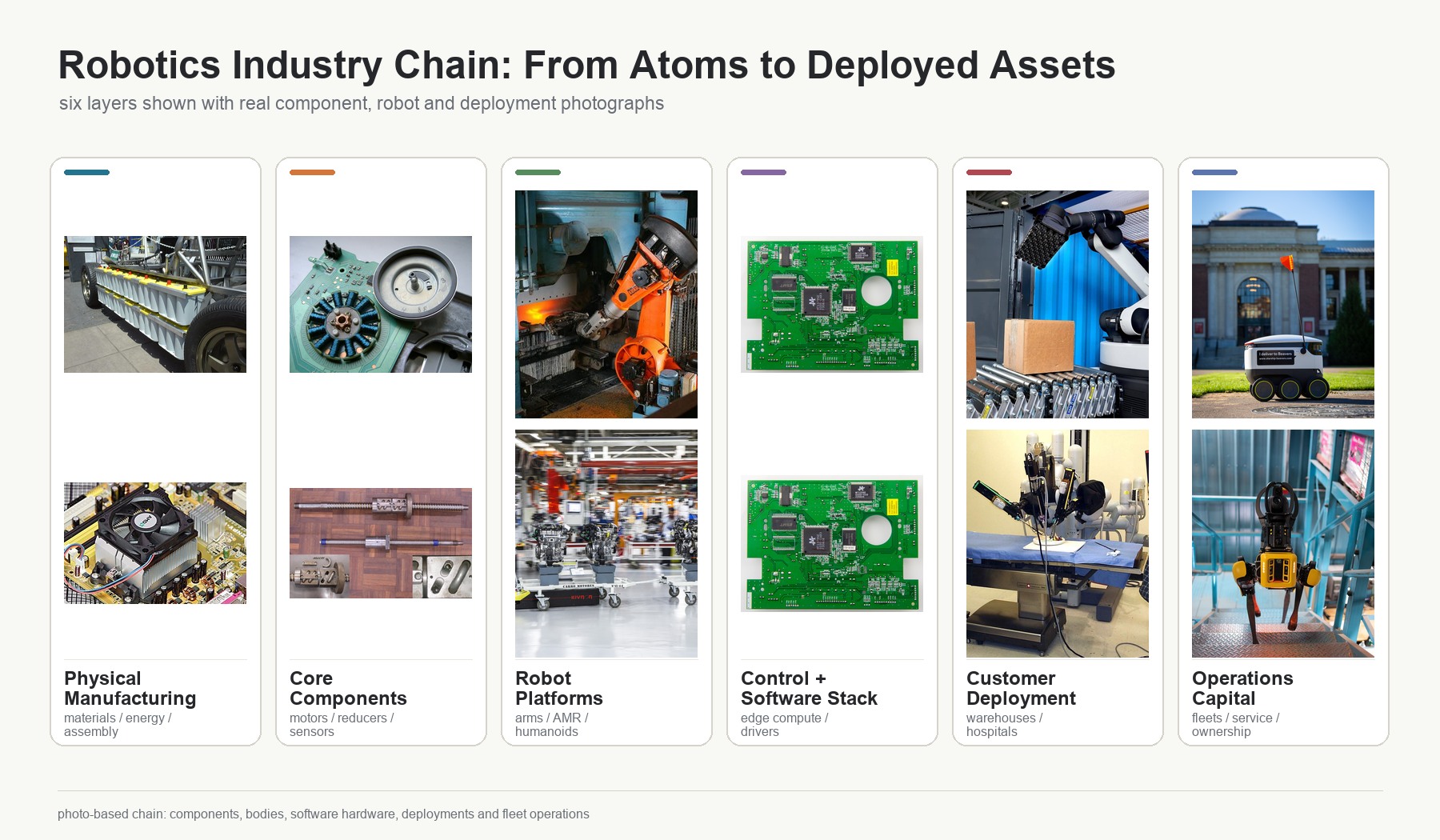
Foundational physics and manufacturing, core components, robot body platforms, software stack and brain models, scenario integration and customers, and capital and operating infrastructure.
The first layer is foundational physics and manufacturing capability. This includes materials, structural parts, precision machining, molds, wire harnesses, connectors, sealing, thermal management, battery packaging, assembly processes, test fixtures, and quality systems. It determines whether robots can be manufactured stably, and it also determines the mass-production boundary of downstream robot-body companies.
The second layer is core components. This includes actuators, motors, reducers, servo drives, encoders, brakes, force/torque sensors, tactile sensors, cameras, LiDAR, millimeter-wave radar, inertial navigation, edge-computing modules, safety controllers, and battery management systems. It determines cost, lifetime, reliability, power density, perception accuracy, and supply stability.
The third layer is robot bodies and platforms. This is not a simple "list of robotics companies," but the packaging of core components into deployable machines: fixed robotic arms, collaborative arms, AMR/AGV, warehouse systems, mobile manipulators, humanoid robots, quadruped/biped robots, home/domestic/companion robots, scenario-specific service robots, surgical robots, drones, unmanned vehicles, unmanned vessels, and defense autonomous systems.
The fourth layer is the software stack and brain models. This includes robot operating systems, middleware, simulation, digital twins, data collection, teleoperation, SLAM, perception models, vision-language-action models, motion planning, task planning, control policies, fleet management, safety policies, logging systems, and training-data closed loops. Figure's Helix, NVIDIA Isaac / GR00T / Cosmos, Google DeepMind's robotics models, Skild AI, Physical Intelligence, and FieldAI all belong to this layer. Over the long term, value may migrate from single robot-body companies toward reusable software and model layers that work across bodies and scenarios.
The fifth layer is scenario integration and downstream customers. Robots ultimately enter automotive, electronics, metalworking, food and beverage, warehousing and logistics, retail delivery, hospitals, homes, energy inspection, agriculture, mining, national defense, and public safety. The key question here is not "can the robot be demonstrated," but whether it can connect into customer workflows, pass safety certification, run stably, reduce downtime, and generate economics on real KPIs.
The sixth layer is capital and operating infrastructure. This includes system integration, certification, repair and maintenance, spare-parts networks, RaaS, insurance, financing, secondary markets, SPVs, closed-end funds, DAOs, tokenized ownership, and other ownership instruments. Maquina and Robo Strategy both sit in this layer, but the underlying risks they bear come from robot-body platforms, software brains, supply chains, and real deployment data.
Decomposing a Robot Body
Robot-body decomposition cannot start from "what forms do robots have," and it also cannot mix actuators, motors, reducers, drives, joints, and grippers into the same layer. Industry-chain and BOM views can place these parts side by side because they map to different suppliers. But a first-principles body tree must drill down layer by layer according to the physical causal chain: carrying loads -> storing and distributing energy -> converting energy into controlled force/motion -> transmitting and constraining motion -> coupling with the environment to do work -> measuring state -> real-time closed loop -> heat dissipation, protection, manufacturing, and maintenance.
This section decomposes only "robot-body hardware." It does not put task scenarios, robot categories, software brains, cloud data closed loops, and capital infrastructure into the same tree. The validation rules are as follows:
- The same layer is split only by the same dimension. The first layer is split by physical function, the second by subfunction, the third by implementation principle, and only then down to parts and supply-chain categories.
- Parent-child relationships must be "functional requirement -> implementation path -> mechanism principle -> parts," not a "popular parts list."
- A part should be placed only under the closest functional node. If a reducer is packaged inside a joint/servo actuator, it belongs under the torque/speed matching mechanism inside the actuator; if it is a remote independent transmission gearbox, it belongs under output transmission.
- Robot forms do not enter the body tree. Humanoids, quadrupeds, AMRs, robotic arms, drones, and surgical robots are combinations of this tree in different task environments.
- Software brains do not enter the body-hardware tree. Main-control boards, real-time controllers, servo drives, and communication buses belong to body hardware; VLA/VLM, simulation, fleet learning, and task planning belong to the software stack and brain-model layer in the previous industry-chain section.
- Cross-layer subsystems should not be forced into a single node. Dexterous hands, mobile chassis, robotic arms, and surgical instrument arms can all be discussed as products or modules. But in the body tree, they should be decomposed back into structure, motion generation, environment coupling, perception, control electronics, thermal safety, and maintenance interfaces.
Under these principles, a robot body should be directly split into eight physical-function sections: structural load-bearing and kinematic topology, energy storage and power distribution, motion generation and transmission, environment coupling and work interfaces, perception and measurement, control/drive and communication electronics, thermal management/protection and functional safety, and manufacturing/calibration and maintenance interfaces. They are expanded layer by layer below.
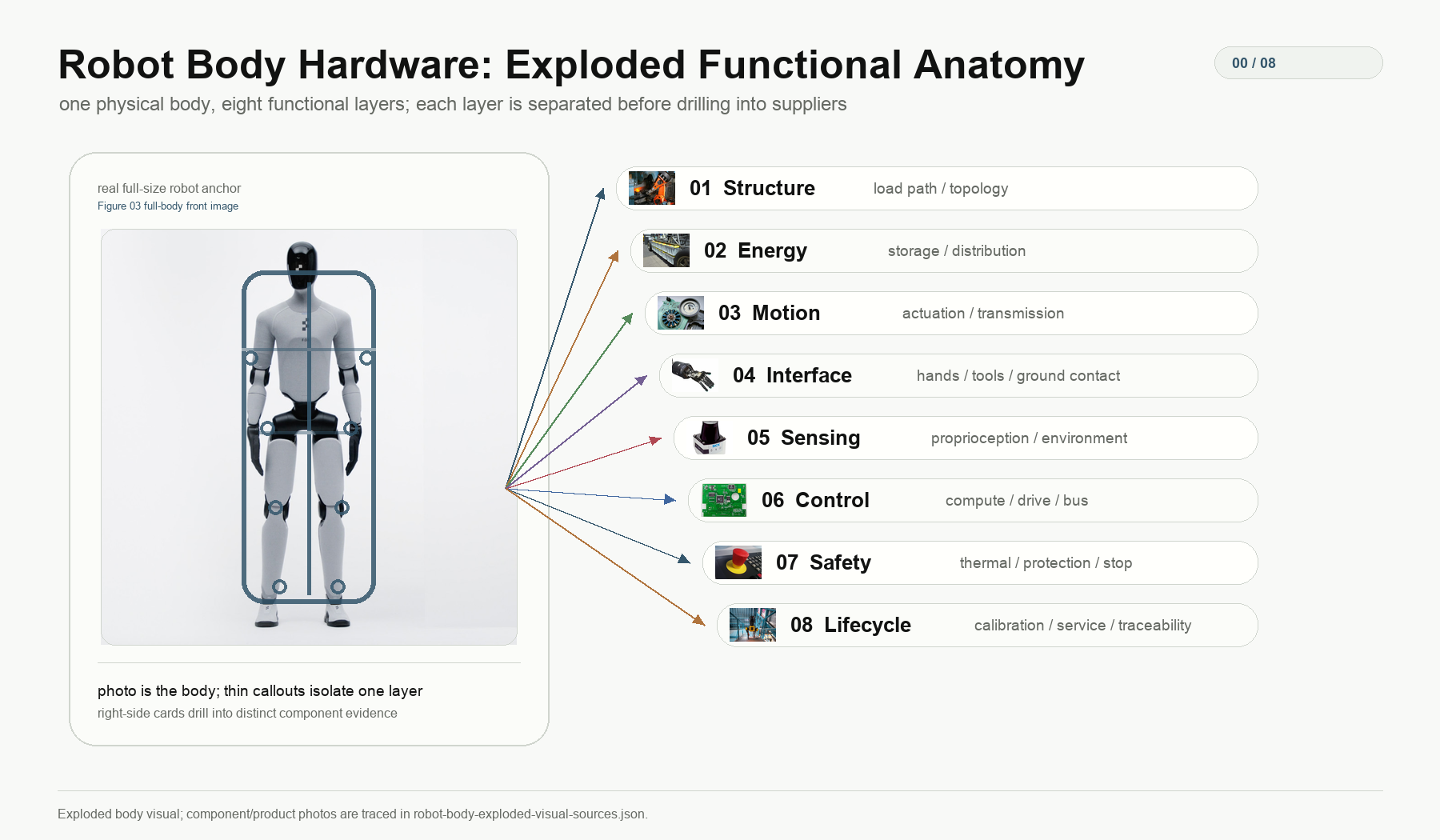
Illustration: overview of a first-principles robot-body decomposition. The left side uses a real full-body front-view product image of Figure 03 collected from the web as the parent anchor for the same robot; the right side extracts the eight physical-function layers one by one. Each subsequent layer has its own image with corresponding real component photos.
Structural Load-Bearing and Kinematic Topology
This layer answers how the robot maintains its shape, bears loads, defines degrees of freedom, and defines its range of motion. Parts that actively generate force do not belong here; motors, hydraulic cylinders, and pneumatic cylinders belong to motion generation and transmission. A reasonable decomposition is:
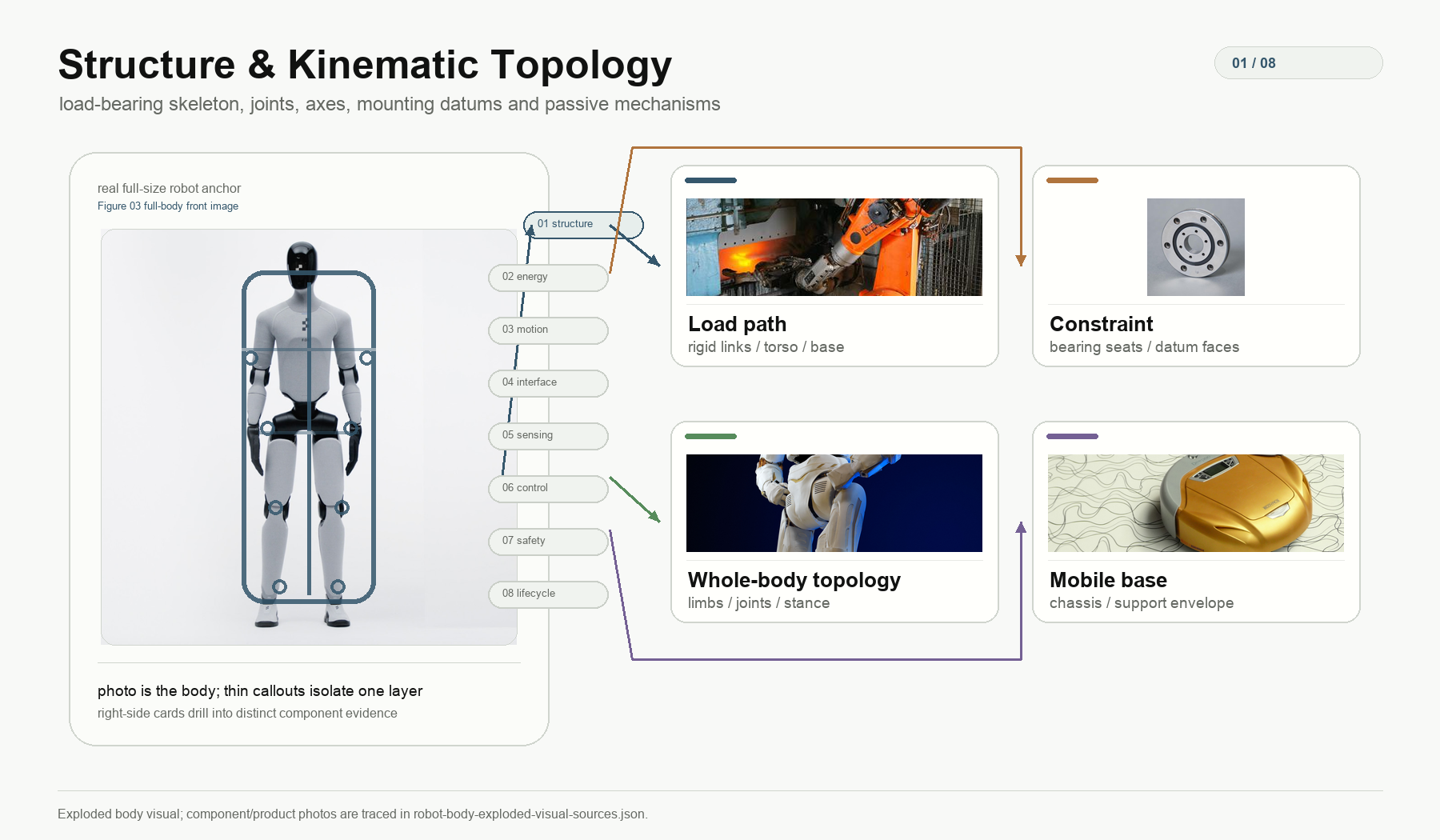
Illustration: single-layer decomposition of structural load-bearing and kinematic topology. The parent robot highlights only load-bearing paths, joint constraints, and topology datums, while the right side uses photos of a load-bearing robotic arm, bearings, whole-machine topology, and a mobile chassis to correspond to structural-layer subfunctions.
Structural Load-Bearing and Kinematic Topology
├─ Load path: torso, chassis, links, supports, load-bearing shells
├─ Degree-of-freedom topology: joint axes, motion chains, serial/parallel structures, mobile-chassis topology
├─ Mounting and positioning: joint seats, bearing seats, mounting surfaces, positioning datums, flange interfaces
├─ Hand/end structure: metacarpals, phalanges, finger joints, palm, end shells
├─ Passive mechanisms: springs, counterweights, compliant elements, limiters, damping and buffering structures
└─ Packaging and maintainability: shells, harness channels, quick-release structures, service openings
Energy Storage and Power Distribution
This layer answers where energy comes from and how it is safely delivered to execution, computing, and perception units. Servo drives and motor-control power stages belong to control, drive, and communication electronics. Battery-pack thermal dissipation can be marked under thermal management, but the battery pack mainly belongs to the energy layer.
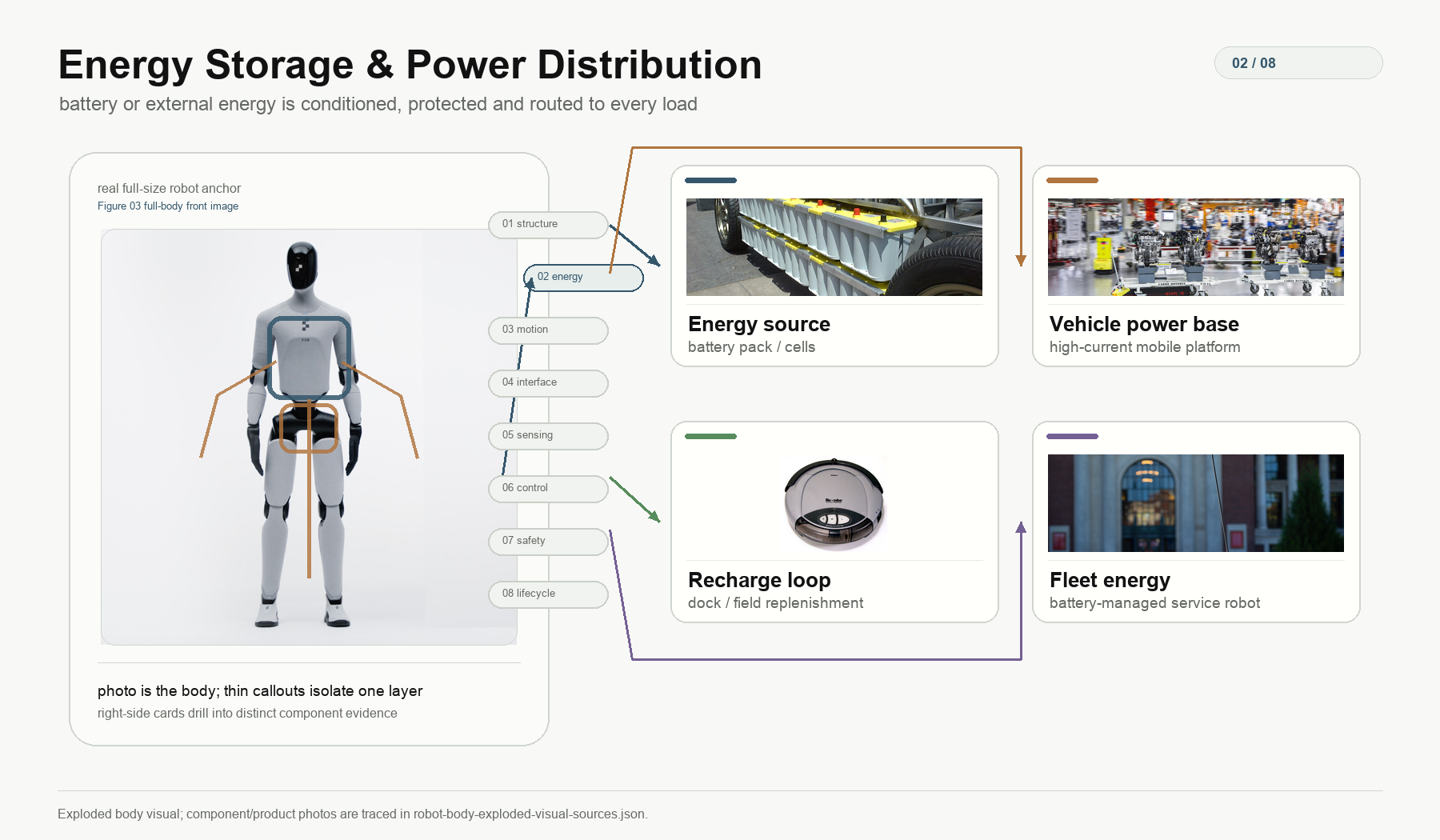
Illustration: single-layer decomposition of energy storage and power distribution. The parent robot highlights only batteries, power paths, and replenishment direction, while the right side uses photos of battery packs, high-power AGV chassis, recharging robots, and delivery robots to show different implementations of the energy layer.
Energy Storage and Power Distribution
├─ Energy sources: battery pack, external power, pneumatic source, hydraulic source, fuel/generation unit
├─ Energy conditioning: BMS, DC/DC, PDU, contactors, fuses and protection devices
├─ Energy distribution: wire harnesses, connectors, busbars, slip rings, air tubes, hydraulic lines
├─ Replenishment systems: charging dock, automatic recharging, battery-swap interface, battery quick release
└─ Energy safety: isolation, overcurrent/overvoltage protection, thermal-runaway protection, pressure relief and power-cut strategy
Motion Generation and Transmission
This layer answers how energy becomes controllable force, torque, speed, displacement, and posture. It is the center of the body-hardware tree and is also the easiest part to decompose incorrectly. The first drill-down for actuators is not "motor, reducer, encoder"; it should first split by output-motion form into rotary actuators and linear actuators, then drill down by energy-conversion method and internal mechanism to parts.
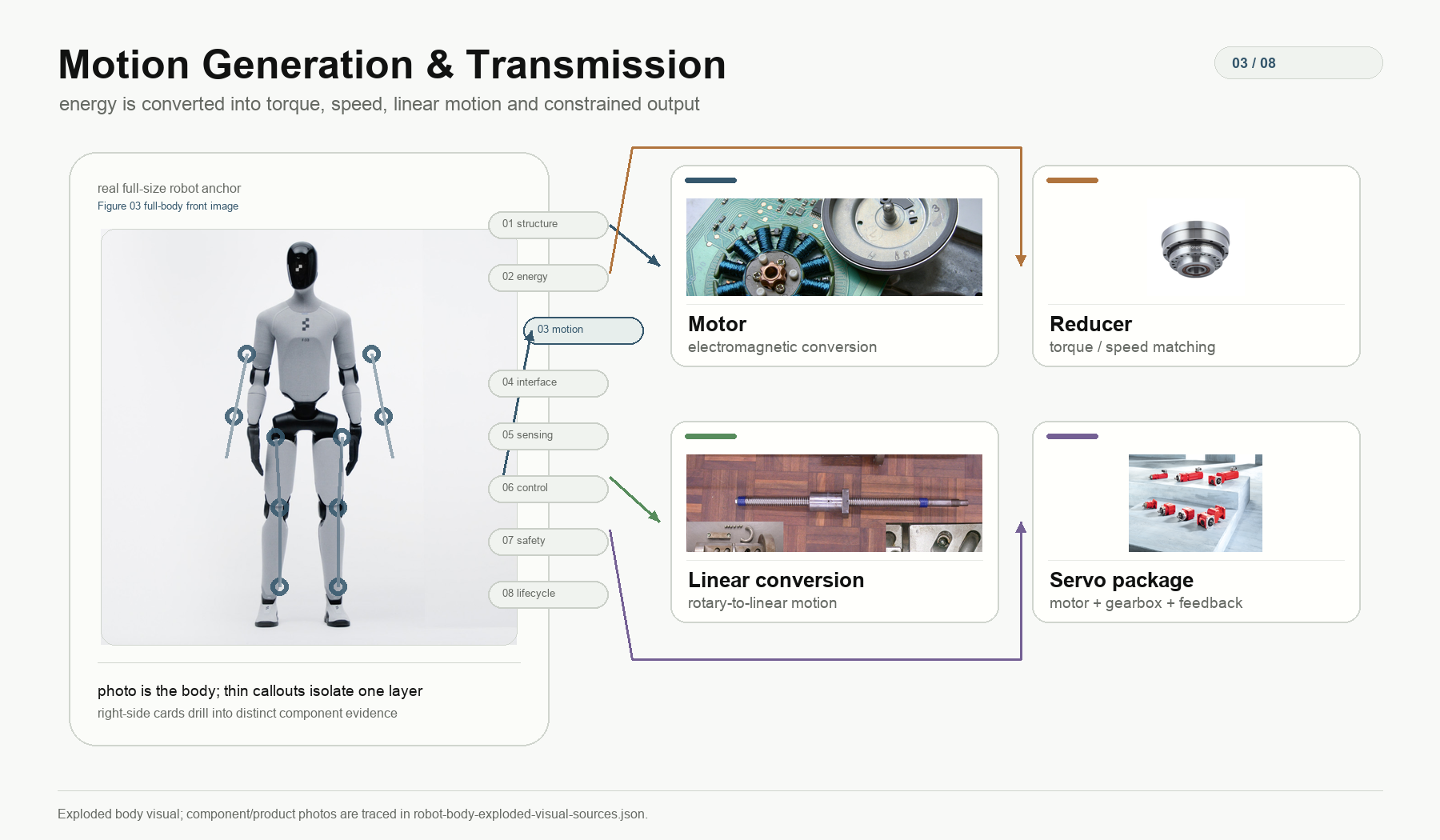
Illustration: single-layer decomposition of motion generation and transmission. The parent robot highlights only joints, output chains, and motion constraints, while the right side uses photos of motors, reducers, screws, and servo modules to correspond to energy conversion, torque/speed matching, rotary-to-linear conversion, and integrated actuators.
Motion Generation and Transmission
├─ Actuators: convert electrical/hydraulic/pneumatic energy into mechanical output
│  ├─ Rotary actuators
│  │  ├─ Motor-type rotary actuators
│  │  │  ├─ Energy conversion: BLDC motor, torque motor, servo motor, stepper motor
│  │  │  ├─ Torque/speed matching: direct drive, quasi-direct drive, harmonic reducer, planetary reducer, cycloidal/RV reducer, gear set, worm gear
│  │  │  ├─ State feedback: encoder, resolver, Hall, current/temperature, torque sensor
│  │  │  ├─ Holding and power-off safety: brake, clutch, locking mechanism
│  │  │  └─ Support packaging: bearings, seals, housing, thermal path, cable outlet structure
│  │  ├─ Hydraulic rotary actuators: hydraulic motor, swing cylinder, valve control, sealing and pressure feedback
│  │  └─ Pneumatic rotary actuators: pneumatic motor, rotary cylinder, valve island and position feedback
│  ├─ Linear actuators
│  │  ├─ Motor-driven linear actuators
│  │  │  ├─ Energy conversion: rotary motor or linear motor
│  │  │  ├─ Rotary-to-linear conversion: ball screw, roller screw, trapezoidal screw, rack and pinion, timing belt, cable/tendon, linkage/cam
│  │  │  ├─ Guidance and load-bearing: guide rail, slider, spline, support bearing
│  │  │  ├─ State feedback: position scale, encoder, force sensor, limit switch
│  │  │  └─ Holding and packaging: brake, mechanical limit, housing, sealing, drag chain/cable outlet
│  │  ├─ Hydraulic cylinder: cylinder body, piston rod, valve, pump/accumulator, pressure/position feedback
│  │  ├─ Pneumatic cylinder: cylinder body, piston rod, valve island, buffering and magnetic switch
│  │  └─ Linear motor: stator, mover, magnetic track, linear guide and position feedback
│  └─ Flexible/soft/special actuators
│     ├─ Tendon/cable drive
│     ├─ Series elastic actuator / variable-stiffness actuator
│     ├─ Shape-memory alloy, piezoelectric, electroactive polymer
│     └─ Pneumatic artificial muscle, soft chamber, fluid-elastic structure
├─ Output transmission and motion constraints: transmit actuator output to the target degree of freedom
│  ├─ Shafts, couplings, timing belts, chains, gears, differentials
│  ├─ Linkages, four-bars, parallel mechanisms, cable/tendon paths, underactuated mechanisms
│  ├─ Bearings, guide rails, sliders, splines, limiters and stops
│  └─ Springs, compliant elements, damping elements, backlash compensation and preload structures
└─ Joint and module packaging: package actuators and transmission constraints into assemblable units
   ├─ Integrated joint modules
   ├─ Hub/wheel-leg modules, ankle/knee/hip/shoulder/elbow/wrist modules
   ├─ Finger/wrist/gripper/dexterous-hand drive modules
   └─ Quick release, sealing, thermal dissipation, harnesses and repair structures
The position of reducers is determined by function, not by supplier name. In robot joints, harmonic, planetary, cycloidal/RV and similar reducers are usually torque/speed matching mechanisms in motor-type rotary actuators, so their upward path is "Motion Generation and Transmission -> Actuators -> Rotary Actuators -> Motor-Type Rotary Actuators -> Torque/Speed Matching." Ball screws, roller screws, racks and pinions, timing belts, and tendons are rotary-to-linear conversion or output-transmission mechanisms inside linear actuators. Only when a gearbox is not part of the actuator internally but is a transmission box located away from the motor and separately connected to the load should it be placed under output transmission and motion constraints.
Environment Coupling and Work Interfaces
This layer answers through what interface the robot applies mechanical work to the environment. What belongs here are "external contact and work interfaces," not the full internal composition of a dexterous hand. In industry product terminology, a complete dexterous hand is often classified together with grippers, EOAT, and end effectors. But when decomposing the body by first principles, a dexterous hand is not a single environment-coupling node; it is a composite subsystem spanning structure, motion generation, contact interface, perception, control electronics, and maintenance interfaces.
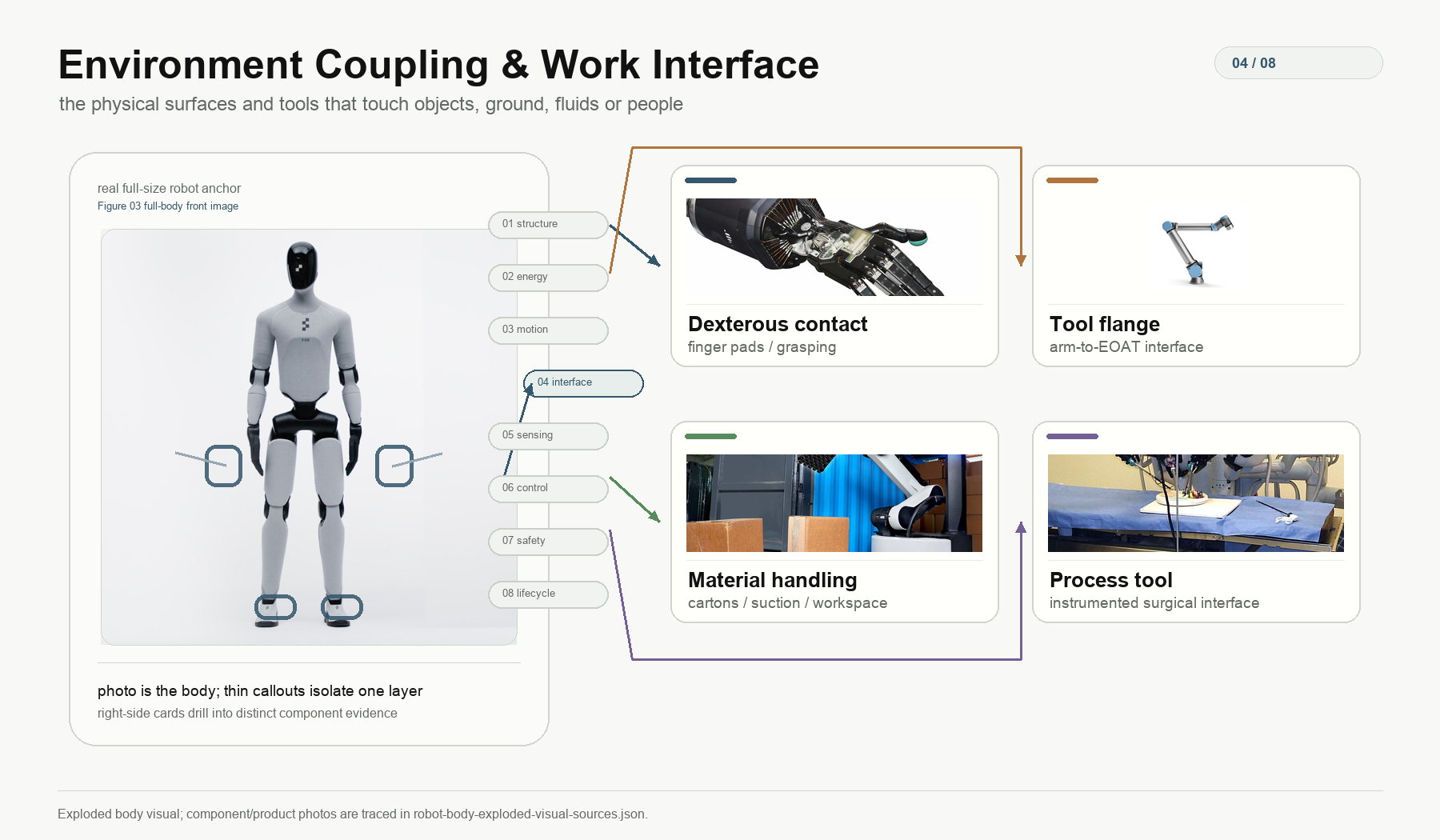
Illustration: single-layer decomposition of environment coupling and work interfaces. The parent robot highlights only hands, feet, and outward-facing contact interfaces, while the right side uses photos of dexterous hands, tool flanges, mobile manipulation platforms, and surgical tools to distinguish contact, gripping, handling, and process tools.
Environment Coupling and Work Interfaces
├─ Mobile contact interfaces: wheels, feet, tracks, propellers, thrusters, tires, control surfaces
├─ Simple end effectors: grippers, suction cups, magnetic grippers, hooks, tray/cargo-bin interfaces
├─ Dexterous manipulation contact interfaces: fingertips, skin, friction materials, nails/hard contact surfaces, palm contact
├─ Tool/object interaction interfaces: grasping, pinching, twisting, insertion/removal, tool holding and human contact
├─ Process tools: welding torch, spray head, cutter, surgical instrument, cleaning/polishing tool
└─ Quick-change and tool interfaces: flange, tool changer, tool identification, pneumatic/electrical/hydraulic interfaces
Perception and Measurement
This layer answers how the body measures itself, contact state, environment state, and safety boundaries. Perception algorithms do not belong here; sensor hardware, synchronization triggers, calibration parts, and safety scanners do.
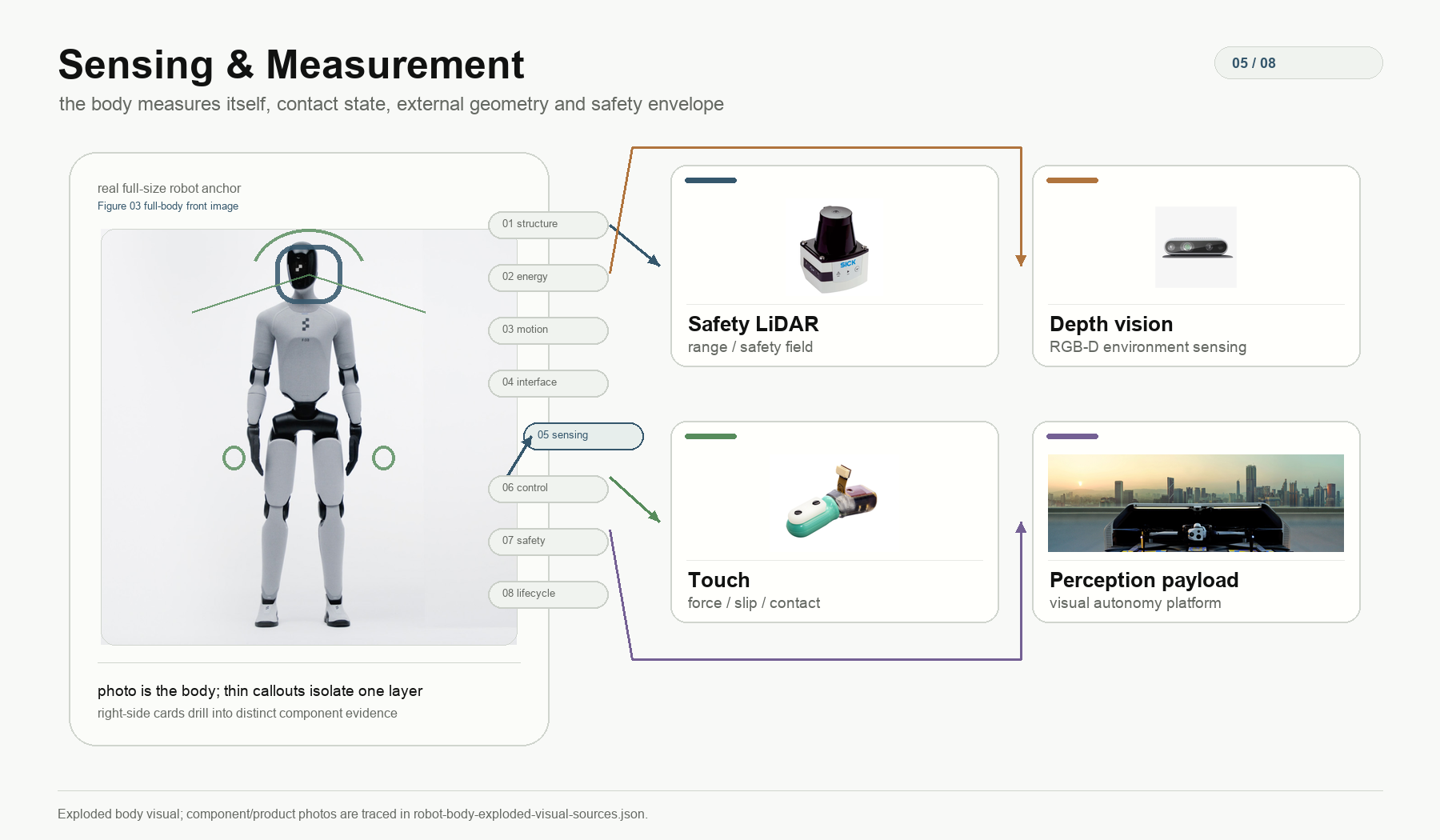
Illustration: single-layer decomposition of perception and measurement. The parent robot highlights only head vision, hand/contact, and external perception boundaries, while the right side uses photos of safety LiDAR, depth cameras, tactile sensing, and vision-autonomy payloads to correspond to different measurement channels.
Perception and Measurement
├─ Proprioception: encoder, IMU, current, voltage, temperature, joint torque
├─ Contact sensing: tactile sensing, foot-end contact, end force/torque, pressure array, slip and contact detection
├─ Environment perception: RGB camera, depth camera, LiDAR, millimeter wave, ultrasound, microphone
├─ Safety perception: safety radar, safety light curtain, collision detection, proximity detection
└─ Calibration synchronization: time synchronization, trigger, calibration parts, sensor extrinsic-reference datum
Control, Drive, and Communication Electronics
This layer answers how the body turns computation results into real-time current, valve control, braking, and safety actions. High-level software belongs to the software stack. Drives serve actuators, but functionally they belong to control and power electronics.
Control, Drive, and Communication Electronics
├─ Main computing: CPU, GPU, edge-computing module, AI accelerator
├─ Real-time control: MCU, motion controller, real-time control board, hand local closed loop, clock synchronization
├─ Actuation drive: servo drive, motor inverter, valve-control unit, brake control
├─ Communication buses: EtherCAT, CAN, Ethernet, serial bus, wireless connection
├─ I/O and diagnostics: sensor interfaces, logs, debug ports, status monitoring
└─ Safety control: safety PLC, emergency-stop loop, redundant control, fault-degradation control
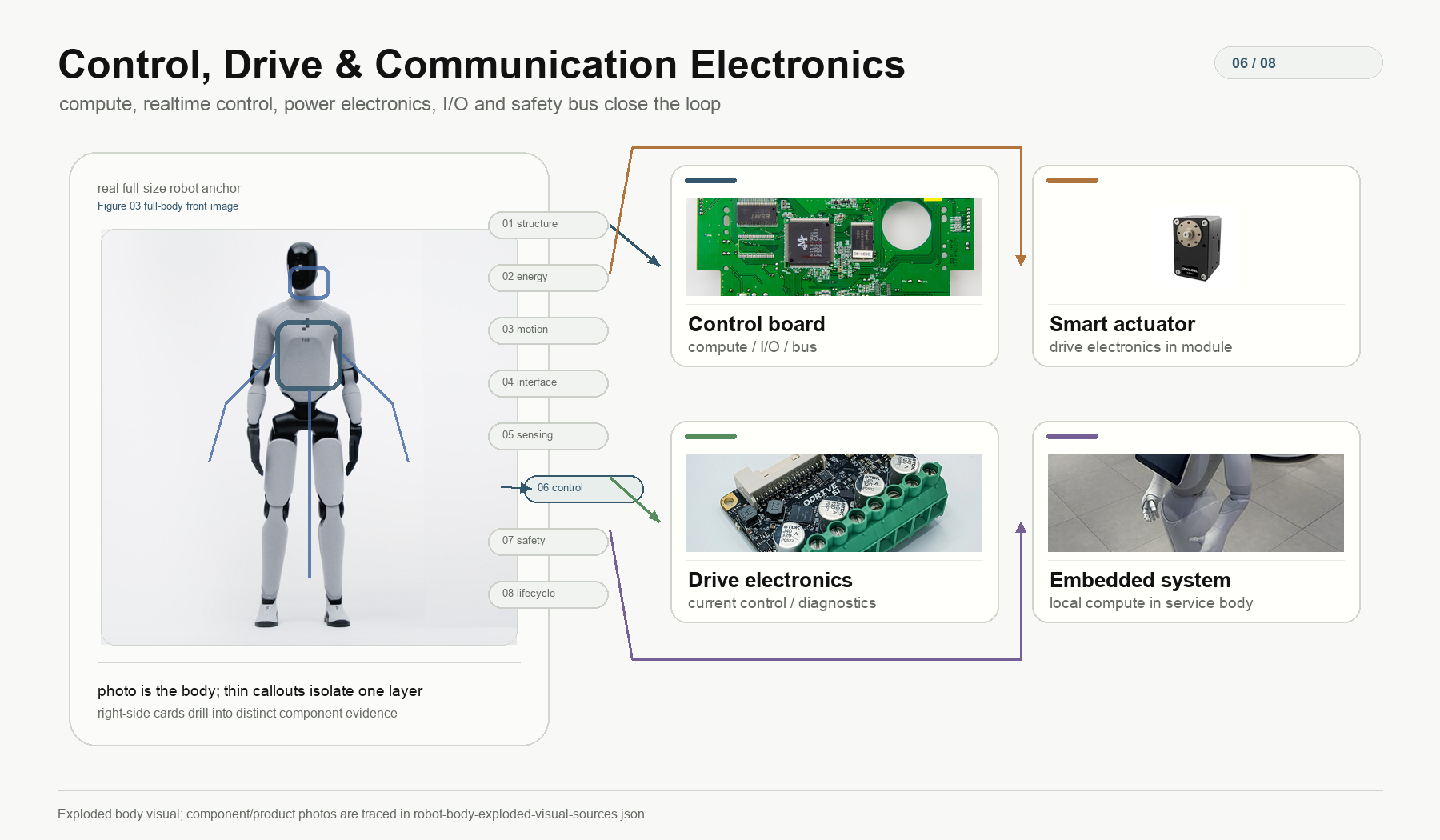
Illustration: single-layer decomposition of control, drive, and communication electronics. The parent robot highlights only main control, torso controllers, drive wiring, and local closed loops, while the right side uses photos of control boards, smart actuators, ODrive S1 drives, and embedded systems in service robots to distinguish computing, drive, and communication hardware.
Thermal Management, Protection, and Functional Safety
This layer answers how the body keeps working under heat, dust, water, impact, EMI, and faults. Brakes, as internal holding parts inside actuators, can belong to motion generation and transmission. System-level emergency stops, safety loops, and fault degradation belong here or under control electronics.
Thermal Management, Protection, and Functional Safety
├─ Thermal path: heat source, thermal-conductive material, heat sink, air cooling, liquid cooling, thermal isolation
├─ Environmental protection: dustproofing, waterproofing, sealing, corrosion resistance, cleaning/disinfection resistance
├─ Impact protection: falling, collision, buffering, shell energy absorption, joint/finger protection
├─ Electrical protection: EMI, ESD, overcurrent, overvoltage, insulation, grounding
└─ Functional safety: emergency stop, braking, redundancy, speed/force limitation, pinch protection, fault degradation
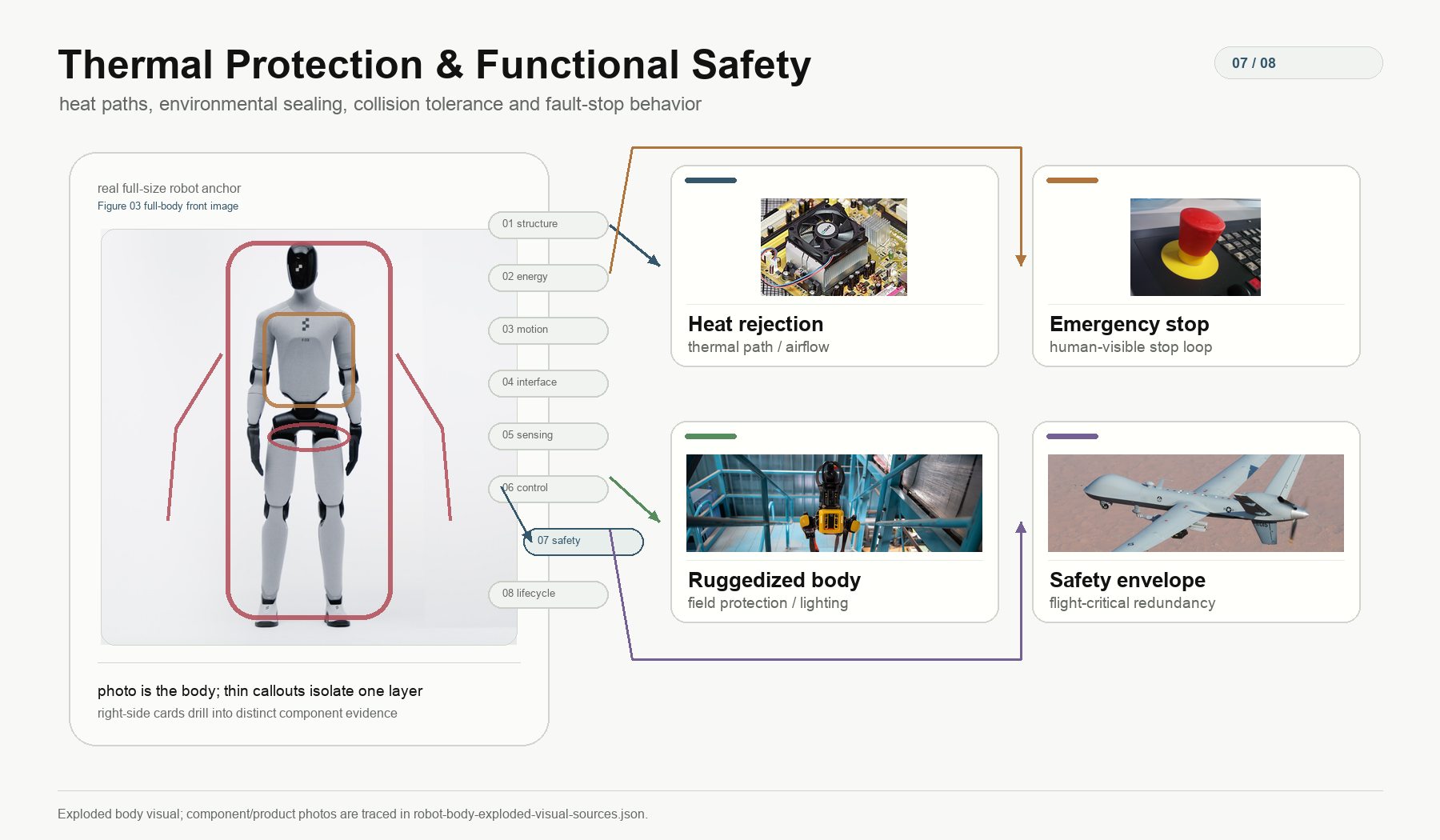
Illustration: single-layer decomposition of thermal management, protection, and functional safety. The parent robot highlights only shell coverage, thermal/safety boundaries, and system-level protection paths, while the right side uses photos of thermal dissipation, emergency stops, reinforced bodies, and flight redundancy to correspond to different safety implementations.
Manufacturing, Calibration, and Maintenance Interfaces
This layer answers how the body becomes a reproducible, repairable, traceable asset from a prototype. Contract manufacturers and repair-service providers belong to the manufacturing/deployment layer of the industry chain. Here, the reference is to hardware interfaces reserved on the body for manufacturing, calibration, and maintenance.
Manufacturing, Calibration, and Maintenance Interfaces
├─ Assembly datums: locating pins, assembly surfaces, fixture interfaces, assembly-sequence design
├─ Calibration interfaces: camera calibration, torque calibration, joint zero position, tactile calibration, tendon-tension calibration
├─ Final-test interfaces: test points, flashing ports, burn-in tests, EOL functional tests
├─ Maintenance interfaces: module quick release, spare-part compatibility, service passages, fingertip/skin replacement parts, field-replacement parts
└─ Traceability system: serial numbers, logs, part-lifetime records, maintenance records
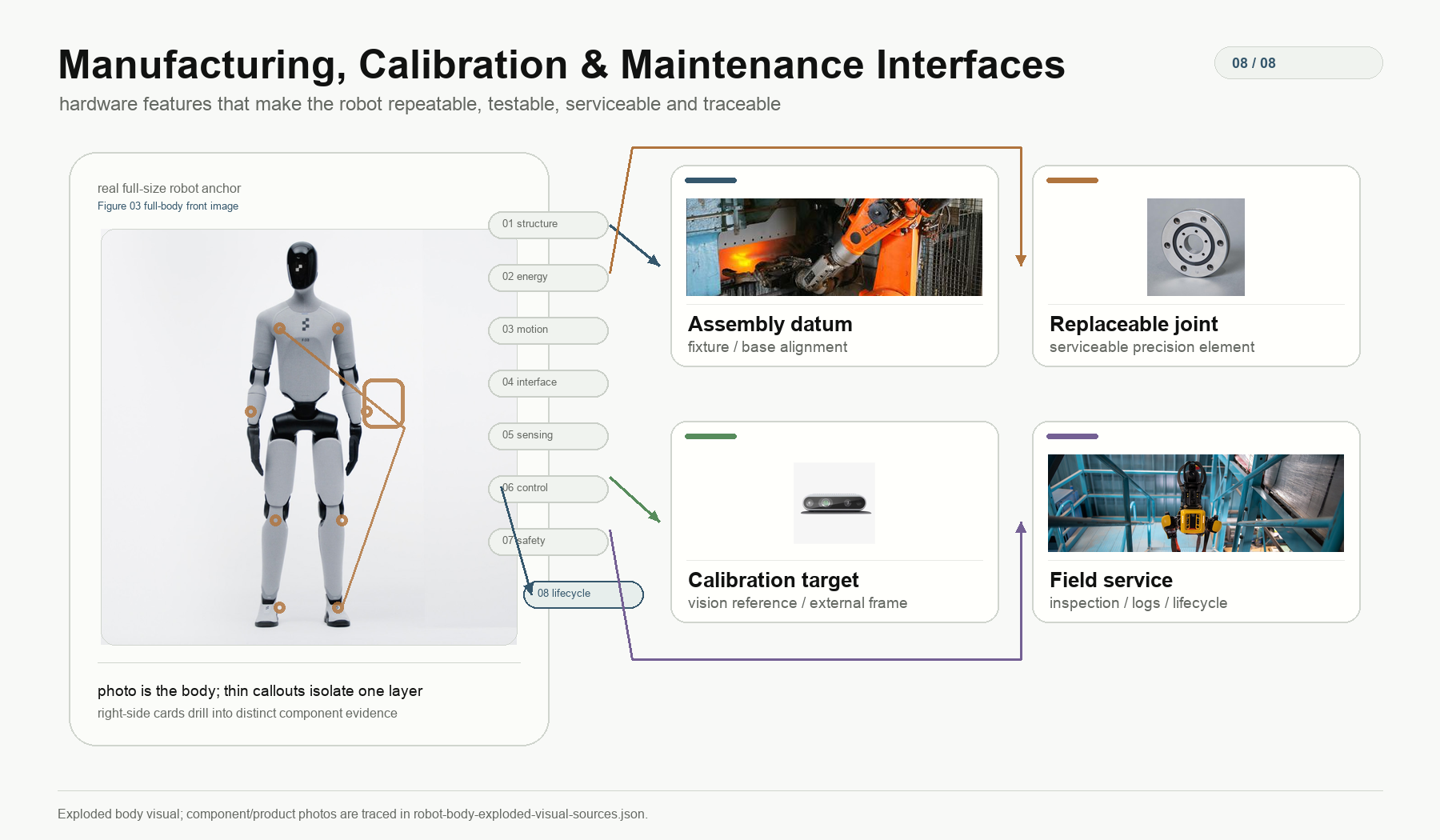
Illustration: single-layer decomposition of manufacturing, calibration, and maintenance interfaces. The parent robot highlights only assembly datums, replaceable nodes, and maintenance paths, while the right side uses photos of assembly robots, bearings, calibration sensors, and field-service robots to correspond to hardware interfaces from prototype to reproducible asset.
Dexterous Hands as a Cross-Layer Subsystem
Therefore, the most robust way to handle dexterous hands is a "dual lens." In industry/product classification, they can be called end effectors or EOAT because they are installed at the wrist end of robotic arms or humanoid robots and directly handle grasping and manipulation. But in the body-hardware tree, they must be decomposed into a cross-layer view and cannot be placed alone into any single physical-function section.
Dexterous Hand System (Cross-Layer View)
├─ Structural load-bearing and kinematic topology: metacarpals, phalanges, joints, palm, shell, finger-degree-of-freedom topology
├─ Motion generation and transmission: micro motors, tendons, gears, linkages, differentials, underactuation, elastic elements
├─ Environment coupling and work interfaces: fingertips, skin, friction materials, hard contact surfaces, tool-holding geometry
├─ Perception and measurement: tactile sensing, force sensing, joint position, temperature, slip, contact detection
├─ Control, drive, and communication electronics: MCU, drive board, sensor interfaces, communication, local closed loop
├─ Thermal management, protection, and functional safety: finger overload, pinch protection, temperature rise, skin/shell durability
└─ Manufacturing, calibration, and maintenance interfaces: fingertip replacement, tendon tension, tactile calibration, lifetime records
With this treatment, gripper/EOAT companies such as SCHUNK, Robotiq, and OnRobot can be classified as end-effectors in product taxonomy. The hand systems of Shadow Robot, Allegro Hand, qb SoftHand, Tesla / Figure / 1X, however, are restored as cross-layer hardware systems in body decomposition. When researching the supply chain, the question is not only "does this company make actuators," but also whether it controls hand motion generation, tactile sensing, contact materials, local control electronics, or a complete hand module.
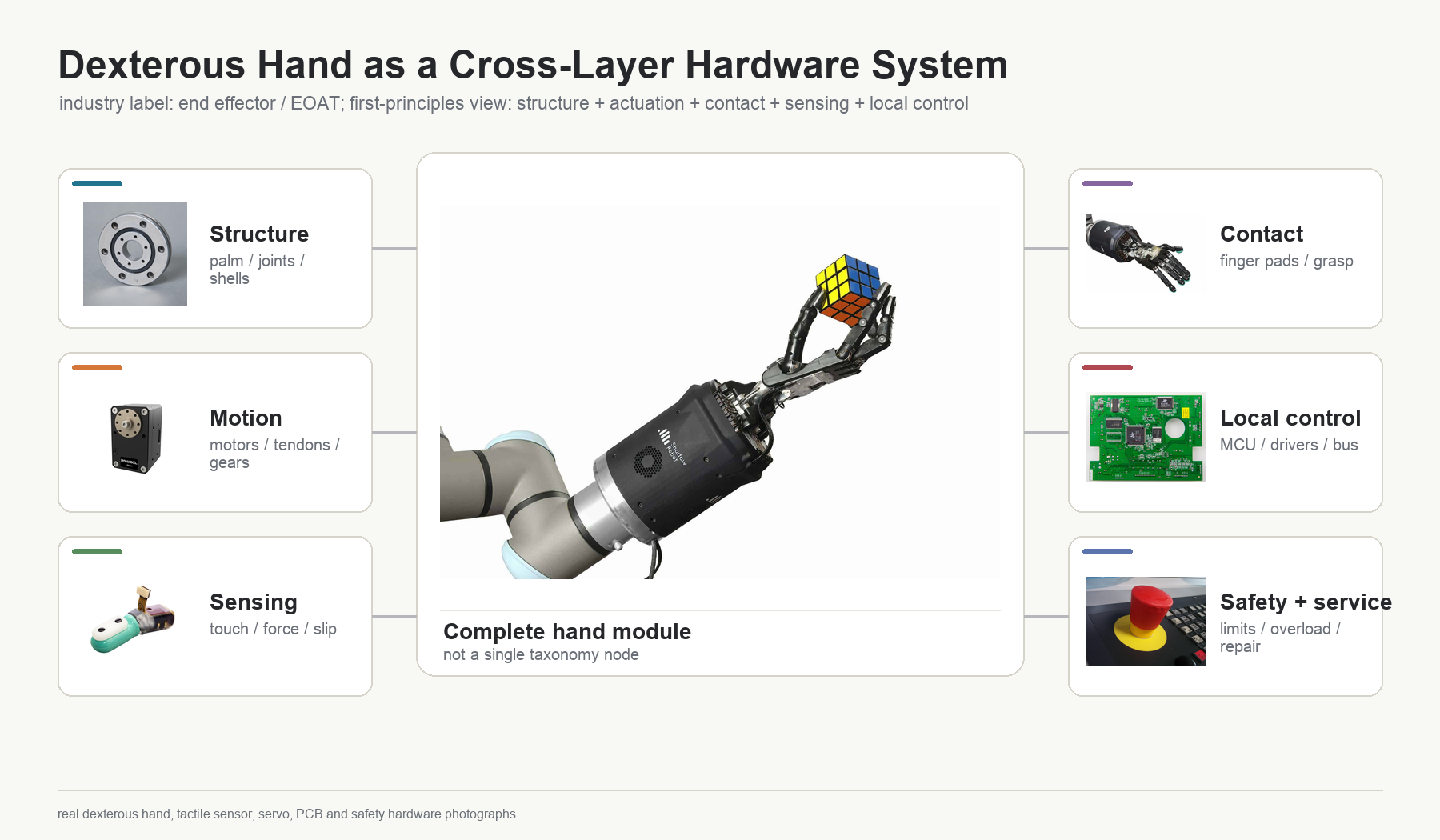
Illustration: dexterous hands are cross-layer subsystems. Product terminology can call them end effectors or EOAT, but body decomposition must split them back into structure, motion generation, contact interface, perception, local control, safety durability, and maintenance interfaces.
This body tree does not overturn the research department's existing robotics-sector taxonomy. The research department's sector taxonomy solves "how should companies/product lines be classified": hardware subsystems, software intelligence, whole-machine systems, manufacturing validation, deployment operations, demand scenarios, and capital infrastructure. Body decomposition solves "how a robot is internally decomposed." It should be used as a hardware due-diligence base map: to penetrate where maxon, Harmonic Drive, Nabtesco, SICK, SCHUNK, HIWIN, and Jabil each sit in the body nodes; to analyze which layers Figure, Apptronik, Agility, and 1X self-develop and which layers they procure externally; to identify missing targets in actuators, dexterous hands, tactile sensing, safety, thermal management, manufacturing calibration, and so on; and to avoid misclassifying dexterous-hand companies as humanoid-robot companies.
Therefore, a first-principles body decomposition is not a supplier list, but a physical hierarchy tree. Supply-chain analysis can compare Harmonic Drive, Nabtesco, maxon, HIWIN, SICK, Jabil and other companies side by side. But in the body tree, they sit in different functional nodes such as reducer inside actuator, motion conversion/guidance, perception and measurement, and manufacturing/maintenance. Only by first decomposing this tree correctly can the later coverage rate, missing targets, and penetration of European and U.S. supply chains avoid misalignment.
The sources of the real product photos used in body-decomposition illustrations are listed in robot-body-exploded-visual-sources.json.
Robot Classification: Re-Examining Types by Complete Robot Systems
After body decomposition, robot classification becomes clearer: different categories are essentially different combinations of tasks, environments, actuators, modes of mobility, work interfaces, and regulatory constraints. This section classifies only complete robot bodies or platforms. It does not list robot foundation models, software brains, simulation, robot operating systems, or fleet OS as robot types; those belong to the software stack and brain-model layer in the industry chain.
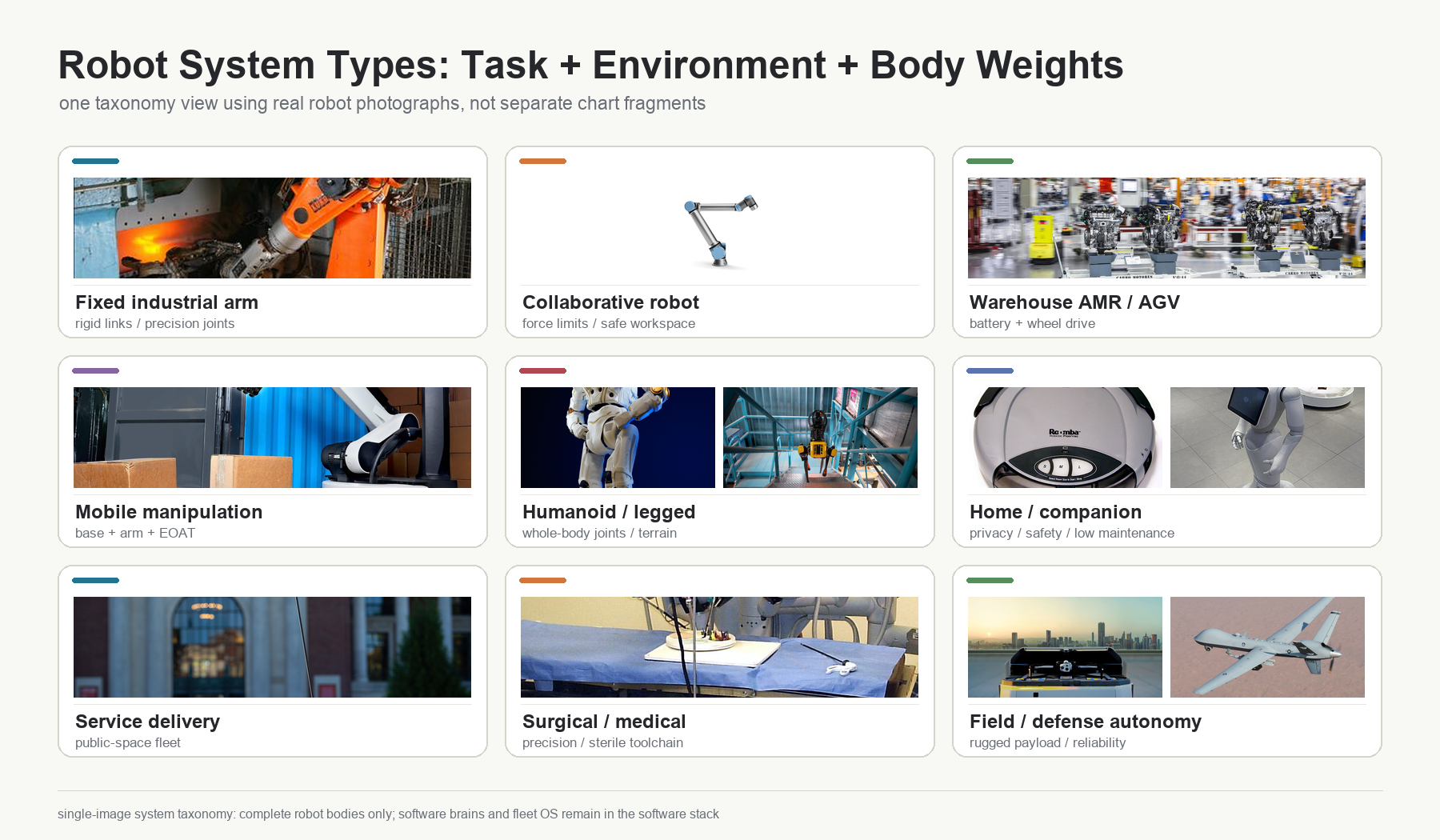
Fixed industrial robots are the most mature robot bodies, mainly used for welding, handling, spraying, palletizing, machine tending, and precision assembly. Core players include FANUC, ABB Robotics, Yaskawa, Kawasaki, Mitsubishi, and KUKA.
Collaborative robots target more flexible automation in small and medium factories. Core players include Universal Robots, Doosan Robotics, FANUC CRX, ABB GoFa, and Standard Bots.
Warehouse automation and mobile robots target goods-to-person, whole-warehouse scheduling, picking, sorting, and handling. Core players include Symbotic, AutoStore, MiR, Locus Robotics, and Exotec.
Mobile manipulators combine a mobile chassis, robotic arm, and end effector, targeting warehousing, retail, laboratories, and light manufacturing. Dyna, Dexmate, Boston Dynamics Stretch, and Toyota Research's mobile manipulation direction are key observation targets.
Humanoid and legged robots try to use a general-purpose body to enter spaces designed for humans. Figure, Apptronik, 1X, Agility, NEURA, Boston Dynamics, and Sanctuary AI are key non-China players. Sanctuary AI needs separate treatment: Phoenix is still part of the humanoid/general-purpose robot route, but the company's public commercial entry point in 2026 has shifted to Physical AI-enabled automation on existing industrial arms.
Home, domestic, and companion robots target residential and personal environments. Tasks include cleaning, organizing, delivery, care, companionship, home security, and remote assistance. The difficulty of this category is not a single demo, but privacy, safety, noise, maintainability, long-tail household objects, and the cost of remote takeover. 1X NEO, iRobot, Matic, and Intuition Robotics / ElliQ are key observation directions. Among them, 1X has both a "humanoid body" tag and a "home scenario" tag.
Scenario-specific service and delivery robots target public spaces, communities, restaurants, hotels, retail, and campuses. The core issues are low-speed mobility, cargo/delivery interfaces, public safety, regulatory permission, and operating density. Serve Robotics, CoCo Robotics, Starship, and Bear Robotics are representatives of this category.
Surgical and medical robotics is a high-regulation, high-gross-margin, high-installed-base-stickiness track. Intuitive Surgical is the absolute leader, while Stryker, Medtronic, CMR Surgical, and Johnson & Johnson are important challengers.
Defense and field autonomous systems include drones, unmanned ground vehicles, unmanned vessels, counter-UAS systems, border/base inspection platforms, and high-risk-environment work platforms. Anduril, Shield AI, Skydio, and AeroVironment are core U.S. players.
The Global Robotics Market Landscape
The International Federation of Robotics World Robotics 2025 industrial-robot summary shows that in 2024, global new industrial-robot installations were approximately 542,076 units, and global operational stock was approximately 4,663,698 units. China installed approximately 295,045 new units in 2024, accounting for about 54% of the global total; its operational stock was approximately 2,027,190 units, accounting for about 43% of the global total.
This shows that China is both the world's largest demand market and the largest mass-production pressure field. But this report uses Chinese companies only as competitive references and does not include them in the ranking. This report focuses on whether Maquina and Robo Strategy already cover leading robotics companies and supply-chain assets in the non-China markets of Europe, the United States, Japan, and Korea.
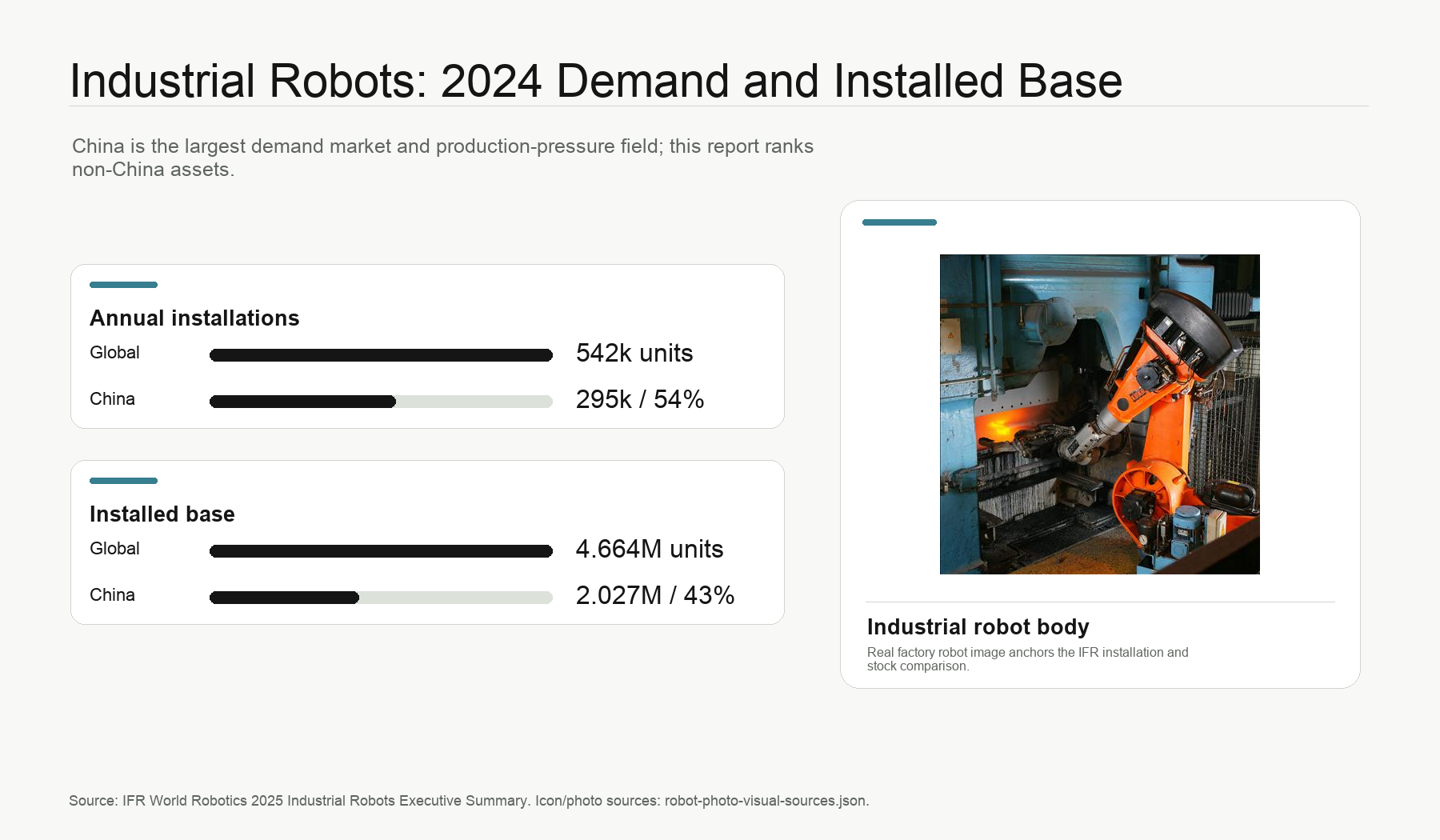
*Illustration: new installations and operational stock of global industrial robots show that China is both the largest demand market and the largest mass-production pressure field
Regionally Differentiated Competition Across Europe, the United States, and Asia
The United States is strong in surgical robotics, warehouse automation, defense autonomous systems, humanoid-robot financing, robot foundation models, and computing platforms. Intuitive Surgical, Symbotic, Figure, Apptronik, Agility, Boston Dynamics, Anduril, Shield AI, Skild AI, Physical Intelligence, FieldAI, and NVIDIA are key nodes in the U.S. map.
Europe is strong in industrial robotics, collaborative robots, warehouse automation, sensors, actuators, industrial safety, and surgical-robot challengers. ABB Robotics, Universal Robots / MiR, AutoStore, Exotec, SICK, Bosch Rexroth, Schaeffler, maxon, CMR Surgical, and NEURA Robotics are core assets.
Japan is strong in industrial-robot bodies, CNC, servos, reducers, machine vision, and precision manufacturing. FANUC, Yaskawa, Kawasaki, Mitsubishi, Keyence, Nabtesco, and Harmonic Drive are foundational supply chains for the global robotics industry.
Korea is strong in automotive-manufacturing coordination, collaborative robots, and humanoid layout. Hyundai owns a core legged-robotics asset through Boston Dynamics, while Doosan Robotics and Rainbow Robotics also maintain presence in collaborative robots and humanoids.
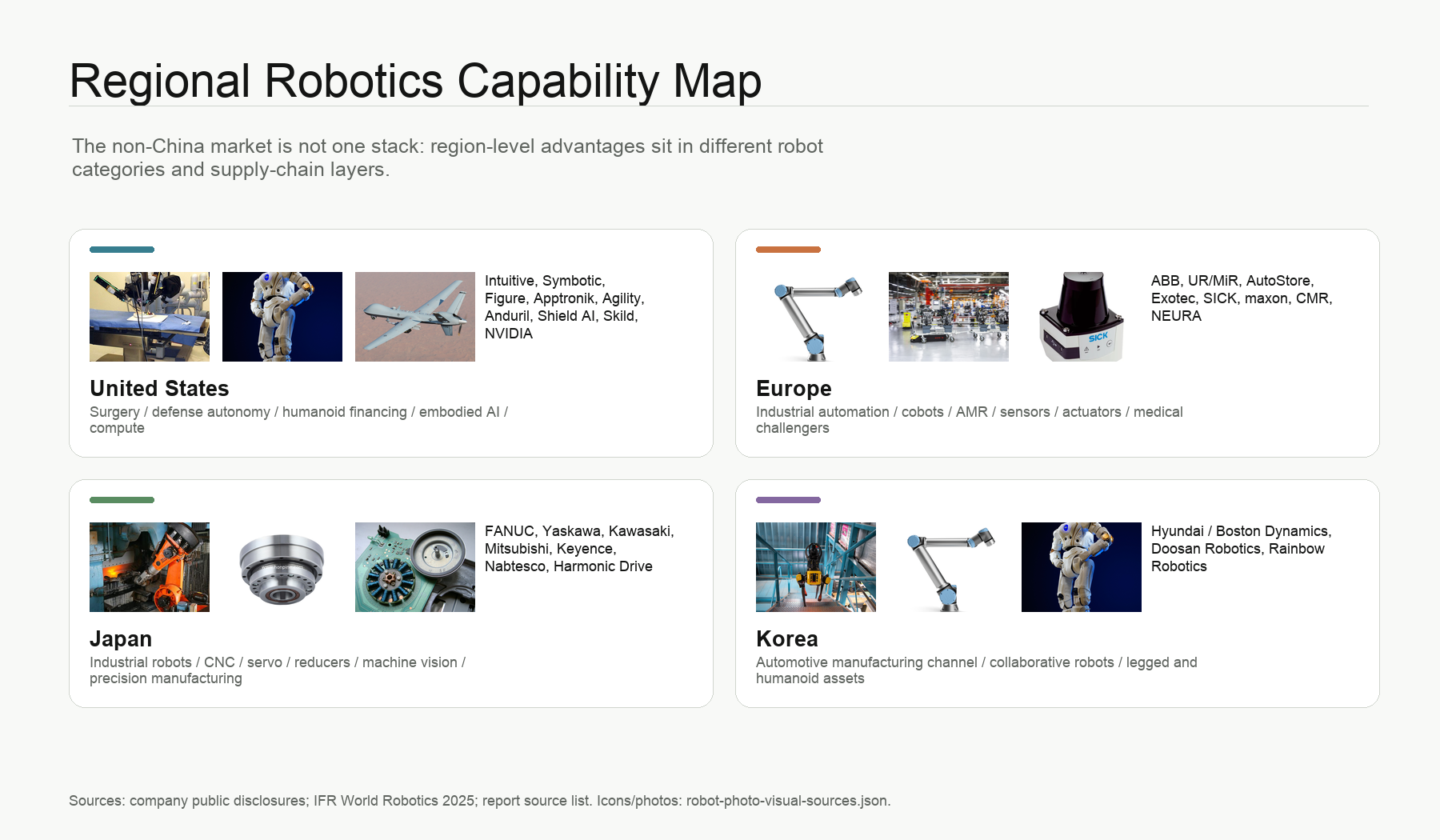
Major Players in Non-China Markets
The following table is roughly ranked by the "latest observable capital size of robotics-related assets." Public companies use market-cap snapshots around 2026-07-02, while private companies use the latest financing or transaction valuations. Group companies are marked as not pure-play robotics businesses; group market cap cannot be directly equated with robotics-business value. Robot shipment, installed-base, and market-share figures are listed only where public measures exist.
| Rank | Company | Region | Category | Latest valuation / market-cap basis | Shipment, deployment, or installed-base basis | Market share or market position | Conclusion |
|---|---|---|---|---|---|---|---|
| 1 | Intuitive Surgical | U.S. | Surgical robotics | About $142.5B market cap; high robotics-business purity | Secondary sources say more than 11,000 da Vinci systems and more than 1,000 Ion systems; 431 da Vinci systems placed in Q1 2026 | De facto global surgical-robotics leader; secondary sources cite 60% to 70% share in robotic surgical systems | Most important uncovered listed robotics leader |
| 2 | Teradyne / Universal Robots / MiR | U.S. / Denmark | Collaborative robots, mobile robots, test equipment | About $66.9B group market cap; robotics business not valued separately | UR historical cumulative shipments have old measures; latest unified basis needs verification | Universal Robots is a core global collaborative-robot player | Core collaborative-robotics miss |
| 3 | Anduril | U.S. | Defense autonomous systems, unmanned systems | Secondary reports show 2026 financing valuation of about $60B | Delivery volume not disclosed | Core U.S. defense autonomous-systems unicorn | Core miss in defense robotics and autonomous systems |
| 4 | FANUC | Japan | Industrial robots, CNC, servos | About $42B market cap; robotics and automation business highly relevant | Common basis says cumulative robot shipments exceed 1M units; needs verification with latest company materials | One of the four major industrial-robot families | Core industrial-robotics miss |
| 5 | Figure AI | U.S. | Humanoid robots | About $39B post-money after 2025 Series C | Company says first BotQ line has annual capacity of 12,000 units; in April 2026 it said more than 350 Figure 03 units had been produced | Highest-valuation tier among private humanoid robotics companies | Covered, but valuation is already highly forward-priced |
| 6 | Symbotic | U.S. | Warehouse automation, system robotics | About $27.1B market cap | Single-robot shipments not disclosed; disclosed by systems and customer deployments | Core player in large-scale North American warehouse automation | Mature warehouse-robotics miss |
| 7 | Skild AI | U.S. | Robot foundation model, warehouse-deployment data layer | 2026 Series C raised $1.4B; valuation over $14B | 2025 live revenue about $30M; partnerships with ABB / UR / MiR / NVIDIA / Foxconn; acquired Zebra / Fetch robotics assets, with transaction terms undisclosed | Leading private robotics foundation-model company, extending into industrial and warehouse deployments | Important model-layer miss |
| 8 | Shield AI | U.S. | Defense AI, drone autonomy | Secondary reports say about $12.7B post-money in 2026 | V-BAT / Hivemind delivery volume not disclosed | Leading U.S. defense autonomy software company | Defense autonomous-systems miss |
| 9 | Yaskawa Electric | Japan | Industrial robots, servos, motion control | About $11.4B market cap | Motoman cumulative shipments have historical measures; latest unified basis not disclosed | One of the four major industrial-robot families; strong in upstream servos | Industrial and motion-control miss |
| 10 | Physical Intelligence | U.S. | Robot foundation model | Confirmed historical valuation about $5.6B; secondary reports say new financing may reach about $11B, pending verification | Software platform mainly; real deployment scale not systematically disclosed | Important private robot foundation-model company | Important model-layer miss |
| 11 | NEURA Robotics | Germany | Cognitive robots, collaborative robots, humanoids, mobile platforms | Official financing basis up to $1.4B; secondary reports once gave about $7B valuation | Company says order/deployment pipeline exceeds $1B; real delivery count not disclosed | Important European cognitive-robotics and humanoid private company | Robo Strategy miss |
| 12 | Apptronik | U.S. | Humanoid robots | Local draft and secondary basis around $5B to $5.5B | Customer pilots are clear; real mass-production deliveries not disclosed | First tier of U.S. enterprise humanoid robots | Covered; shared core asset |
| 13 | ABB Robotics | Switzerland / Sweden | Industrial robots, control, automation | SoftBank acquisition enterprise value about $5.375B to $5.4B; ABB group market cap is higher but does not represent robotics-business valuation | Robot cumulative installations need continued verification against latest company basis | One of the four major industrial-robot families | Mature industrial-robotics core asset missed |
| 14 | 1X Technologies | Norway / U.S. | Home humanoid robots | Maquina entry basis about $4.55B; higher valuation reports not fully confirmed | Preorder demand and capacity are company basis; revenue recognition and delivery not disclosed | Leading private home humanoid robotics company | Robo Strategy miss |
| 15 | AutoStore | Norway | Warehouse automation, cube storage | About $4.3B market cap | Company investor page basis is 1,950+ systems across 65+ countries | Global core player in cube-storage automation | Mature warehouse-automation miss |
| 16 | CMR Surgical | U.K. | Surgical robots | 2021 financing valuation about $3B; subsequent update needed | Historical public basis says Versius procedures exceeded 20,000; latest needs verification | European surgical-robotics challenger | Private medical-robotics miss |
| 17 | Agility Robotics | U.S. | Biped logistics robots | Signed de-SPAC basis about $2.5B pre-money, not yet completed | Company/transaction materials cite 65,000+ operating hours, 9 customer facilities, $300M+ orders, and 1,000 Digit v5 units under three-year leases | Relatively strong commercialization evidence for logistics biped robots | Robo Strategy miss |
| 18 | FieldAI | U.S. | General robot software, field autonomy | Secondary reports value it at about $2B | Reports say revenue and customer contracts exceed $100M; real robot count not disclosed | Important emerging company in robot software and field deployment | Software-layer miss |
| 19 | Locus Robotics | U.S. | Warehouse mobile robots | Old financing basis near $2B; update needed | Large-scale picking measures exist for customers such as DHL; single-unit shipments need verification | Mature warehouse AMR player | Mature warehouse AMR miss |
| 20 | Exotec | France | Warehouse automation, Skypod | Historical valuation around $2B level; update needed | Public materials say 135+ systems and more than one million daily pick/place operations; latest company basis needs verification | Important European warehouse-automation player | European warehouse-automation miss |
| 21 | Boston Dynamics | U.S. / Korea | Legged robots, mobile manipulation | Hyundai 2021 acquisition valuation about $1.1B; current value undisclosed | Real cumulative deliveries of Spot, Stretch, and Atlas not disclosed | Benchmark in dynamic control and legged robotics | One of the most important unlisted body-platform misses |
| 22 | Standard Bots | U.S. | Collaborative robots, factory automation | Local basis about $1B valuation | "Hundreds of robot units/workstations" type basis needs continued verification | Representative of new-generation U.S. collaborative robots | Covered by Robo Strategy; missed by Maquina |
| 23 | Serve Robotics | U.S. | Sidewalk delivery robots | Small-cap listed company | Fleet size and active deployments need continued verification through quarterly filings | Listed target in small delivery robots | Missed, but lower priority |
| 24 | Dyna Robotics | U.S. | Mobile manipulation, embodied intelligence | Series A amount about $120M; valuation undisclosed | Commercial deployments are mostly company self-disclosed; unified unit count not disclosed | Early mobile-manipulation-arm asset | Covered by Robo Strategy; missed by Maquina |
| 25 | Dexmate | U.S. / Turkey | Mobile manipulation arms, grippers | Undisclosed | Undisclosed | Early hardware platform; less certain than leaders | Covered by Robo Strategy; missed by Maquina |
Investment Analysis of Maquina and Robo Strategy
The core of this chapter is not "who invested in robots," but to clarify how the two capital machines turn private robotics equity into tradable assets, and what risks investors actually bear. Maquina's risks come from the DEUS token, DAO governance, on-chain/off-chain asset mapping, and SPV attestations. Robo Strategy's risks come from the 1940 Act closed-end fund, Level 3 private-security valuation, BOT stock premium/discount to NAV, and the large-scale stock issuance mechanism.
Different Investment Models
Maquina: DAO Token, On-Chain Governance, and Off-Chain SPV Combination
Maquina is an investment vehicle that wraps private robotics equity exposure with crypto rails. Its asset and rights chain can be split into five layers:
| Layer | Mechanism | Investment implication |
|---|---|---|
| Token layer | DEUS, 1B maximum supply, fully transferable after the 2026-05-27 TGE | Investors buy a governance/economic-exposure token, not redeemable fund shares |
| Governance layer | DEUS is staked into xDEUS, receiving non-transferable governance rights and vote multipliers that accrue with staking time | Asset allocation, buybacks, staking rewards, and future investment direction are driven by governance |
| Fundraising layer | Five Genesis Auction rounds raised about $10M in total and distributed 23.24% of DEUS supply | This is the source of early robotics-investment capital, but it is not current NAV |
| Execution layer | Investments are approved through DAO proposals such as BOT-01, BOT-03, BOT-04, BOT-06, BOT-07, and BOT-09, then executed through SPVs, fund units, membership interests, or company shares | The security form in investment documents matters; fund units, SPV membership, preferred shares, and ordinary shares cannot be mixed together |
| Attestation layer | Andersen LLP issues attestation after investment execution and ownership are formally secured | What is attested is funded capital / ownership record, not current fair value, and not assets redeemable by DEUS holders |
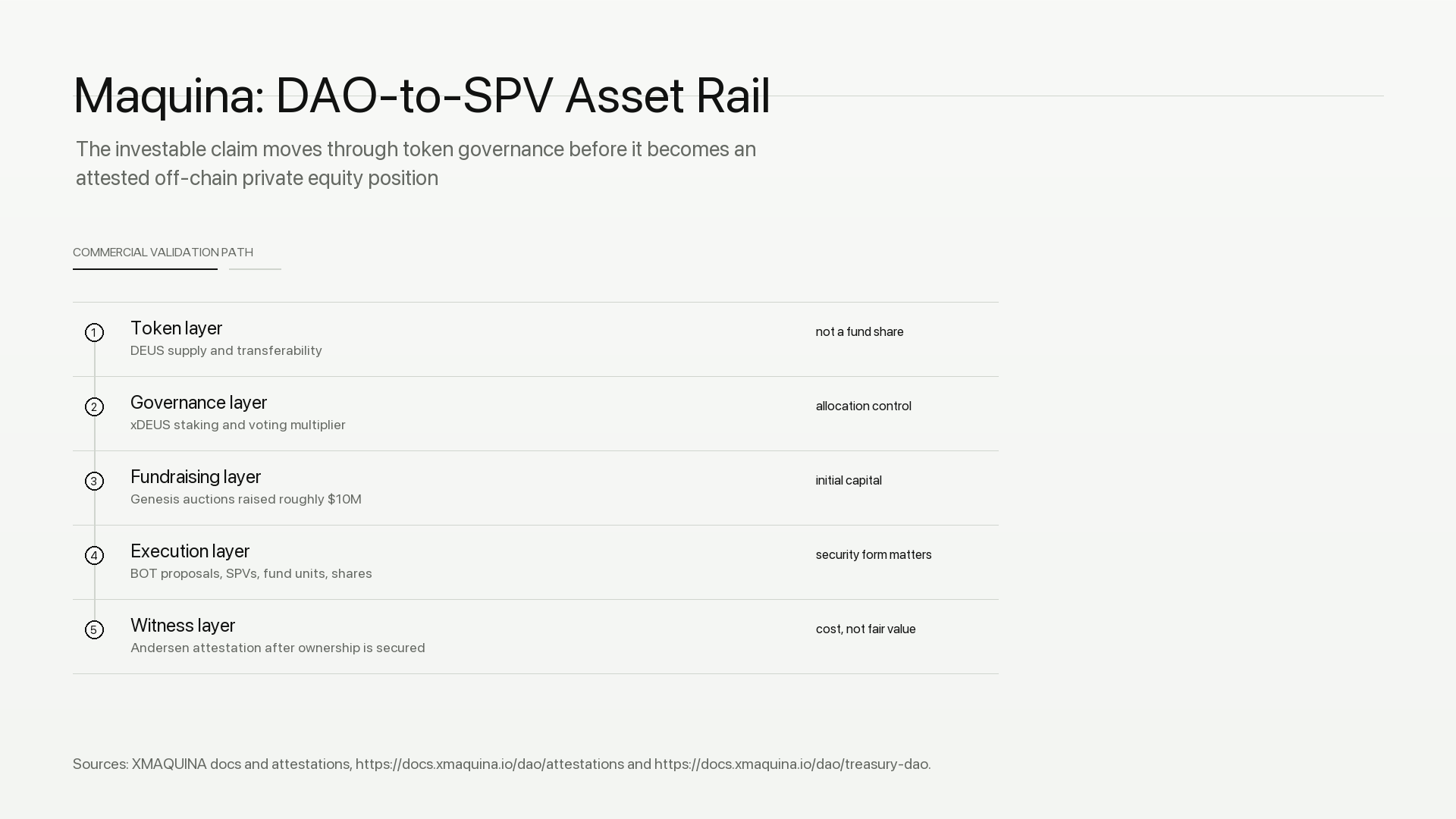
Illustration: Maquina's asset chain must be traced from DEUS / xDEUS governance all the way to specific SPVs, fund units, or company shares, then checked for whether Andersen completed attestation; governance approval, user forms, and attested cost base cannot be mixed.
Maquina's long-term mechanism also includes RCM Protocol and SubDAO. The SubDAO idea is that each public auction raises capital for one specific robotics company; after success, it mints a tradable token anchored to an SPV that holds that company's equity. Each SubDAO returns 5% of token supply to the DAO and brings the DAO issuance fees, trading fees, and operating revenue. This makes Maquina more than a holdings table: it is trying to split private robotics equity into tradable, governable, composable on-chain capital-market assets.
But Maquina's biggest research risk is also here. It has no official audited NAV. A third party once gave a headline treasury NAV of about $32M, but most of it was DEUS held by the DAO itself and is reflexive. After stripping out DAO-owned DEUS, the most reliable non-reflexive asset base is approximately $2M in USDC cash plus the $4.8728M Andersen-attested robotics-equity cost base. If marked to market, the robotics equity is about $6.5M to $7.5M; with a conservative discount, about $5.5M to $6.0M. Therefore, Maquina's real non-reflexive asset backing is closer to a single-digit millions of dollars level, not headline NAV.
Robo Strategy: Listed Closed-End Fund and Public-Market Financing Flywheel
Robo Strategy is a completely different structure. It is an SEC-registered, Nasdaq-listed, non-diversified closed-end management investment company under ticker BOT. It is not a DAO and not a crypto DAT. It wraps private robotics and embodied-intelligence securities in a listed closed-end fund.
| Mechanism | Robo Strategy disclosure basis | Investment implication |
|---|---|---|
| Legal entity | RoboStrategy, Inc., CIK 0002081119, Maryland corporation, 1940 Act closed-end management investment company | Investors hold listed common shares, not the private-company equity itself |
| Listing/trading | BOT began trading on Nasdaq Global Market on 2026-05-11 | Liquidity comes from the stock market; price can deviate materially from NAV |
| Investment scope | Under normal market conditions, at least 80% of net assets are invested in robotics / embodied-AI technology companies primarily located in the United States; long-term target of 20-30 positions | More like a public-market version of a private robotics fund than Maquina |
| Fees | 2.5% annual management fee, paid monthly in arrears based on average gross assets | Fees are based on gross assets; if leverage or balance-sheet expansion is used in the future, the fee base also grows |
| NAV disclosure | NAV calculated monthly and planned to be released within 30 days after month-end; quarterly portfolio investments disclosure, including SPV underlying share class / share count and portfolio percentage | More transparent than Maquina, but valuations are still mainly Level 3 private securities |
| Stock issuance | On 2026-05-11, signed a common stock purchase agreement of up to $2B with Roth Principal Investments; on 2026-06-16, N-2/A registered Roth to resell up to 14.10M shares | If BOT trades at a high premium, issuing stock may accrete NAV; but it also brings dilution, selling pressure, and premium-collapse risk |
The key question for Robo Strategy is not "whether it invested in Figure / Apptronik / Dyna," but whether the public-market wrapper can continue converting a high premium in BOT stock into new private robotics assets. The example in SEC filings is intuitive: on 2026-06-12, BOT closed at $35.39, while 2026-05-31 NAV was $7.26, implying a 387.5% premium to NAV, or about 4.875x NAV. If recalculated using the latest available 2026-06-22 NAV of $8.92, $35.39 is still about 3.97x NAV.
Therefore, Robo Strategy's investment return consists of two layers: one is the fair-value change of private assets such as Figure, Dyna, Apptronik, and Dexmate; the other is the BOT stock premium/discount to NAV and refinancing capacity. The latter is more important in the short term and also more dangerous.
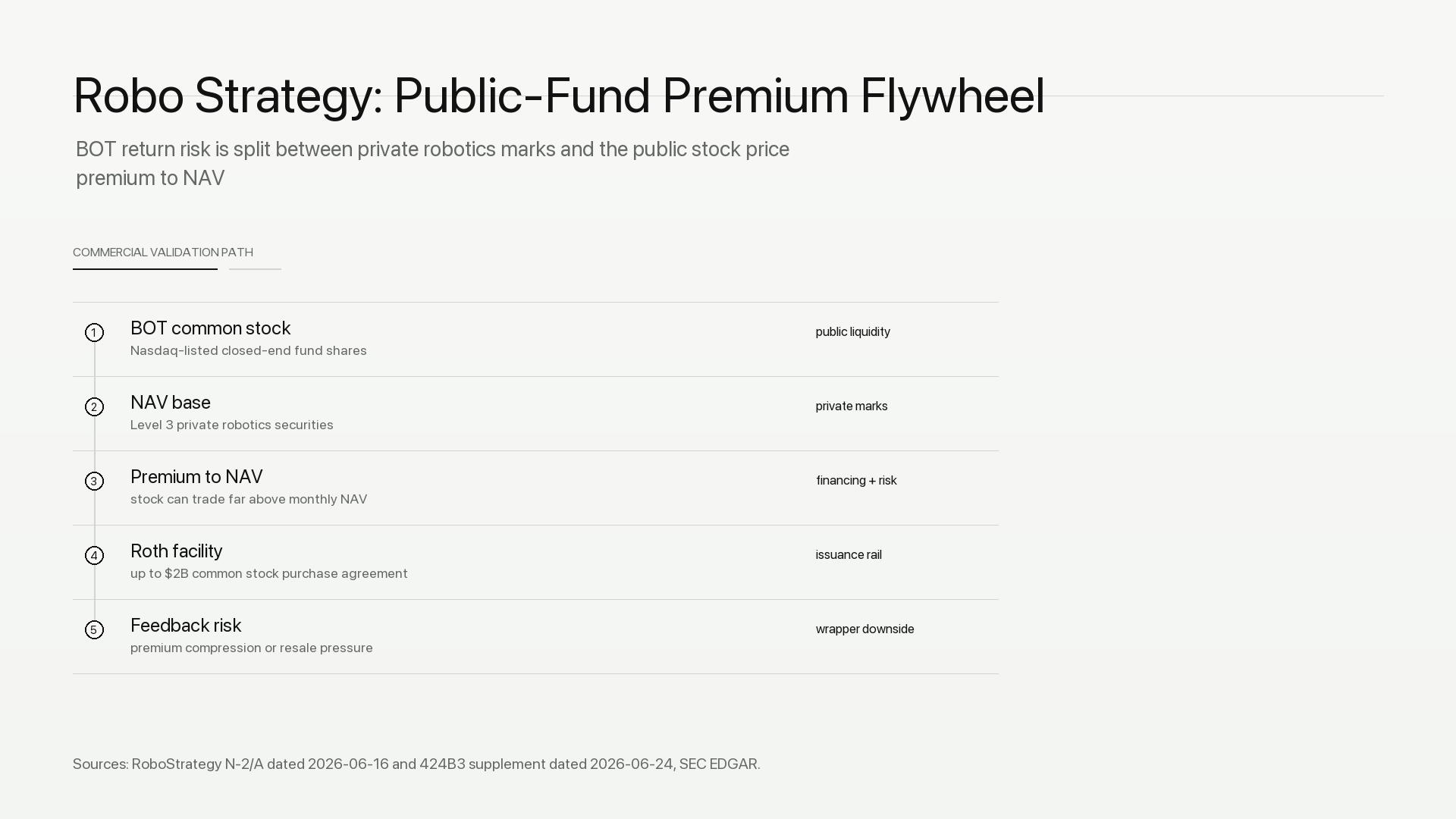
Illustration: Robo Strategy's core is not simply "holding robotics companies," but using the high-premium stock-financing capacity of a listed closed-end fund to expand private robotics assets; when the premium falls, the same mechanism amplifies risk in reverse.
Mechanism Comparison
| Comparison item | Maquina | Robo Strategy |
|---|---|---|
| What investors buy | DEUS token / governance and economic exposure | BOT listed common stock |
| Asset container | DAO treasury + SPV + SubDAO / RCM | 1940 Act closed-end fund |
| Key disclosures | DAO proposals, Andersen attestation, docs / portal, third-party treasury research | SEC N-CSRS, N-2/A, 424B3, monthly NAV |
| NAV nature | No official audited NAV; part of headline NAV is driven by DEUS self-held position and is highly reflexive | SEC-disclosed NAV, but private assets are mostly Level 3 fair value |
| Redeemability | DEUS is not a hard redemption right against NAV | BOT common shares are also not a redemption right against NAV |
| Expansion mechanism | DEUS premium, DAO treasury, SubDAO auctions, RCM fees | BOT high-premium stock issuance, up to $2B Roth facility |
| Advantages | Globally open participation, on-chain governance, ability to split single-company equity into tradable tokens | Strong compliance disclosures, larger asset scale, strong public-market financing capability |
| Core risks | Small asset scale, reflexive NAV, off-chain equity cannot be verified on-chain, DEUS liquidity and governance risks | Fragile high premium, Level 3 valuation, concentrated positions, stock-issuance dilution |
Current Investment Coverage of the Two
Coverage must be layered by basis. If we only look at "number of names," Robo Strategy is broader. If we look at "core private non-China humanoid robotics," Maquina is more complete. If we look at the "global non-China robotics industry chain," both are far from complete.
Maquina's Coverage
Maquina's attested robotics-equity cost base consists of 6 executed allocations covering 5 operating companies: Apptronik, Figure AI, Agility Robotics, 1X, and NEURA. Total funded floor incl. fees is $4,872,761.58.
| Company | Proposal / execution | Holding path | Attested cost | Share of Maquina attested robotics-equity cost base |
|---|---|---|---|---|
| NEURA Robotics | BOT-09, executed 2026-03-06 | InterAlpen Partners LLC; Series C Preferred Stock | $1,741,425 | 35.74% |
| Apptronik | BOT-01 + BOT-06, executed 2025-05-27 and 2025-10-14 | Forge / Fund FG-NMO fund units, 55,702 units total | $1,631,336.58 | 33.48% |
| 1X Technologies | BOT-07, executed 2025-11-12 | 1X Holding AS, 200 ordinary shares | $800,000 | 16.42% |
| Figure AI | BOT-03, executed 2025-09-11 | AI Robotics Investments LLC, 5.6429% SPV membership interest | $350,000 | 7.18% |
| Agility Robotics | BOT-04, executed 2025-08-14 | WPX Fund I / Second Market Growth, 4,799 preferred-share exposure | $350,000 | 7.18% |
| Total | 6 executed allocations | 5 robotics operating companies | $4,872,761.58 | 100.00% |
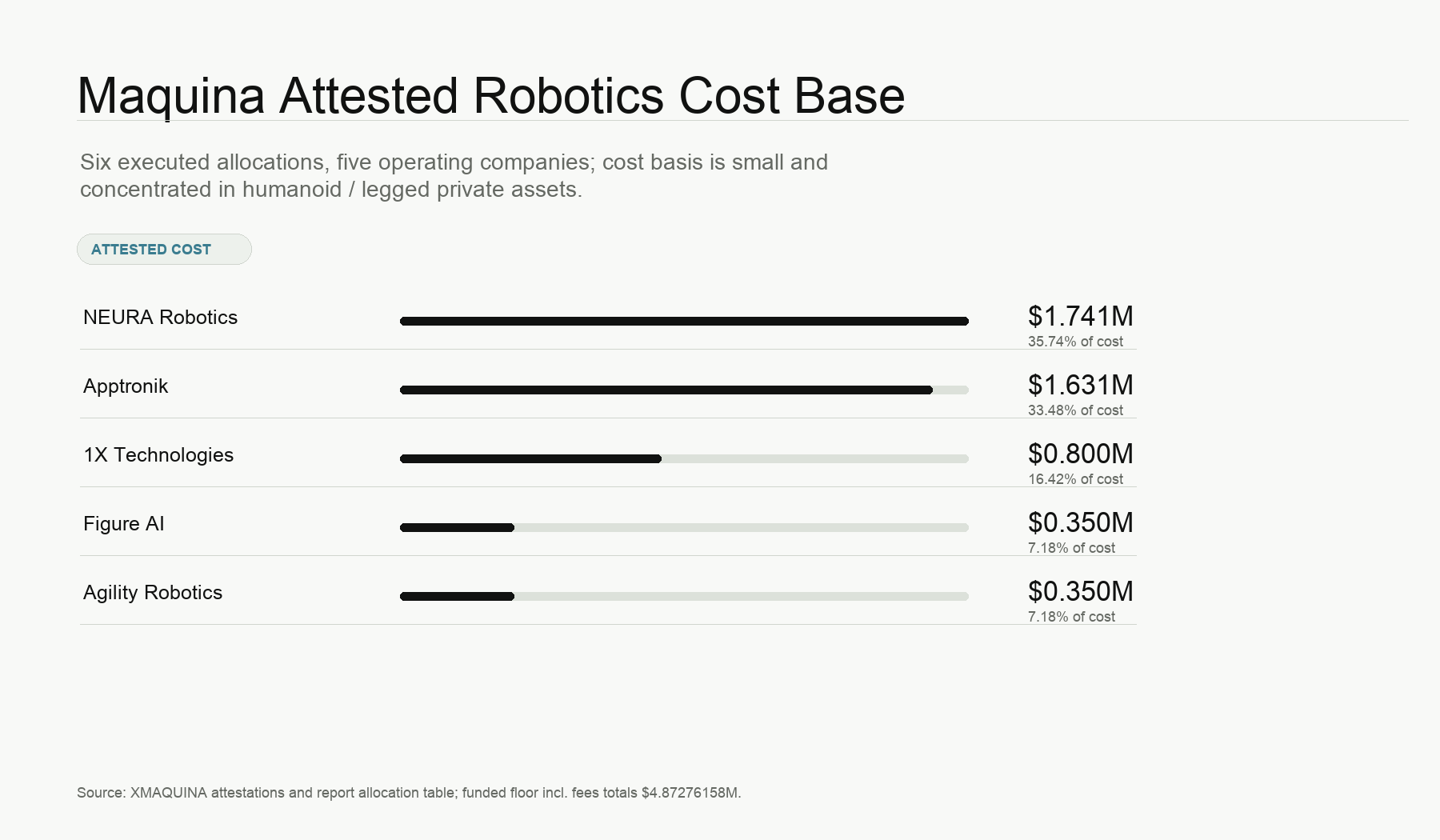
Illustration: Maquina's attested robotics-equity cost base is concentrated in NEURA and Apptronik, while Figure and Agility are only small positions around the $350,000 level; this is why "name coverage" cannot replace "capital coverage."
This shows that Maquina's coverage is not "large and comprehensive," but "small in scale, highly concentrated, and humanoid-tilted." NEURA and Apptronik together account for about 69.22% of the cost base. 1X accounts for 16.42%. Figure and Agility are both only smaller positions around the $350,000 level. Skild AI, Sanctuary AI, Robotico, and Genki Robotics are not counted in the attested cost base in this report: Skild only has approved / pending clues; Sanctuary and Genki lack public Maquina investment documents and Andersen attestation; Robotico has an officially disclosed pre-seed 20% equity allocation from XMAQUINA / DEUS Labs, but lacks amount, transaction documents, and Andersen attestation, so it can only be treated as an ecosystem-incubated equity and market-intelligence infrastructure observation item.
Based on the 25 core non-China player sample above, Maquina has attested coverage of 5, or about 20%. If Skild is included as potential / pending exposure for observation, coverage becomes 6, or 24%, but that is not current deployed-equity coverage. Among the top ten players by capital size, Maquina currently has confirmed coverage only of Figure AI; Skild can only be treated as a pending observation item. In the "humanoid/legged/embodied private core sample," Maquina covers Figure, Apptronik, Agility, 1X, and NEURA, clearly better than Robo Strategy.
Robo Strategy's Coverage
Robo Strategy's SEC-disclosed portfolio is larger and more concentrated. The 2026-05-31 N-2/A current portfolio table shows that its disclosed robotics/embodied-intelligence and adjacent assets had a total fair value of about $142,541,470, covering 13 portfolio companies.
| Company | Instrument / path | 2026-05-31 fair value | Share of net assets |
|---|---|---|---|
| Figure AI | NV FigureAI Series B QP Partners LLC LP interest, economic exposure to Figure AI Series B Preferred | $37,250,000 | 25.31% |
| Dyna Robotics | Direct Series A Preferred Stock, 1,491,163 shares | $37,249,997 | 25.31% |
| Apptronik | SPV LP interest + direct Series Seed 1 Preferred | $37,250,002 | 25.31% |
| Dexmate | Direct Series 1 Seed Preferred, 1,740,280 shares | $9,999,997 | 6.80% |
| Standard Bots | Direct Series C Preferred, 234,190 shares | $6,999,986 | 4.76% |
| Path Robotics | Direct Series D-2 Preferred, 773,660 shares | $5,999,996 | 4.08% |
| REK | Direct Series 1 Seed Preferred, 1,875,891 shares | $2,500,000 | 1.70% |
| S | SAFE, convertible into Series B Preferred at next financing | $2,000,000 | 1.36% |
| Cyan / CoCo Robotics | RoboStrategy DDGR LLC SPV interest in SAFE | $1,500,000 | 1.02% |
| Nox Metals | SAFE, convertible into equity at next financing | $750,000 | 0.51% |
| Endiatx | Direct Series A Preferred, 285,322 shares | $499,998 | 0.34% |
| Allonic | Direct Pre-seed Preferred, 154,798 shares | $291,494 | 0.20% |
| Purple Rhombus | LP interest in PU-1003 Fund I, underlying Purple Rhombus SAFE | $250,000 | 0.17% |
| Total | 13 disclosed portfolio companies | ~$142,541,470 | About 96.87% |
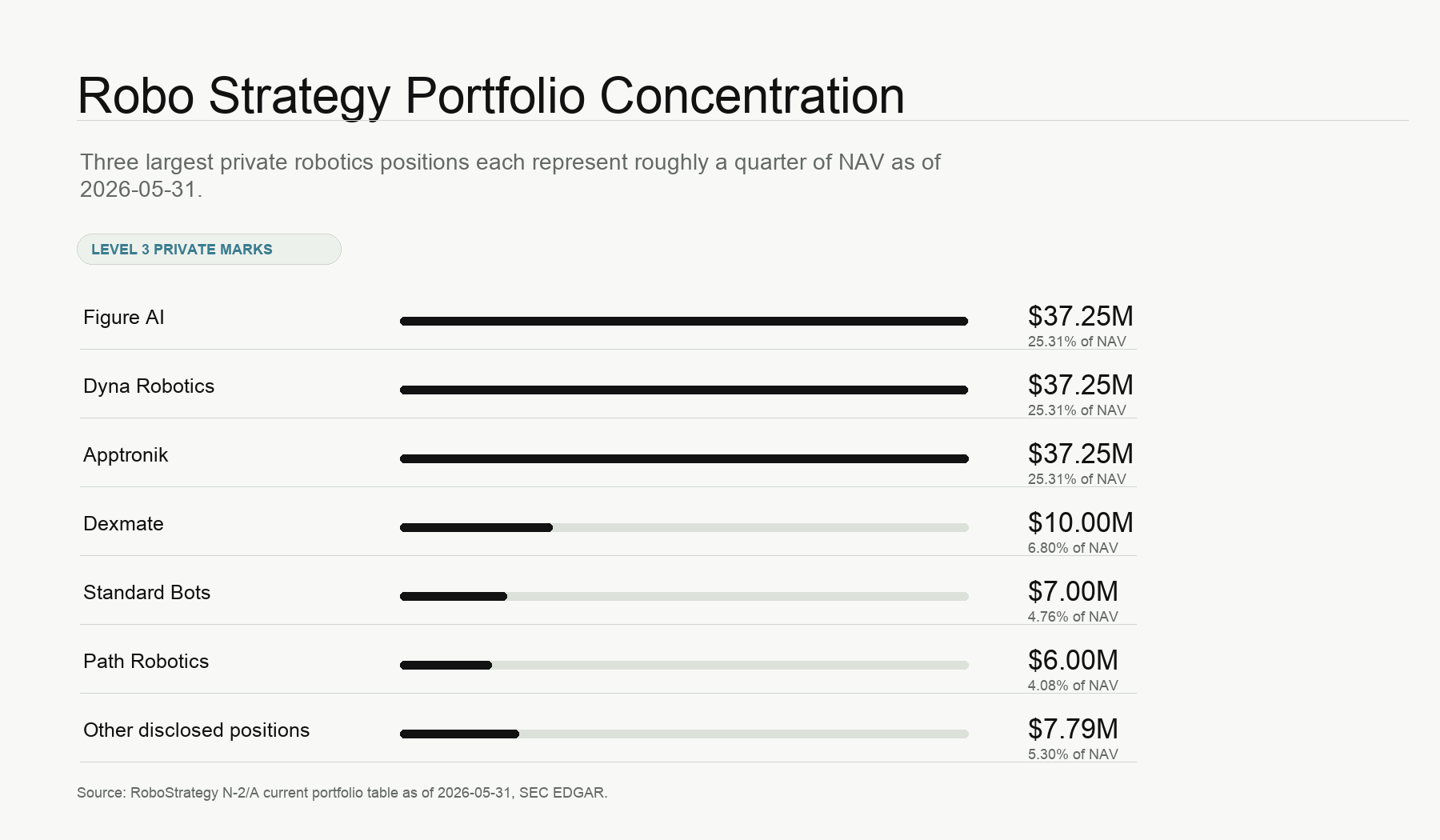
Illustration: Robo Strategy's scale is much larger than Maquina's, but the portfolio is also highly concentrated in three roughly $37.25M positions: Figure, Dyna, and Apptronik. Together they account for about 75.93% of NAV.
Robo Strategy's "broad coverage" is mainly reflected in early-stage U.S. private robotics and robotics-adjacent assets: Dyna, Dexmate, Standard Bots, Path, CoCo, Endiatx, Purple Rhombus and others are directions Maquina does not have. But its coverage of top non-China humanoid/embodied private companies is actually weaker than Maquina's: it does not have Agility, 1X, or NEURA, and it has no disclosed Skild, Physical Intelligence, Boston Dynamics, or Sanctuary.
Based on the 25 core non-China player sample in this report, Robo Strategy covers Figure, Apptronik, Dyna, Dexmate, and Standard Bots, or about 20%. If Path is included as a disclosed robotics-automation asset that did not enter the top-25 sample in Chapter 2, the portfolio has more names, but its coverage of "global non-China leaders" is still not high. Among the top ten players by capital size, Robo Strategy also covers only Figure AI. From the perspective of mature industrial, medical, warehouse automation, and supply-chain leaders, Robo Strategy and Maquina basically do not cover Intuitive Surgical, Teradyne / Universal Robots / MiR, FANUC, Yaskawa, ABB Robotics, Symbotic, AutoStore, Locus, Exotec, and key upstream component companies.
Coverage Conclusion
| Basis | Maquina | Robo Strategy | Conclusion |
|---|---|---|---|
| Number of verified robotics / embodied-intelligence companies | 5 operating companies / 6 allocations | 13 portfolio companies | Robo Strategy has more names |
| Verified robotics equity / portfolio scale | $4.87M attested cost; MTM about $6.5-7.5M | $142.54M disclosed fair value | Robo Strategy is far larger than Maquina |
| Coverage of the 25 core non-China players above | 5/25 = 20%; 6/25 if Skild observation item is included | 5/25 = 20% | Similar count, but different composition |
| Coverage of top ten capital-size players | Figure; Skild pending | Figure | Both are very low |
| Core humanoid/legged/embodied private coverage | Figure, Apptronik, Agility, 1X, NEURA; Skild pending | Figure, Apptronik; Dyna/Dexmate are mobile manipulation / manipulation platforms, not humanoid bodies | Maquina is more complete |
| Early U.S. private robotics coverage | Less broad, concentrated in Apptronik / Figure / Agility / 1X | Figure, Dyna, Apptronik, Dexmate, Standard Bots, Path, CoCo, etc. | Robo Strategy is broader |
Current Portfolio Return Situation of the Two
Maquina: Paper Returns Concentrated in Apptronik, Other Positions Need Discounts
Maquina's returns cannot be simply replaced with DEUS headline NAV. The correct method is to first look at the Andersen-attested robotics-equity cost, then mark to market by each company's latest financing/transaction basis, distinguishing closed rounds, reported rounds, unclosed de-SPACs, and SPV discounts.
| Company | Maquina cost base | Current research-department valuation basis | Estimated multiple | Estimated MTM | Return quality |
|---|---|---|---|---|---|
| Apptronik | $1.631M | 2026 Series A-X1/A-X2 about $5B post; media basis >$5.5B | About 1.6-2.0x blended; first tranche about 3x | $2.6-3.3M | Cleanest closed upside source |
| NEURA | $1.741M | Series C-era mark, financing up to $1.4B, media valuation about $7B | About 1.0x | ~$1.7M | Bought in the current round; short-term re-rate not proven |
| 1X | $0.800M | Maquina basis $4.55B entry; $9-10B financing reports unconfirmed/unclosed | About 1.0-2.0x, depending on whether the new round can be confirmed | $0.8-1.6M | Large upside, but requires high discount |
| Figure AI | $0.350M | About $39B post after 2025 Series C; Maquina entered near high valuation | About 0.85-1.0x | $0.30-0.35M | Not an early low-price position |
| Agility Robotics | $0.350M | Signed de-SPAC with Churchill XI, $2.5B pre-money, not yet completed | About 1.2x headline; closing / redemption risk must be deducted | ~$0.4M | Best liquidity path, but transaction not closed |
| Total | $4.873M | Conservative $5.5-6.0M; aggressive $6.5-7.5M | Conservative about 1.13-1.23x; aggressive about 1.33-1.54x | $5.5-7.5M | Unrealized, non-redeemable, dependent on private valuations |
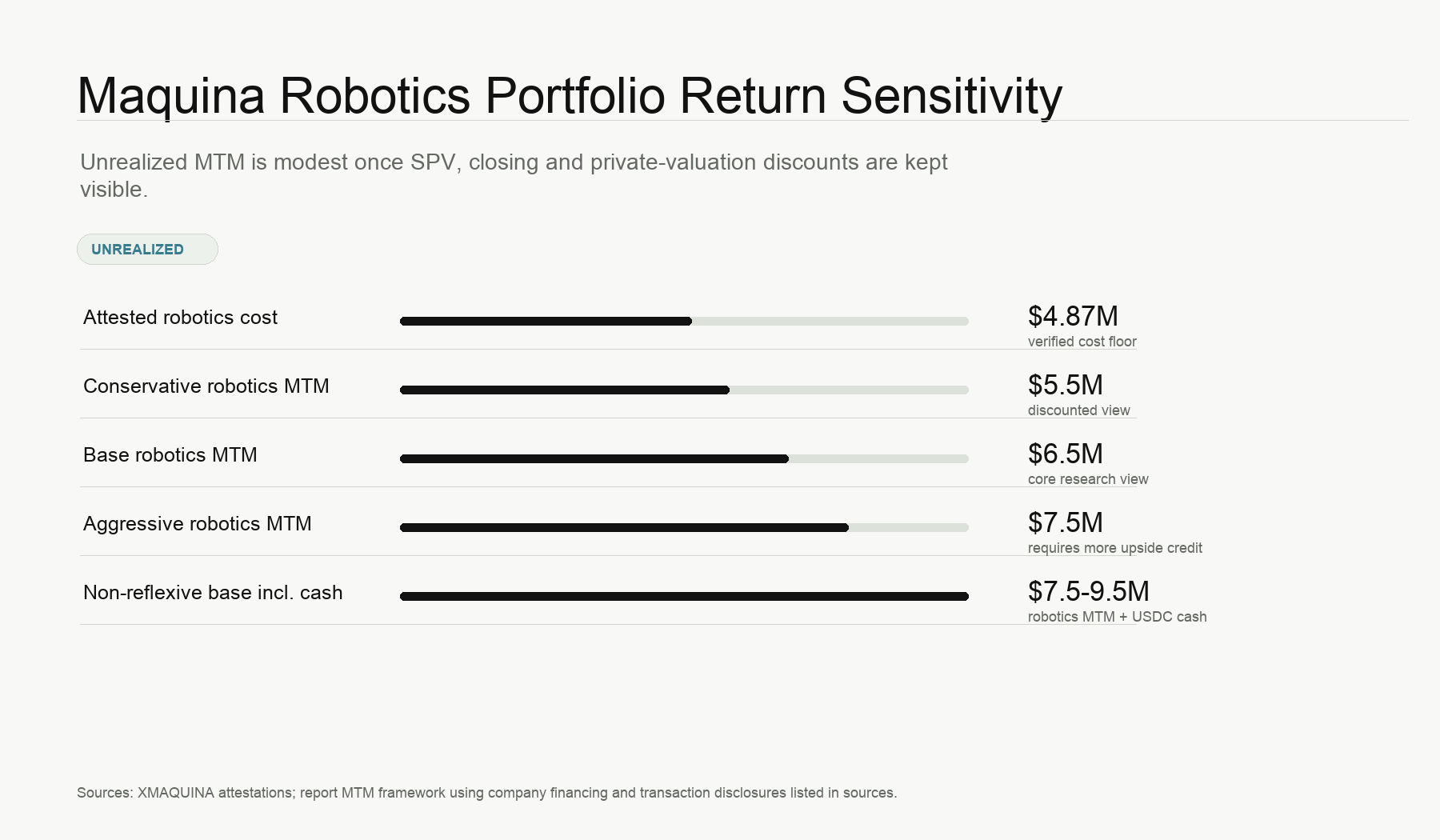
Illustration: Maquina's real alpha currently mainly comes from Apptronik's paper upside. If DEUS self-holdings and reflexive NAV are removed, the non-reflexive asset base is closer to $7.5M to $9.5M rather than headline treasury NAV.
Therefore, Maquina's portfolio has not "already multiplied many times." Under the current research basis, its real alpha mainly comes from Apptronik. 1X is an unconfirmed upside option. Agility is an uncompleted liquidity event. Figure entered at a high valuation. NEURA is a large position but close to current-round cost. After discounting these, it is more reasonable to mark Maquina's attested robotics-equity cost base from $4.87M cost to $5.5M to $7.5M, rather than directly citing headline treasury NAV.
If approximately $2M of USDC cash is also included in non-reflexive assets, Maquina's verifiable non-reflexive asset base is about $7.5M to $9.5M. DEUS self-held tokens, future SubDAO fees, RCM fees, and governance premium can form additional option value, but they cannot be mixed with deployed robotics equity.
Robo Strategy: Underlying Portfolio Has Not Yet Proven Large Appreciation; Stock Premium Is the Core Variable
Robo Strategy's return analysis must be split into two layers: "fund NAV" and "BOT stock price."
| Date | Metric | Value | Explanation |
|---|---|---|---|
| 2026-02-28 | Investments at fair value / cost | $134.80M | N-CSRS shows tax cost equals fair value; unrealized appreciation is 0 |
| 2026-02-28 | Cash | $12.03M | Still some cash in the early period |
| 2026-02-28 | Net assets | $146.21M | Fund net-asset base |
| 2026-02-28 | Shares outstanding | 19,908,968 | Used to calculate NAV |
| 2026-02-28 | NAV per share | $7.34 | SEC disclosure |
| 2026-05-31 | Total assets | $148.03M | N-2/A current portfolio table |
| 2026-05-31 | Disclosed portfolio fair value | ~$142.54M | Total across 13 portfolio companies |
| 2026-05-31 | NAV per share | $7.26 | SEC disclosure |
| 2026-06-12 | BOT stock close | $35.39 | Used in N-2/A premium example |
| 2026-06-12 vs 2026-05-31 NAV | Premium to NAV | 387.5% | Stock price about 4.875x NAV |
| 2026-06-22 | NAV per share | $8.92 | 424B3 supplement disclosure |
| $35.39 vs $8.92 | Implied price / NAV | About 3.97x | Even using updated NAV, the premium remains very high |
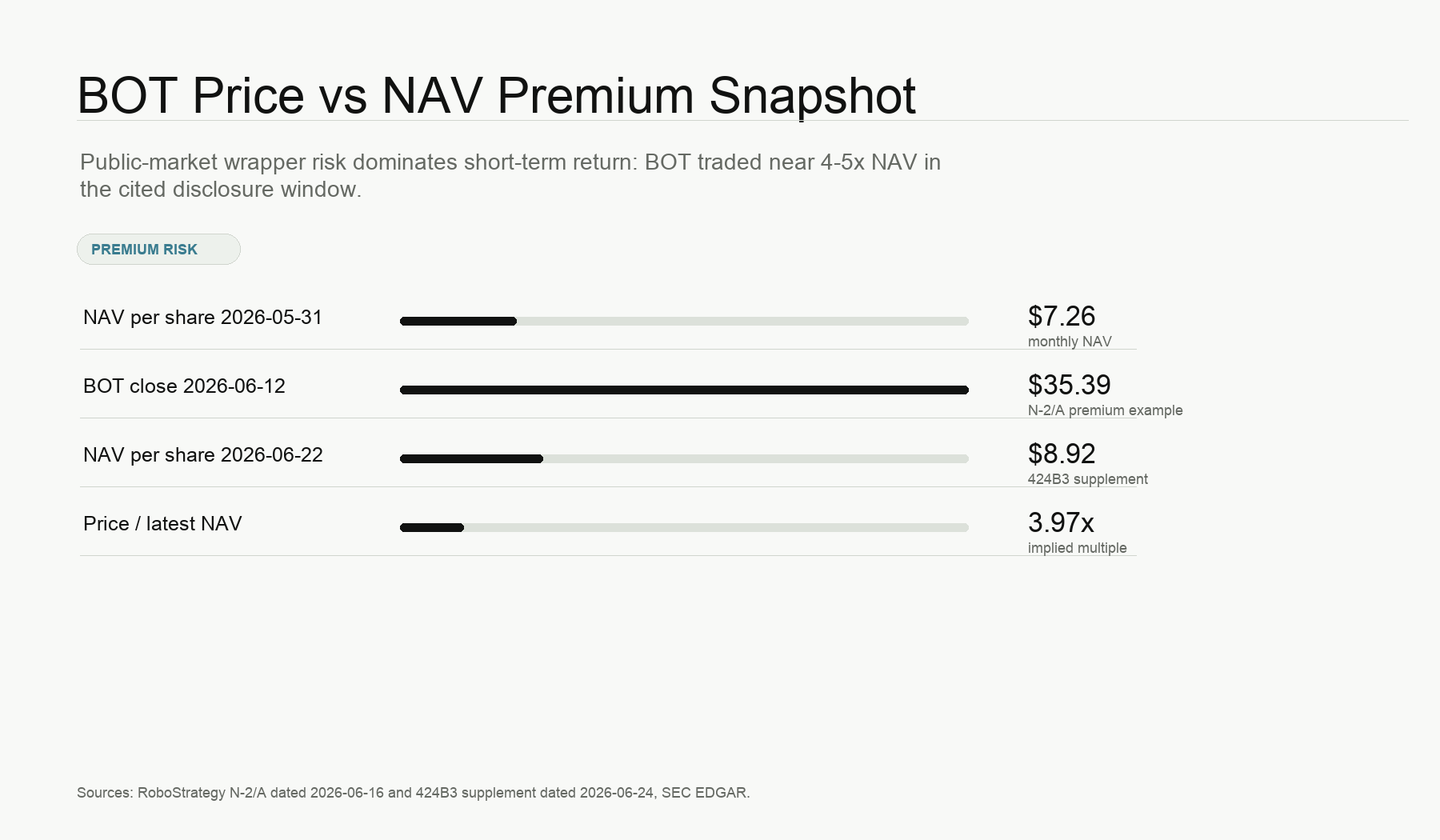
Illustration: Robo Strategy's short-term return risk comes not only from the private valuations of Figure / Dyna / Apptronik, but also from whether BOT stock can sustain a 3.97x to 4.875x premium to NAV.
Looking at the underlying portfolio, Robo Strategy's SEC filings do not prove that the portfolio has already achieved significant investment returns. The 2026-02-28 schedule shows total cost equal to fair value and unrealized appreciation of 0. The 2026-05-31 current portfolio table gives issuer fair value, not third-party exit prices. What is truly aggressive is the listed wrapper: BOT once traded near 4-5x NAV, giving it a financing flywheel of "issuing high-priced shares to buy more private assets."
If this flywheel works, it creates two positive feedback loops. First, issuing shares at a high premium increases per-share NAV or at least does not dilute NAV. Second, new capital continues to buy private robotics assets such as Figure / Apptronik / Dyna / Dexmate, expanding fund scale. But it also has two negative feedback loops. First, if BOT's premium falls, shareholder returns will first be swallowed by valuation compression. Second, the Roth facility registers resale of up to 14.10M shares; if market absorption is insufficient, it can create persistent selling pressure.
Return Conclusion
Maquina's return profile is "small principal, real robotics equity, and a few positions generating paper gains." Its portfolio return can be roughly estimated at a 1.13-1.54x unrealized multiple, depending on whether one recognizes 1X's reported valuation and Agility's de-SPAC headline. Its risks are too-small asset size, reflexive DEUS NAV, and non-redeemable SPV equity.
Robo Strategy's return profile is "large principal, SEC disclosure, underlying Level 3 assets + public-market high premium." The underlying portfolio has not yet proven large appreciation through SEC filings, but BOT stock once traded at 3.97-4.875x NAV. That premium itself is the largest source of both return and risk. Robo Strategy is more like a capital machine of "private robotics assets + public-fund premium financing" than a simple robotics ETF.
Final judgment: if the question is "who has better coverage of the first tier of humanoid robots," Maquina is better. If the question is "who has larger scale and stronger public-market financing capacity," Robo Strategy is stronger. If the question is "whose real investment returns are more verifiable," Maquina's Apptronik upside is easier to explain, while Robo Strategy's returns depend more on whether the BOT premium can persist.
Company-by-Company Analysis of Maquina and Robo Strategy Investments
This chapter is organized by companies' core business categories rather than by Maquina / Robo Strategy investment coverage. The coverage relationship is first organized in a table, then expanded by business category below, to avoid mixing together "which layer of the robotics industry chain this company belongs to" with "who invested in it and what the evidence grade is."
| Core business category | Company | Maquina coverage | Robo Strategy coverage | Investment / evidence treatment |
|---|---|---|---|---|
| Full-size humanoid, biped body, and general robot OEM | Figure AI | BOT-03 indirect fund interest at about the $350,000 level | Disclosed core holding | Covered by both; representative of non-China humanoid-robot beta |
| Full-size humanoid, biped body, and general robot OEM | Apptronik | BOT-01 / BOT-06 total investment of about $1.63M | Disclosed core holding | Shared core asset; one of the clearest sources of Maquina paper appreciation |
| Full-size humanoid, biped body, and general robot OEM | Agility Robotics | Attested holding | Not covered | Maquina target closest to a public-listing exit and order validation |
| Full-size humanoid, biped body, and general robot OEM | 1X Technologies | Attested holding, BOT-07 investment of about $800,000 | Not covered | High-upside home-robotics position, but hardest to prove |
| Full-size humanoid, biped body, and general robot OEM | NEURA Robotics | Attested holding | Not covered | European cognitive robotics and multi-product-line Physical AI platform |
| Robot foundation models, Physical AI, and manipulation policies | Skild AI | Maquina has disclosed / approved or potential SAFE, not counted in deployed cost base | Not covered | Skild Brain horizontal model layer + Fetch/Symmetry warehouse deployment-data entry; no attestation yet; if completed, it can fill the foundation-model-layer gap |
| Robot foundation models, Physical AI, and manipulation policies | Sanctuary AI | Maquina disclosed / user mNAV observation item, not verified as an attested holding | Not covered | Not counted in cost base for now; more accurately represents industrial manipulation policies, dexterous Physical AI, and software deployment on existing industrial arms rather than a pure humanoid-body position |
| Robot foundation models, Physical AI, and manipulation policies | Dyna Robotics | Not covered | Disclosed core holding, about $37.25M and about 25.31% of NAV | Robo Strategy's core alpha in robot foundation models and commercial manipulation |
| Mobile manipulation, collaborative robots, and industrial skill automation | Dexmate | Not covered | Disclosed holding, about $10M and about 6.80% of NAV | Mobile manipulation and gripper hardware-platform option |
| Mobile manipulation, collaborative robots, and industrial skill automation | Standard Bots | Not covered | Disclosed Series C Preferred, about $7M and about 4.76% of NAV | U.S. domestic collaborative-robot and SMB manufacturing-automation position |
| Mobile manipulation, collaborative robots, and industrial skill automation | Path Robotics | Not covered | Disclosed holding | Industrial welding automation and skill-automation position |
| Service, medical, defense, and consumer robotics applications | Cyan / CoCo Robotics | Not covered | Disclosed SPV / SAFE exposure | Low-speed outdoor delivery robots and fleet-operations position |
| Service, medical, defense, and consumer robotics applications | Endiatx | Not covered | Disclosed holding | Long-duration option in medical microrobotics |
| Service, medical, defense, and consumer robotics applications | Purple Rhombus | Not covered | Disclosed SPV / SAFE small-percentage asset | Defense robotics / UAS hypothesis position; public product and customer evidence is not closed-loop |
| Service, medical, defense, and consumer robotics applications | REK | Not covered | Disclosed early-stage asset | Observation position in robotics entertainment, competition, teleoperation, or consumer experience |
| Computing power, manufacturing materials, market infrastructure, and targets pending verification | GMI Computing | Not covered | Disclosed SAFE exposure | Physical AI computing-adjacent asset; not counted as robot-body coverage |
| Computing power, manufacturing materials, market infrastructure, and targets pending verification | Nox Metals | Not covered | Disclosed small-percentage holding | Advanced manufacturing and materials-adjacent asset; robotics supply-chain relevance needs verification |
| Computing power, manufacturing materials, market infrastructure, and targets pending verification | Allonic | Not covered | Disclosed small-percentage early holding | Early robotics infrastructure / structural-innovation option; information remains limited |
| Computing power, manufacturing materials, market infrastructure, and targets pending verification | Robotico | XMAQUINA / DEUS Labs first incubation; official pre-seed 20% equity allocation disclosed, but no Andersen attestation / amount / transaction documents, so not counted in attested cost base | Not covered | Humanoid robotics market intelligence, index, RCM distribution, and capital-market transparency infrastructure; not a robot body |
| Full-size humanoid, biped body, and general robot OEM | Genki Robotics | User mNAV once showed about 5.4% basis, not attested; website/LinkedIn show it is positioned as mission-critical humanoid robots, with investors self-disclosed by the company but no financing details | Not covered | Stealth / early full-size humanoid watchlist; not counted in attested cost base or coverage rate |
If names such as Skild AI, Robotico, Sanctuary AI, and Genki appear in Maquina with only governance, ecosystem, user-form, or unauthenticated signals, they are not counted in deployed equity cost base. But because Maquina has publicly mentioned them or related research has already formed, this chapter still keeps them as separate company sections.
Path Robotics, REK, GMI Computing, Cyan / CoCo Robotics, Nox Metals, Endiatx, Allonic, Purple Rhombus and similar names are small/mid-sized positions disclosed by Robo Strategy for which local research does not yet have company deep dives of the same grade.
Full-Size Humanoid, Biped Body, and General Robot OEM
Figure AI
Company Background and Founding Team
Figure AI is a U.S. humanoid robotics company founded by Brett Adcock. It is not a single hardware company; it is simultaneously betting on four things: the Figure 03 body, the Helix embodied model, the BotQ manufacturing system, and the enterprise-scenario data closed loop. In September 2025, its Series C financing exceeded $1B, with a post-money valuation of about $39B. Investors included Parkway, Brookfield, NVIDIA, Macquarie, Intel, LG, Salesforce, T-Mobile, Qualcomm and others. Both Maquina and Robo Strategy have Figure AI exposure, but their entry bases differ: Robo Strategy has a larger-scale direct/fund-like holding, while Maquina BOT-03 is an indirect fund interest at about the $350,000 level.
From an investment perspective, Figure is the non-China humanoid-robotics target with the "highest valuation, strongest industrial partners, and also the greatest execution pressure." Its core question is not whether it has demos, but how quickly enterprise deployment, manufacturing yield, robot uptime, and unit economics all need to work behind a $39B valuation.
Product Lines and Business Model
Figure's product line should not be understood as "four product layers." A more accurate decomposition is: body product generations are Figure 01, Figure 02, and Figure 03; the current true external commercialization carrier is the Figure 03 body; Helix is an embodied model embedded in the body and iterated with fleet data; BotQ and the enterprise-scenario data closed loop are manufacturing and commercialization infrastructure, not separate product lines.
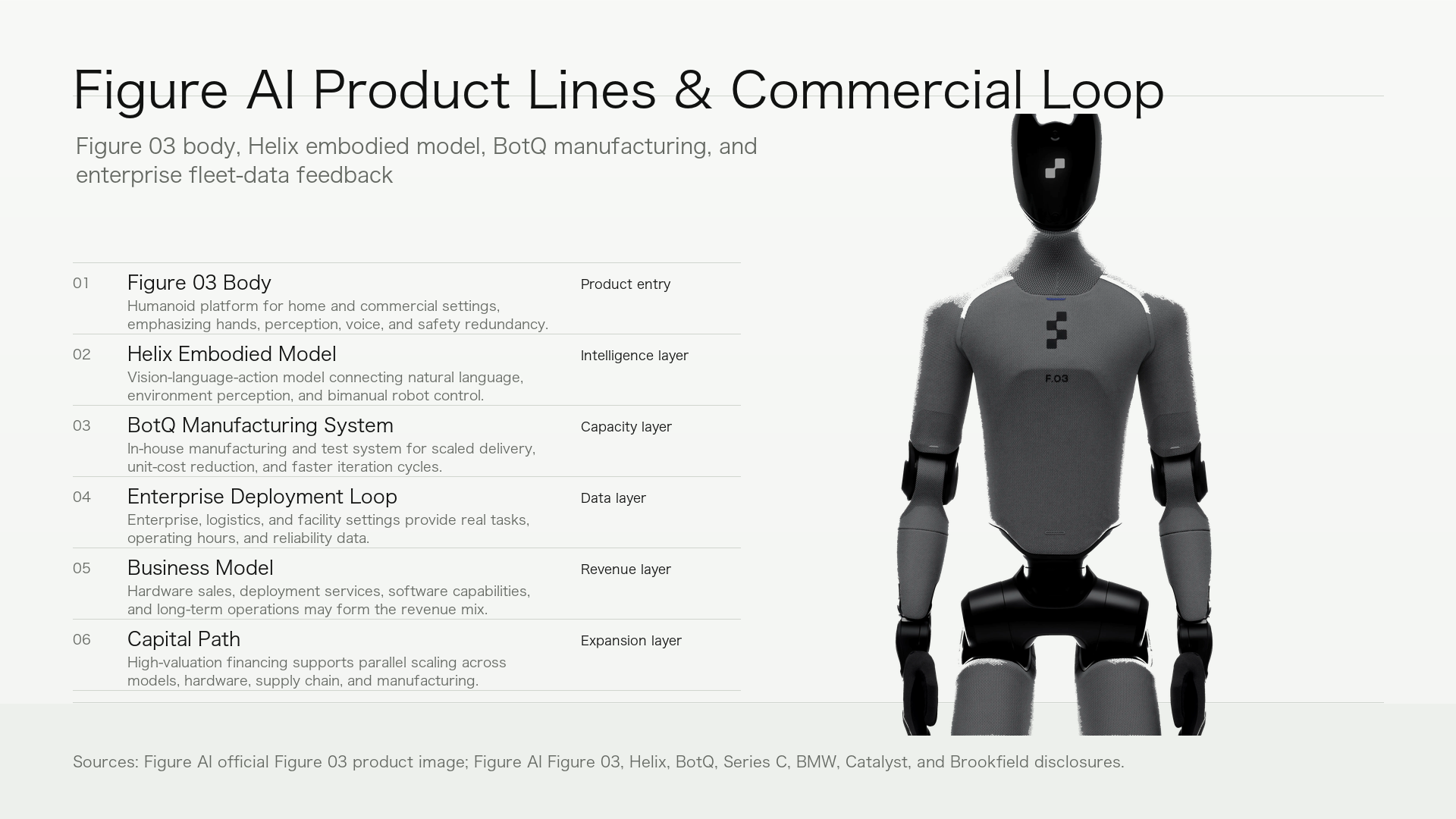
Illustration: the product image on the right uses Figure AI's official Figure 03 product image. Structure and data sources are Figure AI website disclosures on Figure 03, Helix, BotQ, Series C, and BMW / Catalyst / Brookfield.
- Figure 01: early prototype, used to validate the full-size humanoid platform and motion capabilities.
- Figure 02: a generation of work robot for industrial pilots; public materials show it entered BMW scenarios. NVIDIA disclosed that Figure 02 uses Omniverse / Isaac Sim, NVIDIA GPUs, and six RGB cameras, and achieves about 3x inference improvement versus Figure 01 through a second NVIDIA RTX GPU.
- Figure 03: current main platform, about 5'8" tall, about 20 kg payload, about 61 kg weight, about 5 hours of battery life, and about 1.2 m/s speed. Figure 03's focus is not exterior iteration, but redesign for Helix, home scenarios, commercial scenarios, and mass manufacturing, including fewer parts, moldability, internal battery/actuator/sensor modules, and adaptation to the BotQ line.
Helix / Helix 02 is Figure's vision-language-action model and robot-control intelligence. It should not be listed alongside Figure 01/02/03 as a body product generation. Early Helix's upper System 2 performs high-level understanding and action planning at about 7-9 Hz, while lower System 1 performs motion control at about 200 Hz. Helix 02 adds a roughly 1 kHz System 0 for whole-body balance, contact, and low-level control. In other words, Figure 03 is the body, Helix is control and generalization capability, and enterprise-site data in turn trains and validates Helix.
In terms of business model, Figure currently looks more like an "enterprise robot fleet operator" than a pure robot seller. Its closed loop is: Figure 03 enters enterprise scenarios such as BMW, Catalyst Brands, and Brookfield; real tasks generate data; data feeds back into Helix; BotQ improves body manufacturing, quality, and delivery capability; more deliverable robots then enter more enterprise scenarios. Revenue may come from enterprise deployments, robot leasing or sales, Fleet Management / OTA, customer integration, operations and maintenance, and the data closed loop. But public materials have not yet disclosed unit price, lease fee, SLA, gross margin, customer contract amount, or backlog. Therefore, Figure's commercial quality still needs to be validated through the scale of paying customers, robot uptime, task success rate, human takeover rate, and fleet repeat purchase.
Upstream Supply-Chain Vendors
Figure's supply chain has a clear tendency toward "key module internalization." Under the Figure 03 basis, actuators, batteries, sensors, structural parts, and electronics all emphasize self-development or internal design, while BotQ is the core of its manufacturing scale-up. BotQ's first line targets annual capacity of up to 12,000 units. The company has disclosed that more than 350 Figure 03 units have been delivered from BotQ into internal/external fleet categories, that line demonstrations reached a cadence of about 1 unit/hour, and manufacturing signals such as 9,000+ actuators, 500+ battery packs, 80+ EOL functional tests, 50+ in-process inspection points, and a 99.3% first-pass yield on the battery line.
Among external upstream partners, NVIDIA is the clearest key partner: Omniverse / Isaac Sim for simulation, H100 and other training infrastructure for model training, RTX GPUs for body inference, and Figure is also within the NVIDIA Humanoid Robot Developer Program ecosystem. Brookfield is more of a data/scenario/infrastructure partner and should not be misread as a BOM supplier.
Supply-chain nodes still requiring penetration include harmonic/planetary/cycloidal reducers, motor magnetic materials and windings, encoders, hand tactile sensing, camera modules, battery cells, wire harnesses, structural parts, PCBs, thermal management, safety controllers, field repair parts, and yield-ramp cadence. If Figure internalizes all key BOM, potential gross margin and control are stronger, but capex, manufacturing-failure risk, and after-sales pressure also become more concentrated.
Downstream Buyers, Revenue, and Orders
Figure's downstream validation mainly comes from three types of scenarios:
- BMW: a commercial agreement was reached in 2024, with Figure 02 participating in production tasks in BMW scenarios. Public research materials mention that Figure 02 supported BMW vehicle-assembly-related processes in 2025, while Figure 03 entered BMW Spartanburg's Hall 52 for more complex logistics tasks such as sequencing / logistics.
- Catalyst Brands: Figure disclosed a deployment agreement with Catalyst Brands, targeting the Distribution Logistics Center in Reno, Nevada. Catalyst's brands include JCPenney, Aeropostale, Brooks Brothers and others.
- Brookfield: the collaboration focuses on real-world humanoid-robot pretraining data and potential deployment spaces. Brookfield's asset pool includes residential, office, and logistics real estate. The theoretical scenario space is huge, but for now it should be viewed more as a scenario and data entry point than a confirmed order.
On revenue quality, Figure has not yet disclosed robot unit price, lease fee, gross margin, recognized revenue, customer payment scale, or renewals. Its advantages are very strong capital, brand, enterprise partners, and manufacturing ambition. The risk is that the valuation has already priced in "BotQ can mass-produce + Helix can generalize + enterprises are willing to pay at large scale." For Maquina / Robo Strategy, Figure is the position that best represents non-China humanoid-robot beta, but it is not the position easiest to verify with financial metrics.
Apptronik
Company Background and Founding Team
Apptronik originated from the University of Texas at Austin Human Centered Robotics Lab and has long participated in projects such as NASA Valkyrie. Its DNA is more engineering-, hardware-, industrial-deployment-, and enterprise-customer-oriented than Figure's. It does not start from consumer-level imagination, but from definable tasks in logistics, manufacturing, retail, automotive and similar scenarios. Maquina and Robo Strategy both hold it, making it a shared core asset for the two.
In financing and valuation, Apptronik's appreciation path is very clear: 2022 Seed of about $14.6M, post-money about $53.4M; 2023 Seed Plus of about $13.9M, post-money about $101.7M; February 2025 Series A of about $350M, post-money about $1.75-1.78B; October 2025 Series A extension bringing total to about $403M; after 2026 Series A-X1/X2, total Series A funding exceeded $935M, post-money about $5B, with media basis mentioning above $5.5B. Maquina BOT-01 / BOT-06 invested about $1.63M in total, making it one of Maquina's most important potential book-value appreciation sources.
Product Lines and Business Model
Apptronik's core product is Apollo. Its product generations and commercial route lean more toward enterprise pilots to fleet deployment:
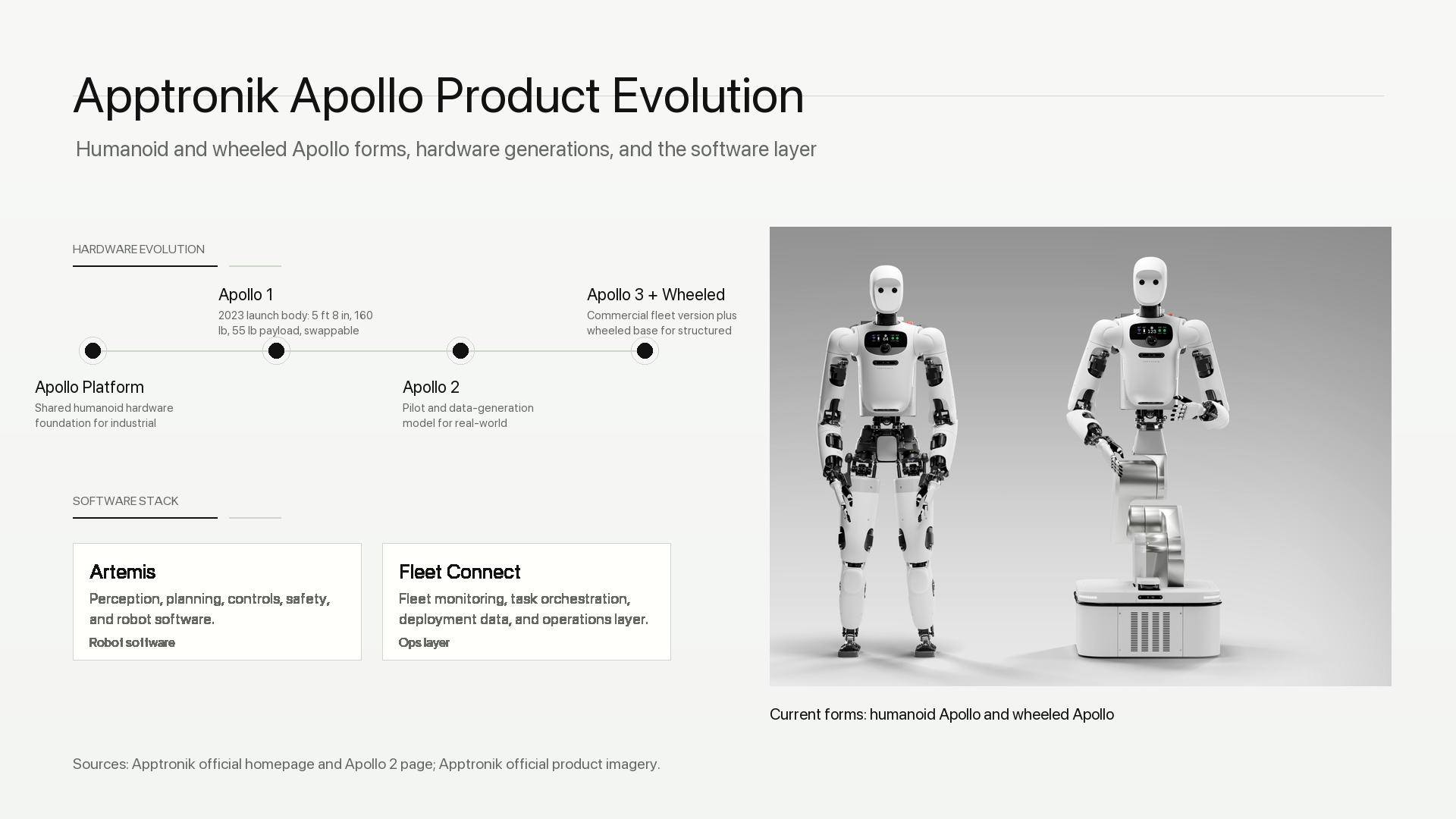
Illustration: text inside the image is in English. The official image on the right shows both humanoid Apollo and wheeled Apollo forms. Structure is sourced from Apptronik's official Apollo page, homepage, and public customer/partner disclosures.
- Apollo 1: publicly unveiled in 2023, about 5'8", 160 lb, 55 lb payload, 4-hour swappable battery.
- Apollo 2: currently mainly used for pilots and data generation. Public reports mention pilots with customers such as Mercedes-Benz and GXO.
- Apollo 3: next-generation version for commercial fleet deployment, still in development and validation.
- Biped/wheeled variants: an important Apptronik feature is that it can choose between biped and wheeled forms by scenario. For industrial and logistics customers, a wheeled version may reduce motion-control complexity and improve stability and early ROI.
- Artemis / Fleet Connect: software stack for perception, planning, control, safety, human-robot interaction, fleet data, and operations management.
Commercially, Apptronik looks more like a combination of "robotics platform + manufacturing partner + deployment services + software fleet management." Short-term revenue should come from enterprise pilots, robot sales/leasing, deployment integration, and operations and maintenance. Long-term value depends on whether Apollo can move from pilots into multi-facility, multi-unit, renewable commercial contracts. The company has not yet disclosed ASP, RaaS pricing, gross margin, order scale, effective operating hours, or customer-renewal data.
Upstream Supply-Chain Vendors
Apptronik's upstream and platform partners are clearer than those of most private humanoid-robotics companies:
- Jabil: global manufacturing partner, responsible for production lines, supply-chain validation, and manufacturing scale-up. Jabil's significance to Apollo is not just contract manufacturing, but bringing manufacturing discipline that can push engineering prototypes toward deliverable hardware.
- NVIDIA: Apollo uses edge-computing platforms such as Jetson AGX Orin / Jetson Orin NX and is part of robotics-development ecosystems such as GR00T, Isaac Lab, OSMO, and Mega.
- Google DeepMind: strategic AI partner and investor; Gemini Robotics has been tested on Apollo. This means Apptronik may not need to fully self-develop a foundation model, but can use its body and enterprise-deployment capability as the carrier platform for AI models.
- Mercedes-Benz / GXO: more downstream customer and scenario partners, but they also define Apollo's engineering specifications, cadence, safety, and maintenance needs in reverse.
- argodesign: industrial-design partner.
Still needing penetration are Apollo's actuators, motors, reducers, hands/grippers, batteries, power management, joint sensing, cameras/depth cameras, structural parts, safety control, and field repair parts. Compared with Figure, Apptronik's manufacturing leverage comes more from Jabil. This reduces the risk of self-built factories, but also means supply-chain control and gross-margin structure require continued validation.
Downstream Buyers, Revenue, and Orders
Apptronik's public downstream includes Mercedes-Benz, GXO, Jabil, and more retail/manufacturing/logistics customer clues:
- Mercedes-Benz: automotive manufacturing scenario customer and investor; public directions include parts handling, inspection, and manufacturing assistance.
- GXO: logistics pilot partner, suitable for validating Apollo's task stability in warehouse workflows.
- Jabil: both a manufacturing partner and potentially a deployment/validation scenario.
- Google DeepMind: not a traditional customer, but has important spillover value for model capability and robot skill stacks.
Revenue and order basis remain the core gaps. Public materials have not yet given Apollo's delivered unit count, commercial contract amount, recurring revenue, per-robot uptime, human takeover rate, single-facility ROI, or gross margin. As an investment conclusion, Apptronik has a lower valuation than Figure, a clearer enterprise path, and a more realistic manufacturing partner, so for Maquina it may be the "better value-for-money shared holding." For Robo Strategy, it forms the core growth positions together with Figure and Dyna.
Agility Robotics
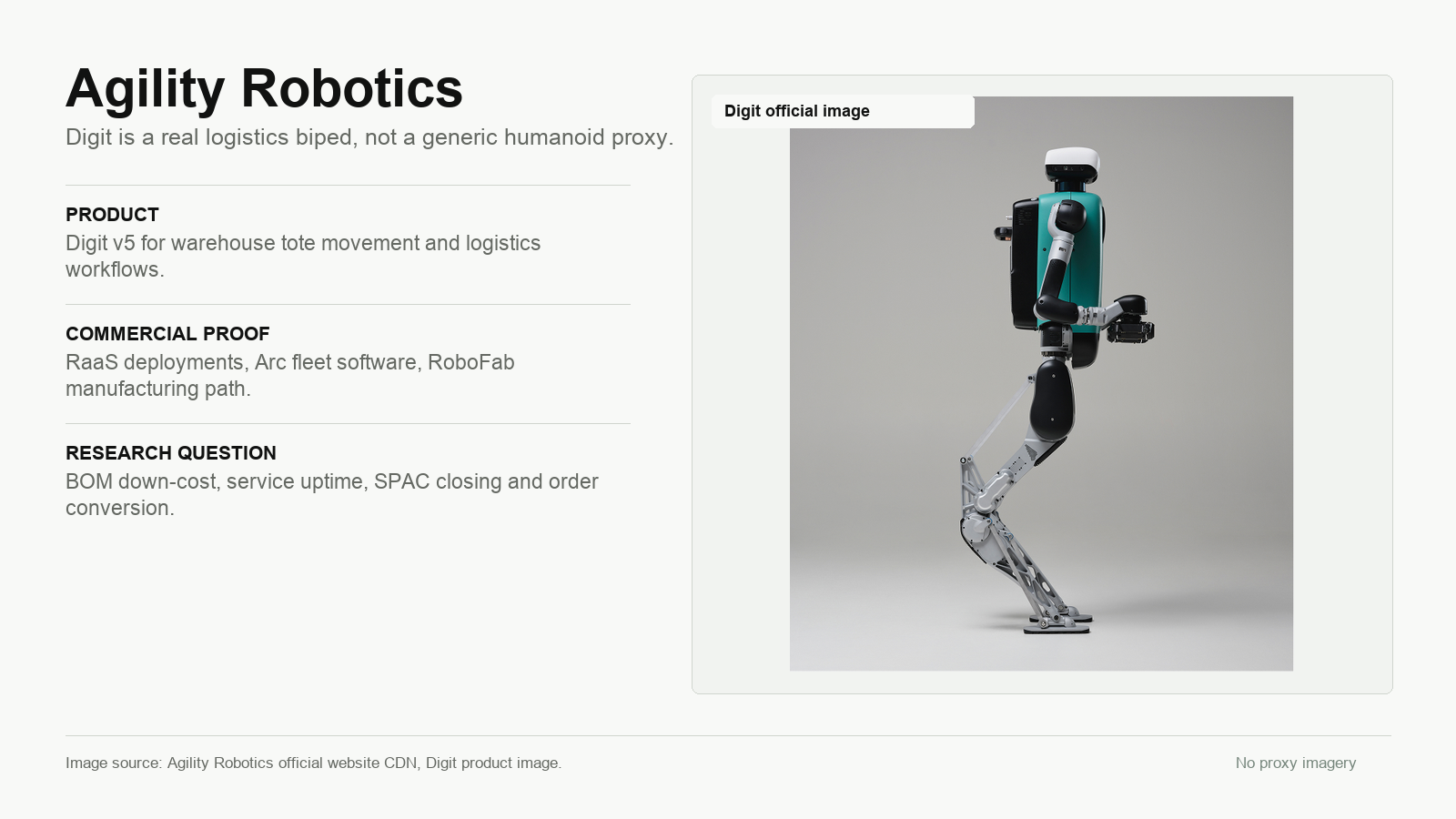
Illustration: Agility's investment profile; the right side uses an official Digit product image from Agility Robotics' website CDN.
Company Background and Founding Team
Agility Robotics is a U.S. biped logistics robot company. Its core product, Digit, targets handling in warehousing, logistics, and manufacturing. The company was founded in 2015 and originated from Oregon State University's Dynamic Robotics Lab. Founders include Jonathan Hurst, Damion Shelton, and Mikhail Jones. It is an attested Maquina holding and is not covered by Robo Strategy.
The biggest difference between Agility and Figure / Apptronik is that it has not told the story of a "general humanoid robot immediately entering all scenarios." Instead, it has long focused on logistics tote movement and in-facility handling. This makes its ceiling narrative somewhat narrower, but its commercial validation more solid. On 2026-06-24, the company announced a de-SPAC with Churchill XI, expected ticker AGLT, with a transaction basis of $2.5B pre-money. Assuming no redemptions, gross proceeds exceed $620M, including a $200M PIPE led by Foxconn, with existing shareholders rolling over 100%.
Product Lines and Business Model
Agility's products and systems include:
- Digit v4 / v5: biped robots for warehouse handling. Digit v5 is the current commercialization core.
- Arc: robot fleet management, workflow, remote monitoring, and deployment software system.
- RoboFab: Agility's self-built manufacturing system. Public basis says the annual-capacity target is 10,000 units. The first year is more realistically at hundreds of units, and full production can exceed 10,000 units/year.
The business model is mainly RaaS and enterprise deployment, not home consumption. Agility's transaction materials provide unit-economics bases closer to what investors need: the RaaS model includes a one-time deployment fee and annual subscription, covering Arc and maintenance, with an example of about $500,000 five-year revenue. Product gross margin improves from about 50% in early stages toward about 70% at 1,000 units/year and about 75% at 10,000 units/year. The ownership model includes deployment fee, one-time hardware sale, and annual Arc/maintenance, with an example of about $400,000 five-year revenue.
More important is the BOM path. In deep-research materials, Digit v4 current BOM is about $125,000; Digit v5 Prototype 2 actual BOM chart reading is about $200,000-210,000; Digit v5 target BOM is about $75,000 at 1,000 units/year and about $30,000 at 10,000 units/year. In other words, Agility's investment value is highly dependent on whether scale manufacturing and engineering cost-down can be delivered.
Upstream Supply-Chain Vendors
Agility's key upstream is not only parts, but a "robot safety and maintainable manufacturing system":
- Self-development / vertical integration: Agility has strong self-development color in actuators, control, safety, Arc, and manufacturing processes.
- RoboFab: determines BOM cost-down, yield, repair, and delivery cadence.
- NVIDIA: Agility uses safety-related computing platforms such as NVIDIA IGX Thor / Halos Core, an important signal for entering real factories and warehouses.
- Foxconn: participates in the PIPE and forms a manufacturing/industrial-validation signal, but public materials cannot simply prove that Foxconn is already Digit's contract manufacturer.
- Schaeffler: strategic investor and potential deployment partner, but it cannot be directly inferred to be a core joint supplier for Digit.
- Amazon: invested through the Amazon Industrial Innovation Fund and tested the system, which is a strong endorsement and also means Amazon's internal robotics system may create coopetition.
Still requiring confirmation are core joint suppliers, reducers/bearings, battery cells, sensors, wire harnesses, structural parts, field repair parts, and safety-certification systems. One Agility advantage is that its target scenario is clearer than home robotics. Another risk is that biped robots are naturally more complex than wheeled AMRs, and BOM and maintenance costs must be covered by sufficiently high task value.
Downstream Buyers, Revenue, and Orders
Agility is currently one of the non-China humanoid/biped companies with the most solid downstream evidence:
- GXO / SPANX: completed live warehouse tote movement and entered multi-year RaaS after PoC, one of the most important early formal commercial-deployment signals.
- Schaeffler: strategic investment and customer agreement. Public basis mentioned potential deployment across its global factory network; media once mentioned possible coverage of 100 factory scenarios by 2030, but the specific purchase amount was not disclosed.
- Amazon: tested tasks such as tote recycling in Amazon robotics R&D. This is a validation and distribution-channel signal, but not proof of a large order.
- Toyota Motor Manufacturing Canada: disclosed a RaaS agreement in February 2026, after a successful pilot.
- Mercado Libre: December 2025 commercial agreement in San Antonio fulfillment scenario; the company says Digit has moved more than 100,000 totes, one of the best pieces of evidence from CAP to commercialization.
- LT Apparel / Tompkins: PoC clues.
On operating metrics, Agility has disclosed evidence such as 65,000+ operating hours, 9 committed facilities, 98% accuracy, and 25,000 / 100,000+ tote movements. Transaction materials mention a Digit v5 order book of about 1,000 units, three-year RaaS, and more than $300M in multi-year orders, but these still need to be checked against milestones, delivery, acceptance, and renewal. For Maquina, Agility is the target closest to "public-listing exit + commercial orders + unit-economics basis." But de-SPAC still does not equal a cash exit, and SPAC redemption, PIPE conditions, and post-listing liquidity all need separate discounts.
1X Technologies
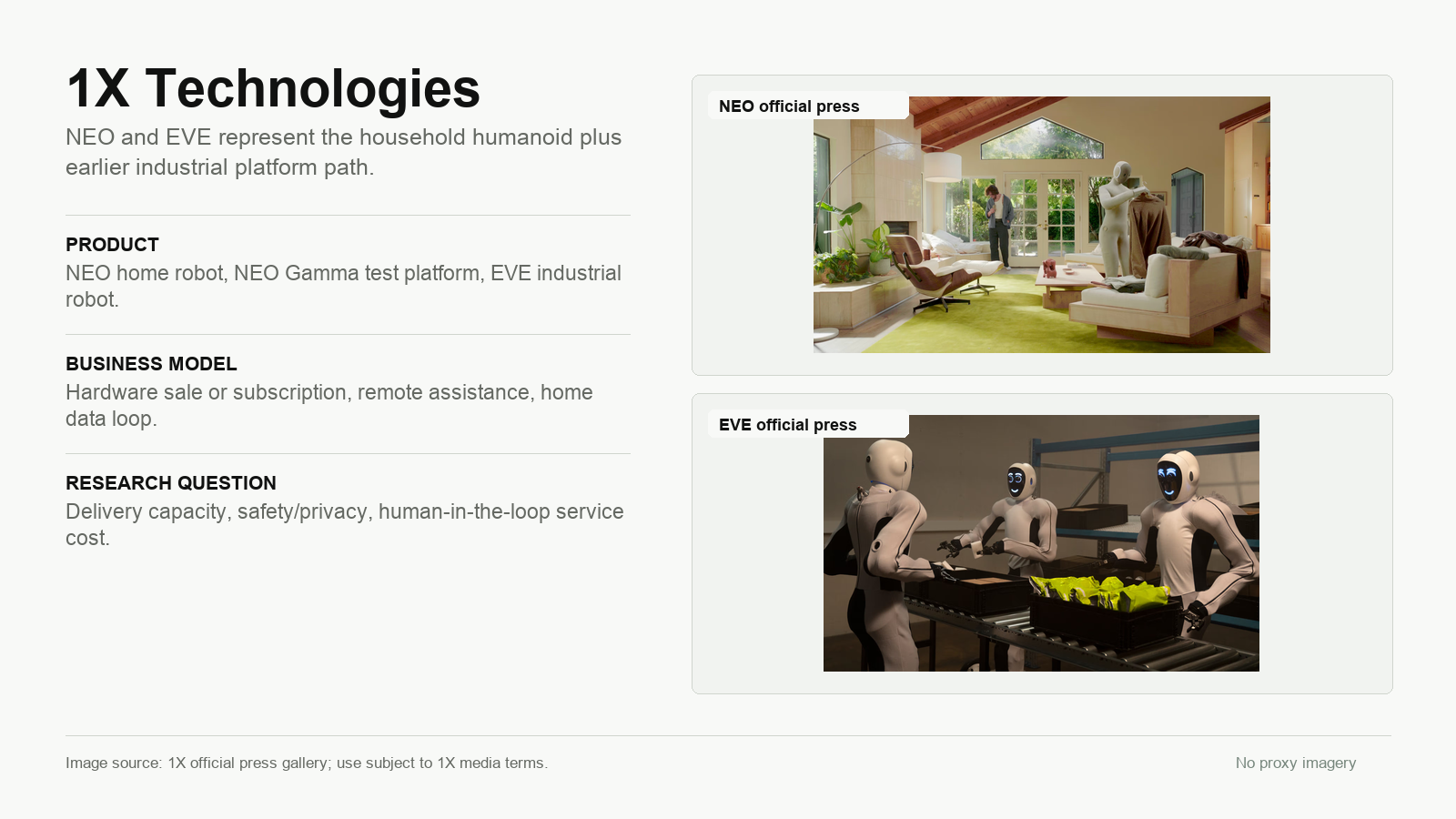
Illustration: 1X's investment profile; the right side uses NEO and EVE product images from 1X's official press gallery to distinguish home humanoid and early industrial platform.
Company Background and Founding Team
1X Technologies is a Norway/U.S. humanoid robotics company. Maquina has an attested holding, while Robo Strategy does not cover it. Its core distinction is an explicit bet on home robots: it transitions from the EVE industrial/security platform to NEO Home Robot and builds a closed loop through remote assistance, home data, and vertical manufacturing. Maquina BOT-07 invested about $800,000, holding 200 ordinary shares of 1X Holding AS, executed in November 2025. Later XMAQUINA basis mentioned an entry valuation of about $4.55B.
1X's investment elasticity comes from the huge TAM of home robotics, but its risk is also the greatest: home scenarios are uncontrollable, safety and privacy requirements are high, after-sales density is high, complex tasks are likely to depend on human remote takeover, and unit economics are harder than in warehouses/factories.
Product Lines and Business Model
1X product lines include:
- NEO Home Robot: a biped humanoid robot for the home, with DTC preorders. Early Access ownership price is $20,000; Standard subscription price is $499/month; refundable deposit is $200. U.S. delivery is planned from 2026. NEO's current automation capability focuses on basic tasks, while complex tasks are completed through 1X Expert Mode remote assistance.
- NEO Gamma: a generation of robot used for home testing in 2025.
- EVE Industrial: wheeled humanoid robot, deployed at global customer facilities in 2022, but customer names and contract amounts were not disclosed.
- Redwood AI: general VLA / vision-language transformer for NEO / EVE, running on embedded GPU on the body, with about 160M parameters and about 5 Hz, integrating language, vision, proprioception, and diffusion policy.
- World Model / World Model Lab: trains predictive models using internet video, first-person human video, simulation, teleoperated robot data, and NEO on-policy data.
Commercially, 1X has possibilities in hardware sales, subscription, remote-assistance services, data closed loop, and future B2B scenarios. If home robotics succeeds, ARPU and data value are both high. But if the human-intervention ratio of Expert Mode is too high, gross margin will be consumed by service cost.
Upstream Supply-Chain Vendors
1X's supply-chain focus is vertical manufacturing and a low-noise, low-inertia, safe body:
- Hayward factory: about 58,000 square feet, 200+ team, 10,000-unit annual NEO capacity basis; San Carlos new facility planned to advance after 2026; company target of reaching 100,000+ units/year by the end of 2027.
- 1X Tendon Drive: low-inertia tendon-drive system, paired with Revo2 motors, in-house motor electronics, copper coils, electrical-steel stators, and proprietary tendon manufacturing. The company disclosed that after Hayward began production, it had manufactured 17,000 motors. Tendon Drive basis includes 2% torque accuracy, 95% backdrivability, 0.1 mm repetition, 1 mm accuracy, and 22 dB noise.
- NEO body: about 5'6", 66 lb, lift 154 lb, carry 55 lb, arm payload 18 lb; each hand has 22 DoF, each arm 7 DoF, neck 3 DoF, spine 2 DoF, each leg 6 DoF.
- Sensors and computing: dual 8.85MP 90Hz stereo fisheye cameras, 4 beamforming microphones, IMU, in-house sensors, hand tactile sensing; NEO Cortex uses NVIDIA Jetson Thor, up to about 2,070 FP4 TFLOPS.
- Battery: 842Wh, about 4 hours of runtime, 6 minutes of charging can restore about 1 hour of operation, automatic recharging, aviation-grade cells, in-house BMS sampling at 100Hz, and battery-line annual-capacity basis of 10,000 packs.
- Safety and home adaptation: HIC <250, low-inertia tendon drive, IP68 hands, IP44 body, 22 dB operating noise, pinch-free design, machine-washable soft outer suit.
Still to verify: real mass-production yield, repair frequency, home safety certification, teleoperation privacy, Jetson Thor supply, external cell/sensor suppliers, consumer after-sales network, and per-household service cost.
Downstream Buyers, Revenue, and Orders
1X's downstream signals fall into three categories:
- Consumer preorders: NEO opened preorders in October 2025. The company basis says the next year's 10,000-unit capacity filled in 5 days. If all were calculated at the $20,000 ownership price, theoretical gross order value would be $200M, but this cannot be equated with revenue because deposits are refundable, subscription/ownership mix is unknown, cancellation rate is unknown, and delivery capability is unknown.
- EQT MoU: EQT can give 1X access to its portfolio companies, with up to 10,000 robot opportunities, but this is more of a scenario entry point and option than an investment or purchase commitment.
- EVE industrial deployment and Robot Fleet charter: EVE was once deployed at global customer facilities, and NEO also has B2B entry, but customer names, contract amounts, payment terms, and renewals are not yet clear.
1X is the "largest upside, hardest to prove" position in Maquina's portfolio. If home robot real delivery, low accident rate, low human takeover, subscription retention, and manufacturing cost all hold simultaneously, its valuation elasticity can be very high. But before these metrics are disclosed, preorder heat and capacity basis should be discounted.
NEURA Robotics
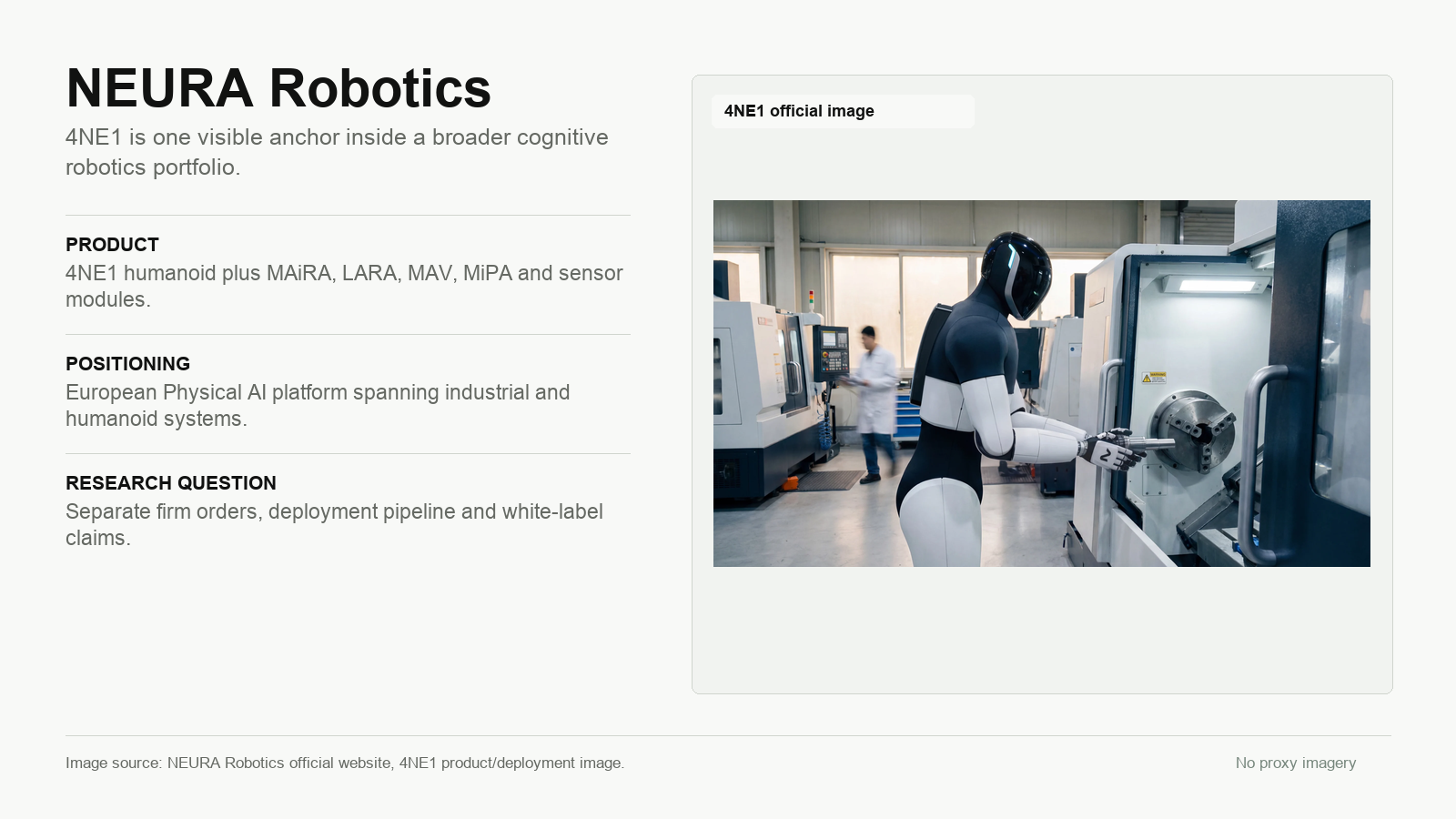
Illustration: NEURA's investment profile; the right side uses official NEURA Robotics 4NE1 product/deployment images from the company website.
Company Background and Founding Team
NEURA Robotics is a German cognitive robotics company founded by David Reger. It is not a single humanoid-robot company, but a rare full-stack Physical AI platform in Europe: collaborative robots, AMRs, service robots, humanoid robots, sensor skin, AI platform, training infrastructure, and application ecosystem are all within one system. Maquina has an attested holding, and Robo Strategy does not cover it.
On financing, NEURA completed about EUR 120M Series B in January 2025. In June 2026, it disclosed up to $1.4B Series C, with investors including Tether, Qualcomm, Amazon, NVIDIA, imec.xpand, Bosch, Schaeffler, EIB, Lingotto, InterAlpen and others. Media basis valuation was about $7B. This "up to" needs to be viewed with a discount, as it may include staged or structured arrangements.
Product Lines and Business Model
NEURA's product line is broader than that of most humanoid companies:
- MAiRA cognitive robot arm: 9-18 kg payload, 1100-1600 mm reach, 7 DoF, 3D vision, voice, dual encoders, force-torque, IP65, 3 m touchless human detection, PL e / SIL3.
- LARA cobot: 3-30 kg payload, 590-1800 mm reach, +/-0.02 mm, IP54 / IP66, PLd Cat3 / SIL2, in-house motors, 24-bit encoders, optional 6DoF force-torque.
- MAV / MAV+: AMR, 500 kg / 1500 kg payload, 1.5 m/s, 7-10 hours battery life, +/-5-7 mm, 360 laser scanners, PLd Cat3 ISO 13849, Navitec or ROS2 / VDA5050.
- MiPA: service assistant, SLAM, LiDAR, AI planning, 3 m touchless detection, environment sensing, WiFi / Bluetooth, API, and modular accessories.
- 4NE1: humanoid robot, about 180 cm, 80 kg, 5 km/h. Public basis gives a 10-100 kg payload range, which needs to be understood by different configurations. Supports remote operation, replaceable forearms, 360 perception, sensor skin, multimodal AI, RL, and also has wheeled and seventh-axis versions.
- AURA / SenseKit / Touch / Teach / OmniSensor: sensing, safety, teaching, and skin modules.
- Neuraverse / NEURA Gym: platform, training, and application ecosystem. TUM RoboGym is about 2,300 square meters, plans to deploy robot fleets in mid-2026, and has an initial investment of about EUR 17M, of which NEURA contributes about EUR 11M.
The business model includes hardware sales, B2B / integrator / OEM / white-label, platform/API/app ecosystem, training-data infrastructure, and deployment services. NEURA's advantage is that its product line spans industrial deterministic revenue and long-term humanoid imagination. The risk is that the product line is too broad, increasing execution complexity and capital consumption.
Upstream Supply-Chain Vendors
NEURA's supply-chain and ecosystem partners have a European industrial character:
- Bosch: investor/partner, potentially creating synergies in sensing, software, electrical, and motion-related capabilities.
- Schaeffler: investor/technology partner. Media has reported large-scale humanoid robot orders and component cooperation with NEURA, but official disclosure needs to distinguish "investment/cooperation" from "confirmed purchase."
- Qualcomm: edge AI, computing, and connectivity capability.
- AWS / Amazon: Neuraverse cloud infrastructure, SageMaker integration, and fulfillment-center exploration.
- NVIDIA: investor and robotics AI ecosystem partner.
- Kawasaki: white-label cooperation clue.
- TUM / MIRMI: RoboGym training and research infrastructure.
- Internal capabilities: NEURA has strong self-development statements in motors, encoders, sensors, and safety-detection modules.
NEURA's key penetration points are: which core components are self-developed, which are supplied by Bosch / Schaeffler / Qualcomm / NVIDIA and others, whether MAiRA/LARA/MAV/4NE1 share motor and control platforms, who handles manufacturing scale-up, and whether Europe's local supply chain can compete with China's robotics supply chain on cost.
Downstream Buyers, Revenue, and Orders
NEURA's downstream evidence mainly includes:
- 2023 TechCrunch basis of about $450M five-year orderbook.
- 2026 company/Automate basis that orderbook + strategic deployment pipeline exceed $1B.
- Kawasaki white-label.
- The statement that four of the world's top ten robotics companies use NEURA technology and deliver it under their own brands.
- Schaeffler: officially an investment/technology partner; media reported about EUR 300M in orders and thousands of humanoid robots by 2035 basis; contract nature still needs continued confirmation.
- Bosch: strategic cooperation and investment.
- Amazon / AWS: exploration of deployment in some fulfillment centers.
As an investment, NEURA is the representative in Maquina's portfolio of "European robotics sovereignty + industrial customers + multiple product lines." It has broader revenue entry than pure humanoid companies, but valuation is also rising rapidly. Research must separate signed orders, strategic pipeline, white-label technology licensing, and media-reported orders.
Genki Robotics
Current Treatment
Genki Robotics should be moved from "robot foundation models / infrastructure pending verification" into "full-size humanoid, biped body, and general robot OEM." As of 2026-07-03, the public website genki.com and the LinkedIn company page jointly point to a humanoid robotics company founded in 2025, headquartered in Minato-ku, Tokyo, Japan, and positioned for mission-critical applications. The website's own description says its direction is bringing Physical AI into public safety, urban maintenance, and other mission-driven environments, with keywords of intelligence, dexterity, and resilience. This makes it more like an early full-size humanoid robotics / Physical AI operating company, rather than a pure software model layer, market-intelligence infrastructure, or computing company.
But Genki still does not meet the evidentiary conditions for entering a strong "non-China robotics leader" conclusion. Public pages do not show a robot model, full-body product photos, hardware parameters, demo videos, customer pilots, orders, deployment count, revenue model, suppliers, BOM, manufacturing partners, or safety certifications. The website's Investor section self-lists a16z, DCM, AMD, Incubate Fund, and X&, but no independent financing announcement, round amount, valuation, or security type has yet been found. Therefore, this report can only write that "there is a company-self-disclosed blue-chip investor signal, but financing details have not closed the loop"; it cannot write any specific financing round, $1B valuation, or investment amount as verified fact.
Product Lines and Business Model
Genki's current public information is sufficient only to confirm its "direction," not its "product lines." The verifiable basis is: the company is developing humanoid robots for mission-critical applications and aims to integrate intelligent humanoid robots into public safety, urban maintenance, and other service/work scenarios. Because there are no public models, photos, dimensions, DoF, payload, battery life, speed, hand degrees of freedom, sensors, computing platform, or safety parameters, the report cannot compare it at the parameter level with Figure 03, Apollo, Digit, NEO, or 4NE1.
The business model can only be inferred conditionally. If its direction lands in public safety and urban maintenance, potential revenue paths may include government/city customer pilots, purchases by facility operators, RaaS, maintenance services, software/teleoperation, scenario integration, and long-term operations and maintenance. If it lands in broader mission-critical labor augmentation, it may also enter industry, security, disaster response, energy inspection, or infrastructure maintenance. But none of these currently has customer, contract, or order evidence. The most robust current judgment is: Genki is an early full-size humanoid watchlist item, not a verified commercial robotics company.
Upstream Supply-Chain Vendors
Genki has not disclosed its BOM or suppliers. Due diligence should ask eight types of questions under the full-size humanoid framework: structure and kinematic chain, actuators/motors/reducers, hand and end interfaces, perception suite, computing and real-time control, battery and power distribution, thermal management/functional safety, and manufacturing/calibration/maintenance interfaces. Because the company is headquartered in Japan, it may have a location advantage close to Japanese precision manufacturing, reducers, motors, sensing, safety control, and system-integration supply chains. But before suppliers, manufacturing partners, or engineering prototypes are public, this can only be a diligence hypothesis, not a fact.
Two misreadings especially need to be avoided. First, AMD appearing in the website's investor links does not mean Genki already uses AMD as an edge-computing or training supplier. Second, Andy Rubin / Android background can explain the company's early capital and software-system narrative, but it cannot replace evidence on robot bodies, manufacturing, reliability, and safety certification.
Downstream Buyers, Revenue, and Orders
Genki has not publicly disclosed customers, revenue, orders, deployment cities, government projects, PoCs, backlog, or pilot KPIs. LinkedIn shows a company size of 11-50 people and a 2025 founding date, indicating that it is more likely still in team-building and early R&D. For Maquina / XMAQUINA portfolio analysis, Genki should still be excluded from attested equity cost base, return calculations, and the coverage-rate numerator: XMAQUINA website portfolio highlights do not list Genki, and the Treasury Attestations registry also has no Genki-related BOT proposal, SPV, issuer, funded amount, or Andersen attestation.
If the 5.4% weight in an internal mNAV table is true, Genki is an unresolved exposure that is "economically potentially important, but evidentially not yet closed-loop." The next step should be to request the legal entity, investment documents, SPV / security structure, funded amount, company product materials, customer / deployment proof, financing announcement, and cap table proof, rather than including it in verified robotics assets ahead of time.
Robot Foundation Models, Physical AI, and Manipulation Policies
Skild AI
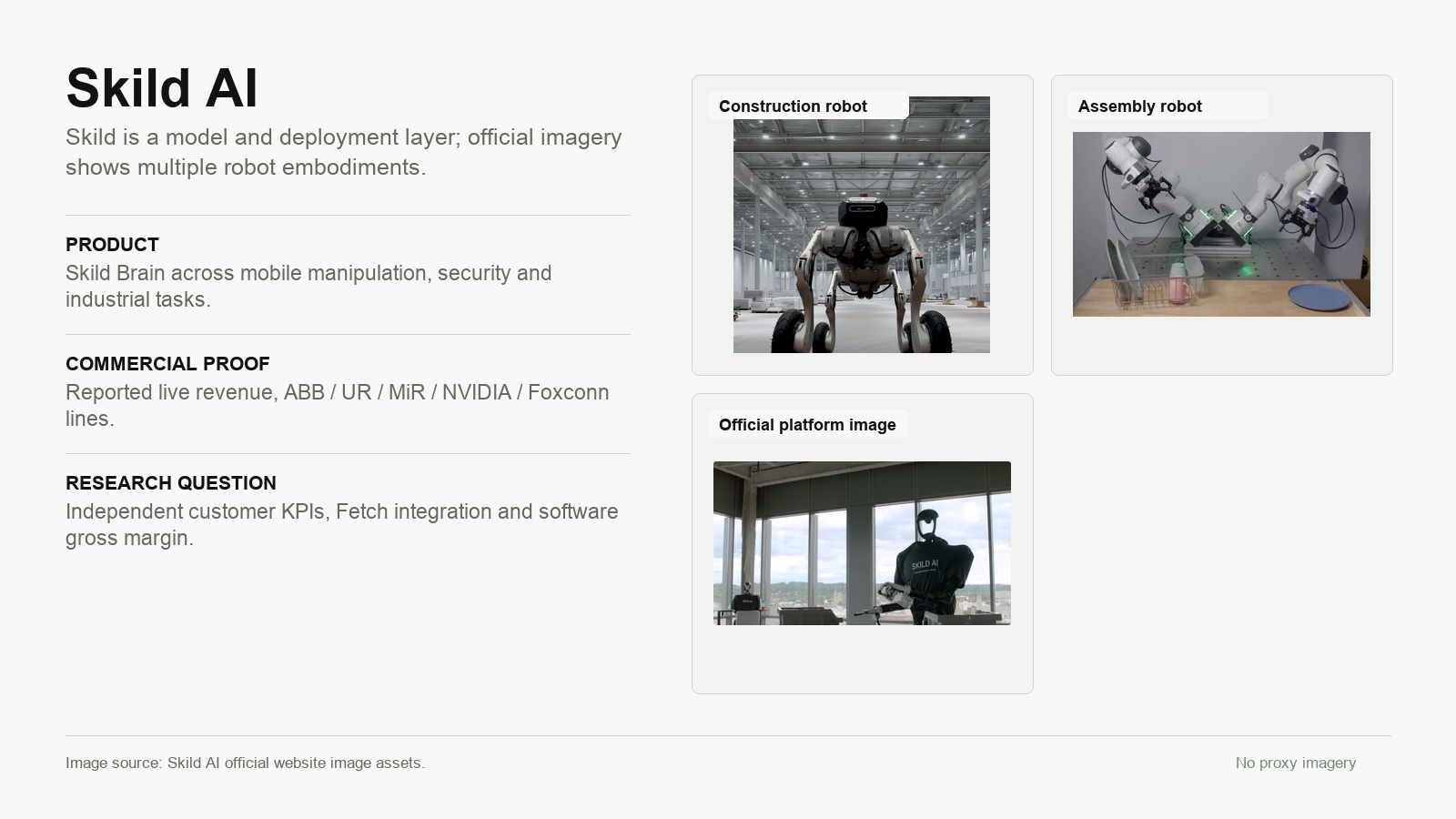
Illustration: Skild's investment profile; the right side uses robot platform/task images disclosed on Skild AI's website to express its cross-body model and deployment layer.
Current Treatment
Not counted in Maquina's deployed cost base; can be viewed as approved/potential SAFE or pending exposure. Castle Labs once disclosed a $500,000 USDC SAFE clue, but as of this verification, the XMAQUINA attestation registry does not list Skild, so it cannot be merged into the attested robotics-equity cost base.
Company Positioning and Product Stack
Skild AI should not be treated as another humanoid-robot body company; it should be placed in the "software stack and brain-model layer." Its core product is Skild Brain: a robot foundation model that attempts to be reused across different bodies such as quadrupeds, humanoids, tabletop robotic arms, and mobile manipulation platforms. Compared with hardware body companies such as Figure, Apptronik, and Agility, Skild's value judgment does not depend on who produces more robots, but on whether it can transform data generated by different robots, tasks, and scenarios into transferable control policies.
Technically, Skild's public route is not simply attaching a VLM to a robot. It uses a hierarchical control stack to connect semantic tasks with low-level execution: high-level policy handles manipulation / navigation, while low-level policy outputs joint angles and motor torques. Its data flywheel consists of four sources: large-scale simulation, internet human-motion videos, teleoperation, and real deployment data. The moat of this route lies in data diversity, cross-body generalization, sim-to-real, low-latency control, and deployment-feedback closed loops. The risk is that these capabilities are still mainly supported by company demos and statements, with a lack of independent benchmarks, customer-level KPIs, and long-term reliability disclosure.
Financing, Commercialization, and Deployment Evidence
In financing, Skild raised about $300M in its 2024 Series A at a valuation of about $1.5B. In 2026, its Series C raised $1.4B, led by SoftBank, at a valuation above $14B, with participants including NVentures, Macquarie Capital, Bezos Expeditions, LG, Schneider Electric, CommonSpirit, Salesforce Ventures and others. This has pushed Skild into one of the highest valuation tiers in the non-China robotics software layer.
Commercially, Skild has moved from a pure research narrative into a deployment narrative. The company disclosed that 2025 live revenue grew from 0 to about $30M, and it announced cooperation with ABB Robotics, Universal Robots, MiR, and NVIDIA / Foxconn, among which the Foxconn / Blackwell line dual-arm assembly is the most specific industrial-task clue. After acquiring Zebra Technologies' robotics division in 2026, namely the former Fetch Robotics assets, Skild obtained warehouse AMR and the Symmetry Fulfillment orchestration platform. This moves it from a "model company" closer to real warehouse deployment and data entry. But public materials do not disclose customer lists, order amounts, ARR, gross margin, deployment count, inherited Fetch revenue, or acquisition consideration, so it cannot be written as already validated at large-scale commercialization.
Investment Implications
For Maquina, Skild is the most important target to fill the "robot foundation-model layer," but it can currently only be treated as approved / pending exposure. If a future transaction closes and receives attestation, Skild would push Maquina from a "humanoid-body tilted" portfolio toward a "body + horizontal brain" portfolio. Before completion, it cannot be counted into current coverage rate or return calculations.
Skild's relationship with Figure / Apptronik / Agility is more like model-layer coopetition than verified direct cooperation. Figure is self-developing Helix; Google DeepMind has clearer model-ecosystem relationships with body companies such as Apptronik, Agility, and Boston Dynamics; NVIDIA / PI / open-source VLA routes will also compress the bargaining power of independent model layers. Skild's upside is to become a horizontal brain supplier for multiple robot bodies. Its downside is that hardware OEMs internalize the model layer, or customers view Skild as an expensive project-based system integrator rather than a reusable software platform.
Sanctuary AI
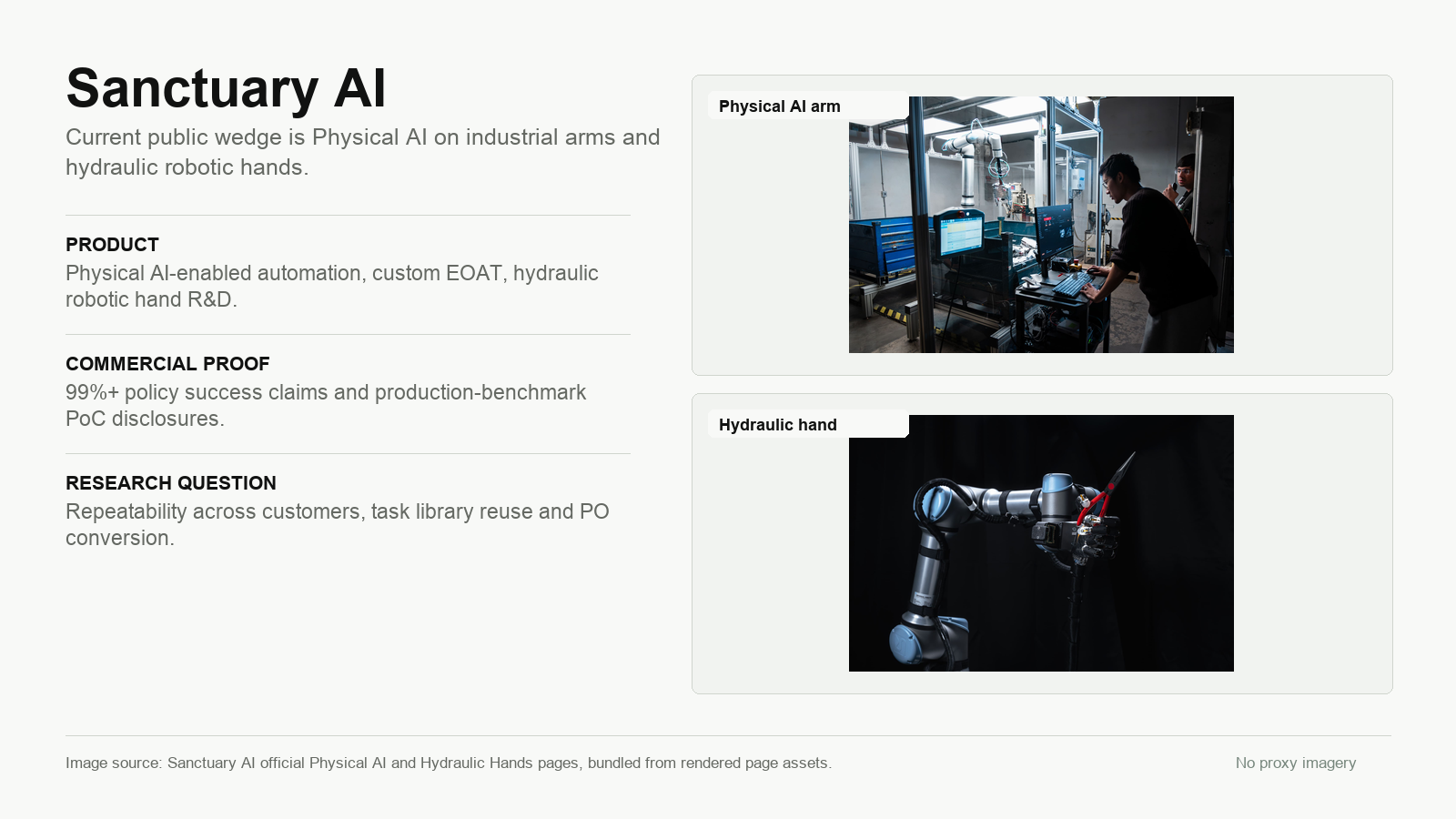
Illustration: Sanctuary's investment profile; the right side uses assets from Sanctuary AI's official Physical AI and Hydraulic Hands pages to show the industrial-arm/EOAT and hydraulic-hand directions.
Company Positioning and Product Stack
Sanctuary AI is better understood as a Physical AI and manipulation-policy company, rather than being classified only as the Phoenix humanoid robot OEM. Its public route has shifted from "waiting for complete humanoid robot mass production" toward a more realistic industrial automation wedge: deploying Carbon / Physical AI control systems on existing industrial robotic arms, custom EOAT, future hydraulic robotic hands, and longer-term humanoid or mobile bodies.
The product stack can be split into four layers. The first layer is Physical AI-enabled automation: making complex insertion, sorting, assembly, and contact manipulation into deployable policies for industrial arms and custom end effectors. The second layer is Carbon / Large Behavior Models: including perception, planning, reasoning, reinforcement learning, simulation, teleoperation, and fleet management. The third layer is dexterous hands and tactile hardware: Sanctuary has long invested in 17-21 DoF-class hands, hydraulic microvalves, tactile sensors, and haptic servoing. Only the fourth layer is Phoenix humanoid, which more serves data collection, future embodiment, and the long-term general-purpose robot narrative, rather than being the only current commercialization carrier.
Commercialization, Supply Chain, and Revenue Evidence
Sanctuary's recent commercialization focus is automotive, electronics manufacturing, logistics, pharmaceutical logistics, material handling, assembly, sorting, and picking. The most important 2026 signal is a wire harness / plug insertion PoC / production-benchmark validation for an unnamed Tier 1 automotive supplier: the company disclosed 99.5%+ task success and 2.54-second cycle time, and said the results were validated against live production benchmarks. This signal is stronger than an ordinary demo because it gives success rate, cadence, and customer production benchmark at the same time. But public materials still call it a proof-of-concept and do not disclose customer name, order amount, deployment count, SLA, gross margin, or repeat purchase, so it cannot be written as a confirmed purchase order or scaled revenue.
On upstream and ecosystem, Sanctuary's supply chain is not a single whole-machine BOM. Recent deployments can use existing industrial arms from FANUC, Universal Robots and others. Magna provides automotive engineering, manufacturing, and potential deployment scenarios. Microsoft Azure supports AI training, inference, and storage. NVIDIA Isaac Lab / Isaac Sim supports simulation and robot learning. Zeon / Zeon Ventures is related to dexterous-hand materials, elastomers, and durability testing. IP from Tangible Research and Giant AI supplements tactile and grasping capabilities. The benefit of this path is that it can first sell policy + EOAT + integration, reducing the BOM and manufacturing risk of a complete humanoid body. The downside is that each customer task may remain highly customized, and whether a reusable task library can form has not yet been proven.
Dyna Robotics
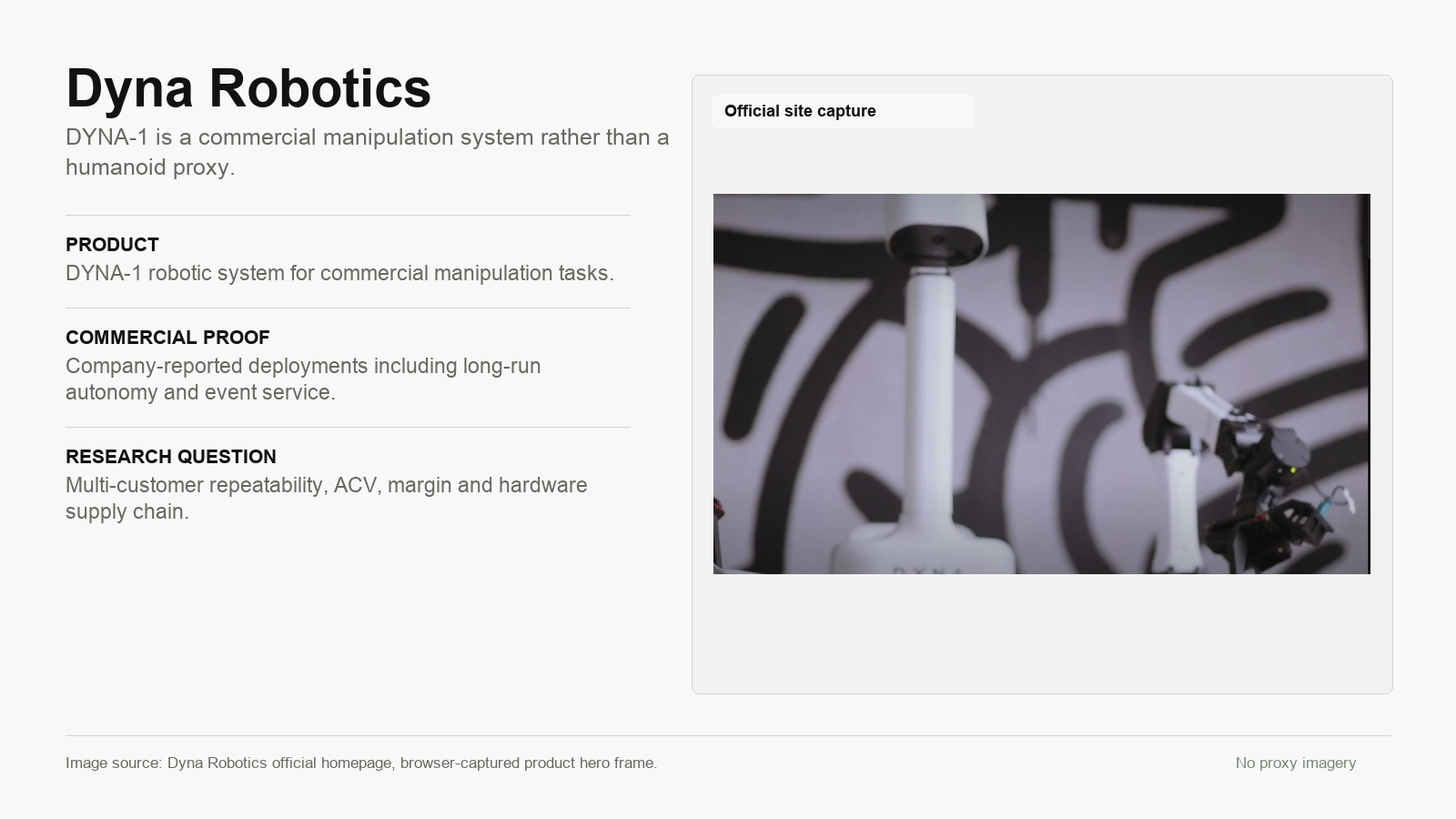
Illustration: Dyna's investment profile; the right side is a browser screenshot crop of the product hero on Dyna's homepage, used to show the DYNA-1 commercial manipulation operating system.
Company Background and Founding Team
Dyna Robotics is a U.S. commercial robotics manipulation company. It is one of Robo Strategy's top three holdings and is not covered by Maquina. It is not a humanoid-robot route, but a "robot foundation model + intelligent robotic arm + commercial scenario deployment" route, focusing on repetitive manipulation tasks in fixed or semi-fixed environments.
Robo Strategy disclosed a Dyna holding of about $37.25M, about 25.31% of NAV, holding 1,491,163 shares of Series A Preferred. This position is very large, showing that Robo Strategy views Dyna as core alpha outside Figure / Apptronik, not as an ordinary early-stage project.
Product Lines and Business Model
Dyna's products and technology stack include:
- Robot manipulation foundation model: used for generalized grasping, folding, service, and other repetitive object-manipulation tasks.
- Intelligent robotic arm: for fixed/semi-fixed tasks in commercial environments, not a general humanoid body.
- DYNA-1: first-generation system shipped in April 2025. Public demos include long-duration autonomous tasks such as napkin folding. The company claims 24+ hours autonomous operation and 99%+ success rate.
- Dynasaur: deployment at the Red Bull Mirage brand event in Palm Springs. Public basis says it served 700+ cans of Red Bull with 99%+ success rate, no interruption, no human intervention, and the ability to handle desert lighting and crowd changes.
- Deployment/data/fleet system: includes site assessment, task-boundary definition, data collection and feedback, on-site tuning, remote diagnostics, continuous updates, and toolchain. Job postings also mention deployment capabilities such as off-board compute operations and local app software.
Commercially, Dyna looks more like an integrated B2B robot deployment company than a pure model seller. Revenue may come from hardware sales or leasing, deployment services, software/model subscriptions, and ongoing operations and maintenance. Its advantage is designing around chargeable tasks from the beginning, rather than waiting for general humanoids to mature. The gap is that scalable RaaS contracts, backlog, gross margin, and multi-customer reuse capability have not yet been disclosed.
Upstream Supply-Chain Vendors
Dyna has little public BOM and supplier information, which is the main research risk of the target. Nodes requiring penetration include:
- Robotic-arm DoF, payload, reach, repeatability, and lifetime.
- Gripper/end effector, tactile sensing, torque sensors, and compliant control.
- Cameras, depth cameras, lighting, edge computing, off-board computing, and network connection.
- Safety control, on-site fencing, remote monitoring, and fault recovery.
- Manufacturing partner, key component suppliers, unit cost, and maintenance parts.
From the investment logic perspective, Dyna's upstream moat may not be in a single mechanical part, but in "real commercial-environment data + continuous model iteration + deployment engineering capability." But if hardware costs, on-site tuning, and customer customization are too high, it will look more like a system integrator than a scalable robotics platform.
Downstream Buyers, Revenue, and Orders
Dyna already has more real scenario validation than most early robotics companies, but still lacks sufficient financial transparency:
- Red Bull Mirage: brand-event deployment, validating stable manipulation under complex lighting, crowds, and outdoor conditions, but whether it was paid, the contract amount, and repeat purchase are unknown.
- Unnamed long-term deployment: deep-research materials mention the longest-running customer scenario at about 10 months of daily use and contain a "sale" hint, but customer name, ACV, gross margin, and expansion plan are not public.
- DYNA-1: shipped in April 2025, but it is not yet clear whether it was an internal system, pilot system, or paid customer system.
Robo Strategy has a large position in Dyna, so Dyna's information transparency directly affects portfolio credibility. The current assessment should be that Dyna is a "high-upside, high-opacity" core asset: if its system can scale from Red Bull/single-customer deployment into standard tasks across industries, return elasticity is strong. If every project requires heavy customization, valuation should be materially discounted.
Mobile Manipulation, Collaborative Robots, and Industrial Skill Automation
Dexmate
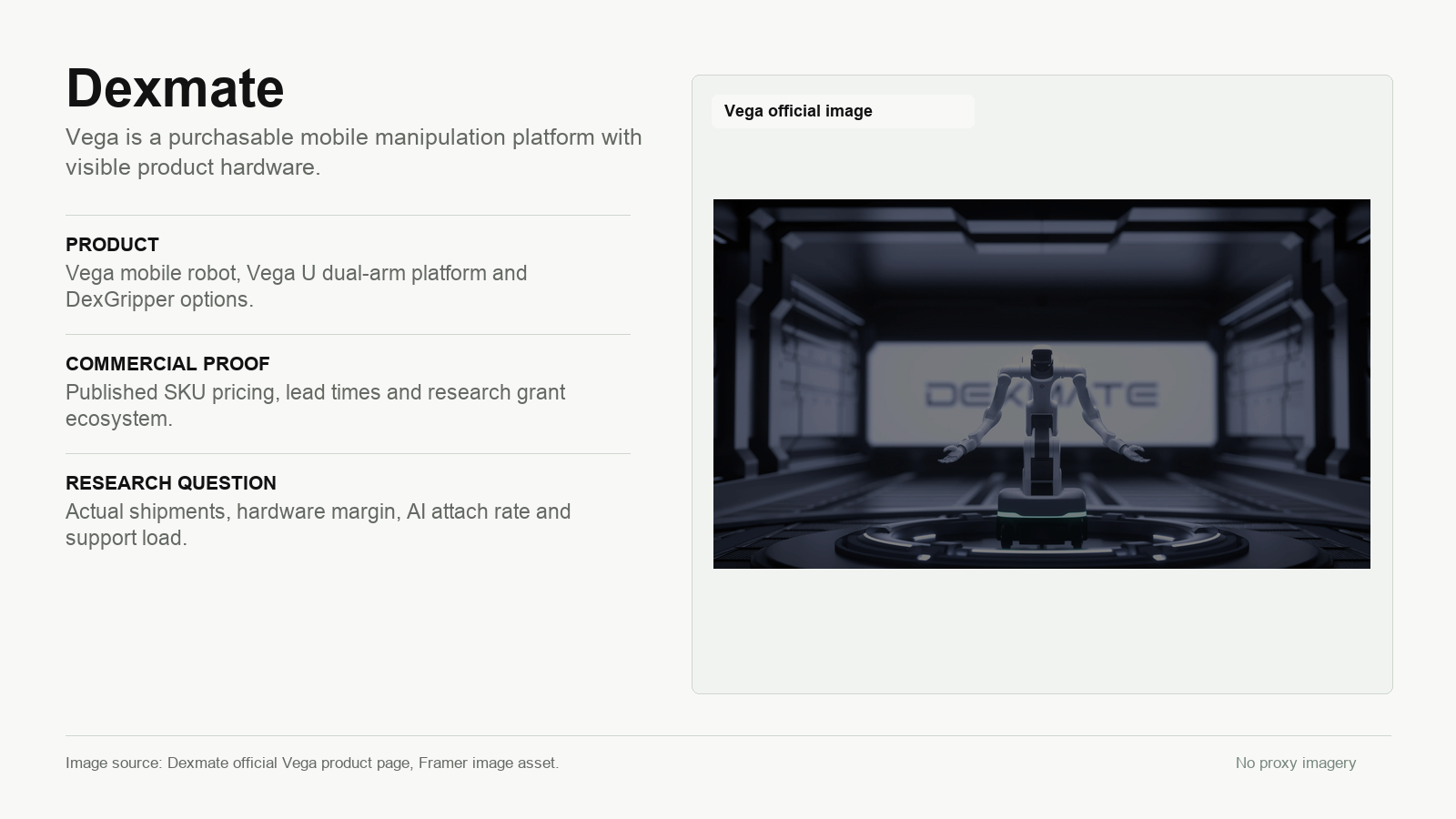
Illustration: Dexmate's investment profile; the right side uses images from Dexmate's official Vega product page to show its mobile-manipulation hardware route.
Company Background and Founding Team
Dexmate Inc is located in Santa Clara and is a mobile-manipulation and gripper-platform company. Robo Strategy has disclosed a holding, while Maquina does not cover it. Robo Strategy holds 1,740,280 shares of Dexmate Series 1 Seed Preferred, with fair value about $10M and about 6.80% of NAV.
Dexmate's characteristic is that it is more "productized" than most early robotics companies: its website/store already shows hardware SKUs and prices. This makes it easier to validate through orders, gross margin, and delivery capability rather than only demos.
Product Lines and Business Model
Dexmate's product lines include:
- Vega: general-purpose mobile robot, 36+ DoF, long battery life, rich sensing, teleoperation-ready, force/torque sensing, fleet management, using NVIDIA AGX Thor. Public price is $81,000 without end effector and $96,000 with dexterous hands; hardware price does not include AI.
- Vega U: dual-arm manipulation platform, 7 DoF per arm, stereo vision, force/torque sensors, simulator files provided, compatible with teleoperation, installable on different bases/workstations. Public price is $45,000 without end effectors and $60,000 with dexterous hands.
- DexGripper S: tactile two-finger gripper, $3,000; version with ZED X One camera is $3,800.
- DexGripper D: four-contact tactile gripper for heavier or longer objects, $4,000; version with ZED X One camera is $4,800.
- Build with Vega U Research Grant: provides 6 Vega U units, each valued at $45,000, to universities/research institutions to build developer and research ecosystem.
The current business model is closer to hardware sales and developer/research platform than a mature RaaS model. In the future, it can extend to software, AI, teleoperation, enterprise deployment, and accessory ecosystem. Its key validation metrics are actual shipments, hardware gross margin, AI add-on fees, developer reuse, and enterprise orders.
Upstream Supply-Chain Vendors
Dexmate's disclosed key upstream includes:
- NVIDIA AGX Thor: Vega's main edge-computing platform. Vega U copy mentions NVIDIA AGX Nano and also Orin / Thor upgrade paths.
- Stereolabs / ZED X One: optional camera for grippers.
- Vega body: folding torso / arms, 3DoF torso/head, omni base, 10h+ operation, LiDAR, head camera, 6-axis F/T, RGB/RGBD cameras, IMUs, ultrasonic, high-capacity battery, and fleet management.
- Vega U: more like a mountable dual-arm manipulation platform, possibly externally powered, with delivery lead time of about 2 months.
Still to verify are actuators, reducers, bearings, torque sensors, LiDAR, batteries, motor drives, PCBs, structural parts, contract manufacturer, and warranty/repair system. Dexmate's transparent pricing is an advantage, but it also means the market will quickly test the product through real deliveries and customer repeat purchase.
Downstream Buyers, Revenue, and Orders
Dexmate's downstream is currently mainly direct sales, research ecosystem, and developer community:
- Public Shopify / website sales form a price anchor, but order count, revenue, gross margin, and completed delivery rate are not disclosed.
- Research Grant provides 6 Vega U units, helping enter universities and research institutions, but this is not cash revenue.
- Demos at events such as Automate 2026 increase enterprise exposure.
- Research such as CAIP uses Dexmate Vega as a real-world manipulation platform, showing that its hardware has research reuse value.
As an investment, Dexmate's advantages are clear product SKUs, transparent pricing, and purchasable hardware. The risk is that it is still early-stage and lacks large enterprise customers, standardized applications, and recurring software revenue. Robo Strategy's position is suitable as a "robot manipulation hardware-platform option," but it should not be interpreted at the same weight as humanoid flagships such as Figure / Apptronik.
Standard Bots
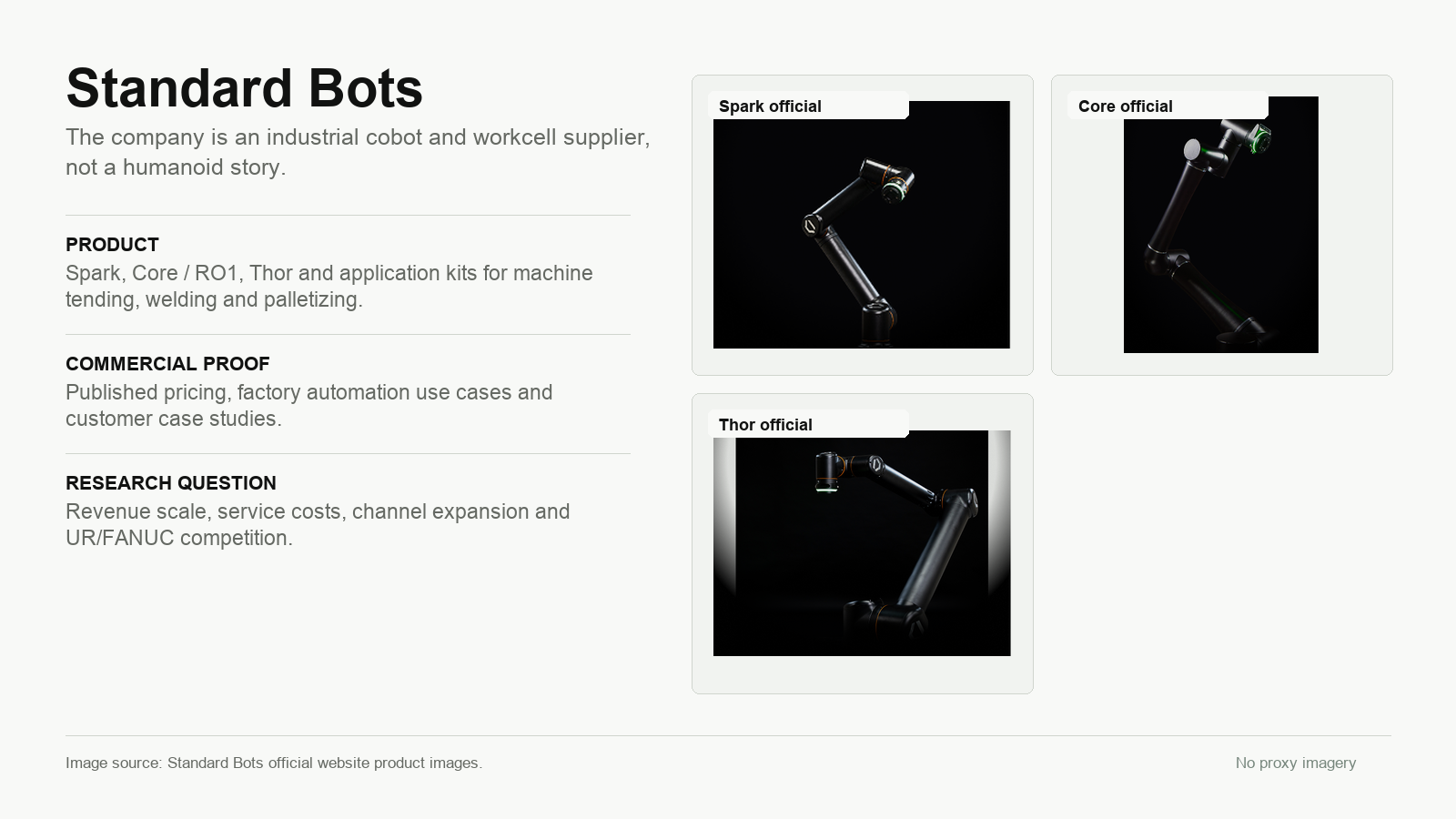
Illustration: Standard Bots' investment profile; the right side uses product images of Spark, Core, and Thor from the Standard Bots website to express its collaborative-arm / industrial-workstation route.
Company Background and Founding Team
Standard Bots is a U.S. next-generation collaborative robotics and industrial automation company. Robo Strategy holds Series C Preferred, while Maquina does not cover it. It does not make humanoid robots. Instead, it uses lower-barrier software experience, public hardware pricing, and preconfigured application workstations to enter automation for small and medium manufacturing.
Robo Strategy disclosed that it holds 234,190 shares, with fair value about $7M and about 4.76% of NAV. In public financing basis, Standard Bots once disclosed $63M financing, followed by basis of a $200M Series C, about $1B valuation, and RoboStrategy-led round.
Product Lines and Business Model
Standard Bots' product line is already very close to an industrial automation company:
- Spark: 7 kg payload, 900 mm reach, starting at $29,500, +/-0.025 mm, 21 kg, IP69K.
- Core / RO1: 18 kg payload, 1.3 m reach, about $37,000-39,500, up to 3 m/s, +/-0.025 mm, wrist / 3D camera, mobile-base ready, remote support, fleet management.
- Thor: 30 kg payload, 2000 mm reach, starting at $49,500, 79 kg, IP69K, 4 m/s, Ethernet at wrist.
- Bolt: 14 kg payload, 900 mm reach, coming soon, positioned as configurable bimanual AI droid.
- StandardOS: no-code apps, routines, fleet management, API/SDK, remote support; Python / TypeScript already supported, C++ / Rust / Go planned.
- AI Platform / Flux VLA: train by demonstration, onboard vision capture, label/review, cloud training, currently in private beta.
The business model includes robot body sales, packaged workstations, deployment training, integration services, remote support, and future software/AI subscriptions. It is closer than humanoid robots to current paid industrial automation demand. The ceiling is narrower, but revenue realization is earlier.
Upstream Supply-Chain Vendors
Standard Bots' upstream and manufacturing characteristics include:
- Local design/assembly in Glen Cove, NY. Company basis emphasizes that it designs almost every part, with motors and drives coming from Glen Cove.
- Public reports mentioned an 8,500-square-foot factory and a planned 13,000-square-foot Long Island factory.
- Long-term vision is deeper manufacturing integration by 2027, from incoming metal to robots leaving the factory, but this cannot be treated directly as proof of current capacity.
- Application kits include explicit suppliers: welding kits use Miller Auto Delta Weld / Auto Deltaweld 350 Basic, Tregaskiss Cobot MIG Gun, AccuLock consumables and others.
Still needing penetration are reducers, bearings, encoders, safety sensing, controllers, cameras, end effectors, contract-manufacturing ratio, warranty cost, and field reliability. Compared with mature players such as Universal Robots, FANUC, ABB, and Yaskawa, Standard Bots may have advantages in software experience and price, but industrial customers will ultimately screen by MTBF, service response, channels, and ecosystem.
Downstream Buyers, Revenue, and Orders
Standard Bots' downstream is closer to real payment than many robotics startups:
- Application kits: Machine tending, Palletizing, Welding, Inspection, Education, Development.
- Machine tending kit: supports Haas Ethernet, Ethernet/IP, Modbus, discrete I/O; DIY about $47,000, Value-Add about $57,000, Full Integration custom quote.
- Palletizing kit: Thor + control box + status light + button + pedestal + sensors + gripper; about $73,000-75,000, Value-Add about $79,000.
- Welding kit: RO1 + Miller / Tregaskiss / AccuLock etc., about $75,000, Value-Add about $79,000.
- Customer basis: the company says it is used by Fortune 500 and hundreds of independent factories and has automated hundreds of U.S. manufacturers; public logos include Amazon, NASA, Timken, Lyndex, MAC and others, but logos do not equal contract scale.
- Case: Shaw Barrels increased from about 200 pieces per day to 800 pieces, a relatively persuasive capacity-improvement case.
Standard Bots' investment logic differs from humanoid companies: it is more like equity exposure to "U.S. domestic collaborative robots and SMB manufacturing automation upgrade." Robo Strategy's investment in it can partially hedge the risk of an excessively long humanoid-robot realization cycle. But it needs continued tracking of revenue, gross margin, after-sales cost, channel efficiency, and whether it can maintain growth under ecosystem pressure from UR / FANUC / ABB.
Path Robotics
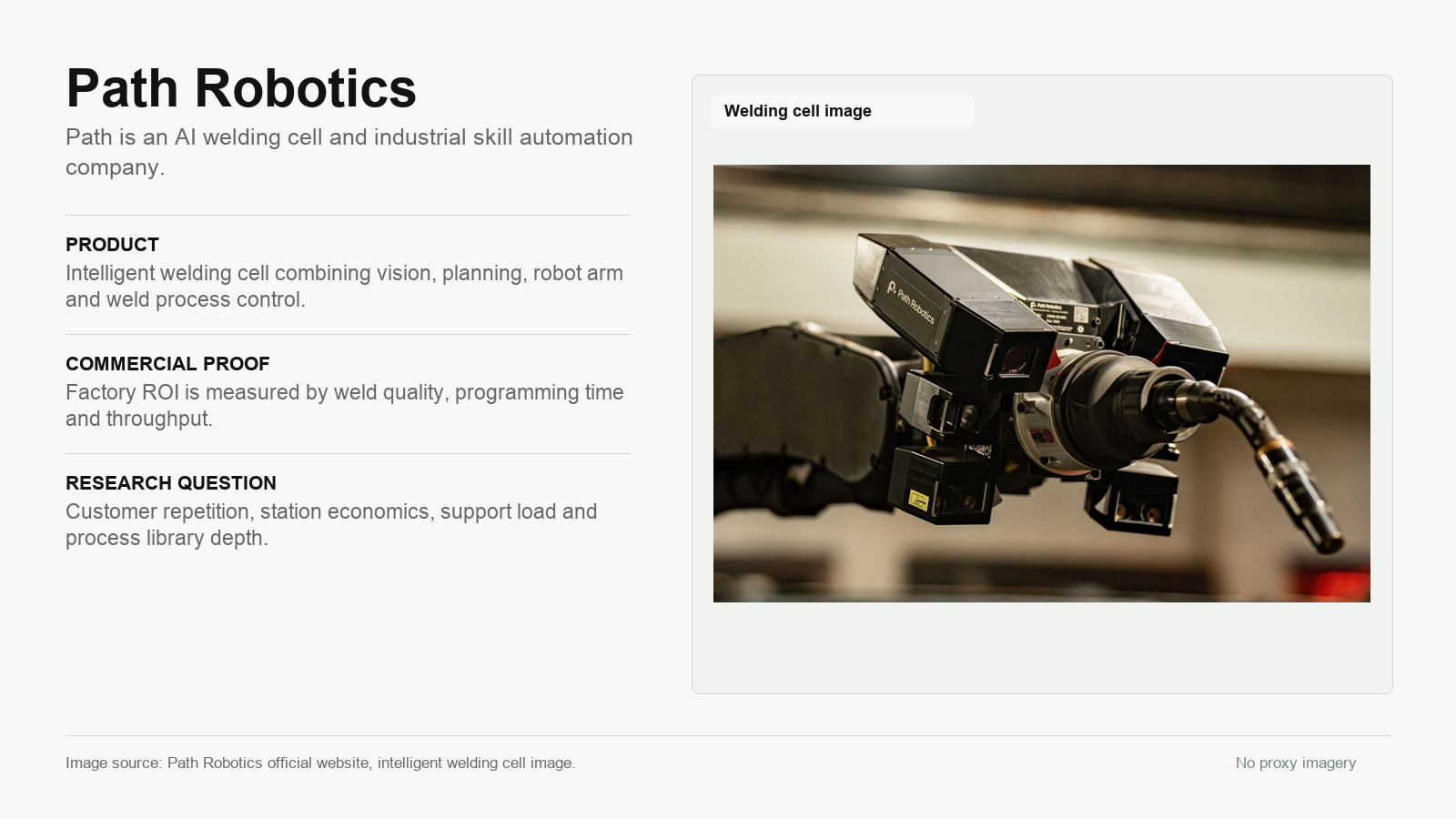
Illustration: Path's investment profile; the right side uses a smart welding cell image from the Path Robotics website to express welding skill automation rather than general humanoid robotics.
Company Background and Founding Team
Path Robotics is a U.S. industrial welding automation company, and Robo Strategy has disclosed a holding. It is not a humanoid robot and not a general embodied-intelligence company. It directly targets real factory pain points such as welder shortages, high-mix low-volume manufacturing, and transfer of process experience. Compared with Figure / Apptronik's "long-term general humanoid," Path has a narrower TAM, but a shorter ROI chain. Customers can more easily evaluate it by throughput, yield, weld quality, and labor substitution.
Product Lines and Business Model
Its product direction is AI-driven welding robotics systems. The core is not self-developing a completely new robot body, but packaging vision, path planning, welding process, fixtures, industrial robotic arms, and field integration into deployable systems. The business model may include workstation sales, software licensing, maintenance services, process tuning, and long-term support.
Path's investment value lies in "industrial skill automation": if the system can reduce dependence on senior welders for programming and tuning, it can serve many small and medium manufacturing enterprises. If it remains highly dependent on project-based integration, scaling speed will be limited.
Upstream Supply-Chain Vendors
Core upstream includes industrial robotic arms, welding power supplies, vision sensors, fixtures, controllers, welding consumables, safety fences, tooling, and system integration. Path's key supply chain is not one scarce component, but whether it can combine mature industrial hardware into low-tuning, high-consistency, reproducible welding cells.
The research department next needs to fill in: the robotic-arm brands it uses, welding machine / welding gun suppliers, vision and sensor solutions, single-workstation BOM, average deployment cycle, field-tuning person-days, and after-sales cost.
Downstream Buyers, Revenue, and Orders
Downstream consists of metalworking, equipment manufacturing, industrial welding, agricultural/construction machinery parts, steel structures, and high-mix manufacturing customers. Public orders, revenue, gross margin, and customer retention still need verification. Path's role in the portfolio is to add to Robo Strategy exposure to automation with existing paid industrial demand, rather than pursuing the humanoid-robot narrative. Customer repeat purchase, weld-quality metrics, labor-substitution ratio, and deployment gross margin should be tracked closely.
Service, Medical, Defense, and Consumer Robotics Applications
Cyan / CoCo Robotics
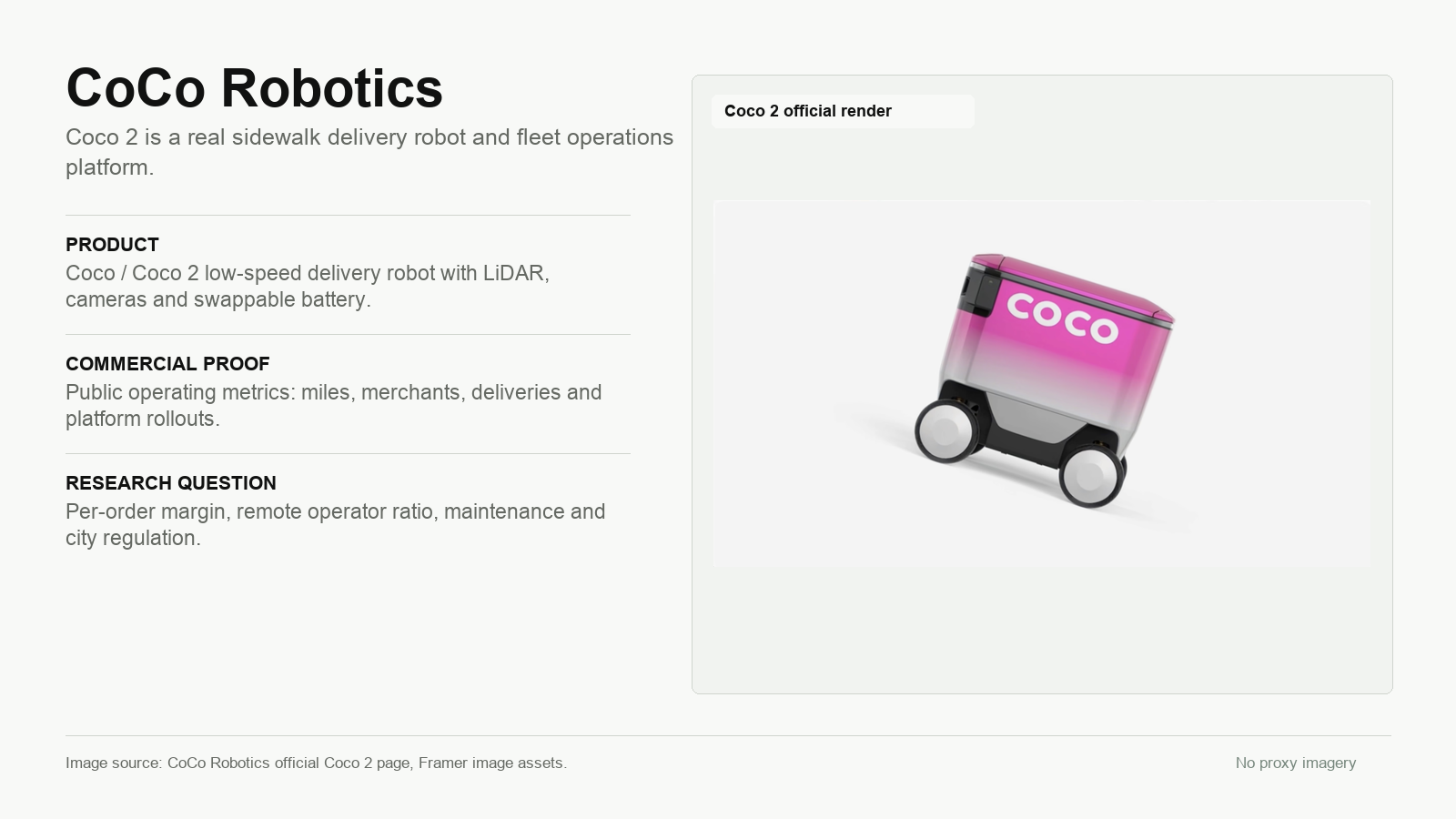
Illustration: CoCo's investment profile; the right side uses the robot image from CoCo Robotics' official Coco 2 product page to express city fleet operations, remote assistance, and unit-economics issues.
Company Background and Founding Team
Cyan Robotics dba CoCo Robotics is a sidewalk delivery robot company. Robo Strategy holds exposure through the SPV / SAFE of RoboStrategy DDGR LLC, with fair value about $1.5M and about 1.02% of NAV. It is not a humanoid robot and not an industrial robotic arm; it is a low-speed outdoor service robot / local delivery fleet operator.
CoCo's public evidence is more solid than that of most small Robo Strategy positions. The company website discloses operating cities including Los Angeles, Miami, Chicago, and Helsinki, and gives operating bases such as 1M miles traveled, 1K robots produced, 3K merchant partners, and 500K successful deliveries. For the founding team, the website discloses Zach Rash as co-founder and CEO and Brad Squicciarini as co-founder and CTO. The two began developing CoCo as UCLA students.
As an investment, CoCo's core question is not "whether there is a robot," but whether sidewalk delivery can make urban density, platform orders, remote-assistance labor efficiency, robot maintenance, regulation, and per-order gross margin work. It is more comparable with Serve Robotics, Starship, Cartken, Avride and similar companies than with Figure / Apptronik / Agility.
Product Lines and Business Model
CoCo's core product is Coco / Coco 2. Key parameters disclosed on the official Coco 2 page include 21 kph speed, 32 km range, 30% max grade, quick-swappable tires, swappable battery, 360 turn-in-place, capacity for four 18-inch pizzas, solid-state LiDAR, and 360 light ring. This product does not pursue high-speed autonomous driving, but is designed for short-distance, local, repeatable, high-order-density city delivery.
At the software layer, CoCo emphasizes end-to-end neural networks, precision mapping, onboard cameras, LiDAR, GPS, real-time map intelligence, and human oversight. Its "robot intelligence" is not full autonomy, but a combination of AI + maps + remote operations center. Pilot Terminal gives operators ETA, turn-by-turn navigation, obstruction alerts, troubleshooting guide, and map annotation tools when human intervention is needed. The key operating metric here is operator-to-robot ratio, not a pure algorithm demo.
The business model should be split into three layers. First, delivery service, working with DoorDash / Wolt / local restaurant merchants and charging by order or platform agreement. Second, fleet operations, in which CoCo owns/operates robots and undertakes dispatching, charging, maintenance, and exception handling. Third, advertising and local media; the website lists Advertising as a service line, but this matters only when fleet density and city exposure are high enough. CoCo is essentially an outcome service / managed fleet company, not a one-time robot hardware seller.
Upstream Supply-Chain Vendors
CoCo has not disclosed a complete supplier list, so specific motor, battery, or LiDAR suppliers cannot be hard-listed. What can be confirmed is that the BOM and operating system include at least: low-speed mobile chassis, tires/suspension/braking, battery and swap system, cameras, solid-state LiDAR, GPS, communication module, lockable cargo compartment, status lights, remote-operation terminal, real-time map, dispatching system, and repair parts.
For CoCo, the real upstream risk is not high-end actuators, but low-cost, low-maintenance, scalable fleet manufacturing. Unit vehicle cost, MTBF, accident rate, vandalism/theft probability, remote-assistance frequency, charging/battery-swap efficiency, city map-maintenance cost, and field-repair radius will all directly determine per-order delivery gross margin.
Still to confirm: whether robots are self-developed/produced or outsourced; how many of the 1K produced are active fleet; average daily orders per robot, average lifetime, single repair cost, battery-swap labor cost, city operations team headcount, and whether different cities require large-scale hardware modifications.
Downstream Buyers, Revenue, and Orders
CoCo's downstream evidence mainly comes from platforms and city operations:
- DoorDash / Wolt: public reports show that after DoorDash's Helsinki pilot with Wolt, CoCo robot delivery expanded to Los Angeles and Chicago. The U.S. rollout connected nearly 600 merchants, and DoorDash disclosed that its global pilot with CoCo had completed 100,000+ deliveries.
- Chicago: Axios reported that CoCo launched in West Loop, River West, Fulton Market and other areas, with orders completed through DoorDash. The report also mentioned that CoCo had completed 500,000+ deliveries since launching in Los Angeles in 2020.
- CoCo official basis: the website discloses 3K merchant partners, 500K successful deliveries, and 1M miles traveled.
On revenue and orders, CoCo still does not disclose per-order revenue, platform take rate, daily orders per vehicle, robot utilization, city-level EBITDA, maintenance cost, compensation cost, or remote-operation labor efficiency. Therefore, it is closer to commercialization than an ordinary demo company, but still cannot be valued directly like a mature logistics-robotics company. For Robo Strategy, CoCo is real operating exposure to "low-speed outdoor autonomous fleets." The risk is that open city blocks are harder to control than warehouses, and regulation and unit economics matter more than technical demonstrations.
Endiatx
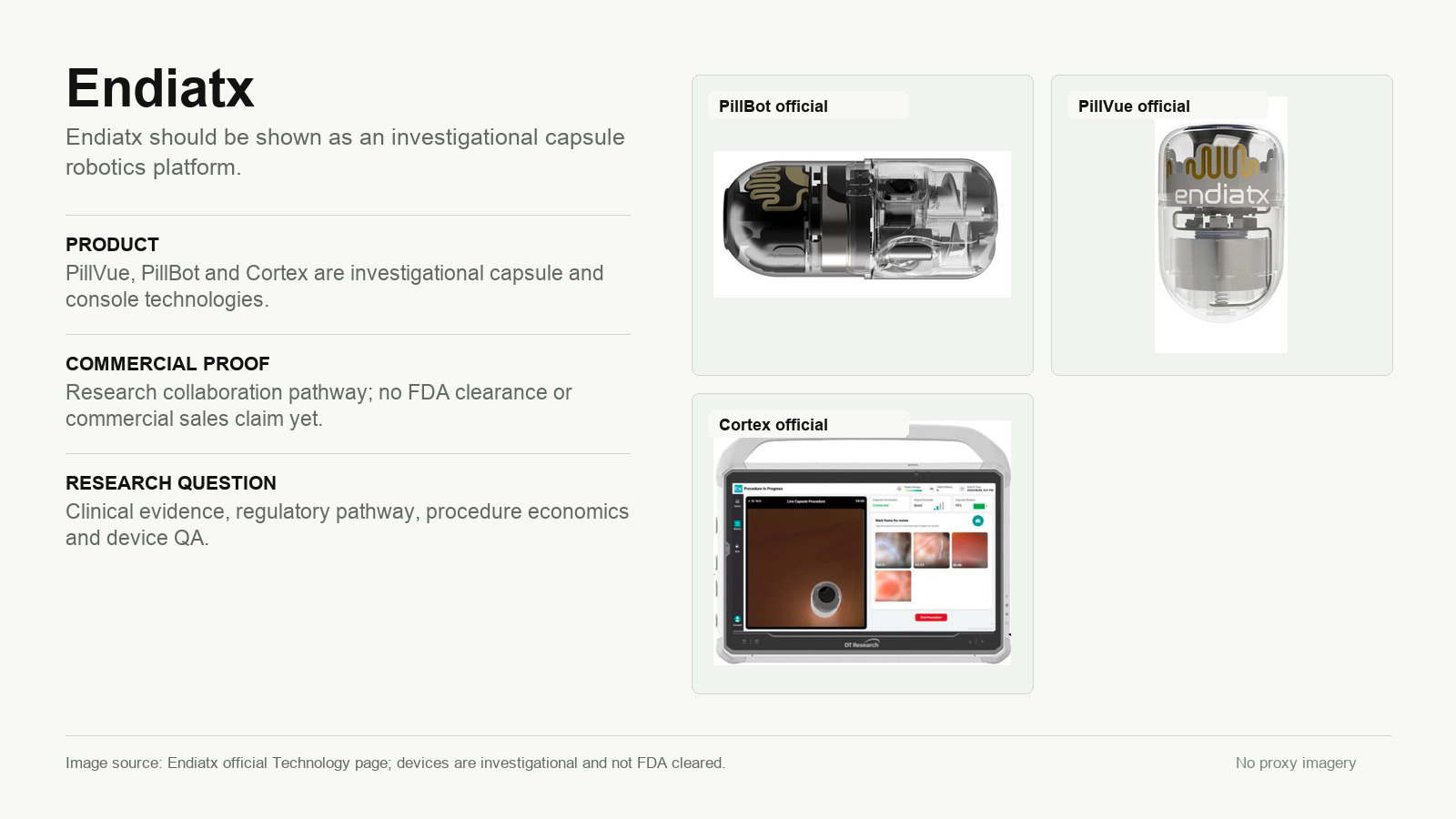
Illustration: Endiatx's investment profile; the right side uses PillBot, PillVue, and Cortex images from Endiatx's official Technology page and marks its investigational-device boundary.
Company Background and Founding Team
Endiatx is a medical microrobotics / swallowable capsule imaging company. Robo Strategy holds 285,322 shares of Direct Series A Preferred, with fair value about $500,000 and about 0.34% of NAV. It represents a direction in medical robotics that is earlier, longer-cycle, and more strongly constrained by regulation.
Endiatx is completely different from industrial robotics and humanoid robotics. Its core is not immediate shipment or using robots to replace labor in the short term, but using swallowable capsule imaging / capsule robotics to change gastrointestinal visualization and potential minimally invasive diagnostic and treatment workflows. The company website very clearly defines current products as investigational devices and says they have not yet received U.S. FDA clearance / approval. Therefore, its value depends on clinical evidence, regulatory approval, physician workflow, hospital procurement, reimbursement path, and medical-device quality systems.
Product Lines and Business Model
Endiatx's public product line can be split into three layers:
- PillVue: investigational capsule imaging platform for real-time gastric visualization. Official description says it is swallowed with water and transmits live video imagery in coordination with an external console. PillVue is currently more like a near-term clinical-research entry point.
- PillBot: investigational capsule robotic platform. Future versions may add active locomotion and AI-assisted navigation for controlled positioning / targeted visualization inside the stomach and GI tract. This is the true robotics upside space.
- Cortex: investigational external workstation used to receive live video stream and support real-time interaction with compatible investigational devices. Cortex is very important to physician workflow, data recording, audit, UI, safety, and clinical process.
The short-term business model should revolve around clinical research cooperation, investigator-initiated studies, trial equipment, and future regulatory path. Medium and long term, it may be device + disposable capsule consumables + hospital/clinic service workflow + software workstation. What truly determines valuation is whether it can move from investigational platform into standard clinical workflow, not the capsule demo itself.
Upstream Supply-Chain Vendors
Endiatx has not disclosed supplier names. Decomposable upstream and quality systems include: capsule shell and biocompatible materials, micro camera and lighting, wireless communication, micro battery or energy system, sealing, image quality inside the gastric environment, real-time video transmission, Cortex workstation, medical data security, sterilization/packaging, design history file, risk management, ISO 13485 quality system, and FDA filing materials.
If PillBot enters the active-motion phase, it will also need to validate micro propulsion/steering mechanisms, gastric localization, thermal safety, fault recovery, patient comfort, swallowing safety, and controllability. Unlike ordinary consumer hardware, failure modes of medical capsule robots connect directly to human safety, and any BOM change may affect validation and approval cycles.
Downstream Buyers, Revenue, and Orders
Endiatx's current public pages emphasize research cooperation rather than commercial sales. The company's IIS page welcomes qualified researchers to submit investigator-initiated studies, focusing on scientific, technical, workflow, usability, and clinical research questions related to PillVue. This is a positive signal, showing that the company is building a clinical evidence entry point; but it is not proof of hospital orders or commercial revenue.
Potential downstream customers include gastroenterologists, hospitals, outpatient endoscopy centers, clinical research institutions, medical-device channels, and final payers. Public information does not disclose FDA clearance, commercial revenue, orders, hospital procurement, procedure volume, reimbursement codes, or gross margin. Robo Strategy's Endiatx holding is essentially a long-term option on "medical microrobotics moving from research to approval." This position does not prove the portfolio has current robot-shipment capability, but it can add medical-robotics tail upside.
Purple Rhombus
Company Background and Founding Team
Purple Rhombus is one of the lowest-transparency small positions in the Robo Strategy portfolio. The verifiable facts are narrow: RoboStrategy's SEC filing lists PU-1003 Fund I, LLC / Purple Rhombus LLC SAFE Note, with fair value of about $250,000 and about 0.17% of NAV. This security is a private / Level 3 fair-value asset. The SEC filing can prove that Robo Strategy has disclosed exposure to this SAFE / fund-like interest, but it cannot automatically prove Purple Rhombus's product, customers, revenue, contracts, or defense classification.
The local ledger marks Purple Rhombus as defense robotics / UAS-related. This can be kept as a research hypothesis, but it cannot be written as a publicly verified conclusion. As of this verification, the public web does not form a closed loop around a company website, founding team, robotics product, drone / unmanned ground-system photos, government contracts, SBIR/OTA records, prime-contractor cooperation, customer announcements, or financing news. Therefore, it should currently be defined as a "low-transparency defense autonomous-systems observation option in Robo Strategy," not an "attested defense robotics company."
Product Lines and Business Model
The specific product of Purple Rhombus cannot currently be publicly confirmed. If the local defense robotics / UAS label is ultimately validated, it may fall into one of four categories: small drones / UAS, unmanned ground systems, defense robotics software/autonomy stack, or dual-use sensor/communication/payload modules. But these four categories are due-diligence paths, not factual statements.
The business model must also be treated conditionally. Defense robotics or dual-use autonomous systems may typically generate revenue through SBIR/STTR, AFWERX / DIU, OTA, military programs, prime-contractor subcontracting, government procurement, system integration, training, and long-term operations and maintenance. They may also first enter through public safety, energy inspection, disaster response, or industrial security before turning toward defense customers. Purple Rhombus currently has no public contract, order, revenue, backlog, pilot KPI, or program-office evidence. Therefore, it cannot be compared at the same evidentiary strength as defense autonomy companies with public product/customer evidence, such as Anduril, Shield AI, Skydio, and Forterra.
Upstream Supply-Chain Vendors
Because the product form is unverified, specific suppliers cannot be listed. The next step should be to first obtain the legal entity and product definition, then continue verification by conditional checklist:
- Legal and securities: Purple Rhombus LLC's state of registration, managers, founding team, the relationship between PU-1003 Fund I / MV Funds LP and the underlying SAFE, SAFE valuation cap / discount / MFN / pro rata, SPV fee, side letter, and conversion rights in later financings.
- If it is small UAS: airframe, propulsion, battery, flight control, GNSS/INS, communication links, EO/IR payload, ground station, anti-jamming, mission software, endurance, payload, mass-production yield, and export controls.
- If it is an unmanned ground system: chassis, motor/drive, battery, sensors, edge computing, teleoperation, communication, ruggedization, IP rating, obstacle/terrain capability, and safety redundancy.
- If it is autonomy software: sensor compatibility, mapping/navigation, simulation, test range, edge deployment, cybersecurity, data closed loop, task success rate, human takeover rate, and reusability.
- If it is a defense supplier: ITAR/EAR, CMMC / NIST 800-171, SAM.gov, USAspending, SBIR/STTR, OTA, DIU/AFWERX, prime / subcontractor relationships, test reports, and reliability data.
The core research action for this position is not to expand inference, but first to close the loop on four things: who the company is, what it makes, who it sells to, and what the specific SAFE terms are.
Downstream Buyers, Revenue, and Orders
Downstream could be national defense, public safety, borders, energy inspection, disaster response, or government customers, but there is currently no public evidence of orders, revenue, backlog, government contracts, prime-contractor cooperation, or program office. For Robo Strategy, the significance of Purple Rhombus is to leave the portfolio a small defense robotics / UAS option, not to provide proof of defense autonomous-systems coverage.
In investment treatment, it should receive a high discount and low weight: the holding is truly disclosed, but operating quality has low transparency. It can be counted in Robo Strategy's "disclosed private-asset cost / fair value," but should not be counted in "verified robotics company coverage" or "commercialized defense autonomous-systems coverage." Only after product, customer, contract, compliance, and technical-testing evidence appears can it be compared in the same table with true defense autonomy leaders.
REK
Company Background and Founding Team
REK is Robot Entertainment Kombat. Robo Strategy holds 1,875,891 shares of Direct Series 1 Seed Preferred, with fair value about $2.5M and about 1.70% of NAV. Public reporting describes REK as a robotics entertainment/competition company founded by Cix Liv, using VR teleoperation of humanoid robots for live full-contact matches.
REK does not follow the same logic as industrial robots, warehouse robots, or home robots. It is more like a combination of "humanoid robots + live entertainment + teleoperation + content IP." Public reports in 2026 show that REK leased a site at 1415 Van Ness Avenue in San Francisco, planned as a robot workshop, showroom, private demos, public opening, robot purchase/rental/customization/repair/demo space, and event venue. Its value depends on attention, venues, competitions, content, sponsorship, and hardware sales, not robots replacing labor.
Product Lines and Business Model
REK's product/business lines can be split into five:
- Live robot combat league: audiences watch humanoid robots controlled remotely by humans compete.
- Offline venue and demos: San Francisco site handles repairs, displays, private demos, public events, and robot interaction.
- Robot purchase/rental/customization/repair: reports mention visitors may buy, rent, customize, repair and demo humanoids.
- Content/IP: robot combat naturally fits short video, live streaming, sponsorship, event IP, and merchandise.
- Teleoperation interface: VR control and low-latency human-machine collaboration are the underlying capabilities.
The business model may come from tickets, membership, venue events, sponsorship, live-stream/media rights, hardware rental/sales, customization services, repair, and brand partnerships. But none of these have disclosed revenue, gross margin, or orders. It is closer to an early entertainment-technology company than a traditional robotics company.
Upstream Supply-Chain Vendors
REK is clearly not fully self-developing humanoid robots in its early stage. REK's early hardware upstream may depend on existing humanoid robot OEMs, with additional custom protection, teleoperation, event safety, and repair capabilities.
The truly key upstream factors are: low-latency VR control, robot motion policies, remote stop and emergency stop, collision safety, joint protection, armor/shells, repair parts, venue safety boundaries, network reliability, and insurance/liability. The 2025 public video of DeREK losing control/falling is instead an important risk signal: robotics entertainment pushes safety, fault handling, teleoperation latency, disconnected behavior, and on-site audience protection to the front.
Downstream Buyers, Revenue, and Orders
Downstream includes live audiences, robot/technology enthusiasts, brand sponsors, content platforms, event organizers, and potential customers who buy/rent robot hardware. Public reporting validates the venue and concept heat, but does not disclose paid-audience count, average ticket price, sponsorship contracts, live-stream revenue, robot sales revenue, or gross margin.
As an investment conclusion, REK is one of the most non-typical robotics positions in Robo Strategy's portfolio. If it succeeds, returns come from an attention flywheel of "robots entering mass culture." If it fails, risks come from safety incidents, hardware wear, venue economics, insufficient event demand, and regulatory/insurance costs. It should be treated as a high-volatility entertainment robotics option and should not be viewed with the same weight as industrial robotics commercialization assets.
Computing Power, Manufacturing Materials, and Market Infrastructure
GMI Computing

Illustration: GMI's investment profile; the right side uses an image from the GMI Cloud website to express its Physical AI computing-adjacent attribute rather than a robot-body company.
Company Background and Founding Team
GMI Computing's external product is GMI Cloud. Robo Strategy holds a SAFE, convertible into Series B Preferred at next financing, with fair value about $2M and about 1.36% of NAV. It is not a robot-body company and not a robotics software company, but an AI-native inference cloud / GPU infrastructure provider.
Its relationship with the robotics track lies in Physical AI computing adjacency: robot foundation models, VLA, world models, simulation, synthetic data, real-world fleet data replay, training evaluation, and large-scale inference all require GPU infrastructure. GMI does not increase Robo Strategy's coverage of robotics OEMs, but it adds picks-and-shovels exposure to "embodied-intelligence computing demand."
Product Lines and Business Model
GMI Cloud's public product lines include:
- Serverless inference: automatic scale-to-zero, batching, latency-aware scheduling, LLM / multimodal API, multi-tenant isolation.
- Dedicated GPU infrastructure: bare metal GPU, container service, managed GPU clusters, root access, SLA-backed delivery, multi-region deployment.
- GPU products: the website discloses H100, H200, B200, GB200 NVL72, GB300 NVL72 and others. Pricing page shows H100 from $2.00/GPU-hour, H200 from $2.60/GPU-hour, B200 from $4.00/GPU-hour, and GB200 NVL72 from $8.00/GPU-hour.
- Full-stack platform: inference layer, orchestration layer, compute layer, hardware layer, Kubernetes-based platform, RDMA-ready networking.
The business model is GPU-hour, reserved capacity, dedicated cluster, enterprise AI infrastructure, managed GPU cluster, and possible rent-to-own. For robotics companies, it may serve model training, simulation, data processing, and inference. But GMI's current public customers lean toward general AI rather than robotics-specific customers.
Upstream Supply-Chain Vendors
GMI's upstream is not robotics BOM, but the AI data center supply chain: NVIDIA GPUs, servers, racks, RDMA networking, storage, data centers, power, cooling, security, operations and maintenance, and financing. The website discloses 30,000+ GPUs deployed, 99.99% platform availability, 300+ AI team customers, U.S. / Europe / APAC multi-region presence, and NVIDIA Reference Architecture / Reference Platform Cloud Architecture.
The risks of this type of asset also differ from robotics: GPU acquisition cost, depreciation cycle, customer utilization, declining compute prices, debt/lease burden, power and data-center capacity, NVIDIA ecosystem position, customer concentration, gross margin, and capex cycle are more important than robot shipments.
Downstream Buyers, Revenue, and Orders
GMI's website lists or displays customers/cases including Trend Micro, Mirelo AI, Magna AI, WiAdvance, Higgsfield, Utopai, HeyGen, Eigen AI and others, showing some validation among general AI customers. But public materials do not disclose robotics customers, percentage of robotics training revenue, ARR, backlog, GPU utilization, contract duration, gross margin, or customer concentration.
Nox Metals
Company Background and Founding Team
Nox Metals is a small Robo Strategy SAFE holding, with fair value about $750,000 and about 0.51% of NAV. The local Robo Strategy ledger shows that the SEC narrative mentioned Nox Metals' 2026 $11.5M Seed round, led by Hyperion, with Robo Strategy participating.
Product Lines and Business Model
Business logic: it is essentially a vertically integrated automated metals supplier. It mainly provides raw materials such as aluminum plates, metal blocks, and tubing to CNC manufacturers, aerospace OEMs, defense contractors, and automotive manufacturing plants.
Core advantage: under this "reindustrialization" wave, high-end manufacturing companies such as SpaceX and Anduril need suppliers with extremely fast response speed and quality traceability. Nox Metals fills the gap left by traditional incumbents' slow response.
Geographic coordinate: headquartered in Detroit, reflecting its strategic vision of "revitalizing American industry."
Potential robotics-related value includes: reducing the weight of humanoid robot structural parts, improving durability of joints/shells/brackets, improving thermal performance, strengthening defense unmanned-system ruggedization, shortening critical metal-part machining cycles, and reducing dependence on non-China supply chains. But these remain potential relevance, not verified revenue.
Upstream Supply-Chain Vendors
Nox due diligence on upstream and manufacturing should revolve around six questions:
- What materials/processes exactly: alloys, powders, forming, casting, machining, additive manufacturing, heat treatment, surface treatment, or testing?
- Does it have unique IP: patents, formulations, process windows, equipment, software, automated process, or yield data?
- Can it scale: equipment count, capacity, yield, scrap rate, unit cost, delivery cycle.
- Does it have certifications: aerospace, automotive, defense, medical, or industrial customer certifications.
- Does it serve robotics: has it entered the supply chain of robotics OEMs, unmanned systems, defense, aerospace, or automation customers?
- Does it have economics: gross margin, capex intensity, customer qualification cycle, working capital.
Downstream Buyers, Revenue, and Orders
Downstream may be robotics, aerospace, defense, advanced manufacturing, energy, or high-reliability industrial customers, but there are currently no publicly verified customers, revenue, purchase orders, qualification milestones, or robotics OEM wins.
The next most important step is to fill in product definition, customer proof, process moat, and robotics relevance evidence.
Allonic
Company Background and Founding Team
Allonic is an extremely small Robo Strategy pre-seed preferred holding, with 154,798 shares held and fair value of about $291,500 as of 2026-05-31, representing about 0.20% of NAV.
Allonic is an extremely early, low-transparency manufacturing / soft-structure / robotics-infrastructure option.
Product Lines and Business Model
Allonic may involve robot skin, flexible coverings, soft structures, composites, wearable/exoskeleton structures, soft grippers, compliant mechanisms, embedded sensing materials, custom processes, or prototype-to-production manufacturing services.
The business model may be component supply, manufacturing-process licensing, engineering services, prototype cooperation, robotics infrastructure tooling, or small-batch custom production. Because there is no customer and product evidence, it cannot be counted as robot-body coverage, nor as a verified core supply-chain company.
Upstream Supply-Chain Vendors
Allonic due diligence should revolve around materials and manufacturing: does it use elastomers, textiles, composites, foams, polymers, coatings, embedded sensors, or special molding/sewing/lamination/casting/additive/forming processes? Is there repeatable quality control? Can it withstand wear, cleaning, impact, temperature, and safety requirements in outdoor, industrial, medical, or human-contact robotics scenarios?
If Allonic wants to become a robotics supplier in the future, it needs to prove that its products improve safety, durability, tactile sensing, compliance, lightweighting, appearance/skin, dexterous hands, soft grippers, or wearable structures. Otherwise, it is only a general manufacturing/materials early-stage asset.
Downstream Buyers, Revenue, and Orders
Public customers, revenue, orders, production qualifications, and robotics OEM supply relationships are all unverified. Because the position is extremely small, Robo Strategy can bear the information risk. But the research report cannot therefore treat Allonic as proof of supply-chain coverage.
Robotico
Robotico is positioned as a humanoid robotics intelligence and indexing platform. It is more like market intelligence, indexes, trading/treasury flows, mNAV, proposal-to-execution ledgers, SubDAO / RCM project indexes, and transparency infrastructure for robotics capital markets.
Robotico is the first incubation of DEUS Labs, with a DAO approved treasury allocation to acquire a 20% equity position at pre-seed stage. Its "upstream" is not BOM, but data sources: XMAQUINA DAO Portal, governance proposals, treasury movements, Andersen attestations, SPV/issuer documents, private robotics financings, valuations, customers, deployments, secondary markets, and tokenized-asset liquidity. Its "downstream" is also not robotics customers, but DAO members, DEUS holders, RCM/SubDAO users, robotics investors, researchers, and potential data/API/terminal users.
Investment Implications
Robotico's significance to Maquina is strengthening trust, distribution, research, transparency, and capital-market infrastructure. Maquina's largest pain points are that private robotics assets are hard to verify, valuations are opaque, and governance proposals can easily be confused with final holdings. If Robotico succeeds, it can organize DAO proposal, treasury movement, attestation, SPV / issuer, RCM / SubDAO market, and private robotics financing data into a traceable information layer, pushing Maquina from a "single tokenized treasury" toward a "robotics capital-market network."
These pending-verification names also explain why this report cannot mechanically aggregate only according to "companies that appeared in the user table." For portfolio analysis, the most important thing is evidence grade: attested equity, disclosed holdings, governance-approved but pending deployment, ecosystem projects, and low-confidence user tables must be calculated in layers. Otherwise, Maquina's real coverage rate will be overestimated, and the investment-quality difference between Robo Strategy and Maquina will be misjudged.
Penetrating Core European and U.S. Supply-Chain Players
This chapter works backward from the invested companies above to infer supply chains, then adds mature leaders missed in the major-player table. The goal is to identify core non-China vendors in the robotics supply chain and identify unlisted companies among them that can serve as future primary-market / M&A targets.
Penetration Framework
The first layer is computing and models. Humanoid, mobile manipulation, and defense autonomous systems all need training, simulation, inference, and edge computing. Core public companies are NVIDIA, Qualcomm, AMD, and Intel. Core unlisted targets are Skild AI, Physical Intelligence, and FieldAI.
The second layer is perception and safety. Robots need vision, depth, tactile sensing, force control, LiDAR, safety scanning, and industrial inspection. Core companies include Keyence, Cognex, SICK, ifm, Basler, Teledyne, Omron, and Sony image sensors.
The third layer is actuation and motion control. The cost curves of humanoid robots, collaborative robots, and industrial robotic arms are highly dependent on reducers, motors, servos, drives, encoders, and joint modules. Core companies include Harmonic Drive, Nabtesco, maxon, Wittenstein, Kollmorgen, Moog, Bosch Rexroth, Schaeffler, SKF, Nidec, Yaskawa, and FANUC.
The fourth layer is end effectors and dexterous hands. True labor substitution requires grasping, clamping, tactile sensing, and tool changing. Core companies include SCHUNK, Zimmer Group, Robotiq, OnRobot, Shadow Robot, and ATI Industrial Automation.
The fifth layer is industrial control and safety certification. Robots entering factories need PLCs, fieldbus, safety control, certification, production-line integration, and maintenance networks. Core companies include Siemens, Rockwell, Beckhoff, Pilz, SICK, Omron, and ABB Robotics.
The sixth layer is manufacturing and system integration. For robots to move from prototypes to mass production, they need contract manufacturing, quality systems, supply-chain management, and field service. Core companies include Jabil, Flex, Foxconn, Celestica, Sanmina, Bosch, Schaeffler, GXO, Tompkins, and Ricoh.
Core Non-China Supply-Chain Player Table
| Layer | Core company | Country/region | Listing status | Meaning to the robotics industry |
|---|---|---|---|---|
| Computing and simulation | NVIDIA | U.S. | Listed | Jetson, Thor, Isaac, Omniverse, Cosmos, GR00T; core of Physical AI computing and simulation |
| Robot foundation model | Skild AI | U.S. | Unlisted | Skild Brain cross-body model + Fetch / Symmetry warehouse orchestration platform; core is model, data, and deployment runtime, not broad hardware OEM |
| Robot foundation model | Physical Intelligence | U.S. | Unlisted | General robot policies and foundation models |
| General robotics software | FieldAI | U.S. | Unlisted | Field-environment and general robotics software; customer contracts have public reports |
| Machine vision | Keyence | Japan | Listed | High-moat supplier in industrial vision, sensors, and automation |
| Machine vision | Cognex | U.S. | Listed | Industrial vision and identification systems |
| Safety sensing | SICK | Germany | Unlisted / family-controlled | Industrial sensing, safety scanning, and factory-robot safety |
| Actuators | maxon | Switzerland | Unlisted | High-performance motors and drives; key supplier for robot joints and mobile platforms |
| Reducers | Harmonic Drive | Japan | Listed | Core player in harmonic reducers |
| Reducers | Nabtesco | Japan | Listed | Core player in RV reducers |
| Motion control | Bosch Rexroth | Germany | Bosch Group | Industrial motion control, hydraulics, automation |
| Motion control | Schaeffler | Germany | Listed | Precision bearings, actuators, industrial supply chain, and also Agility downstream customer/partner clue |
| Control systems | Beckhoff | Germany | Unlisted / family-controlled | PC-based control, EtherCAT, factory automation control |
| Safety control | Pilz | Germany | Unlisted / family-controlled | Industrial safety control and certification |
| End effectors | SCHUNK | Germany | Unlisted / family-controlled | Core player in grippers, clamping, and end effectors |
| End effectors | Robotiq | Canada | Unlisted | Collaborative-robot grippers and end tools |
| End effectors | OnRobot | Denmark | Unlisted | Collaborative-robot end effectors |
| Manufacturing | Jabil | U.S. | Listed | Apptronik's key manufacturing partner and a robot mass-production amplifier |
| Warehouse AMR | Locus Robotics | U.S. | Unlisted | Mature warehouse AMR and picking systems |
| Warehouse automation | Exotec | France | Unlisted | Skypod goods-to-person system; core European warehouse-automation target |
| Surgical robots | CMR Surgical | U.K. | Unlisted | Versius surgical robot; European medical-robotics challenger |
| Defense autonomy | Anduril | U.S. | Unlisted | Defense unmanned systems, autonomy software, and scaled manufacturing |
| Defense autonomy | Shield AI | U.S. | Unlisted | Hivemind, V-BAT, autonomous unmanned-system software |
| Legged robots | Boston Dynamics | U.S. / Korea | Hyundai-controlled | Spot, Stretch, Atlas; benchmark for legged control and technology brand |
Unlisted Targets Most Worth Continued Tracking
The first group is robot foundation models and the software layer: Skild AI, Physical Intelligence, and FieldAI. They may not manufacture all hardware, but they may control cross-body generalization capability, data closed loops, and deployment software. If the robotics industry shifts from "competition among body companies" to "control by the model layer," this group of targets will be very important.
The second group is mature bodies that are still unlisted: Boston Dynamics, Locus Robotics, Exotec, and CMR Surgical. Their common feature is that they already have real products, real deployments, or a regulatory path, making them closer to commercialization than most pure humanoid stories.
The third group is defense autonomous systems: Anduril, Shield AI, and Skydio. They are not necessarily included by traditional robotics investors as "robotics companies," but from first principles, unmanned systems are robots. Orders, government budgets, and real deployment in this direction may realize faster than consumer robotics.
The fourth group is upstream family/private supply chains: SICK, maxon, Beckhoff, Pilz, SCHUNK, Robotiq, OnRobot, and Wittenstein. They do not necessarily have a high-growth narrative, but they control the sensing, safety, motion-control, and end-effector capabilities required for robots to enter real factories.
Unitree Supply-Chain Penetration: Calibrating European and U.S. Supply-Chain Coverage with a Chinese Mass-Production Sample
Unitree's registration prospectus gives a very rare reference system: for a Chinese robotics company that has entered mass production across quadruped, humanoid, consumer-grade, and industry-grade products, where exactly do the real BOM and supply chain fall by account category?
Procurement Structure: Mechanical Parts' Weight Continues Rising
Unit: RMB 10,000.
| Category | 2023 | 2024 | 2025 | Reading |
|---|---|---|---|---|
| Mechanical parts | 2,815.78 / 39.91% | 9,384.04 / 48.45% | 40,255.54 / 50.71% | Largest BOM exposure, and share continues rising. After humanoid and large-platform volume grows, structural parts, transmission parts, machined parts, shells, and assembly parts become more important. |
| Electronic components | 2,249.28 / 31.88% | 4,626.81 / 23.89% | 17,782.18 / 22.40% | Control, perception, PCBs, chips, connectors, passive components, etc.; the high 2023 share partly came from early stocking and product-iteration cadence. |
| Electrical materials | 1,580.10 / 22.39% | 4,285.12 / 22.12% | 17,642.58 / 22.23% | Related to motors, harnesses, power, batteries, drives, and electrical connections; key layer for actuator and whole-machine reliability. |
| Packaging materials | 142.62 / 2.02% | 382.83 / 1.98% | 1,587.12 / 2.00% | Scales linearly with shipments, but is not a core barrier. |
| Auxiliary materials | 120.81 / 1.71% | 256.04 / 1.32% | 1,505.84 / 1.90% | Consumable materials in volume manufacturing. |
| Basic materials | 147.06 / 2.08% | 433.27 / 2.24% | 604.74 / 0.76% | Declining share shows procurement shifting more toward processed parts and modular materials. |
| Total raw-material procurement | 7,055.65 / 100.00% | 19,368.12 / 100.00% | 79,378.00 / 100.00% | 2025 grew by about 3.10x versus 2024; supply-chain expansion pace moved in sync with revenue growth. |
Unitree also disclosed that imported materials procured through domestic agents account for about 20% of raw-material procurement. This means that even if a Chinese robotics company has strong self-developed joints, motion control, and whole-machine integration capability, high-end chips, key sensors, servo/electrical components, and cloud computing power may still be affected by trade friction, export controls, and overseas supply-chain cadence. For Maquina / Robo Strategy, this in turn shows that a robotics portfolio cannot look only at body companies; it must also look at computing, sensing, motion control, and manufacturing.
Top Five Raw-Material Suppliers in the Last Three Years
Unit: RMB 10,000.
| Year | Supplier | Procurement amount | Procurement content | Share of total raw-material procurement |
|---|---|---|---|---|
| 2025 | Supplier AB | 4,320.34 | Mechanical parts, auxiliary materials | 5.44% |
| 2025 | Supplier I | 3,789.07 | Mechanical parts | 4.77% |
| 2025 | Shanghai Yaoli Electronic Technology Co., Ltd. | 3,725.74 | Electronic components, electrical materials | 4.69% |
| 2025 | Supplier AC | 3,052.16 | Mechanical parts, auxiliary materials | 3.85% |
| 2025 | Supplier D | 3,003.53 | Electrical materials | 3.78% |
| 2025 | Total | 17,890.84 | - | 22.54% |
| Year | Supplier | Procurement amount | Procurement content | Share of total raw-material procurement |
|---|---|---|---|---|
| 2024 | Supplier B | 1,259.21 | Electronic components | 6.50% |
| 2024 | Shanghai Yaoli Electronic Technology Co., Ltd. | 1,170.05 | Electrical materials, electronic components | 6.04% |
| 2024 | Supplier I | 1,042.43 | Mechanical parts | 5.38% |
| 2024 | Ningbo Yichuang Metal Technology Co., Ltd. | 828.48 | Mechanical parts, basic materials | 4.28% |
| 2024 | Zhejiang Tiandiao Precision Manufacturing Co., Ltd. | 821.12 | Mechanical parts | 4.24% |
| 2024 | Total | 5,121.29 | - | 26.44% |
| Year | Supplier | Procurement amount | Procurement content | Share of total raw-material procurement |
|---|---|---|---|---|
| 2023 | Shenzhen Pingshan New District Yujinkang Hardware Products Factory | 459.09 | Mechanical parts | 6.51% |
| 2023 | Shanghai Yaoli Electronic Technology Co., Ltd. | 427.41 | Electrical materials, electronic components | 6.06% |
| 2023 | Shenzhen Boke Supply Chain Management Co., Ltd. | 258.66 | Electronic components | 3.67% |
| 2023 | Shenzhen Futonlin Electronics Co., Ltd. | 212.80 | Mechanical parts | 3.02% |
| 2023 | Ningbo Yichuang Metal Technology Co., Ltd. | 199.45 | Mechanical parts, basic materials | 2.83% |
| 2023 | Total | 1,557.41 | - | 22.07% |
First, supplier concentration is not high. The top five raw-material suppliers accounted for 22.07%, 26.44%, and 22.54% respectively, with no single supplier exceeding 50% of procurement, and the company has no related-party relationship with major suppliers. This shows that Unitree's mass-production capability is not tied to a single supplier, but built on a relatively distributed Yangtze River Delta and Pearl River Delta manufacturing network.
Second, in 2025, more large suppliers appear as anonymous codes, showing that the registration prospectus desensitized key commercial partners. Among disclosed real names, Shanghai Yaoli Electronic Technology Co., Ltd. entered the top five for three consecutive years, covering electronic components and electrical materials, making it the most stable named supplier clue. Ningbo Yichuang Metal Technology Co., Ltd. appeared in 2023 and 2024, pointing to mechanical parts and basic materials.
Third, most direct suppliers are not mature listed companies. For secondary-market research, Unitree's disclosure is more suitable for "functional-layer mapping" than for a "direct supplier buy list." What truly transfers to overseas portfolios are supply-chain nodes: mechanical parts, transmission/actuation, electrical drives, electronic components, cloud computing power, servers, outsourced manufacturing.
Outsourcing, Computing Power, and Manufacturing Flexibility
| Link | Unitree disclosure | Reading |
|---|---|---|
| Outsourced processes | SMT/placement, injection molding, surface treatment, wire customization, winding, machining, assembly, welding, overmolding, cutting, etc. | Unitree is not a pure self-built full-process factory, but a manufacturing organization of "self-developed design + outsourced supply-chain processes + internal assembly and testing." |
| Outsourced procurement amount | RMB 2.3881M in 2023, RMB 7.0118M in 2024, RMB 23.5467M in 2025; 2.72%, 4.17%, and 3.50% of operating cost. | Outsourcing grows with volume, but is not the largest cost item. The core remains raw-material BOM and internal integration capability. |
| Labor outsourcing | RMB 11.6169M in 2023, RMB 19.2226M in 2024, RMB 68.0265M in 2025. | Labor outsourcing supports assembly flexibility during volume ramp. Automation rate, output per employee, and quality consistency need to be tracked later. |
| Cloud services and servers | Multiple cloud-service contracts with Beijing Kingsoft Cloud Network Technology Co., Ltd., including amounts of RMB 48.2238M, RMB 16.2510M, RMB 21.8547M, RMB 14.3040M, etc.; Pusai Computer (Shanghai) Co., Ltd. servers at RMB 5.5920M; Supplier AA cloud service at RMB 5.9993M. | Embodied-intelligence companies' procurement has explicitly entered computing and cloud services, not only hardware BOM. Training, simulation, and data closed loops will become part of robotics companies' cost structure. |
Mapping to European and U.S. Supply-Chain Players
| Unitree supply-chain node | Chinese sample signal | European / U.S. / Japanese functional-equivalent observation | Implication for Maquina / Robo Strategy |
|---|---|---|---|
| Mechanical parts and transmission parts | 50.71% of raw-material procurement in 2025; multiple top-five suppliers are mechanical-parts suppliers. | Harmonic Drive, Nabtesco, Wittenstein, Schaeffler, SKF, Jabil, Flex, etc. | When humanoid body companies enter mass production, the true pressure points are precision machining, transmission, structural parts, and manufacturing yield. The portfolio needs upstream industrial supply-chain exposure. |
| Electronic components and electrical materials | 44.63% combined in 2025; Shanghai Yaoli Electronics appeared for three consecutive years. | maxon, Kollmorgen, Bosch Rexroth, Beckhoff, Omron, Nidec, Yaskawa, Qualcomm, NVIDIA, etc. | Robots are not "AI model + shell." Motors, drives, control, power devices, and edge computing determine cost and reliability. |
| Perception, chips, and imported materials | Imported materials procured through domestic agents account for about 20%. | NVIDIA, Qualcomm, Sony image sensors, SICK, Keyence, Cognex, Basler, Teledyne, etc. | Overseas supply-chain companies may simultaneously be constraint variables for Chinese body companies and core supply for overseas body companies. |
| Cloud computing and servers | Kingsoft Cloud, Pusai servers, and Supplier AA cloud services enter major procurement contracts. | NVIDIA, GMI Computing, CoreWeave, AWS, Google Cloud, Microsoft Azure, etc. | Robotics funds cannot classify computing power only as "AI software." Physical AI training and simulation consume real capital expenditure. |
| Outsourced manufacturing and system integration | SMT, injection molding, surface treatment, machining, assembly and other outsourced processes, but cost share is not high. | Jabil, Flex, Foxconn, Celestica, Sanmina, Ricoh, Tompkins, etc. | When Figure, Apptronik, and Agility move from prototypes to scaled delivery, EMS, line integration, quality systems, and field service become amplifiers. |
Investment Conclusion
Unitree's disclosure strengthens this report's core judgment on Maquina and Robo Strategy: both are currently more sensitive to robot body companies and have clearly insufficient coverage of supply-chain companies. Humanoid-robot financing stories easily concentrate on bodies such as Figure, Apptronik, Dyna, NEURA, and 1X, but Unitree's prospectus shows that the real cost curve of a mass-produced robotics company first lands on mechanical parts, electronic components, electrical materials, and manufacturing organization.
Therefore, the next step for non-China robotics portfolios should not simply be to add an "overseas Unitree." Instead, they should fill in the "overseas functional equivalents of Unitree's supply chain": motion control, reducers, motors, drives, sensing safety, industrial control, EMS, cloud computing, and deployment integration. If Maquina wants to become a robotics capital-market DAO, it should bring upstream private leaders and mature supply-chain companies into its target pool. If Robo Strategy wants to look like a robotics industry index rather than a high-volatility humanoid private fund, it also needs to reduce body concentration and increase supply-chain exposure that is deliverable, certifiable, and manufacturable at scale.
Reference Sources
- XMAQUINA official documentation and attestation: https://docs.xmaquina.io , https://docs.xmaquina.io/dao/attestations , https://docs.xmaquina.io/dao/treasury-dao , https://docs.xmaquina.io/deus-labs-overview , https://www.xmaquina.io/how-it-works , https://www.xmaquina.io/deus-token
- RoboStrategy SEC filings: N-CSRS (2026-05-08) https://www.sec.gov/Archives/edgar/data/2081119/000121390026053808/ea0288089-01_ncsrs.htm , N-2/A (2026-06-16) https://www.sec.gov/Archives/edgar/data/2081119/000121390026068988/ea0294552-01_n2a.htm , 424B3 (2026-06-24) https://www.sec.gov/Archives/edgar/data/2081119/000121390026071580/ea0295862-01_424b3.htm
- Skild AI official disclosures: https://www.skild.ai/blogs/announcing-our-300m-series-a , https://www.skild.ai/blogs/building-the-general-purpose-robotic-brain , https://www.skild.ai/blogs/series-c , https://www.skild.ai/blogs/reindustrial-revolution , https://www.skild.ai/blogs/skild-zebra
- Sanctuary AI official disclosures: https://sanctuary.ai/solutions/physical-ai/ , https://sanctuary.ai/solutions/hydraulic-hands/ , https://sanctuary.ai/news/sanctuary-ai-expands-physical-ai-strategy-to-industrial-robotics-demonstrating-production-ready-ai-performance/ , https://sanctuary.ai/milestones/
- Genki Robotics public identity clues: https://genki.com/ , https://www.linkedin.com/company/genki-robotics
- Company real product illustration source list: company-real-product-image-sources.json
- IFR World Robotics 2025 industrial-robot summary: https://ifr.org/img/worldrobotics/Executive_Summary_WR_2025_Industrial_Robots.pdf
- Figure AI Series C, BotQ, and F.03 production disclosures: https://www.figure.ai/news/series-c , https://www.figure.ai/news/botq , https://www.figure.ai/news/ramping-figure-03-production
- Agility Robotics de-SPAC transaction materials and company disclosures: https://www.agilityrobotics.com/news
- AutoStore investor relations page: https://www.autostoresystem.com/investors
- Intuitive Surgical installed-base and market-share secondary basis: https://moneyweek.com/investments/tech-stocks/intuitive-surgical-a-comforting-stock-for-troubled-times
- Anduril financing valuation secondary report: https://www.axios.com/2026/03/04/anduril-palmer-luckey-valuation
- ABB Robotics / SoftBank transaction secondary report: https://www.marketwatch.com/story/softbank-to-pay-5-4-billion-for-robotics-producer-one-of-four-areas-its-investing-to-realize-artificial-super-intelligence-df5b737b
- CoCo Robotics official product, team, and operating basis: https://www.cocodelivery.com/ , https://www.cocodelivery.com/coco2 , https://www.cocodelivery.com/about
- CoCo / DoorDash and Chicago rollout reports: https://www.theverge.com/news/647206/door-dash-coco-side-walk-robot-delivery-la-chicago , https://www.axios.com/local/chicago/2024/12/13/coco-food-delivery-robot-chicago
- Endiatx official investigational-device disclosures: https://www.endiatx.com/technology.html , https://www.endiatx.com/iis.html
- REK / Robot Entertainment Kombat public reports: https://www.sfchronicle.com/tech/article/buy-fighting-robots-sf-22231111.php , https://nypost.com/2025/07/24/tech/human-like-robot-goes-berserk-and-throws-tantrum-at-san-francisco-robotics-lab/
- GMI Cloud official product, GPU, and company disclosures: https://www.gmicloud.ai/en , https://www.gmicloud.ai/en/company/about , https://www.gmicloud.ai/en/gpus