TL;DR
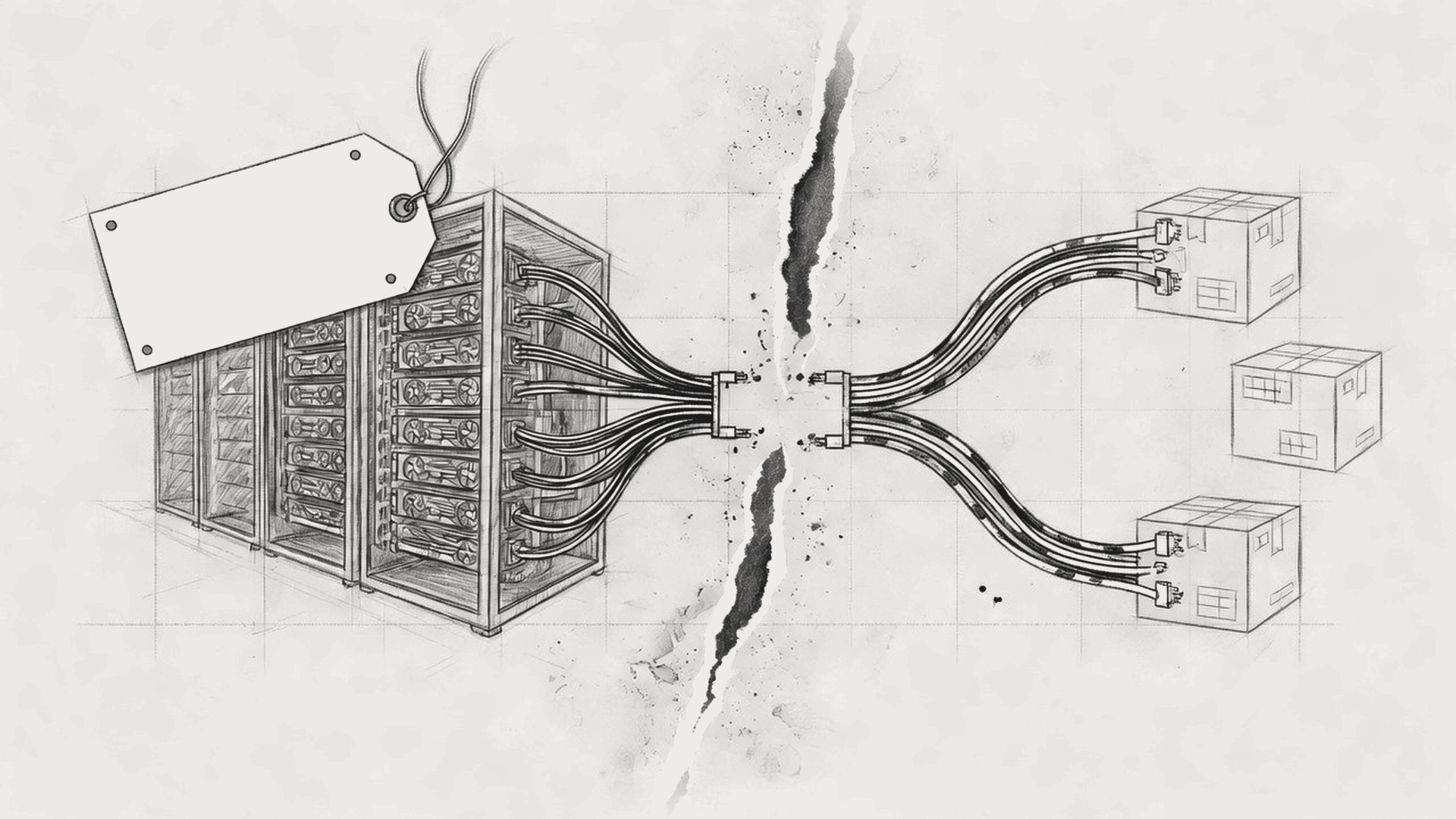
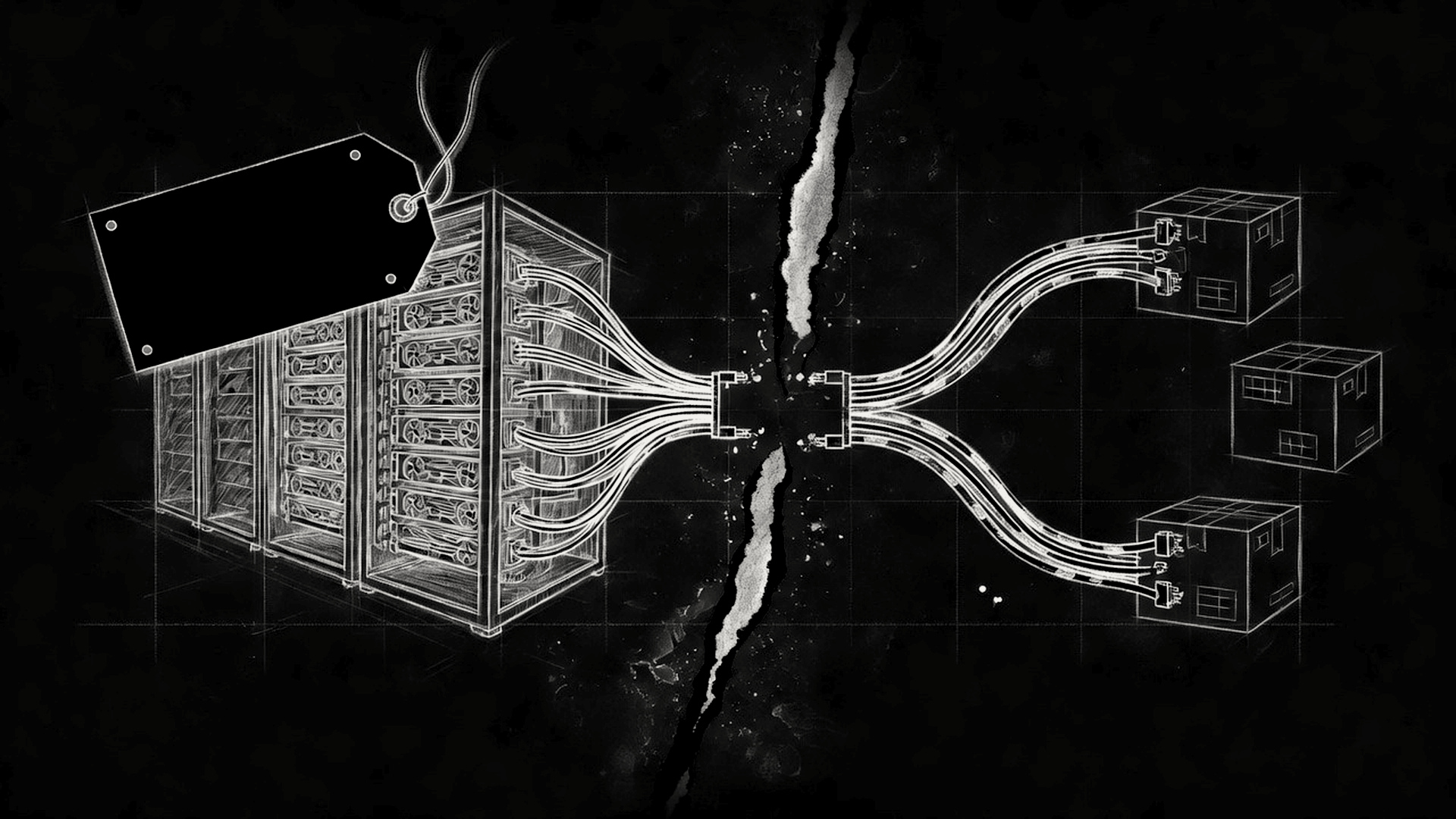
"Holding the GPUs / selling compute can be split apart" is not an invention of SGRX; the crypto mining-rig circle (at least CYPH) has already used pre-funded warrants to exchange for equipment and hosting contracts. SGRX's difference is: applying the same playbook to not-yet-delivered NVIDIA Blackwell B300 receiving rights, and stacking on top of that pre-delivery recurring-revenue guidance plus unnamed third-party management. The thickest layer of the story is precisely the thinnest layer of the public filings.
The APA signed by SGRX has a nominal consideration of about $11M ($1M cash + $10M stated-value pre-funded warrants); the subject matter is in-transit/receiving rights to 16 B300s and interests in undisclosed customer and hosting contracts. To date, the company still discloses not delivered, not deployed; the manager, the Malaysia facility, and customer names are all unnamed in the main contract body. The substance of the main business remains close to a DOGE treasury + highly dilutive financing shell, rather than an AI infrastructure operator that already contributes revenue.
DUOT, by contrast, is four layers of entities composing the same kind of narrative—Duos Edge AI self-operates Edge DCs, GPUaaS LLC (SPV) holds the cards, Hydra Host is named for GPUaaS distribution and operations, USD.AI $98.1M asset-backed financing. Cash and equity are thick; equipment deposits and GPUaaS contract liabilities are already on the balance sheet; but Hosting/GPUaaS revenue has almost not yet entered the income statement, and the big story still sits in contract liabilities and management guidance.
SGRX
Company development history and management team
SANGRIX (ticker SGRX) is not an AI-infrastructure native company, but a continuous Cayman micro-cap path of changing businesses: pork-processing shell → U.S. Bitcoin mining → trace DePIN/mining-rig agency → Dogecoin treasury → undelivered GPU rights package. To understand the B300 deal, one must first see clearly this shell history—otherwise it is easy to read the "AI infrastructure assets" in the PR as racks that are already powered on.
In 2018 it was established in the Cayman Islands as China Xiangtai Food and prepared for listing; in 2019 it listed on the Nasdaq Capital Market as PLIN, with its main business Chongqing pork slaughtering, packing, and wholesale. In 2022 it spun off the food assets for about $1M cash, renamed Bit Origin (BTOG), and shifted into U.S. BTC mining; at end-2023 it shut down U.S. mining sites for cost reasons. In 2024 it signed an Aethir sales-representative agreement with NGH/AEAI (the PR once wrote Strategic Partnership; the contract substance is sales representative rather than JV); FY25 mining-rig agency net revenue was only about $39k. Mid-2025 it launched DAT: through convertibles and private placements it stacked DOGE to about 70.54 million coins (cost basis totaling about $16M), and marketed externally a $500 million financing capacity—that figure is the sum of the convertible ceiling and the EPFA equity capacity ceiling, not cash received. Mid-2026 it further stacked the B300 APA, and from 2026-09-04 began trading as SANGRIX INC. / SGRX.
The full event table is below
| Time | Event |
|---|---|
| 2018-01-23 | Cayman incorporation of China Xiangtai Food Co., Ltd. |
| 2018-09-28 | IPO registration effective (Boustead underwriting; best-efforts 1–3 million shares @ $5.00) |
| 2019-05-10 / 08-14 | IPO closing; Nasdaq opens as PLIN (Chongqing pork) |
| 2021-12-13 | Jinghai Jiang becomes COO |
| 2022-02-15 | Ticker PLIN → BTOG |
| 2022-04-27 | Food spin-off closes (about $1M cash); rename Bit Origin; Lucas Wang becomes CEO/Chairman |
| 2022-05 → 2023-12 | BTC mining starts then shuts down (Indiana/Wyoming) |
| 2023-05-30 | 1-for-30 reverse split |
| 2024-03-20 | CFO Xia Wang terminated; thereafter long-term no successor |
| 2024-04-10 | Jiang concurrently CEO, Chairman, director (still concurrent COO) |
| 2024-06-07 | Aethir "Edgar" sales-representative agreement (counterparty NGH, later said assigned to AEAI) |
| 2025-03-14 | Dual-class equity: Class A 1 vote, Class B 20 votes; Jiang's holdings converted to Class B |
| 2025-07–08 | DAT: debt-for-coin / equity-for-coin cumulative about 70,543,745 DOGE |
| 2026-01-20 / 08-21 | 1-for-60, 1-for-5 successive reverse splits |
| 2026-06-28 | APA closing: 16× B300 rights; $1M cash + $10M pre-funded warrants |
| 2026-08-05 | Operations statement: B300 still not delivered, not deployed; still expects Q3 / Malaysia |
| 2026-09-04 | Opens trading as SANGRIX INC. / SGRX |
| 2026-09-07 | Research window: still no delivery 6-K; Q3 calendar quarter through 09-30 |
Management team. Current power is highly concentrated: Jinghai Jiang concurrently holds CEO + COO + Chairman; the main 6-Ks for 2024–2026 are all signed in his triple capacity. Public résumé is blockchain community and self-described data-center investing. CFO vacant since 2024-03; board turnover and PRs about "evaluating" talent additions cannot substitute for a finance head being in place. Predecessor Lucas Wang (mining-period CEO) resigned in 2024-04; no disagreement disclosed. The governance implication is very direct: public Class A under the dual-class structure are bystanders; dilution tools (convertible standby conversion, pre-funded warrants, reverse splits) mainly hit Class A.
| Role | Name | Key points |
|---|---|---|
| CEO + COO + Chairman | Jinghai Jiang | COO from 2021-12; triple roles from 2024-04; compensation long-term low cash + Class B debt settlement |
| CFO | Vacant | No successor disclosed after 2024-03 termination |
| Predecessor (pork period) | Zeshu Dai | Chairwoman/CEO at IPO; replaced 2022-04 |
| Predecessor (mining period) | Lucas Wang | CEO/Chairman 2022-04 to 2024-04 |
Current business status
As of the H1 FY26 main statements, the company is still not an AI compute operator; the most real assets are the DOGE holdings and financing capacity; the most hollow is the undelivered B300 story.
| Business line | Company narrative | Verifiable facts | Status |
|---|---|---|---|
| Pork processing | Historical main business | Spun off 2022-04 for about $1M cash | Spun off |
| BTC mining | Multi-year PRs still write engaged in mining | U.S. sites stopped 2023-12; FY25/H1 mining revenue $0 | Shut down |
| Aethir / mining-rig agency | "Strategic Partnership", F-1 sales narrative | Sales-rep contract; FY25 net revenue about $39k; H1 $0 | Almost no revenue |
| DOGE treasury | "1st Ever Dogecoin Treasury"; "$500M" | Holdings about 70.5M coins booked; facilities mostly undrawn; staked about 40.5M | Holdings shipped; scale narrative overstuffed |
| B300 / AI | "about $11M NVIDIA Blackwell assets"; post-deployment ~$360k/mo | Contract shipped; machines not delivered | Rights package |
The DOGE books (why we say "substance is still DAT"). July 2025 debt-for-coin about 40.54 million coins (priced at $10M, average about $0.247); August 2025 private-placement equity-for-coin 30 million coins (@$0.20, corresponding to $6M). Blended cost about $0.227/coin. H1 period-end fair value about $8.27M (about $0.117/coin); period FV loss about $7.73M entered operating expenses. In other words: the coins are on the books, but market value has drawn down sharply versus cost; the "treasury" narrative cannot cover the micro-cap constraints of zero operating revenue and cash of about $0.48M (2025-12-31).
On the financing side, the "$500 million" from July 2025 onward = up to about $100M senior secured convertibles + up to about $400M EPFA equity capacity (through 2028-08), Chardan placement, ATW-system funding, coupon 8.25%. Drawn amounts far below the ceiling; the cash engine has long been financing and asset swaps, not mining or GPU rents.
The B300 business in transition
Launch timeline
The AI strategy can earliest be traced to 2026-04, but the 6-K that landed that month was mainly convertible financing, not GPU procurement. The true contract point is 2026-06-28 APA closing; the next day 6-K/PR released about $11M, 16 units, Malaysia facility, and about $360k/mo before opex guidance. The 2026-08-05/06 operations update was still undelivered status, and introduced a five-year unnamed third-party management narrative
| Date | Event | Status / notes |
|---|---|---|
| 2026-04 | AI expansion language appears | Substance leans financing / explore, not procurement closing |
| 2026-06-28 | APA closing | Buyer then named Bit Origin; seller PT Mitra Manunggal Sangkara |
| 2026-06-29 | 6-K + PR | "sixteen (16)" written in 6-K/PR, not in APA §1.01 body |
| 2026-08-05/06 | Operations statement | Still not delivered; five-year unnamed management; still Q3 / MY |
| Through 2026-09-07 | EDGAR review | No 6-K; Q3 window through 09-30 |
Contract information that can actually be confirmed
What was actually bought
In one sentence, for a nominal price of about $11M, what was bought is receiving rights to 16 B300s not yet in hand + interests in several undisclosed customer/facility contracts, not racks already powered on.
| Nominally written into the APA | Reality confirmable from public filings |
|---|---|
| 16× NVIDIA Blackwell B300 (incl. in-transit and receiving rights) | 2026-08-05 still states not delivered, not deployed; through 2026-09-07 no delivery 6-K |
| Interests in related customer service agreements | Customer names, full contract text not filed; |
| Interests in hosting / colo agreements | APA body only has hosting/colo wording; "Malaysia" only in PR/MD&A, not in EX-10.1 |
| Related rights and interests | Absent third-party consent, may only be a seller nominee/agency structure (§1.04) |
The 2026-06-28 "closing" closed a package of contractual rights (company announced APA completed), not server delivery. Indemnity basket $100k, cap $1M (≈ the cash leg, fraud etc. excepted), far smaller than the headline $11M; no escrow.
Counterparty: PT Mitra Manunggal Sangkara
The seller is an Indonesian PT. APA notice address is No.29 Tampa Boulevard, PIK2, Tangerang, Banten; signatory and addressee is David Tedjo (Director / Managing Director). Recitals self-describe engagement in AI infrastructure / GPU computing—but these are seller representations, not third-party verification. No related-party disclosure with Bit Origin / Jiang; also does not claim to be an NVIDIA Partner.
| Field | Fact |
|---|---|
| Legal form | Indonesian limited liability company |
| Notice address | No.29 Tampa Boulevard, PIK2, Tangerang, Banten, Indonesia |
| Signatory / addressee | David Tedjo (Director / Managing Director) |
| Blank in filed HTML | |
| Affiliation with issuer | No related-party disclosure |
| NVIDIA partner | Not claimed; not established on public lists |
Deal machines: B300 @ 687K
The $687,500/unit figure includes stated warrant value. It is not an independent hardware appraisal.
Public filings do not state GPUs per machine, specific SKU (whether NVL8 etc.), and there is no independent hardware appraisal, but we estimate based on the common 8-GPU configuration
| Basis | Amount | Meaning |
|---|---|---|
| Cash / 16 | $62,500/unit | Cash |
| (Cash + stated warrants) / 16 | $687,500/unit | Includes paper warrant value |
| Stated consideration total | $11,000,000 | $1M cash + $10M stated warrant value |
Payment method: 1M + 10M
Cash is the only hard outflow in the headline $11M. Warrant shares are restricted securities; there are no S-3 registration rights.
The payment structure is typical equity-dilutive consideration: little cash, much future equity rights.
- $1M cash: payable / wire to seller (but subsequent 6-Ks have no standalone wire evidence)
- $10M "stated" warrant value: pre-funded warrants issued to seller (about 6,457,863 Class A @ $0.00006 on closing date; aggregate exercise price contractually stated as pre-funded); $10M is contract stated value, not a third-party valuation, nor audited equity injection
Warrant key points: no separate expiration date; exercisable in tranches; has cashless; blocker default 4.99%, can be raised not above 9.99%; no S-3 registration rights; §4(a)(2) private placement. Exercise shares are restricted securities, cannot be publicly resold as ordinary free-trading stock before registration.
| Term | Contract fact |
|---|---|
| Issue date | 2026-06-28 |
| Warrant Shares | 6,457,863 Class A (closing-date base) |
| Exercise price | $0.00006/share; aggregate pre-funded |
| Exercisable | In whole or in part until fully exercised (no separate expiration) |
| Cashless / Blocker | Yes; 4.99% raisable to not exceed 9.99% |
| Registration rights | No piggyback / demand / S-3 |
Operations management outsourcing
The PR says a five-year management agreement related to the transaction was signed, with an experienced third-party management company coordinating deployment, management, and commercialization. The APA requires the seller to deliver the Management Agreement, but Exhibit C is not attached. Thus the five-year term appears only in the PR; rates, waterfall, opex sharing, SLA are undisclosed; whether the seller is itself the manager—the APA only requires the seller to sign that agreement, the PR writes third-party; currently other information cannot confirm.
If taken literally as established, the operating model approaches the listed company as asset/financing party + outsiders operate and sell on its behalf. The difference from DUOT is not in slogans, but in verifiable entities: DUOT's Hydra Host, facilities, and financing parties can all be named and tracked; SGRX leaves the key execution layer in unnamed status.
Data cross-check
$22,500 per unit-month and $4.32M annualized are arithmetic on PR guidance. Customer agreements are not filed.
Post-deployment about $360,000/mo recurring revenue comes from the PR. Customer agreements not filed, not named; management fees/power/colo/network/maintenance undisclosed. Thus $22,500/unit-month, annualized $4.32M is only dividing the guidance, not realized guidance.
Further $/GPU-hour inference depends on "how many GPUs per machine". The industry often narrates HGX B300 as 8 cards, but the issuer's APA/6-K/PR none of them state it. 16×8=128 GPUs is a research assumption;
| Result | |
|---|---|
| $360,000 / 16 | $22,500 / unit-mo (before opex) |
| $360,000 × 12 | $4.32M / year (before opex) |
| Assume 8 GPU/unit, 100% utilization, 730h | Implied about $3.85/GPU-hour |
| Same at 70% utilization | About $5.50/GPU-hour |
Summary: SGRX's "APA model"
Compressed into four sentences:
- Subject matter = undelivered GPU receiving rights + packaged customer/hosting contract interests (names not given)
- Consideration = small cash + large pre-funded warrants (equity dilution)
- Operations = claimed five-year third-party management (person not named, agreement not exhibited)
- Narrative = reports revenue guidance before delivery ($360k/mo before opex)
This is not the same kind of business as "buy the cards yourself, rack them yourself, rent them yourself". It is closer to using capital-structure tools to pack a rights package into a listed-company story.
Current financial condition, reflecting fundamentals
| Metric | Figure | Reading |
|---|---|---|
| H1 revenue | $0 | No operating revenue |
| H1 period-end cash | ~$0.48M | Extremely tight liquidity |
| DOGE FV (2025-12-31) | $8.27M | Holdings shipped; large FV loss vs cost |
| Shareholders' equity | $(1.8M) deficit | Micro-cap shell base color |
| APA cash leg | $1M outflow (subsequent event) | Further squeezes cash |
| Concurrent convertibles | Up to $10M, first tranche $2M etc. | Financing to stay alive, not GPU cash generation |
Adding the $10M warrant "value" into equity to meet Nasdaq shareholders' equity tests belongs to management belief / PR, not an audited balance sheet. If the GPU story is to upgrade to "assets already on balance sheet, revenue already recognized", at minimum it needs a delivery 6-K, identifiable PPE/receivables, and revenue evidence no longer dependent on unnamed contracts—none of which exist yet.
DOGE fair value is the largest asset-like line. Adding $10M warrant “value” into equity to meet Nasdaq tests is management belief / PR, not an audited balance-sheet fact.
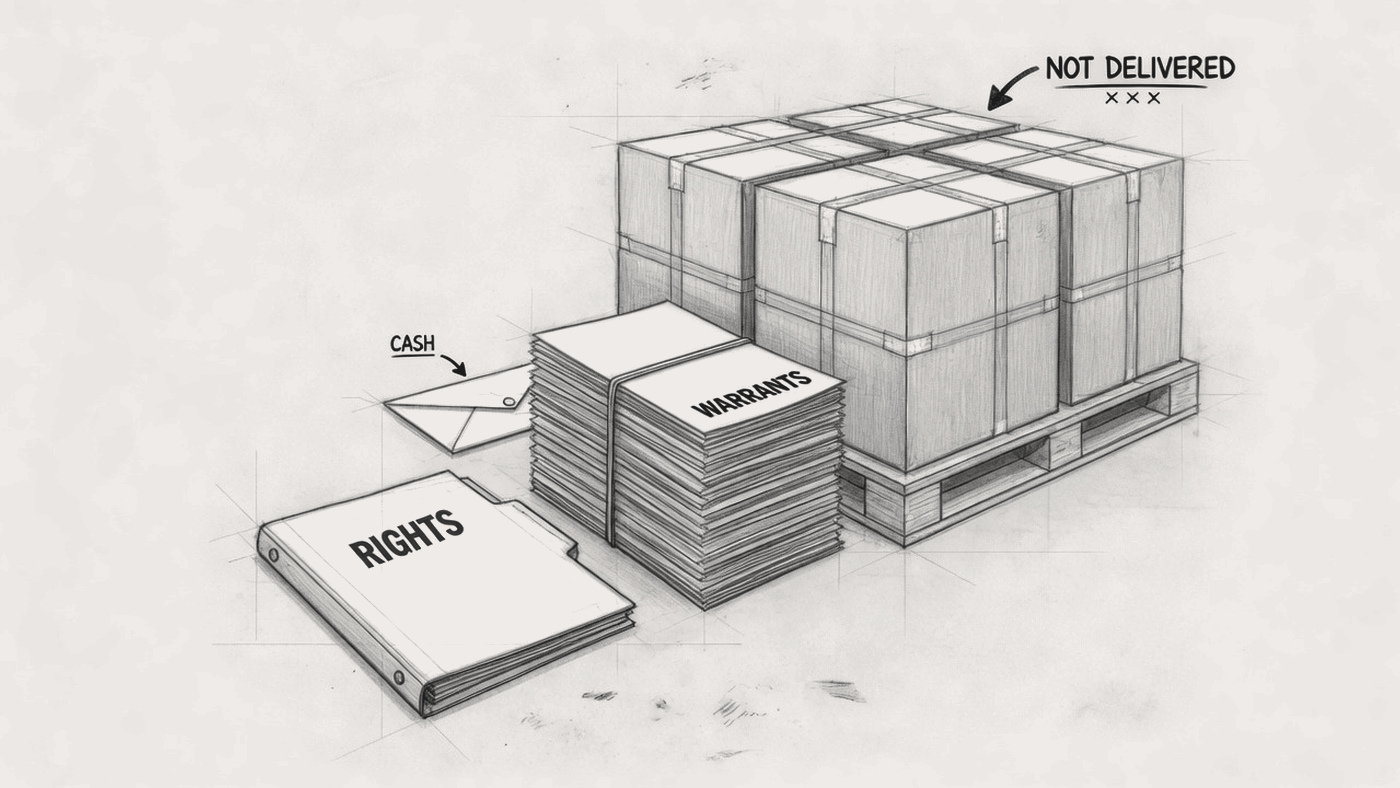
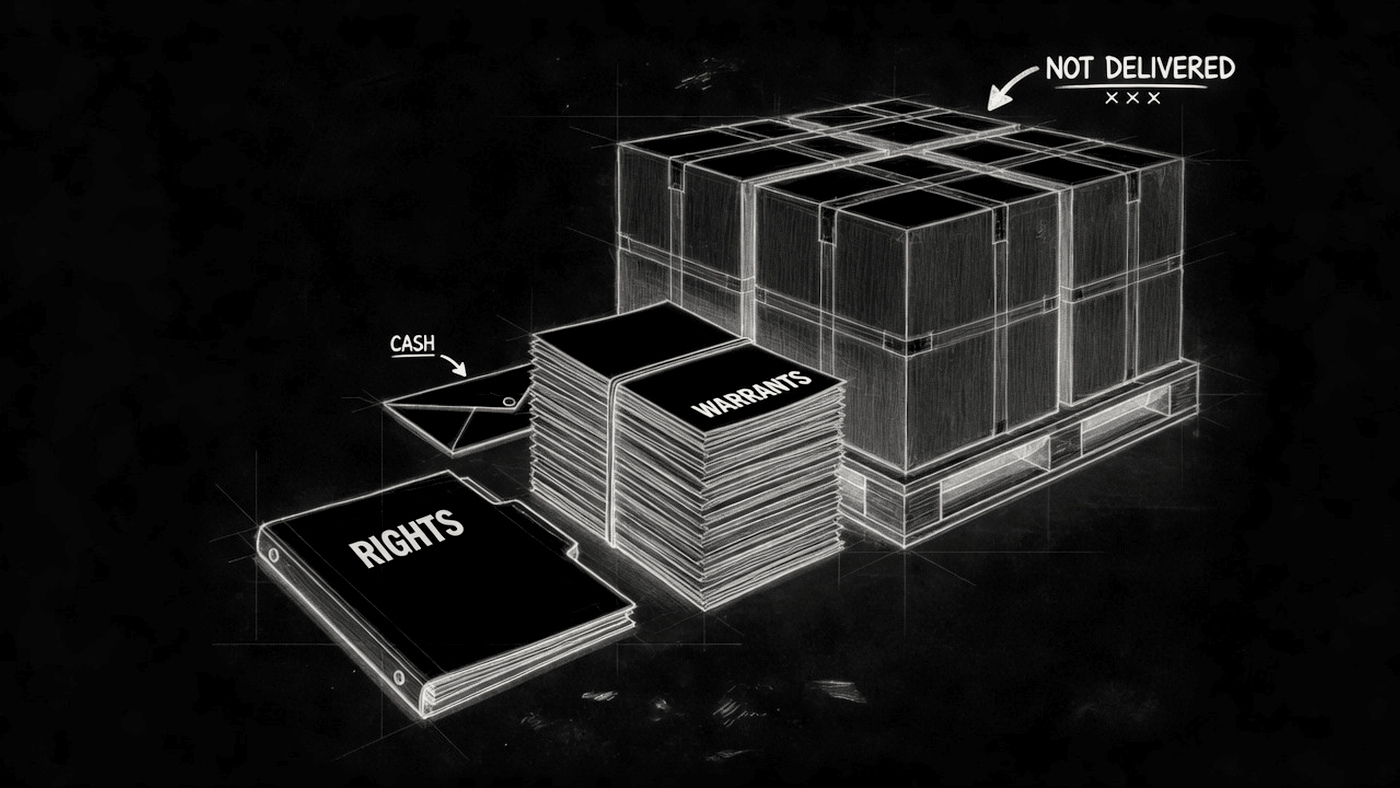
Figure 1. SGRX closed an APA for receiving rights paid mostly with pre-funded warrants. The machines were still not delivered as of the research window. Conceptual illustration, not a photograph of the crates.
DUOT
Company development history and team
Duos Technologies Group (NASDAQ: DUOT) started in Jacksonville, Florida, early on doing machine-vision inspection of rail locomotives/freight cars. Listed on Nasdaq in 2020; in 2024 formally spun out Duos Edge AI, turning toward modular edge data centers; in H1 2026 sold the rail subsidiary, monetized energy-related interests, stacked cash to $110M+, and shifted the main business to "build/own edge facilities + sell rack power + self-hold a batch of GPUs for GPUaaS".
| Time | Event |
|---|---|
| ~2001 | Jacksonville start: rail vision / AI |
| 2015 | Merger path with Information Systems Associates → public-company lineage |
| 2020 | Nasdaq listing (DUOT); Chuck Ferry becomes CEO |
| 2024-05 | Board adopts Edge + Energy dual-subsidiary direction |
| 2024-07 | Forms Duos Edge AI, Inc.; Doug Recker becomes Edge president |
| 2024-12 | Duos Energy × New APR signs AMA (Asset Management Agreement, energy asset-management agreement—old main business, not facilities) |
| 2025 | FY revenue jumps to $27.0M (AMA-driven); Hosting first year only $56k |
| 2026-Q1 | Hydra LOI→formal contract; about $65M equity financing; Recker elevated to group CEO |
| 2026-Q2 | USD.AI $98.1M; Registered Direct $55M; APR interest monetization; Columbus shell purchase and install narrative |
| 2026-08-05 | Rail subsidiary closing spin-off → statements closer to a pure Edge / Tech Solutions platform |
The current management team and board have infrastructure/transport backgrounds, but in 2026 the CFO seat changed multiple people (Brown → Goldfarb interim → DeAlmeida). The major-shareholder system is centered on Bleichroeder
| Role | Name | Key points |
|---|---|---|
| CEO / President | F. Douglas (Doug) Recker | EdgePresence→Ubiquity, Colo5→Cologix background; built Edge from 2024-07; group CEO from 2026-04 |
| CFO | Christopher J. DeAlmeida | Appointed 2026-08-24; base salary $350k; RS 200k shares |
| COO | Dipan Patel | Announced on Q2 call; SBA / Telstra InfraCo infrastructure experience |
| Former CEO / current director | Charles (Chuck) Ferry | 2020–2026 CEO; power/infrastructure background |
| Former Interim CFO | Adrian Goldfarb | Multiple CFO stints; now advisor; holds 50% of rail buyer Sandbank (related party to track) |
GPU business model
Four-layer split framework (analytical main axis)
DUOT is the mode that most resembles what SGRX claims post-delivery: hold the cards + outsource commercialization
| Layer | Entity | What it does |
|---|---|---|
| Physical layer / Edge DC | Duos Edge AI, Inc. (and project entities) | Site selection, buy/build modular or brick-and-mortar facilities, power, racks, operate colo |
| Asset layer / GPUs | Duos Edge AI – GPUaaS, LLC (bankruptcy-remote SPV) | Owns GPUs and related equipment; collateral for USD.AI debt; parent pledges SPV equity |
| Commercialization / GPUaaS | Hydra Host, Inc. (Brokkr AI Factory OS™) | Workload distribution, GPUaaS operations and monetization |
| Financing layer | USD.AI | $98.1M three-year asset-backed, non-dilutive, allegedly non-recourse/off-balance-sheet narrative |
0) How the four entities relate to the listed company (look at equity/contracts first, then cash flows)
The listed parent is Duos Technologies Group, Inc. (NASDAQ: DUOT). Among the four layers, some are consolidated subsidiaries/project entities, some are external contract counterparties.
The parent consolidates Edge AI (facilities) and GPUaaS LLC (card-holding SPV); Hydra connects via contract into "selling compute"; USD.AI connects via debt into "money to buy cards". Risk and profit consolidation scope depends on whether you look at owner rents, GPUaaS service release, or SPV debt and deposits.
| Entity | Relationship to listed company | How they interlock |
|---|---|---|
| Duos Edge AI, Inc. | Wholly owned/consolidated operating subsidiary (Edge DC / hosting / colo core) | Contributes Hosting and some projects to listed parent; provides racks, power, and on-site ops for SPV's cards |
| Duos Edge AI – GPUaaS, LLC | Bankruptcy-remote SPV; parent pledges its equity, generally no joint guarantee (except bad-boy); USD.AI borrower | Holds legal title to GPUs; cards installed in facilities operated by Edge AI; commercialization not by SPV directly to retail customers, but via Hydra |
| Hydra Host, Inc. | External operator/distributor (not a DUOT subsidiary) | Finds customers, uses Brokkr for distribution/ops; prepaid cash enters Duos's books (see below), not Hydra collecting first then remitting |
| USD.AI | External asset lender (not a DUOT subsidiary) | Lends to GPUaaS LLC, collateralized by GPUs etc.; closing tied to delivery/install; PR's "off-balance-sheet" ≠ automatic off-balance-sheet |
Within the same group there are other entities involving non-GPU business: - Duos Technology Solutions, Inc. (equipment sourcing/integration, one of the large continuing-operations revenue heads in Q2); - Duos Energy (the APR/AMA old energy main business discussed below is winding down); rail DTI already spun off. - Axe Compute path: with Duos 51/49 project company to expand MW—hosting/JV tool
1) Physical layer: Duos Edge AI itself as facility owner
Entity: Duos Edge AI, Inc.
Role: Site selection, shell purchase/build-out, power and racks, day-to-day colo operations—facility owner and on-site ops are at this layer, not outsourced to Hydra.
Products are mainly relocatable/assemblable modular edge data centers (company calls them EDC / POD); larger data centers like Columbus also retrofit brick-and-mortar buildings. Company marketing says single-rack power can reach 100 kW+, with clean-room dust-protection selling points, and self-claims ability to take 1–20 MW scale demand. Management on earnings calls has orally said Columbus after shell purchase took about 60 days to install 7+ MW.
On operations, the Q1'26 call said about 22 people on site, with one NOC each in Jacksonville and Amarillo watching machines, redundancy at N+1; local work is contracted out, but dispatch remains controlled by Duos.
Columbus construction is typical AIDC build, not paid in one lump: first cash about $15M, plus up to another $15M owed to the seller—every additional 5 MW of facility power expansion, pay another $5M (cap about three milestones); payment may settle in stock, not necessarily cash outlay.
The key distinction is that within the same facility there are two completely different customer businesses. One is powering/racking the Hydra GPUaaS package (cards under SPV name); the other is pure colo / hosting for external customers who self-hold GPUs.
Capacity totals and mix (only add disclosed MW; do not invent GPU-package power).
| Basis | Approximate scale | Inside: GPU package vs external customers |
|---|---|---|
| Columbus campus → about 20 MW (end-2026 contracted narrative) | Phase 1 about 10 MW (narrative contributing revenue from 2026-08) + separately signed IG 10 MW (available Q4'26) | The latter half (10/20 ≈ 50%) can clearly be labeled external pure colo (customer self-holds GPUs). The first half (10 MW) is the phase-1 deployment basket: stacked inside are Hydra/SPV's 2,304× B300 racking, the 4.3+ MW colo anchor attached to the Hydra path, and Nistar up to 2 MW |
| MW nameable on Hydra/SPV side | Attached colo 4.3+ MW (March PR); GPU proper only discloses unit count 2,304, not MW | By conventional B300 power draw, roughly around 4 MW |
| Company FY26 deployment guidance | About 25 MW contracted & planned | Columbus campus 20 MW narrative already the bulk; remainder other sites/plans |
| Further-out external hosting (not counted in Columbus 20 MW) | Axe total 55 MW (multi-site, conditional; base >$500M ex-power); 0Lat 15 sites/225 cabinets (price undisclosed) | Almost all 1b external/structured deals, not Hydra card-holding package |
Under the expectation of about 20 MW contracted at Columbus, about half the power is already clearly sold to external IG colo; the remaining half is the phase-1 mixed basket—truly self-held GPU package accounts for about 25% of it. The company's further-out growth story (Axe 55 MW etc.) will continue to push physical-layer capacity weight toward customers bringing their own cards, Duos selling power and racks; Hydra's first order is the special case of buying cards itself.
1a) Facility capacity serving the Hydra / SPV GPU package
| Item | Verifiable facts |
|---|---|
| Location | Columbus, Georgia campus (installing) as main narrative |
| Cards | 2,304× B300 installed in Duos facilities; legal title in GPUaaS LLC |
| Who operates facility | Duos Edge (power, cooling, connectivity, break-fix) |
| Who sells compute | Hydra (Brokkr) |
| Attached colo narrative | LOI (Feb 8-K) states incremental colo about $25M / 36 months; March PR separately writes 4.3+ MW colo anchor |
| When revenue enters statements | GPUaaS released as GPUs power on; how facility-side colo fees settle within the group undisclosed |
1b) External customer business (customer self-held GPUs / pure colo·hosting)
| Contract | Counterparty | Nature | Scale / term | Status | Public detail depth |
|---|---|---|---|---|---|
| Columbus IG colo | UNNAMED investment-grade hyperscaler | Pure colo: customer self-holds GPUs; Duos supplies critical IT-load | >$111M / 10 MW / 5 years; available Q4'26 | Signed PR (2026-07-16) | PR clear on critical IT-load; initial 10 MW deployment narrative contributing revenue from 2026-08; this deal plus another 10 MW → campus contracted 20 MW / company self-claims 2026 total contracted deployment 20 MW; separately $55M financing supporting shell purchase. Customer name, $/kW, power-fee split, SLA undisclosed |
| Axe hosting | Axe Compute (AGPU) | Hosting + project SPE equity intent | Two five-year hosting orders totaling 55 MW; contract base payments >$500M (incl. annual escalators, ex power and other usage fees); readiness target late 2026–early 2027 (billing only after RFS + Axe written acceptance) | Non-binding term sheet; final contract not closed | Duos IR: Axe minority, Duos maintains majority; Axe-side draft: Axe expects to hold 49%. Separately existing Georgia 10 MW path narrative. Not Hydra GPU package. Old note "up to $140M for 49%" should not be mixed with this item without source annotation |
| Nistar | Nistar (2026-07-07 PR) | colo MSA | Up to 2 MW critical IT-load @ Columbus; billing narrative about end-2026-08 | MSA signed; deploying | Nistar CEO publicly says serving-customer path about 2 MW / ~1,024× B200; "first of multiple deployments". Specs still flexible |
| 0Lat | 0Lat LLC (Zero Latency) | Non-binding structured lease term sheet | 15 sites (TX/GA) / 225 cabinets total | Diligence ongoing | 90-day mutual exclusivity; intent to structure as true lease in accounting/tax sense; price and payment undisclosed; only exclusivity/confidentiality/fee terms binding |
| Q1 separately described hyperscaler colo | leading hyperscaler (unnamed) | High-power colo | 4.8 MW; call says "complementary" to Hydra path | Call basis | Whether same evolution track as July 10 MW / $111M—public filings do not explicitly equate; research should not forcibly merge |
Site overview (physical layer):
| Site | Status | Capacity narrative |
|---|---|---|
| Columbus, Georgia | Shell purchased (2026-07); installing | Hydra/SPV GPU package + IG colo 10 MW; campus plan ~20 MW; Axe path also points here |
| Iowa (Muscatine etc.) | Deed LOI / advancing | Up to 10 MW; call says some priority shifted to Georgia |
| Nistar | Deploying | ~2 MW colo |
| 0Lat (TX/GA) | Exclusive term sheet | 15 sites / 225 cabinets—not final contract |
Statement reality is Hosting revenue FY24 $0, FY25 only $56k, Q2'26 about $33k, H1'26 about $63k.
Why FY25 (and even H1 2026) the facility revenue side is almost invisible is not that sales were bad and concealed, but that the timeline has not yet reached revenue recognition:
- The Edge business itself is very new: Duos Edge AI only formed in 2024-07; all of FY25 was still in site selection/build-out/commissioning, almost no colo rents recognizable over a service period.
- FY25 company total revenue was not low, but not earned by facilities: FY25 about $27.0M, about 83% from APR/AMA - AMA = Asset Management Agreement; - APR = counterparty New APR / APR Energy system (fast-start generation and other energy assets); - Executing entity is subsidiary Duos Energy: under the AMA provides the counterparty services like finding contracts, engineering/ops, related-party; - This is a remnant of the old main business before transformation, not the same business as Edge facilities or Hydra/GPU; winding down in 2026, revenue will drop toward near zero (company still retains about 5% non-voting equity in the APR parent).
- Large contracts all piled into 2026: Hydra LOI/formal contract, USD.AI, Columbus shell purchase, IG 10 MW, Nistar, Axe etc., main timestamps all after H1 2026; under ASC 606 colo enters books only when service occurs; GPUaaS prepayments first sit in contract liabilities (about $18.77M at Q2 end); income statement still near zero before power-on.
Therefore: the facility story has already unfolded on the asset, contract, deposit side; the revenue side is deliberately lagged—it is not yet delivered/not yet served, not already at full-load operations with no orders.
2) Asset layer: SPV holds the cards, separated from the parent
This layer answers: in whose name are the GPUs legally hung? When borrowing from USD.AI, who is the borrower, what is pledged, and does the parent have to guarantee with the whole listed company?
Duos's approach is: separately open a small company called Duos Edge AI – GPUaaS, LLC (abbreviated Edge GPU in 8-K filings; below called SPV / the box), let the box hold the GPUs, the box borrow; cards can be plugged into Columbus racks, but title is not written into the listed parent DUOT's own equipment ledger as one pot.
- This box is a subsidiary of the parent, and structured as a bankruptcy-remote special-purpose entity (bankruptcy-remote SPV);
- USD.AI lends money to the box, collateral mainly GPUs and other equipment in the box's name;
- The parent pledges its equity in this box to the lender, but generally does not use the whole company to repay this debt; only if it steps on agreed bad-boy (fraud, malicious hollowing-out and similar misconduct) red lines may recourse reach the parent;
- Same facility set: the box is responsible to operate (operate this GPU infrastructure), Hydra is responsible to manage (commercialization management)—PRs sometimes write Duos Edge AI as operating, not fully consistent with the 8-K; the 8-K prevails.
In the public narrative, this is a card-holding little box controlled by the parent; there appear to be no co-shareholders outside; for accounting, view as consolidated subsidiary.
The core motive for going to the trouble of opening the box is to keep money borrowed to buy cards as much as possible inside the project, reducing the surface contractual risk that if the GPU project blows up, the whole listed shell is dragged down by debt.
- Who owes money, what repays it. The borrower is the box; if it cannot repay, the lender first disposes of cards and project assets in the box. The parent usually need not put facility business, book cash, Tech Solutions up as whole-company general guarantor.
- What the parent pledges is "equity in the box", not "whole-company guarantee". On default, the lender can take the parent's ownership interest in this box—the project may change hands; but that is not the same as "every dollar on DUOT's balance sheet guarantees this debt".
- Bad-boy is the fuse. Generally no joint liability is not absolute. Once agreed misconduct like fraud is touched, non-recourse protection may be torn away;
- Risks packed separately. Cards worthless, debt unrepayable → mainly look at the box; facility rents unsold → Edge AI; compute unsellable → Hydra. Clearer than SGRX's one APA pasting all layers.
- Physical location and legal title can be separated. Cards on Columbus racks, title in the box; financing documents write collateral cleanly.
On the other hand
- PR says "off-balance-sheet"; accounting-wise the box is still consolidated. As of 2026-06-30, group statements already have equipment deposits about $68.8M, GPUaaS contract liabilities about $18.77M. What is isolated is "who is general guarantor", not "the group statements cannot see this pile of things".
- Equity is pledged out; the project can still be taken. The parent can avoid joint repayment, but that does not equal GPUs can never be lost.
- Bad-boy boundaries are opaque. How wide the protection really is, public filings have not made clear.
- One card, three roles. Box operates, Hydra manages, Edge AI runs the facility—internal revenue split, who invoices the customer, contracts not public.
- When the lease ends cards remain; residual value needs someone managing it. Management orally said after three years cards may be worth $50–58M, can be sold or renewed at lower price (or only 40–60% of original revenue left)—call basis; shows it is not "lease ends then zero".
Progress currently visible in public
| Item | Status |
|---|---|
| Target deployment | 2,304 NVIDIA B300 GPUs (public original text GPUs; if modeled 8 cards/node ≈ 288 units, issuer has not locked chassis packing) |
| Model language has changed | Earlier LOI/March wrote B800 (scalable to 4608); from June switched to B300—same project narrative evolution, do not treat as two sets of goods |
| Equipment deposits paid | 2026-06-30 ~$68.8M (Q1 ~$41.2M)—money already out, not yet equal to cluster converted to PPE |
| Naming friction | 8-K: Edge GPU operate + Hydra manage; USD.AI PR sometimes writes Duos Edge AI operates—8-K prevails |
Q2'26 10-Q asset side has a line Deposits on equipment ≈ $68,793,810 (about $68.8M). End-Q1 about $41.2M, H1 added another stretch. Management/call basis describes it as deposits against the GPU equipment procurement program ("deposits against our GPU equipment program"); deposits are mainly the company using its own cash (mainly from equity financing etc.) advanced first to buy cards.
3) Commercialization layer: Hydra Host operates and sells compute
Entity: Hydra Host, Inc. (software stack Brokkr AI Factory OS™).
Position in Duot structure: External operator/distributor, not a DUOT subsidiary;
| Item | Public information |
|---|---|
| Product | Brokkr: bare-metal GPU provision / billing / monitoring; long contracts, on-demand marketplace, interruptible, white-label |
| Network scale (self-described) | Brokkr page: 40+ DCs / about 20,000 GPUs; USD.AI About Hydra: 40+ DCs / >30K GPUs; Series A draft: 50+ DCs—marketing figures fight each other; body text only write "company claims tens of thousands of cards, dozens of facilities", do not nail a single number |
| Financing | 2026-06-15 $100M Series A (Kindred lead; participants include NVIDIA, ARK, Founders Fund etc.); aggregator cumulative financing narrative about $189M |
| Named demand-side corroboration | Series A draft names Verizon Business GPUaaS PoC, Parasail (procurement/B300 cluster assistance)—not Duos contract counterparties |
| HQ/people | Boulder (website/PR) and Miami (some secondary sources) coexist; leadership public page lists Aaron Ginn (CEO) etc. |
| Relation to DUOT deal | Financing coverage back-links Duos $176M; Hydra Capital lead also appears in USD.AI deal narrative |
3a) How far the operating contract can be dissected
The main public file is the 2026-03-17 8-K Item 1.01 (contract signing date 03-13) + accompanying PR; inputs/revenue share can only be pieced together from management oral statements and accounting corroboration, cannot be written as audited contract terms.
| Dimension | Disclosed | Still unknown |
|---|---|---|
| Roles | LOI/8-K: Duos Edge = data center and asset owner; Hydra = operator | Boundary details of on-site electricians vs software orchestration |
| Subject evolution | LOI/March: 2304 GPU B800, and can scale to 4608; from June public narrative switched to B300 / 2,304—no separate errata Exhibit | Whether switch revised contract price/amounts |
| Revenue narrative to DUOT | About $176M / 36 months | Whether GPUaaS gross or net, whether before Hydra fee deduction |
| Prepayment | About $18M customer pre-payment; CFO: $15M received in May, another $3M pending; into GPUaaS contract liability (Q2 end total about $18.77M) | Whether prepayment refundable, milestone release schedule |
| Gross margin / EBITDA narrative | GM >80%; annualized EBITDA about $40M | Whether already deducts Hydra share and power fees |
| Attached colo | +4.3 MW colo narrative; colo | Relationship to July IG $111M |
| Revenue share | Recker (Q1'26 call): Hydra does not hold GPUs; specialty is selling and support; original text is”it's a revenue share. They get a small portion of the revenue“ | Share %, waterfall, minimum spend, SLA penalties undisclosed |
| Who collects from end customers | Prepayment enters DUOT consolidated contract liability; CFO says Hydra"secured a customer for the company" | Whether Hydra separately collects platform fees, Brokkr marketplace cut |
| Term | GPUaaS 36 months; colo often called 5–7/5–10 years | Renewal rights, early termination |
Who puts up the inputs: Hardware and large deposits at DUOT/SPV (deposits $68.8M + debt commitment $98.1M); facility CapEx at Edge AI (Columbus etc.); what is publicly visible on Hydra's side is software platform + customer acquisition + operations management
Operating data that can land on DUOT is still only on the DUOT statement side: prepaid liability $18.77M, Hosting revenue still negligible, management says GPUaaS 2H'26 about $26M, Q2 call says Columbus equipped with 2,304× B300. Hydra's own utilization, ARPU, contribution profit on the Duos deal—no independent 10-Q. Why the ~$18M prepayment is recorded in Duos's GPUaaS contract liability, not on Hydra's books, is because of the real flow
- Money flow (CFO Q1'26 call): Hydra"secured a customer for the company"—helped Duos find the end customer; then the customer around 2026-05 wired the company about $15M deposit (another $3M pending), aggregate narrative ~$18M. Collecting entity is the Duos system, not Hydra booking first.
- Why accounting calls it contract liability: Under ASC 606, when the customer pays first and the company has not yet finished delivering the compute service, cash increases while a liability (deferred / contract liability) must be recorded—representing owing the customer future GPU service. After power-on/performance, transfer from liability into revenue. So at Q2 end seeing GPUaaS contract liability about $18.77M matches the prepayment narrative, but the income-statement revenue line is still near zero.
- Why recorded in Duos/SPV consolidation, not Hydra: In the public structure Duos (via SPV) holds the GPUs, is the principal of asset/service obligations; Hydra is external operator / distribution management, taking (undisclosed %) revenue share. The performance obligation corresponding to customer prepayment sits on the card-holder/contract-seller side, hence the liability appears on DUOT consolidated statements. If Hydra's own share exists, public filings do not show it as "Hydra collected 18M first".
- Versus equipment deposits $68.8M: $68.8M is Duos's advance payment to suppliers to buy cards (asset side); $18.77M is customers paying Duos service prepayment (liability side)—opposite directions.
3b) Timeline and differences from SGRX
| Date | Event |
|---|---|
| 2026-02-16 | Non-binding LOI (B800 language; scalable to 4608) |
| 2026-03-13/17 | Formal contract + 8-K; ~$176M / 36 mo; prepay ~$18M |
| 2026-05 | Prepay $15M booking narrative (+$3M pending) |
| 2026-06 | USD.AI; SKU→B300; Hydra itself $100M Series A |
| 2026-08-17 | Q2 call: Columbus equipped 2,304× B300; 2H ~$26M |
| Through 2026-09-07 | Contract Exhibit not public; share % unknown; USD.AI closing not independently confirmed; end customer still UNNAMED |
Versus SGRX: SGRX is a five-year unknown third-party manager; DUOT at least has the manager named, facilities named, financing party named, and the CEO orally acknowledges revenue share, Hydra takes the small end. End customer unnamed, share % and Exhibit missing, remain hard gaps—but verifiability is already a step higher.
4) Financing layer: USD.AI $98.1M asset-backed
What this layer answers. Besides equity raises and own-cash-advanced deposits, is there non-dilutive debt to buy 2,304 B300s? Who borrows the debt, what is pledged, what is the rate, when does it actually fund?
USD.AI (usd.ai) positions itself as an InfraFi protocol doing asset-backed, non-dilutive financing for AI / DePIN hardware—using GPUs and other physical assets as collateral to provide loans to operators; funding side is synthetic dollars / on-chain settlement, letting capital providers access "revenue-generating compute assets". It is not a Duos subsidiary, nor a traditional bank-branch retail brand.
| Item | Public statements |
|---|---|
| Business | Provides asset-backed / non-recourse loans to GPU operators; claims interest comes from overcollateralized credit facilities |
| Product narrative | USDai synthetic dollar; CALIBER framework (turning physical assets into enforceable on-chain warrant/NFT-type documents, with insurance, custody/bailment) |
| Risk-control marketing | Hardware LTV cap narrative about 80%; collateral leans enterprise NVIDIA (incl. B300 etc.); requires install in Tier III/IV facilities, lien waiver / insurance etc. before funding |
| Scale marketing | Claims deployed over $100M GPU loans, plus large pipeline |
| With Hydra | Duos's PR on this deal writes both as the same "AI Factory" stack: Duos facilities + Hydra ops + USD.AI financing; Hydra financing drafts/personnel also appear in USD.AI deal narrative—commercial partnership, not equity consolidation |
What can be confirmed publicly on the $98.1M is three-year term, is a commitment/pending close, not a balance already sitting on the long-term debt line. To truly track "whether the debt has landed", look at subsequent 8-K/notes on delivery + closing, not just the PR headline. USD.AI $98.1M said to close after delivery and install; within the research window no independent "closed" 8-K seen, yet deposits already paid a large amount; someone on Hydra's product side also relayed on LinkedIn about this financing that about $84.1M was first placed in escrow (third-party custody account), to fund only after GPUs are installed and online—meaning most of the loan capacity cash has not yet entered Duos/SPV accounts, stuck at "disbursement only when conditions met".
| Term | Confirmable | Still unknown |
|---|---|---|
| Amount | $98.1M | Whether drawn in one shot, any staged/commitment fees |
| Term | Three-year debt facility | Amortization schedule, maturity, extendability |
| Borrower | Duos Edge AI – GPUaaS, LLC (Edge GPU) | SPV internal account structure |
| Use | Support disclosed NVIDIA B300 deployment | BOM unit price, whether includes networking/racks |
| Collateral | GPUs and related equipment owned by Edge GPU; PR also writes incl. associated offtake contracts | Whether offtake legally assigned, account-control details |
| Parent responsibility | Pledge equity interest in Edge GPU; generally not liable, except bad-boy | Bad-boy list, full pledge agreement |
| Operating roles | Facility operated by Edge GPU, managed by Hydra | Difference from PR wording "Duos Edge AI operate" |
| Closing | Expected to close after GPU delivery and install (then-narrative about within 30 days) | No independent "closed" 8-K within research window |
| Interest rate | — | Undisclosed |
| LTV / covenants / financial covenants | — | Not given in 8-K; USD.AI site 80% LTV etc. cannot be directly written as Duos contract figures |
| Truly "off-balance-sheet"? | PR: non-recourse, non-dilutive, off-balance-sheet | GAAP consolidation and debt recognition follow 10-Q; as of 6/30 no equal long-term debt on books yet, because not yet closed, not because permanently off-balance-sheet already proven |
| Relation to deposits | Company already used cash to pay equipment deposits ~$68.8M | How debt proceeds after close offset payables / top up remaining |
So in practice the cash advanced comes from the listed company itself; in 2026 the parent still thickly raised (about $65M public offering + $55M RD etc.) + APR monetization etc., cash stacked to about $112.3M at 6/30. The sequence more like:
- Equity cash first advances equipment deposits ~$68.8M (and facilities/other);
- USD.AI after delivery/install provides $98.1M asset debt, trying to reduce "keep buying cards via raises";
- Customer prepay ~$18M enters contract liability, improves operating-cash-flow optics, but is not card-purchase funding itself.
So the financing layer more accurately is: the legal framework for the debt exists; cash progress on buying cards relies on deposits first; closing and power-on remain the switches.
The four layers together: how money and risk flow
PR “off-balance-sheet” isolates who is general guarantor. The group statements already show the deposits and the GPUaaS contract liability. 8-K wording on operate/manage prevails over PR.
| Question | Which layer |
|---|---|
| Facility built slowly, power insufficient | Physical layer (Duos) |
| Card residual value, debt unrepayable | Asset layer + financing layer (SPV / USD.AI) |
| Cannot sell compute, utilization low | Commercialization layer (Hydra) + unnamed end customer |
| Continue diluting old shareholders | Parent equity financing (parallel to the four layers, does not disappear inside USD.AI) |
Business estimates
The left side only relies on issuer-disclosed arithmetic (contract price ÷ months ÷ card count); the right side uses our own model sheet under $4.50/GPU-h × 80% utilization × 8 cards/node projections, analyzing the gap.
Common base: Public original text is 2,304 (units of) B300 GPUs, not 2,304 whole machines. Model separately assumes 8 GPUs per node ⇒ 288 servers (issuer has not disclosed chassis packing).
Model anchors (base 3 years): bare-metal $650k/unit, all-in $850k/unit; rent $4.50/GPU-h; utilization 80%; annual hours 8,760; node IT 14.5 kW; facility $3.5M/IT-MW·year.
A. Duos disclosure-side unit economics
| Metric | Calculation | Result |
|---|---|---|
| Contract TCV (narrative) | Disclosed | $176,000,000 / 36 mo |
| Monthly average revenue (if straight-line) | 176e6 / 36 | ~$4.889M / mo |
| Annualized revenue (if full-production straight-line) | 176e6 / 3 | ~$58.7M / year |
| GPU count (current) | PR / call | 2,304 B300s |
| Contract value per card | 176e6 / 2304 | ~$76,389 / GPU / 36 mo |
| Per card per month | 76389 / 36 | ~$2,122 / GPU / mo |
| Prepayment | Disclosed | ~$18M (≈ BS GPUaaS CL $18.77M) |
| Prepay as % of TCV | 18 / 176 | ~10.2% |
| Debt financing | USD.AI | $98.1M / 3 years |
| Debt / contract annualized | 98.1 / 58.7 | ~1.67× one year of revenue |
| Equipment deposits paid | BS | $68.8M |
| Deposits / debt commitment | 68.8 / 98.1 | ~70% already cash-fronted |
| Management gross margin narrative | PR | >80% |
| Management annualized EBITDA narrative | PR | ~$40M |
| Implied management EBITDA margin | 40 / 58.7 | ~68% |
B. Model projection (same 2,304 cards)
| Metric | Model algorithm | Result |
|---|---|---|
| Server count | 2304 ÷ 8 | 288 units |
| Annual revenue | 2304 × 8760 × 80% × $4.50 | ~$72.66M / year |
| Monthly average revenue | Annual / 12 | ~$6.05M / mo |
| Three-year cumulative revenue | ×3 | ~$218.0M |
| Per card 36 months | 218e6 / 2304 | ~$94,608 / GPU / 36 mo |
| Per card per month | 94608 / 36 | ~$2,628 / GPU / mo |
| Implied net rent (pin Duos $58.7M, utilization 80%) | Back-solve | ~$3.63 / GPU-h |
| Implied utilization (pin $58.7M, rent $4.50) | Back-solve | ~65% |
| IT power | 288 × 14.5 kW | ~4.18 MW |
| Annual DC cash cost | 4.18 × $3.5M | ~$14.62M |
| Implied cash gross margin (rev−DC)/rev | ~79.9% | |
| Rough EBITDA (before Hydra share; before model SG&A) | Rev−DC | ~$58.0M; margin ~80% |
| Rough EBITDA (further deduct model personnel SG&A ~$2.6M) | ~$55.5M; margin ~76% | |
| Equipment CAPEX bare / all-in | 288×650k / 288×850k | $187.2M / $244.8M |
C. Comparison table: where the gap is
To pin $176M, effective rent is about $3.63 at 80% utilization, or utilization about 65% at $4.50 — or the $176M is already net after Hydra’s undisclosed share.
| Metric | Duos disclosure arithmetic | Model estimate | Gap | How to read |
|---|---|---|---|---|
| Three-year revenue | $176M | ~$218M | Model higher about +24% | Main gap. To pin $176M, effective rent or utilization must be below model baseline (≈$3.63@80% or ≈65%@$4.50); or $176M is already net after Hydra share (share % undisclosed) |
| Annualized / monthly avg | ~$58.7M / ~$4.89M | ~$72.7M / ~$6.05M | Same about +24% | Same, linear scale |
| Per card 36 mo / monthly | ~$76.4k / ~$2,122 | ~$94.6k / ~$2,628 | Same about +24% | Card count same; gap all from revenue assumptions |
| Prepay ~$18M | ~10.2% of TCV | About 3 months of model annual rev; about 3–4 months of Duos annualized | Close | Prepay ratio reasonable; two sides do not conflict |
| Deposits $68.8M + debt $98.1M = $166.9M | Relative to "contract annualized" 1.67× debt | Relative to bare CAPEX ~89%; relative to all-in ~68% | OK vs bare, short ~$78M vs all-in | If procurement near all-in midpoint, deposits+debt alone insufficient; if near bare/$144M oral, then more coherent |
| Management GM >80% | PR | Model (only deduct MW lump-sum DC) ~80% | Close | Model DC method happens to stick to PR; both sides undeduct Hydra share and real power-fee detail |
| Management EBITDA ~$40M (~68% margin) | PR | Model rough EBITDA ~$55–58M (before share) | Model higher about +$15–18M / higher margin | If accept $176M revenue, management $40M EBITDA is more "tight"; gap may come from share, power fees exceeding lump sum, or PR basis containing conservative buffer |
Gap conclusions (three sentences):
- Revenue side systematically tight by about a fifth: Studio "$4.50 × 80%" is about 24% higher than company $176M narrative—not wrong card count, but effective unit price / utilization / whether net at least one of the three took a hit.
- Cost/GM narrative surface-matches, EBITDA does not: PR >80% GM close to model's ~80% after DC; but management annualized EBITDA $40M clearly below model's "before share" $55M+, meaning the official profit story is more conservative, or costs/share heavier than model assumptions.
- Capital side: deposits+debt barely OK for bare metal, insufficient for all-in; prepay share works on both sides. Tracking focus remains deposits converting to PPE after delivery, USD.AI closing—not treating $176M as already-booked run-rate.
D. Capital-side detail table (deposits / debt vs model CAPEX)
Deposits plus debt are close to bare metal and about $78M short of all-in. Recker’s oral “~$144M worth of GPU” would be ~$500k/unit, below the model bare midpoint.
| Basis | Amount |
|---|---|
| Model CAPEX (bare / all-in) | $187.2M / $244.8M |
| Duos equipment deposits (6/30) | ~$68.8M |
| USD.AI debt commitment | $98.1M |
| Deposits + debt | ~$166.9M |
| Gap vs all-in | ~$78M |
| Gap vs bare | ~$20M |
| Recker "~$144M worth of GPU" oral (Med) | ÷288 ≈ $500k/unit (below model bare midpoint) |
SGRX vs DUOT
| Dimension | SGRX | DUOT |
|---|---|---|
| Subject status | 16× B300 undelivered receiving rights | Own Edge DC + deposits/install narrative; large-scale GPU revenue not yet on P&L |
| Consideration | $1M cash + $10M pre-funded warrants | Equity financing + USD.AI asset debt + customer prepay |
| Facility | Unnamed MY colo (APA body has no Malaysia) | Own/self-operate Columbus etc. |
| Commercialization manager | Unnamed five-year third party | Hydra Host named |
| Cash / equity | Micro-cap, H1 shareholder deficit | 6/30 cash $112M, equity $207M |
| Verifiability | Rights narrative mainly | Entities, debt, prepay, facilities verifiability two orders of magnitude higher; end customer still unnamed |
Plain-language closing: where the two companies differ
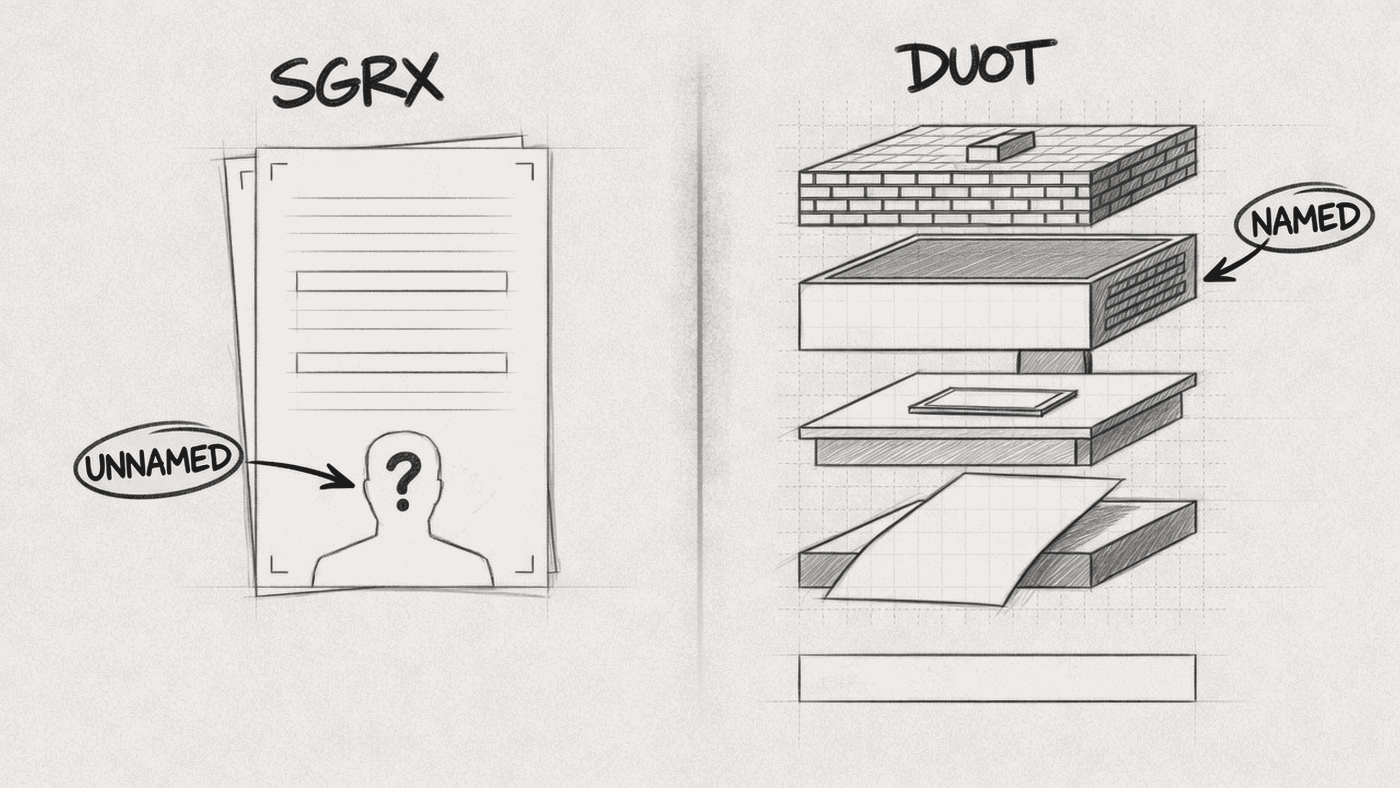
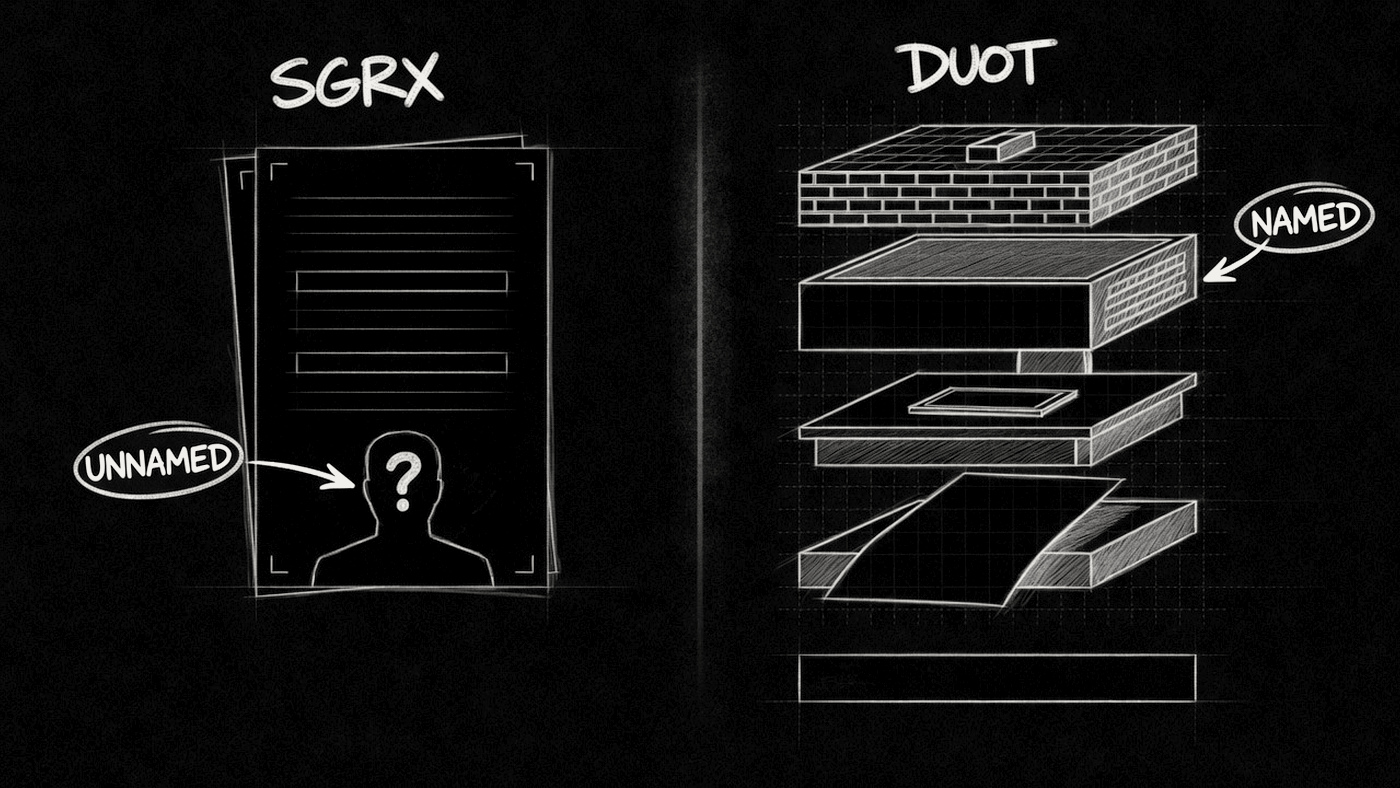
Figure 5. The common technique is splitting title from commercialization. SGRX leaves the execution layer unnamed; DUOT names the layers and still has almost no GPU revenue on the income statement. Conceptual illustration, not a measured ranking.
Put the two on the same table, the difference is actually easy to remember—the common theme is not "APA", but that holding cards (or holding rights) and selling compute can be split to different parties.
SGRX sells "paper not yet in hand". What public filings can nail down is mainly one APA: cash plus warrants exchanged for receiving rights to 16 B300s, plus undisclosed customer/hosting interests; through the research window machines still not delivered. Where the facility is, who operates, who the customers are—the main contract body almost all blank. What is more "real" on the books remains the DOGE treasury and financing tools, not compute rents already powered on. APA + unnamed outsourcing is SGRX's writing on this side.
DUOT sells "a structure that can be named", but the income statement has not caught up. Facilities self-built/self-operated (Edge AI), cards put into a bankruptcy-remote box (GPUaaS LLC), selling compute handed to named Hydra, money to buy cards docks to USD.AI asset debt; customer prepay already into consolidated contract liability. Structure clearer than SGRX by two orders of magnitude. Yet Hosting/GPUaaS entering the income statement is still near zero—the big story is still in deposits, liabilities, and guidance, not a NeoCloud profit engine already running steady. Own facilities + SPV holds cards + named sell-on-behalf is DUOT's side—should not be stuffed back into the label "APA model".
One-sentence contrast: SGRX = undelivered rights package + slogan-style outsourcing; DUOT = verifiable layered structure + outsourcing only occurs at the commercialization layer. High verifiability ≠ already earning GPU money; low verifiability ≠ the story does not ring—reading this kind of name, first ask "who signed", then ask "which line did the money enter".
Whole-piece takeaways: how to read "holding cards / selling compute split apart"
- First distinguish what was bought. APA/rights package (undelivered receiving rights, contract interests) and purchased-and-installed GPUs are not the same kind of asset. The former is like options+story; only the latter can talk rents and residual value. Reading "APA closed" as "racks already powered on" is the most common misread—this ruler mainly hits SGRX-type narratives.
- Outsourced commercialization can be very real, or just an adjective. True split-apart at least must answer: what is the manager's name, in whose name is the facility, whose books does money enter first, who covers default. DUOT uses Hydra + Edge AI + SPV + USD.AI to answer more than half of these four questions; SGRX leaves the key execution layer at "unnamed third party". Slogans can be similar; evidence thickness is completely different.
- "Who operates" and "who recognizes revenue" are often not the same company. DUOT public filings write clearly: Hydra operates for the company, finds customers for the company, but prepay enters Duos consolidated contract liability; customer credit risk also sits with the Company. Seeing "XX manages / operated by" do not automatically assume revenue is on the operator's books.
- The financing layer rewrites the risk map. Equity public offering, Registered Direct, asset-backed debt, customer prepay are four completely different kinds of money. If debt is tied to delivery closing, if prepay first sits as liability, the income statement can stay near zero for a long time while the narrative is already very full—tracking switches should be delivery/closing/power-on 8-Ks, not TCV in PR headlines.
- Replicability test. Second named manager? Can facilities be named? Does prepay enter issuer statements? Has debt closed and entered the books? Is the end customer named or credit-verifiable? Long-term all five no → story on a shell; structure verifiable but revenue not released → infrastructure under construction. On neither side treat prematurely as a stable compute operator.
Closing: This comparison is not of the same "APA model", but of the same split technique—asset rights, physical facilities, commercialization manager, financing party can be split to different entities. SGRX uses a thinly disclosed APA to make the split into a headline; DUOT uses thick structure to land the split onto entities and statement lines, yet still waits for power-on. The ruler is: does each layer have a public entity, public contract, public statement line—not whether someone has shouted "outsourcing".