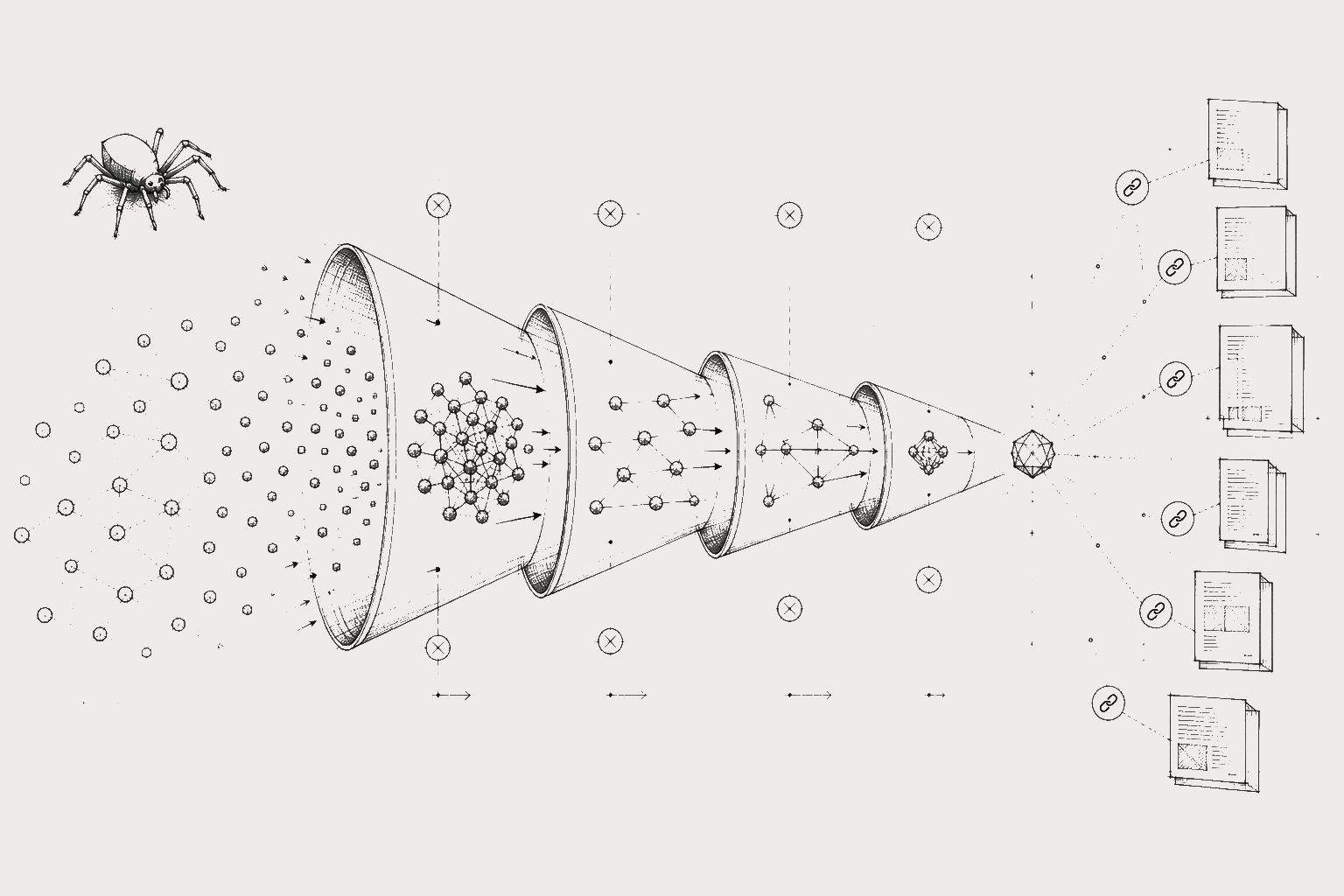

TL;DR
Generative Engine Optimization, or GEO—a term often used interchangeably with AEO and LLMO—is not a new set of black-hat techniques for bypassing search fundamentals. It is a marketing workflow that recombines traditional SEO, entity knowledge, evidence-rich content, off-site reputation, generative-answer monitoring, and conversion attribution. Google explicitly states that its AI search features still rely on the core Search index and existing ranking and quality systems, with no special AI markup required. OpenAI, Perplexity, and Anthropic likewise obtain web information through search crawlers, user-triggered retrieval, or search indexes.
The market has moved beyond manually asking ChatGPT whether a brand appears, but it still lacks common standards for visibility, share of voice, and attribution. Generative systems use query fan-out, multi-source retrieval, grounding, and answer synthesis, while their source selection varies across engines, time, and repeated runs. What vendors can sell, therefore, is not a fixed “AI ranking,” but a combination of sample-based monitoring, controllable optimization, and business attribution.
Across leading AI applications, foundation models and search backends do not map one-to-one. Google/Gemini and Microsoft 365 Copilot provide the clearest disclosures of their reliance on Google Search and Bing. ChatGPT discloses only some sources, including Bing and Shopify. Perplexity says it operates its own index. Claude, Grok, DeepSeek, Kimi, and Doubao disclose web search and citation orchestration but not their full general-web backends.
The easiest product to commoditize is the prompt-monitoring dashboard, But Google and Bing have already introduced native reporting for generative-search performance, which reduce the stand-alone value of tools that offer only ranking screenshots or mention counts. More durable profit pools lie in five capabilities: proprietary cross-engine data, first-party conversion attribution, structured entity or knowledge graphs, an execution loop from diagnosis through publishing, and enterprise-grade data governance and integration.
No public company worldwide currently discloses a confirmed, positive, stand-alone GEO, AEO, or LLMO revenue or ARR figure. Such activities are typically reported together with SEO, broader AI, advertising, or marketing services. The clear trend, however, is that many listed companies are extending into GEO from SEO, search advertising, digital marketing, media and PR, CRM and CMS, or local entity data. This is best understood as product-line migration or adjacent-capability expansion built on existing resources. In public markets, the migration has been even more pronounced in Japan than in the United States. A second route is acquisition-led entry into GEO and SEO, with Adobe the clearest example.
1. GEO: Definition, Discovery Mechanics, Execution, and Industry Structure
1.1 What GEO Optimizes—and Where It Differs from SEO and AEO
| Category | Primary target | Typical controllable inputs | Core metrics | Typical pricing |
|---|---|---|---|---|
| SEO | Traditional search results | Crawl/index access, pages, and links | Ranking, impressions, clicks | Software subscriptions or service fees |
| GEO / LLMO | Generative answers and citations | SEO foundation + entities, evidence, passages + cross-engine monitoring | Mentions, citations, share of voice, AI referral/assist | Prompt/model usage, annual platform fees, services |
| AEO | Broader answer environments | Schema, FAQs, knowledge graphs, answer formatting | Answer inclusion, zero-click visibility | Often bundled with SEO/GEO |
| Paid performance advertising | Paid-media auctions | Bids, creative, audiences, conversion goals | ROAS, CPA, revenue | Media and platform fees |
SEO, AEO, and GEO are not three competing funnels. SEO establishes whether a page can enter and compete within a search candidate set. AEO emphasizes matching a single query or a relatively short structured answer. GEO extends those capabilities into multi-source generation and citation. Paid performance advertising buys distribution through an auction and has different control variables and economics; advertising revenue should not be counted as GEO revenue.
GEO can be understood as the optimization of the discovery, source selection, synthesis, citation, and attribution chain around generative systems, with the goal of increasing the probability and accuracy with which an entity and its claims enter an answer. It is not an “AI tag” added to a page. It connects technical search foundations, entity consistency, first-party evidence, cross-site reputation, content structure, and answer monitoring into one workflow. Because applications may use different indexes, vertical datasets, direct content feeds, and rerankers, the unit of GEO measurement is usually “application × model × question cluster × region × time,” rather than a permanent rank.
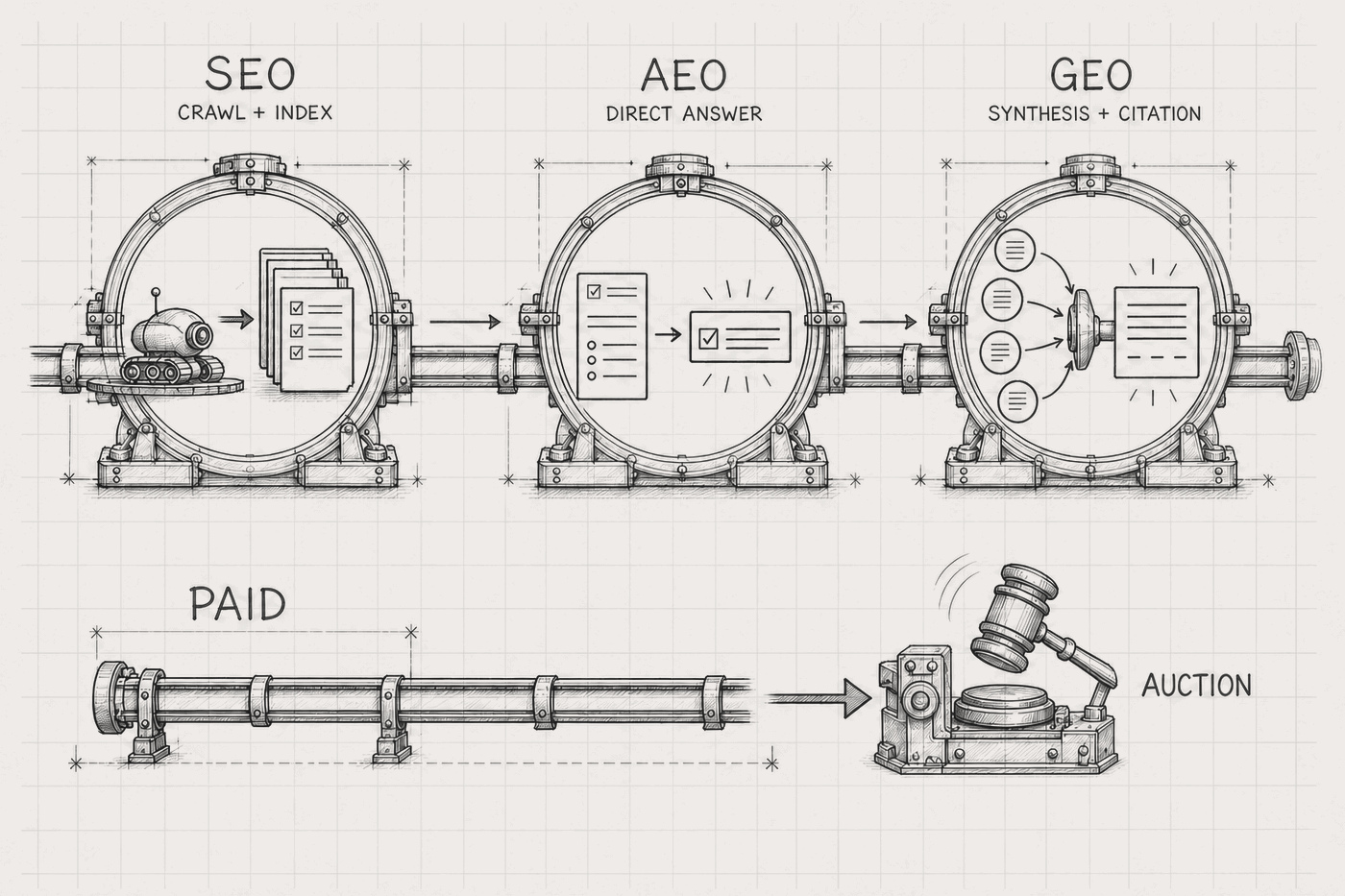

Figure 1.1. SEO, AEO, and GEO form one discovery chain with different optimization centers; paid performance has separate auction economics. Conceptual illustration, not a data visualization.
1.2 How GEO Discovery Works
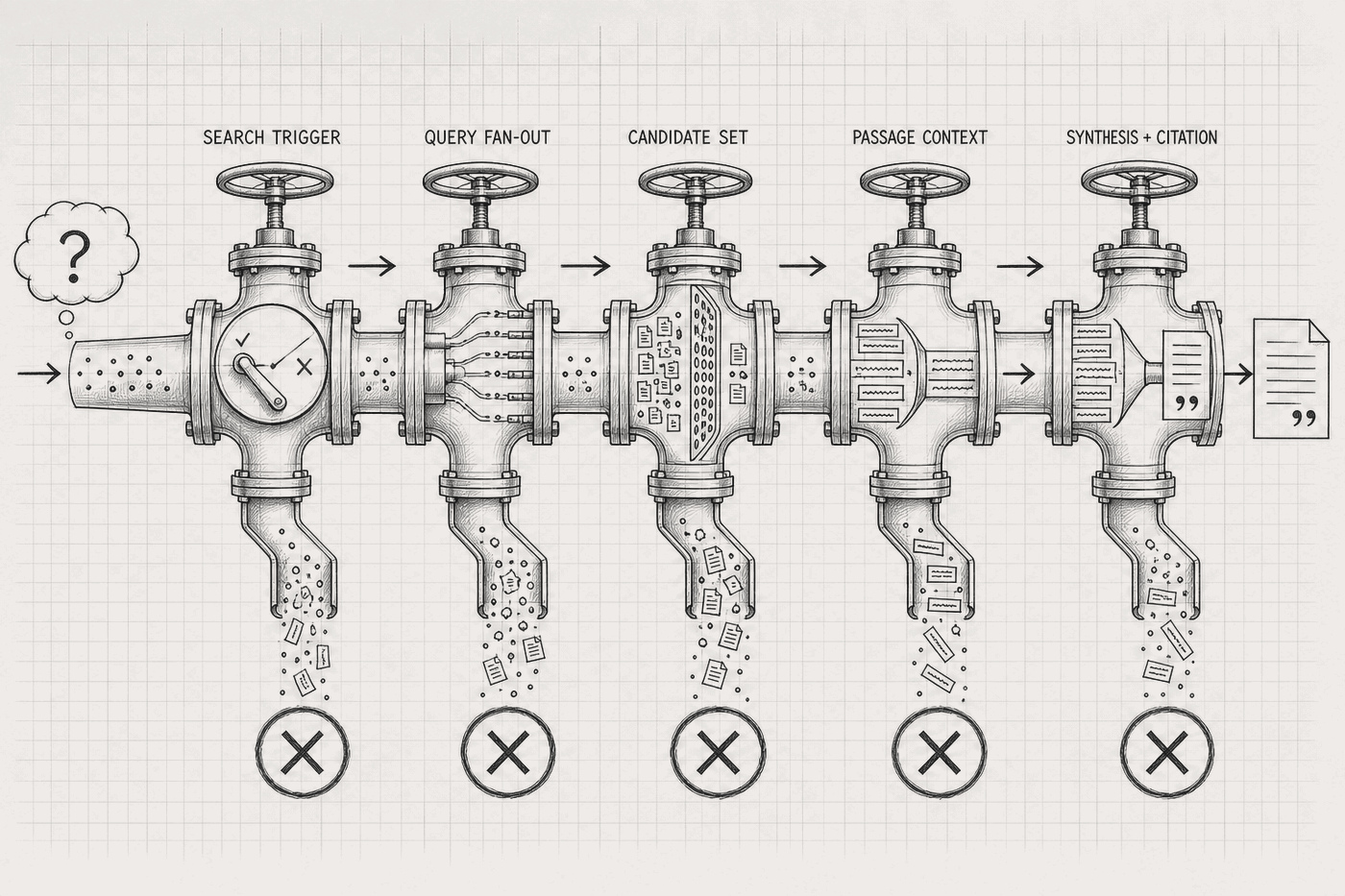
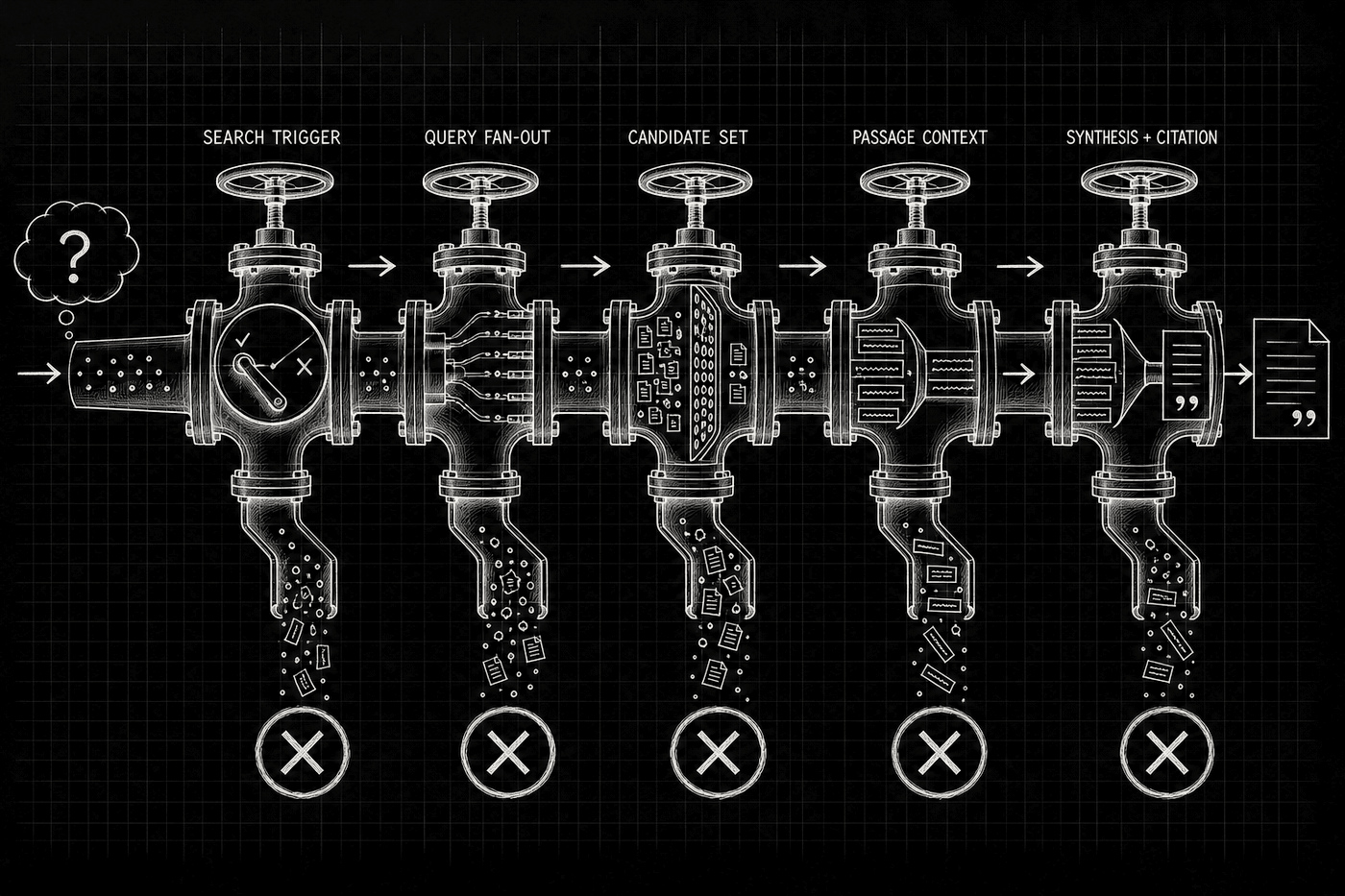
Figure 1.2. Five selection gates in the generative-answer pipeline, including explicit branches for candidates that do not advance. Conceptual illustration, not a data visualization; products may merge, skip, or reorder stages.
Public materials from Google, OpenAI, Anthropic, Perplexity, and Baidu/Qianfan differ in detail, but collectively support the above research abstraction.
Google's formal documentation and the US antitrust judgments confirm the search-side upstream pipeline: pages go through discovery, crawling, rendering and understanding, indexing and deduplication, and candidate retrieval. Traditional Search then proceeds to ranking and SERP assembly, while generative Search adds fan-out, RAG or grounding, synthesis, safety processing, and link presentation on top of the same foundation. Other applications need not reproduce Google's implementation and may skip layers or combine several within their own services.
The pipeline's greatest value is that it makes five GEO selection points explicit above SEO: whether external search is triggered; which rewritten queries are executed; which pages or datasets enter the candidate set; which passages enter the model context; and which claims are ultimately synthesized and displayed with citations. A URL appearing first in a Sources panel therefore does not mean it ranked first in the raw search backend, nor does it prove that it contributed most to the answer. Conversely, the absence of a visible citation does not prove that the system never read the source.
1.2.1 Whether External Search Is Triggered
The first gate is routing: whether the product invokes external search or another retrieval tool for the request. Search may be explicitly enabled by the user, required by a product mode, or selected by the application's orchestration layer. If it is not triggered, the answer may still draw on model knowledge, conversation context, uploaded files, or connected first-party data, but no new open-web candidate set is created for that request. In that run, crawlability, ranking, passage formatting, and citation optimization have no request-time candidate set on which to operate.
A brand cannot directly force a platform to search. It can only improve the probability that useful external evidence is available when retrieval occurs through accessible pages, current facts, clear entities, and coverage of relevant question clusters. The practical sequence is to determine whether a prompt entered an external-search path before interpreting a missing citation as a ranking or content failure.
1.2.2 Query Understanding and Query Fan-Out
Generative systems do not necessarily execute only the user's original wording. Google explicitly states that AI features may decompose a question into fan-out queries covering multiple subtopics and data sources. A prompt such as “What is the best enterprise AI CRM?” may be decomposed into pricing, company size, integrations, compliance, case studies, and competitor comparisons. This implies that:
1.2.3 Crawling, Indexing, and Permissions: The Pre-Request Eligibility Layer
Open-web discovery, crawling, rendering, and indexing usually happen asynchronously in advance and create the inventory and eligibility conditions on which request-time retrieval depends. Answer engines commonly combine information from proprietary or partner search indexes, dedicated crawlers, user-triggered fetches, and model knowledge. Platforms may use different user agents for training, search indexing, and user requests.
This is why traditional SEO foundations remain necessary. Content that cannot be crawled, lacks a proper canonical, has weak topical authority, contains stale facts, or delivers a poor page experience will not automatically earn citations because it carries an “AI-optimized” label. Google also explicitly states that no additional AI file or special schema is required.
1.2.4 Retrieval, Ranking, and Grounding
Google says its AI search capabilities are rooted in core Search ranking and quality systems and retrieve material from the Search index for grounding. Other engines have not disclosed an identical architecture, but their search crawlers and citation mechanisms likewise demonstrate the importance of external retrieval.
Grounding means generating against external evidence, or anchoring factual output to currently retrieved material. The search backend provides candidates, but the application may still extract, filter, rerank, and compress them before orchestrating the final context passed to the model.
1.2.5 Answer Synthesis and Citation Selection
Even after grounding and successful retrieval, a page is not guaranteed a citation; a citation also does not guarantee that the brand is described favorably or accurately. The system must still select among candidate passages, compress the material, and organize the answer. Academic research shows that:
- Early generative search sometimes produced citations that did not fully support the generated sentence.
- Vendors differ in source diversity, reliance on internal versus external sources, and stability across repeated runs.
- In benchmarks, document-level properties generally explain citation visibility better than isolated word substitutions.
The reliable approach is therefore to improve the quality and structure of evidence: use clear entities, verifiable facts, original data and methods, named authors and update dates, explicit comparison boundaries, concise passages, and topic-consistent internal links. “Authoritative tone” or additional statistics are useful only when the underlying facts are true and the sources traceable.
1.2.6 Display, Clicks, and Zero-Click Outcomes
Answer engines can satisfy a user without generating a click. The final mile of GEO success is a visit or an assisted conversion. A brand mention may improve awareness without creating a referral; a citation may appear in a collapsed panel; and a click may occur only after several exposures. Website traffic alone misses brand effects, while mention share alone overstates commercial value.
1.3 Which GEO Levers Are Actually Controllable?
GEO is not about optimizing a single “rank.” Its objective is to make a brand, product, or point of view:
A simplified value decomposition is easier to understand as a six-link value chain than as a single visibility score. Sections 1.2.1–1.2.6 trace the operational sequence: external-search triggering, query understanding and fan-out, crawling and indexing eligibility, retrieval and grounding, answer synthesis and citation selection, and display and click outcomes. In the compact formula below, the first two request-time decisions are represented together as query demand; the sixth factor is customer conversion rate multiplied by customer value. Effective GEO value therefore equals query demand × crawl/index eligibility × retrieval probability × mention/citation probability × display/click probability × (customer conversion rate × customer value); because the relationship is multiplicative, if any factor approaches zero, the effective GEO value of that specific path also approaches zero.
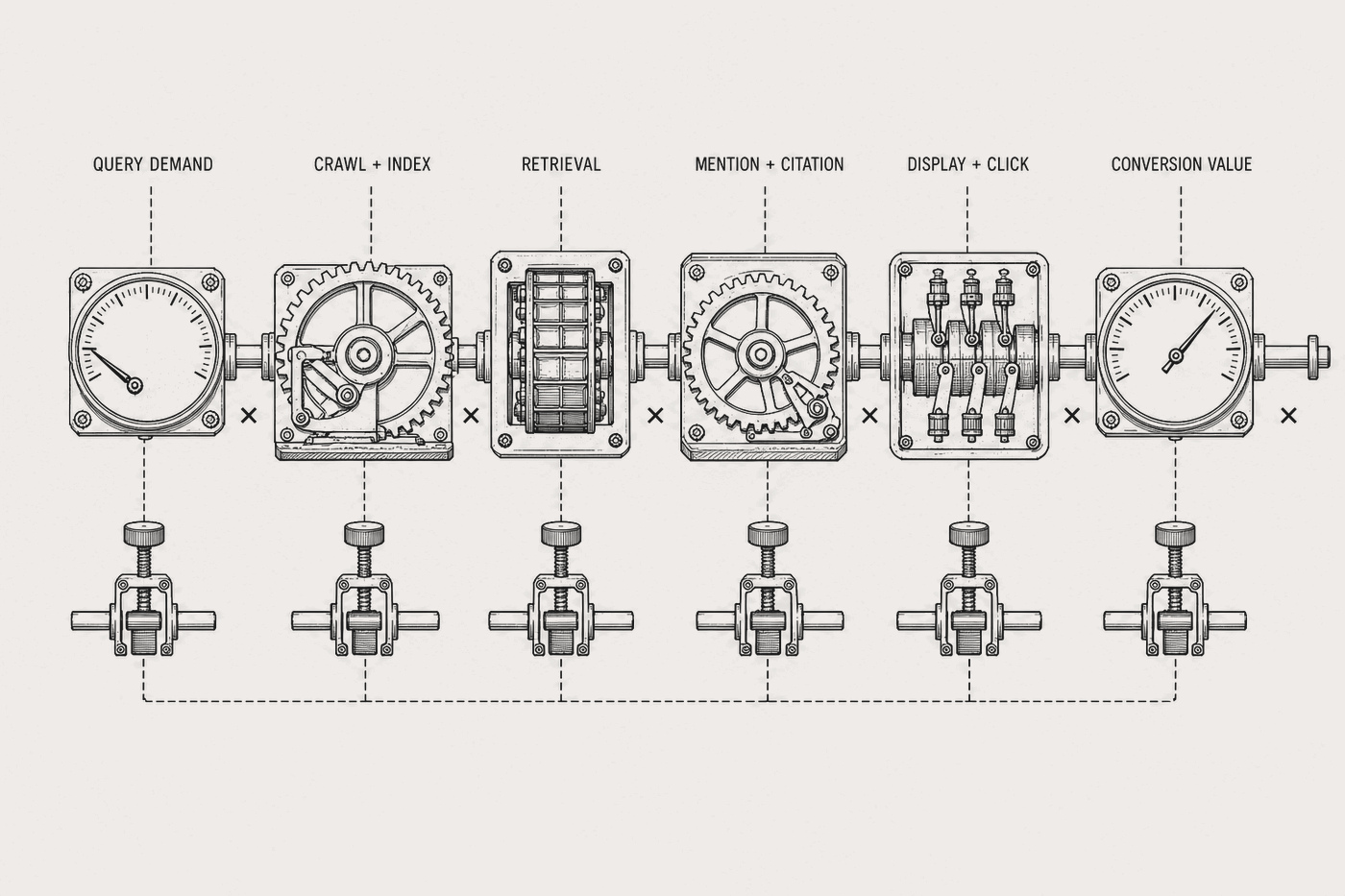
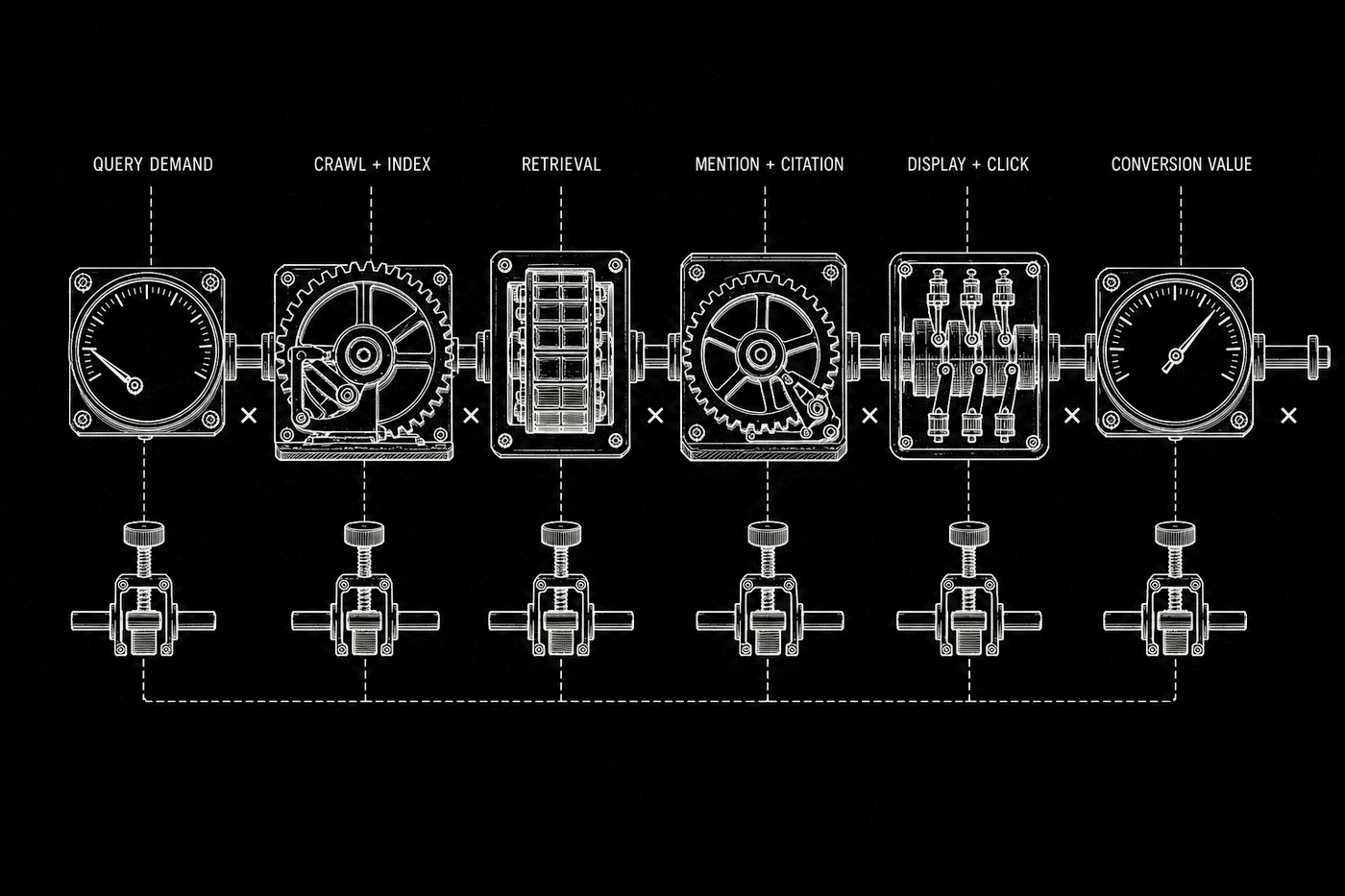
Figure 1.3. Effective GEO value is calculated from six multiplied factors: query demand, crawl and index eligibility, retrieval probability, mention or citation probability, display or click probability, and customer conversion rate multiplied by customer value. If any factor approaches zero, the value of that specific path also approaches zero. Conceptual research decomposition, not a platform formula, measured funnel, or performance guarantee.
This is a multiplicative chain, not a sum of independent metrics. For any specific attributable path, failure at a critical stage—no relevant query demand, no crawl or index eligibility, no retrieval, no selection into context, no synthesis or display, or no resulting conversion value—reduces the value of that path to zero. A separate path may still form through third-party sources or model knowledge, but it does not rescue the broken path. Raising mention rate alone may therefore create no commercial value if the upstream and downstream stages are ignored.
This serial relationship creates a clear upstream-first principle. The further upstream a step sits, the more downstream stages depend on it and the wider the damage when it fails. If no relevant query is triggered, there is no corresponding candidate set. Without crawl and index eligibility, the page cannot be retrieved. Without retrieval, passage optimization, answer synthesis, and citation display have no object to act on. Importance should therefore be judged first by whether a step is a prerequisite for later stages, not by how close it appears to revenue. Execution should repair the furthest-upstream failure before investing in downstream optimization; otherwise, teams may be improving a local metric for a candidate opportunity that does not yet exist.
But importance is not the same as controllability. In the request-time chain, query understanding and query fan-out sit upstream of SEO candidate retrieval. They have broad influence but are controlled primarily by the platform. A company cannot directly decide whether the system searches the web, how it rewrites a question, or which subqueries it executes. It can only improve matching probability through question clusters, entities, and topical coverage. By contrast, crawling, indexing, canonicals, renderability, content quality, and entity clarity are the furthest-upstream, most stable, and most testable controls available to the brand. They are also the foundations long managed by SEO. The most natural starting point for GEO is therefore still SEO. This does not make GEO identical to SEO, nor does strong SEO guarantee a citation. It means first ensuring that a brand is eligible to enter the candidate set, then extending optimization into passage selection, answer synthesis, citation display, and business attribution.
1.3.1 Measurement
Mature measurement requires a fixed specification for:
- Prompt sets, intent, language, region, role, and device.
- Model and product versions, web access, login state, and sampling time.
- Number of repeated runs and confidence intervals.
- Separate definitions of mention, citation, link, sentiment, and position.
- Attribution windows for AI referrals, assisted conversions, pipeline, and revenue.
Bing and Google's native reports are not equivalent data products. Bing Webmaster Tools' AI Performance remains in Public Preview, but already includes Total Citations, Cited Pages, Grounding Queries, and page-level citation activity. Users can move from a grounding query to the corresponding cited pages, or from a page to related grounding queries. These phrases and citation counts are aggregated and sampled data—not complete user prompts, individual answer logs, rankings, or authority scores. Google Search Console has begun to offer separate generative-AI performance reports for Search and Discover. Search covers AI Overviews and AI Mode, centers on impressions, and can be broken down by page, country, device, and date. Discover can be broken down by page, country, and date. Google's public documentation does not currently offer equivalents to Bing's grounding queries, citation counts, or query-to-page mapping, and both reports are still rolling out to only some sites.
Official pages:
- Bing: Product announcement, AI Performance help, and Bing Webmaster Tools entry point.
- Google Search: Launch announcement, Search report help, and Search report entry point.
- Google Discover: Discover report help and Discover report entry point.
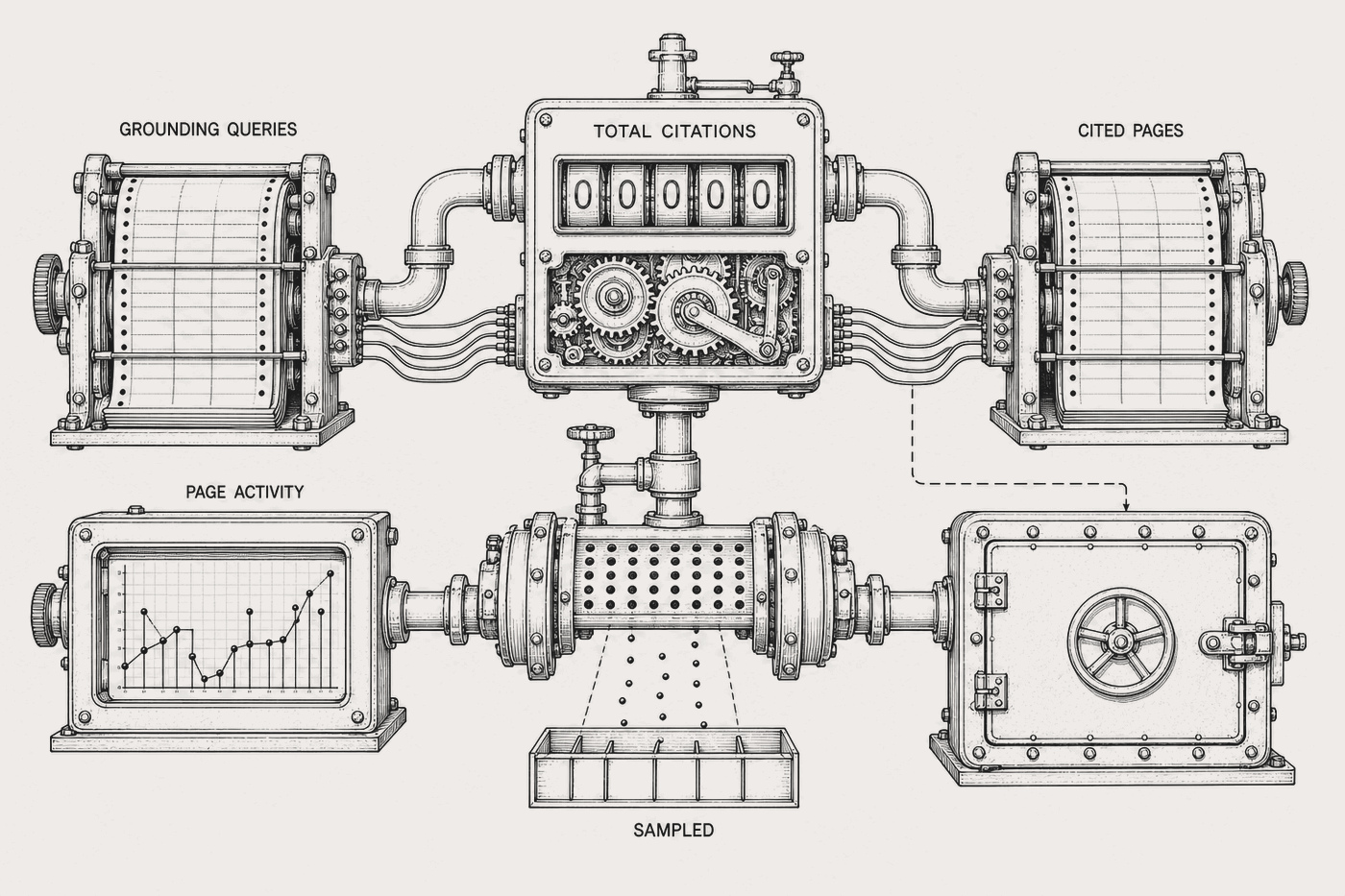

Figure 1.4. Engineering redraw of the official Bing AI Performance evidence model. Grounding Queries and Cited Pages expose sampled query and page-level citation activity, but not a complete retrieval log or rank report.
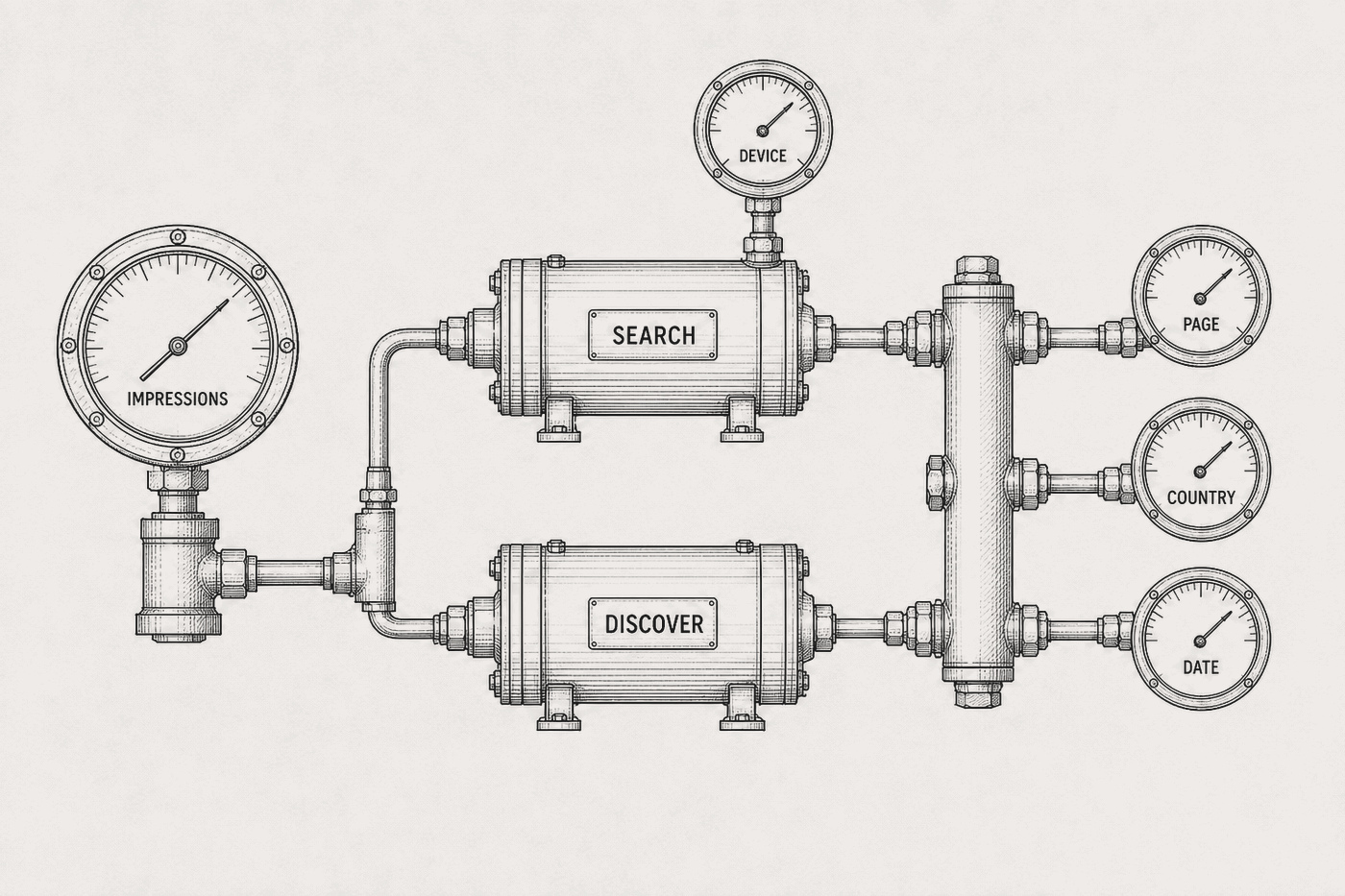
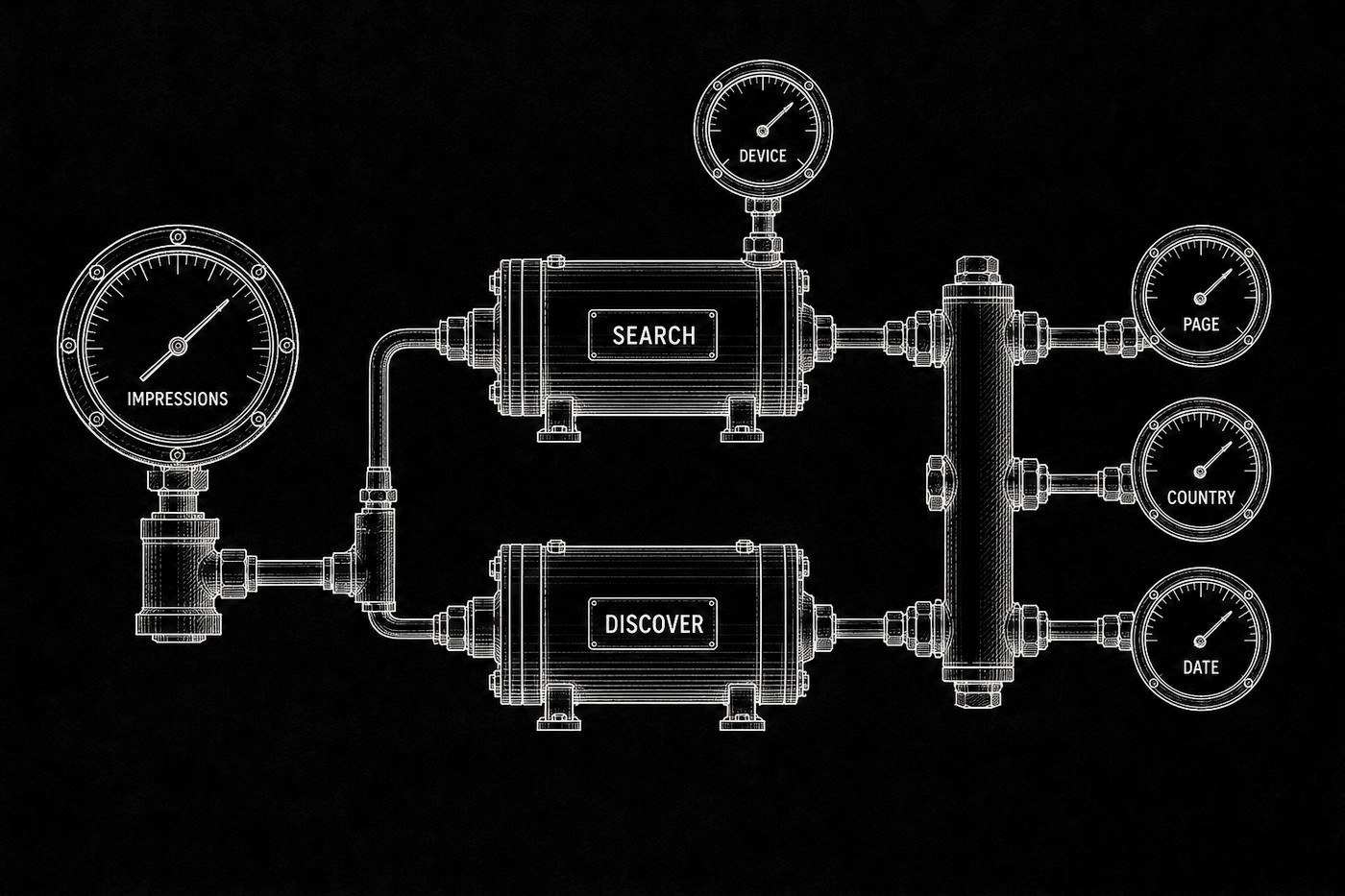
Figure 1.5. Engineering redraw of Google's generative-search performance model. It reports impressions and dimensions such as pages, countries, devices, and dates, but does not expose Bing-style query-to-page citation mapping.
1.4 GEO Industry Structure and Defensibility
1.4.1 A Defensibility Ladder
From weakest to strongest:
- Prompt replay and screenshots.
- Unified multi-engine reporting.
- Large, stable, legally sourced data panels and historical benchmarks.
- First-party analytics, CRM, and revenue attribution.
- Vertical or local entity graphs and enterprise fact governance.
- An execution loop from recommendation through publishing, monitoring, and rollback.
- Suite-level integration across content systems, customer data, distribution channels, and workflows.
1.4.2 The Most Likely Industry Evolution
Many stand-alone GEO tools will continue to appear in the near term. Over the medium term, four types of established platform are best positioned to integrate or bundle these capabilities. SEO and competitive-intelligence platforms already own search-demand, competitive, and historical-visibility data. CMS and DXP platforms control content production, technical governance, publishing, experimentation, and rollback. CRM and marketing-automation platforms own customer journeys, first-party conversion data, and revenue attribution. Local knowledge and commerce platforms manage authoritative facts, update cadence, and distribution channels for places, products, and business entities. The current product directions of Adobe, HubSpot, Yext, and Salesforce show how these control points can extend GEO from monitoring into content execution, entity-data distribution, and business attribution.
Their shared advantage is not that they can also build a GEO dashboard. It is that they already have customers, enterprise permissions, and first-party data, allowing them to connect monitoring → diagnosis → modification → publishing/distribution → conversion attribution → re-optimization. Suite bundling can also compress the stand-alone price of monitoring. Independent companies that want to remain in the middle layer over time need cross-platform proprietary data, a hard-to-replicate vertical fact layer, or stronger execution and attribution—not merely answer screenshots and mention counts.
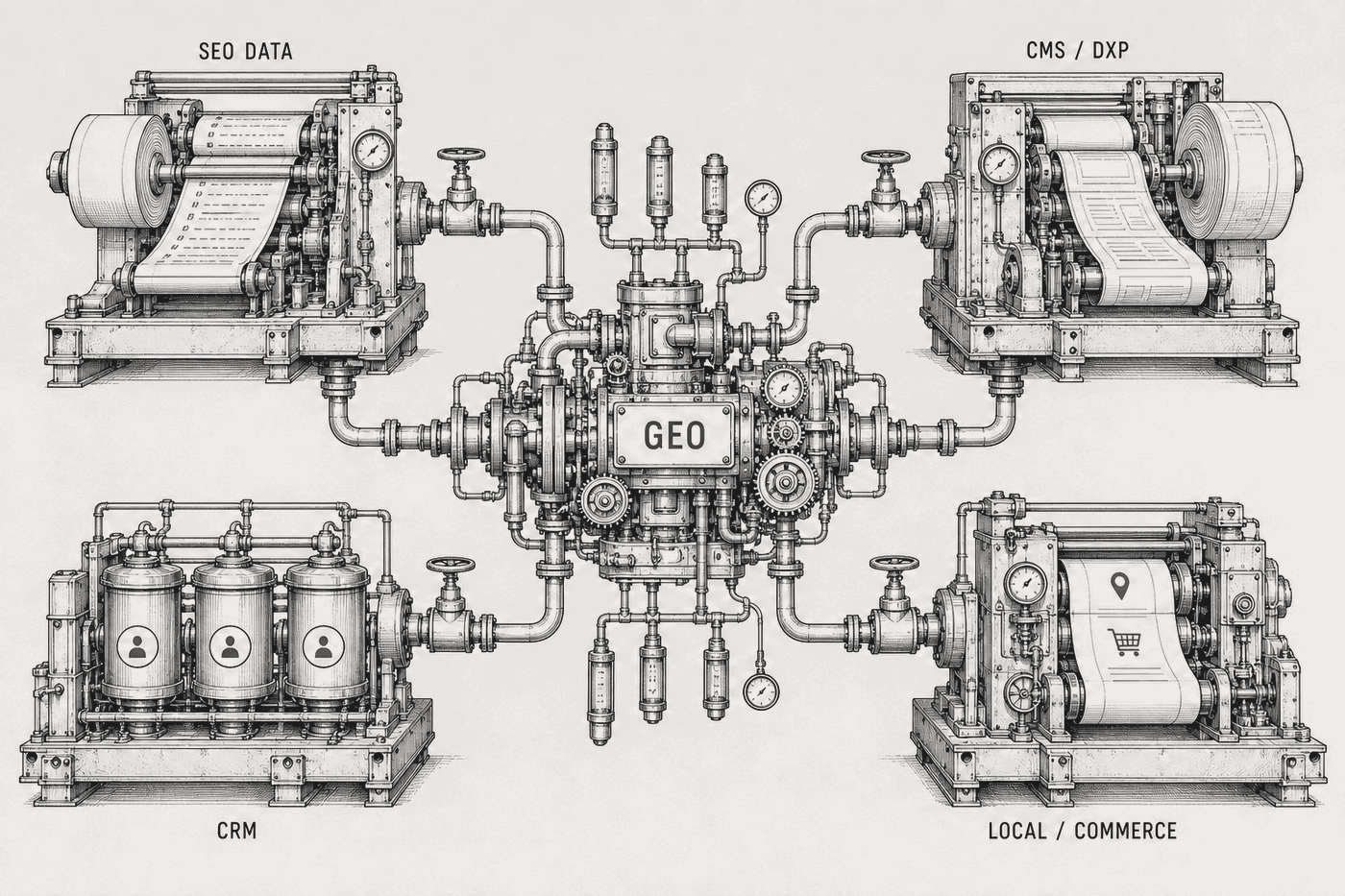
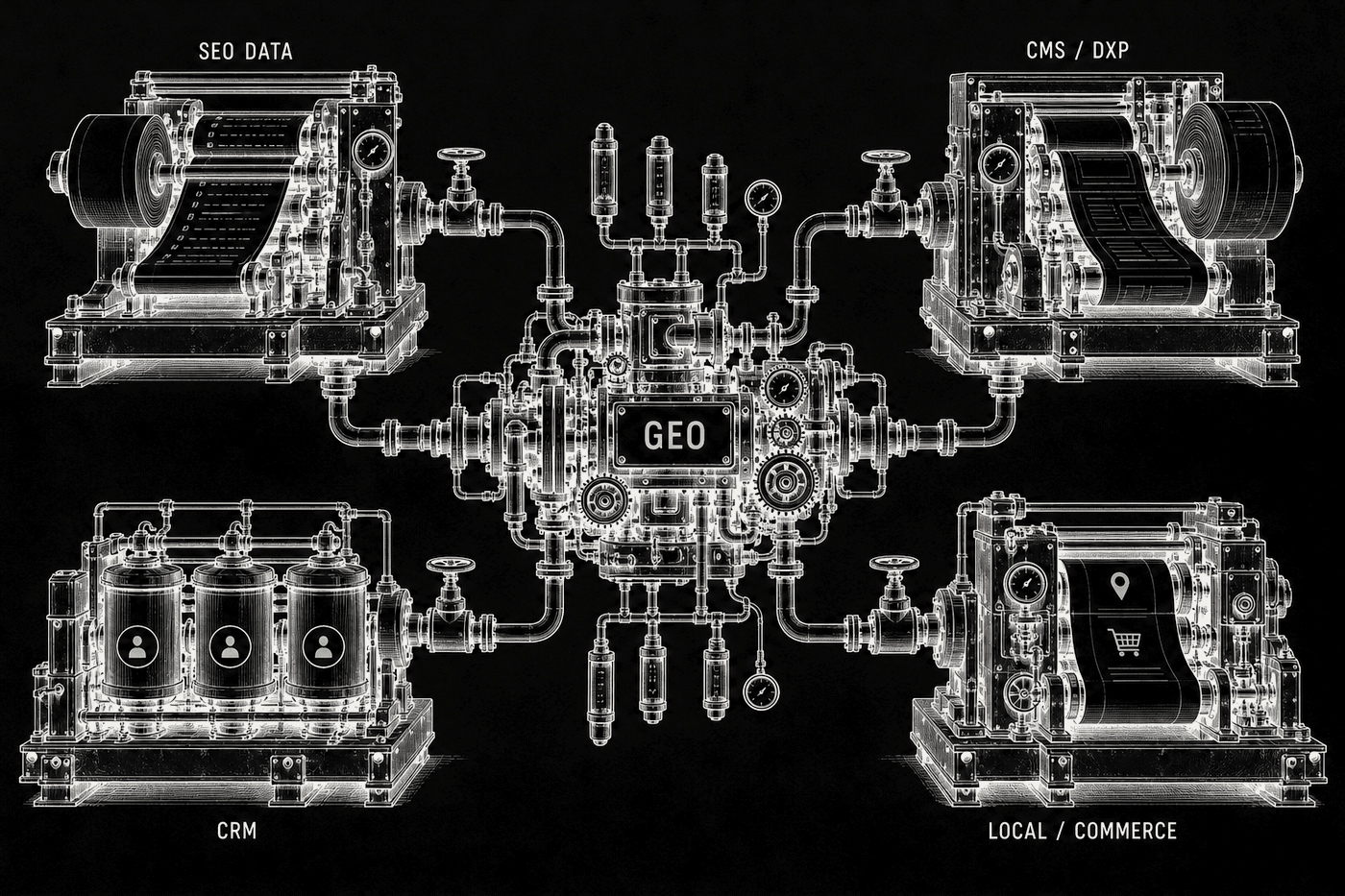
Figure 1.6. Why incumbent SEO, CMS/DXP, CRM, and local-knowledge or commerce platforms can absorb GEO: they already own adjacent data, publishing, identity, attribution, or execution rights. Conceptual illustration, not a measured market-concentration forecast.
2. Search Backends and Grounding Technology Across Leading AI Applications
This chapter starts from the application-level question: when an AI product answers a current question, how does it call external search, place retrieved material into model context, and produce an answer with sources? The same foundation model can be connected to different search services by different applications. The same application can also switch retrieval paths by region, question type, product mode, cost, and freshness requirements.
We use Similarweb's January 2026 ranking of generative-AI web products by worldwide unique monthly visits as the starting point for sample selection. The research focuses on products with general-purpose Q&A or search functions, including ChatGPT, Gemini, DeepSeek, Grok, Claude, Perplexity, Quark, Kimi, and Qwen. The ranking measures visits to destination websites only. It does not capture use through apps, APIs, operating systems, or office-suite integrations, so it identifies the research sample rather than a complete market share.
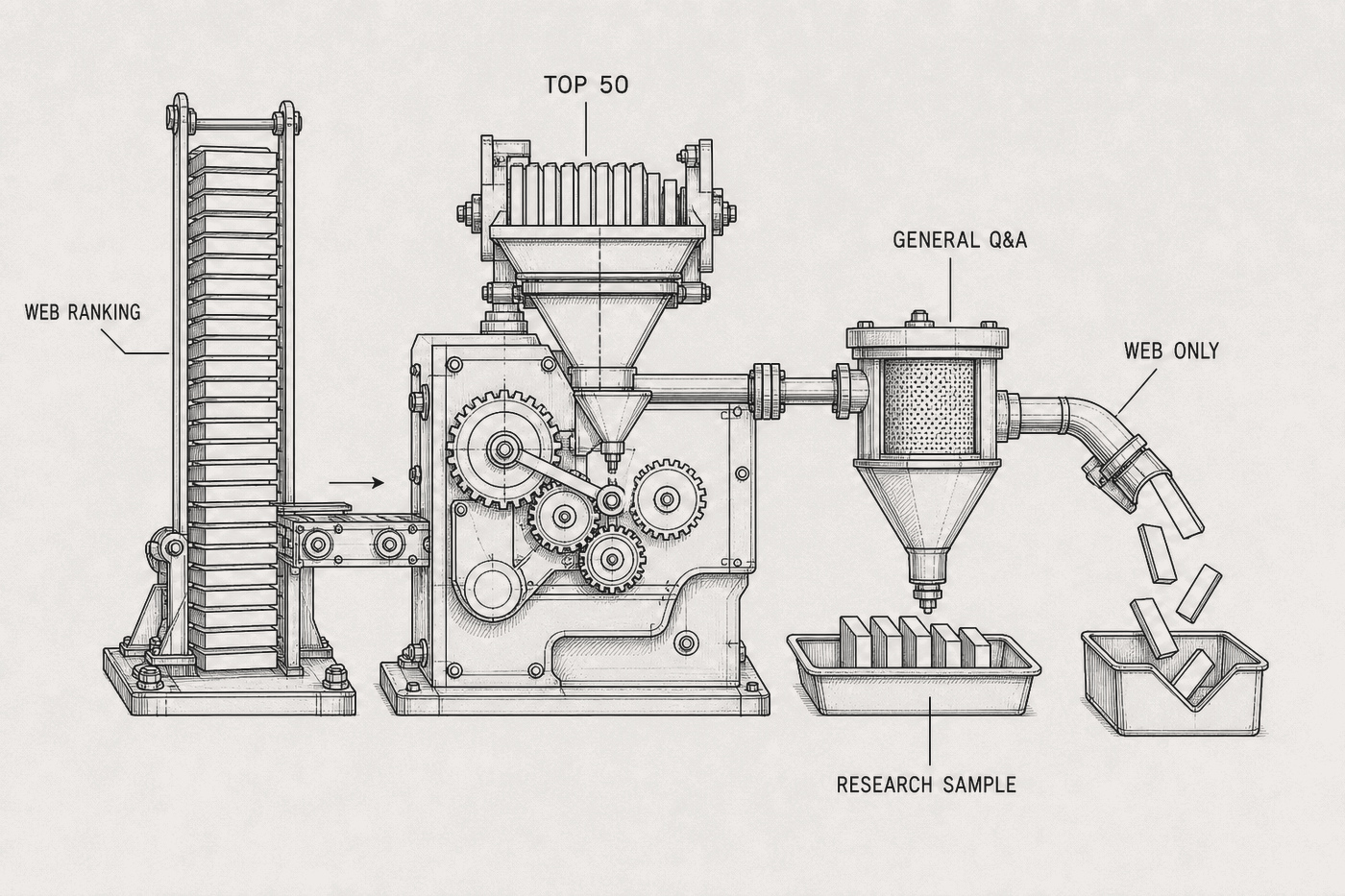

Figure 2.1. Engineering redraw of the research-sample selection process based on Similarweb's January 2026 destination-level web ranking. The ranking is used only to select major applications for backend coverage, not as an exact global market-share estimate.
For accessibility, the top ten products in the ranking are ChatGPT, Gemini, Canva, DeepSeek, Grok, Claude, Character.AI, Perplexity, Notion, and Google AI Studio. The original ranking contains the complete top 50.
Public disclosure currently falls into four categories:
- Current and explicitly named: Google's Gemini API grounding explicitly uses Google Search; Microsoft 365 Copilot explicitly sends shortened queries to Bing; and Mistral's privacy documentation names Brave as one provider of search content.
- Partially named or mixed with proprietary infrastructure: ChatGPT's current help page lists Bing and Shopify but does not disclose the full provider set or retrieval and reranking weights. Perplexity says it migrated from early third-party APIs to its own internet-scale index while continuing to use third-party crawlers.
- Orchestration disclosed, underlying index undisclosed: Claude, Grok, DeepSeek, Kimi, and Doubao confirm web search, page reading, or citation workflows without fully disclosing their general-web indexes, suppliers, or ranking systems.
- Developer-selectable or historically confirmed: GLM's developer interface can use proprietary search, Sogou, Quark, or multiple engines, while Qwen-related gateways can select Quark. These choices do not establish consumer defaults. Meta explicitly used Bing in 2023, but has not disclosed whether Bing remains its only or primary open-web backend.
2.1 Major International Applications: What Public Evidence Confirms
The international market can currently be summarized around three principal open-web retrieval paths: Google Search, Bing, and proprietary or hybrid indexes. Google Search is the clearly disclosed foundation for Gemini grounding. Bing explicitly powers Microsoft 365 Copilot and is one of ChatGPT's disclosed third-party search sources. Among proprietary approaches, Perplexity explicitly reports an internet-scale index. OpenAI and Anthropic operate dedicated crawlers for search discovery but do not disclose complete index coverage, full third-party supplier sets, or production weights.
These are major paths, not the complete source universe. Search APIs such as Brave, first-party platform data such as X, direct publisher and commerce feeds, and user-specified URLs can all enter products as supplementary layers. Owning a crawler therefore proves control over part of discovery or fetching; it does not by itself prove ownership of a complete search engine.
Search-index crawlers, training crawlers, and user-triggered page readers must also be distinguished. OpenAI, Anthropic, Perplexity, and Kimi separate these purposes to varying degrees.
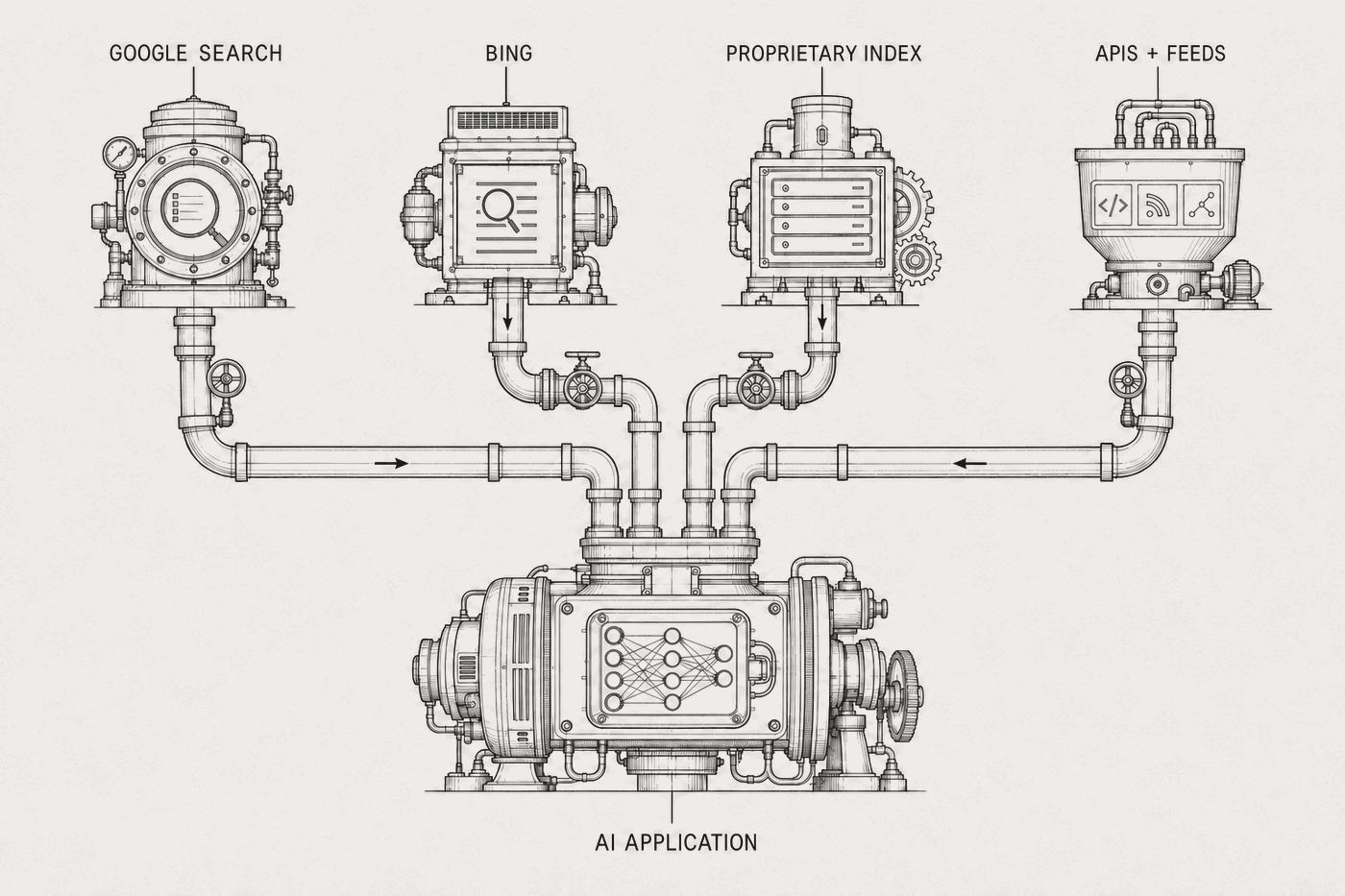
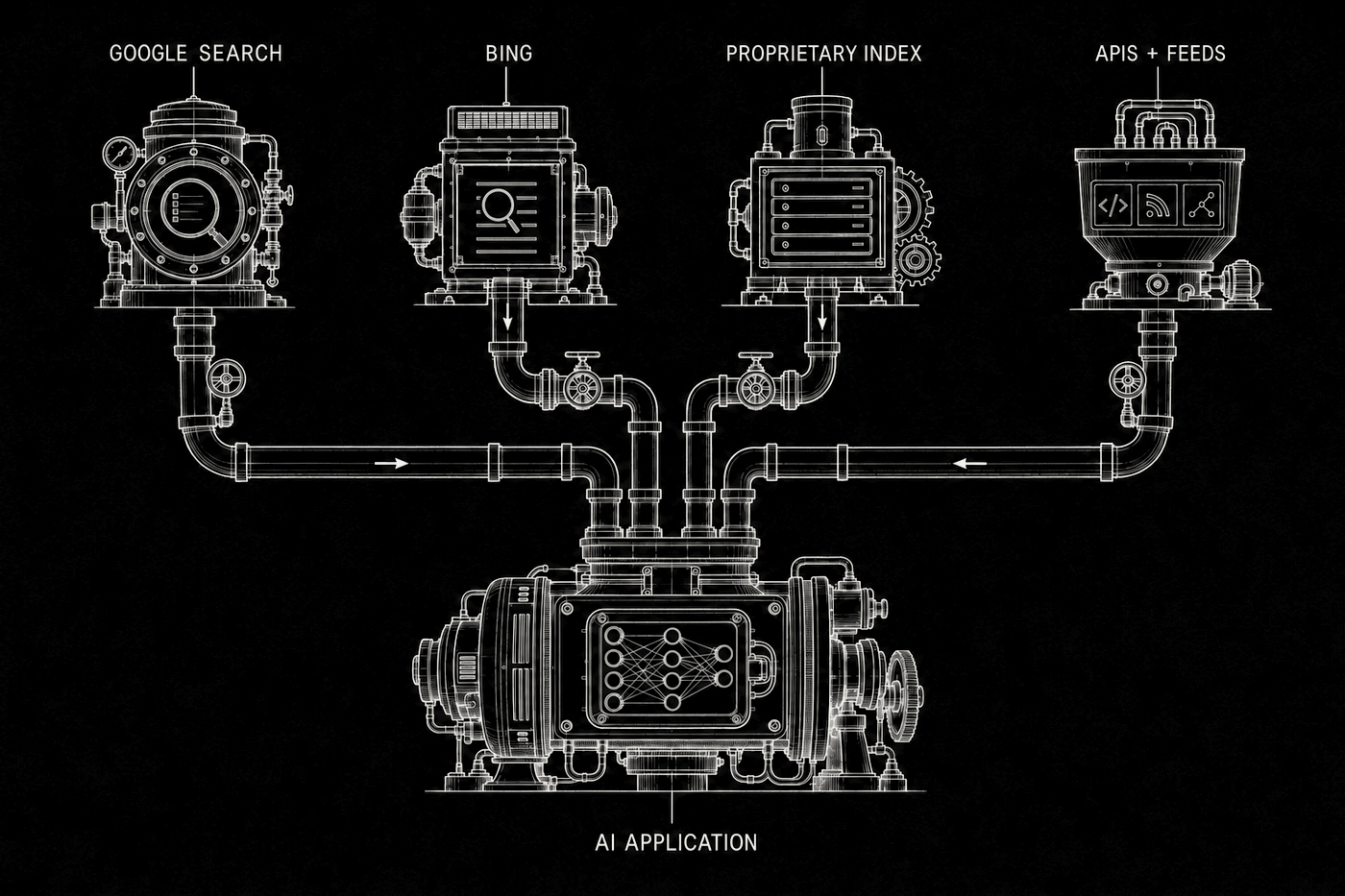
Figure 2.2. Four publicly observable backend patterns: Google Search, Bing, proprietary indexes, and APIs, feeds, or vertical data. Applications can combine patterns and change suppliers by mode or surface. Conceptual mapping, not a static one-to-one vendor table.
| Application / surface | Publicly confirmed search or data source | Publicly disclosed implementation | Boundary |
|---|---|---|---|
| Gemini App / Gemini API | The API's google_search grounding explicitly uses Google Search | Prompt analysis → one or more queries → search-result processing → generation; metadata can return queries, source chunks, and answer-fragment-to-source mappings | The API does not mean every ordinary Gemini App conversation searches; the App's Double-check feature is not the original answer's source list |
| ChatGPT / OpenAI API | ChatGPT's current help page lists Bing and Shopify; it also has direct content partners, while OAI-SearchBot crawls for search discovery | ChatGPT may rewrite a request into one or more queries and refine them after the first results; the API discloses fast, agentic, and deep-research paths plus search, open, and find tools | The full supplier set, index coverage, routing, and weighting by mode are undisclosed; OAI-SearchBot does not prove a fully disclosed proprietary index |
| Claude / Anthropic API | The underlying general-web index or supplier is undisclosed; Claude-SearchBot supports search discovery | The model decides whether to search, creates targeted queries, and may search progressively; results can be dynamically filtered before context injection, with passage-level citations returned | Public API contracts cannot be applied unconditionally to every claude.ai mode; no evidence supports Brave as the default backend for commercial Claude web search |
| Grok / xAI API | Open Web Search and X Search are separate; X is a proprietary real-time and social source | Web tools search, open, and extract pages; X tools support keyword, semantic, user, and thread retrieval, with citations in answers | The open-web index, third-party suppliers, crawler, and ranker are undisclosed; X Search is not open-web search |
| Microsoft 365 Copilot / Copilot Studio | 365 Copilot explicitly calls Bing; Studio can use Bing open web, Bing Custom Search, or specified URLs | Copilot reduces the prompt into shorter Bing queries; Bing returns titles, snippets, and citations; Copilot synthesizes them with work context | Evidence is specific to 365, Agents, and Studio and cannot be generalized to every current consumer Copilot mode |
| Perplexity | The company reports a proprietary internet-scale index combined with PerplexityBot, third-party crawlers, and user-triggered reads | Lexical and semantic retrieval, multi-stage ranking and reranking, document- and subdocument-level extraction; complex tasks can organize repeated searches through code | Index scale and performance are company-reported; the complex Search-as-Code path does not represent every ordinary query |
| Meta AI | A Bing partnership was explicit in 2023; Meta later added social content and direct publisher content | Meta confirms open-web search and real-time synthesis but does not disclose full orchestration or citation mapping | Bing is a historically confirmed dependency; the only or primary open-web backend in 2026 is unknown |
| Mistral Le Chat / Vibe | The privacy policy names Brave as one processor providing search content; an AFP direct news feed also exists | Web search, URL opening, and citations are supported; direct feeds coexist with general-web retrieval | Brave is confirmed as at least one production supply-chain component, not necessarily the exclusive backend in every region and mode |
| You.com / Poe | You.com discloses its Research API orchestration; Poe offers an optional @Web-Search bot | You.com can plan → search/read/cross-reference → compact context → cite; Poe requires explicit invocation of the search bot | You.com's API does not represent every consumer mode; third-party models hosted on Poe do not automatically inherit the same search backend |
2.2 Major Chinese Applications: More Multi-Source Orchestration, Fewer Disclosed Consumer Defaults
The more common pattern in China is “open web + group-owned vertical content + developer-selectable engines.” Ownership of search assets can make a backend more plausible, but group affiliation alone does not establish a default call chain without product documentation or regulatory disclosure.
| Application / vendor | Publicly confirmed search or data source | Public retrieval-to-generation implementation | Boundary |
|---|---|---|---|
| DeepSeek | Public internet retrieval; no named search engine or proprietary index | The web product extracts multiple keywords, searches and reads pages in parallel, then generates from retrieved material | Search engine, crawler, ranker, context assembly, and citation selection are undisclosed |
| Qwen / Alibaba Cloud Model Studio | Model Studio web search; related gateways can select Quark; the Qwen App also connects to vertical data from Taobao, Alipay, and Amap | Turbo, max, and agent strategies support multi-round search, sources, and citations; gateways may rewrite a question into one, three, or five concurrent queries | “Quark available” and “Alibaba ecosystem connected” do not prove that consumer Qwen uses Quark as its open-web default |
| GLM / Zhipu Qingyan | The developer Web Search API can select proprietary search, Sogou, Quark, or multi-engine collaboration | Supports intent detection, query rewriting and decomposition, routing, structured results, and citation markers | Developer choices do not reveal the consumer product's actual default mix or weights |
| Kimi | Kimi-SearchBot creates part of its search-discovery capability while the product also calls unnamed search engines and vertical databases | Agentic Search decides whether to search, calls tools, and revises its strategy from results; server-side search and fetch are supported | A crawler does not mean all results come from a proprietary index; the external-engine and vertical-database lists are incomplete |
| Doubao / Volcano Engine Ark | Doubao searches third-party public pages; developer plugins can combine the open web, Toutiao, and Douyin Baike | Doubao detects search intent, retrieves, generates from results, and displays sources; Ark returns web-connected content to developers | The consumer open-web engine, query rewriting, ranking, and citation algorithm are undisclosed; plugin sources are not the complete consumer implementation |
| Baidu Wenxiaoyan / Qianfan | Baidu owns full-web search assets; Qianfan exposes baidu_search_v2 | Can detect intent, rewrite and expand parallel queries, retrieve iteratively, filter materials, summarize with an LLM, and return footnotes or citations | Capabilities and assets are clear, but whether every Wenxiaoyan request uses the same interface and routing remains undisclosed |
| Tencent Yuanbao / Tencent Cloud WSA | WSA explicitly derives from Sogou Search and combines public pages with Tencent ecosystem content; Yuanbao is named as an application case | The API returns structured URLs, text passages, and relevance signals for upper-layer model synthesis | Yuanbao-specific rewriting, number of searches, context assembly, generation, and final citation mapping are undisclosed |
2.3 Search Infrastructure Is Being Unbundled into Composable Services
The external-information layer for major AI applications now has three broad supply models:
| Infrastructure model | Examples | What it provides | Application-layer impact |
|---|---|---|---|
| Proprietary large-scale search assets | Google, Microsoft/Bing, Baidu, Tencent/Sogou, Perplexity | Crawling and indexing, retrieval, ranking, freshness, and some vertical data | Greater control, but high build costs and demanding anti-bot and content-rights governance |
| Independent Search APIs / agent retrieval | Brave, Exa, Tavily, Parallel | Queries, page extraction, LLM-ready excerpts or chunks, reranking, caching, or research agents | Faster launches and easier model switching, but dependence on supplier coverage, pricing, and terms |
| Direct content and closed ecosystems | Shopify, AFP, publisher feeds, X, and the Meta, Alibaba, ByteDance, and Tencent ecosystems | Fresh or structured product, news, social, mapping, and local-services data | Can bypass ordinary web ranking and create new paid, licensed, or platform-access layers |
In a composable implementation, an application can retain query planning and generation while sourcing search or crawl APIs, result processing, and context engineering separately.
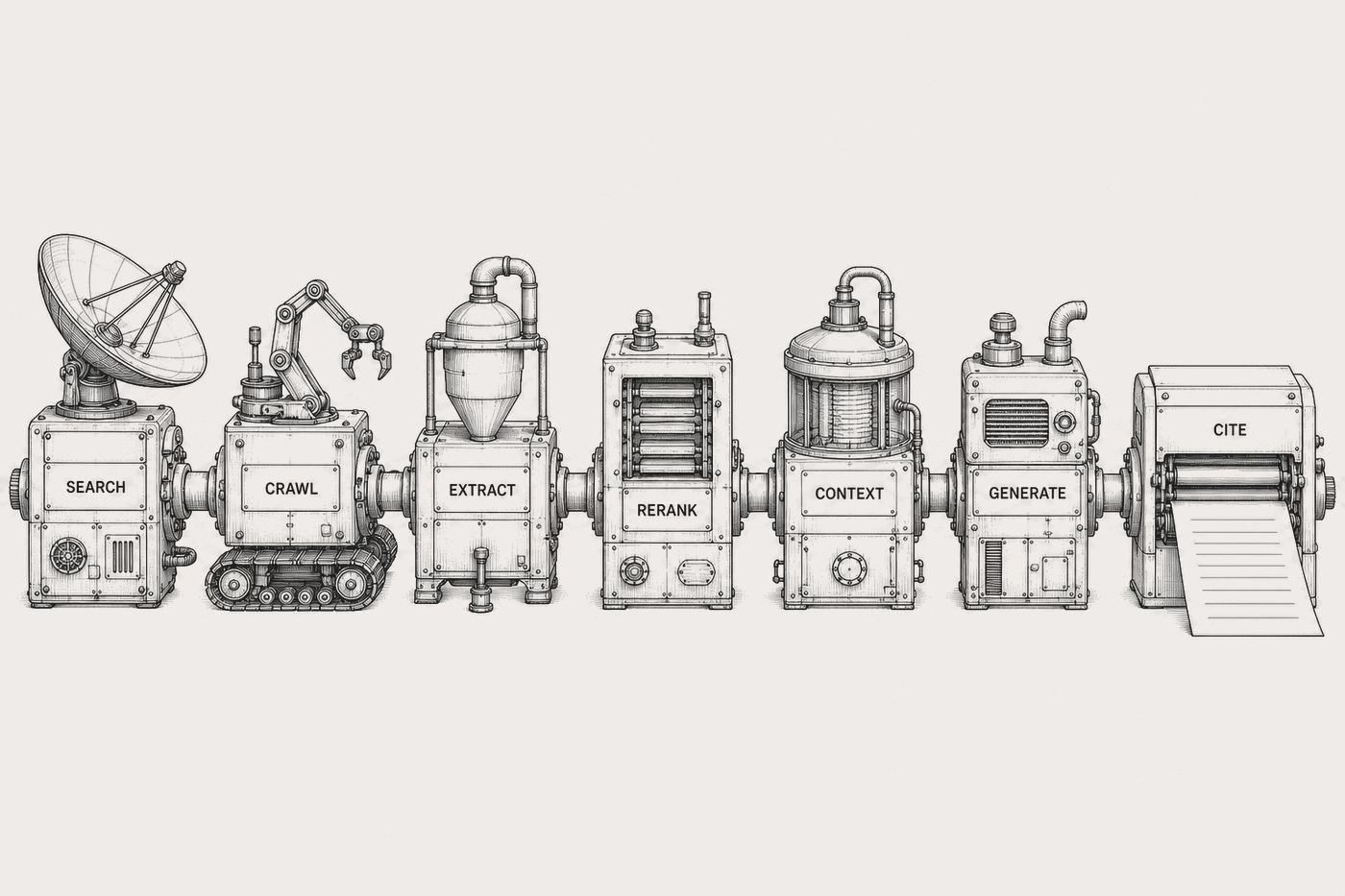

Figure 2.3. Search as a composable service stack: applications may independently source search, crawl, extraction, reranking, context engineering, generation, and citations. Conceptual architecture, not a disclosed implementation for every product.
This is why Google and Bing alone are insufficient coverage. A single AI answer can combine a general index, real-time social data, vertical databases, and directly licensed content. Conversely, the existence of developer products from Brave, Exa, Tavily, or Parallel does not prove that an undisclosed consumer application uses them.
The pipeline conclusion can now be restated. The weakest products merely reproduce the final answer. Stronger products understand multi-engine sourcing, preserve repeatable samples, diagnose crawl and passage-level gaps, and connect the findings to content execution and business attribution.
3. Global Public-Company GEO Landscape
GEO already reflects real demand, but from a public-market and investment perspective it is better understood as the migration of search, content, digital marketing, and enterprise-software workflows into generative discovery—not yet as an independent software category with stable boundaries and mature financial disclosure. Generative answers alter the point of brand discovery, creating demand for new monitoring, evidence governance, execution, and attribution. At the same time, Google and Bing are beginning to offer native generative-performance data, while crawling and indexing continue to rely on SEO foundations. These forces will keep compressing the value of stand-alone products that sell only prompt replay, ranking screenshots, or mention counts.
Investment value therefore depends on more than whether a company has launched a GEO product. The key question is whether it can connect cross-engine demand and competitive data, trusted enterprise facts and content, technical and off-site execution, CRM and revenue attribution, and continuous experimentation. Public companies currently offer varying degrees of direct or indirect exposure, but none is a financially well-disclosed GEO pure play. Any “GEO company” label should be accompanied by judgments about business directness, revenue purity, data and execution defensibility, platform dependence, and the portability of existing resources.
3.1 A Unified Framework: Four Dimensions That Cannot Substitute for One Another
Public companies should not be reduced to a binary “GEO company” label. We places them in a four-dimensional framework: value-chain position, business model, business origin, and disclosure level. A company may span multiple value-chain layers or business models, but it should still be assigned a primary position. Business origin explains why its existing resources can support GEO. Disclosure level determines whether that exposure can enter a valuation model.


Figure 3.1. A public company must be read across four independent dimensions: value-chain position, business model, business origin, and disclosure quality. Conceptual classification framework, not an investment score.
3.1.1 Value-Chain Position and Company Classification
| Layer | Role in GEO | Representative public companies | Investment implication |
|---|---|---|---|
| L1 Answer surfaces, search, and access infrastructure | Determines crawling, indexing, search candidates, citation display, and native data definitions | Alphabet and Microsoft; adjacent Cloudflare | Controls rules and traffic but does not sell GEO optimization software to brands; native platform reports compress pure-monitoring value |
| L2 Monitoring, data, and intelligence | Cross-engine sampling, competitive benchmarks, entity and demand data, diagnostics, and APIs | Similarweb, Yext, Adobe/Semrush, Zeta Global | Coverage, historical continuity, and independence are central; prompt replay alone has little defensibility |
| L3 Workflow, execution, and attribution software | Connects recommendations to CMS, CRM, commerce, CXM, and analytics for publishing and revenue attribution | Adobe, HubSpot, Locafy, Sprinklr, Amplitude, Wix, Salesforce, Zeta Global, Rezolve AI | Closest to durable software revenue, but GEO is often bundled as a suite feature with low financial purity |
| L4 Services, content, and off-site distribution | Technical remediation, content, PR, media, social, and managed execution | Onfolio/Pace, WPP, Omnicom, CyberAgent, CINC, and others | Fastest route to project revenue, but GEO gross margin, renewal, and labor efficiency are hardest to observe separately |
Brands and agencies ultimately return first-party conversion, pipeline, and revenue feedback to L2 and L3, so the value chain is not a linear ranking. A software company may sit in both L2 and L3, and a service company may build its own monitoring data. The primary classification should reflect the core value the customer is actually buying.
3.1.2 Business Models
Business model answers why and by what unit a customer pays; it is not the same dimension as value-chain position. A company can sit in both L2 and L3 and use both M2 and M3. Classification should first identify the core product, then determine whether revenue is generated through a stand-alone product, a broader suite, or a service contract.
| Code and business model | Core product | Primary pricing | Representative companies |
|---|---|---|---|
| M1 Monitoring SaaS | Visibility monitoring across prompts, models, regions, and time | Monthly or annual subscriptions tiered by prompts, models, regions, refreshes, projects, seats, or credits | Similarweb, HubSpot's stand-alone AEO product, Locafy, selected Semrush products |
| M2 Data, intelligence, and API | Proprietary data, benchmarks, historical trends, and decision support | Enterprise annual contracts, data/API credits, MCP/API usage | Yext, Similarweb, Adobe/Semrush |
| M3 Suite bundling and cross-sell | GEO features and execution workflows embedded in existing marketing, content, CRM, CMS, or commerce suites | Add-ons, tier upgrades, usage, attach and upsell, or indirect monetization through retention | Adobe, HubSpot, Sprinklr, Amplitude, Wix, Salesforce, Zeta Global, Rezolve AI |
| M4 Managed services / execution | Technical remediation, content, PR, off-site distribution, and ongoing operations | Project fees, retainers, content or technical output, or consulting days | Onfolio/Pace, WPP, Omnicom, CINC, CyberAgent, BlueFocus |
| M5 Access, distribution, and content rights | Crawler governance, data access, content licensing, and infrastructure | Crawl/API usage, licensing fees, traffic, or infrastructure charges | Adjacent infrastructure such as Cloudflare; Alphabet and Microsoft primarily monetize through search and advertising ecosystems |
The five business models are M1 monitoring SaaS, M2 data, intelligence, and API, M3 suite bundling and cross-sell, M4 managed services and execution, and M5 access, distribution, and content rights.
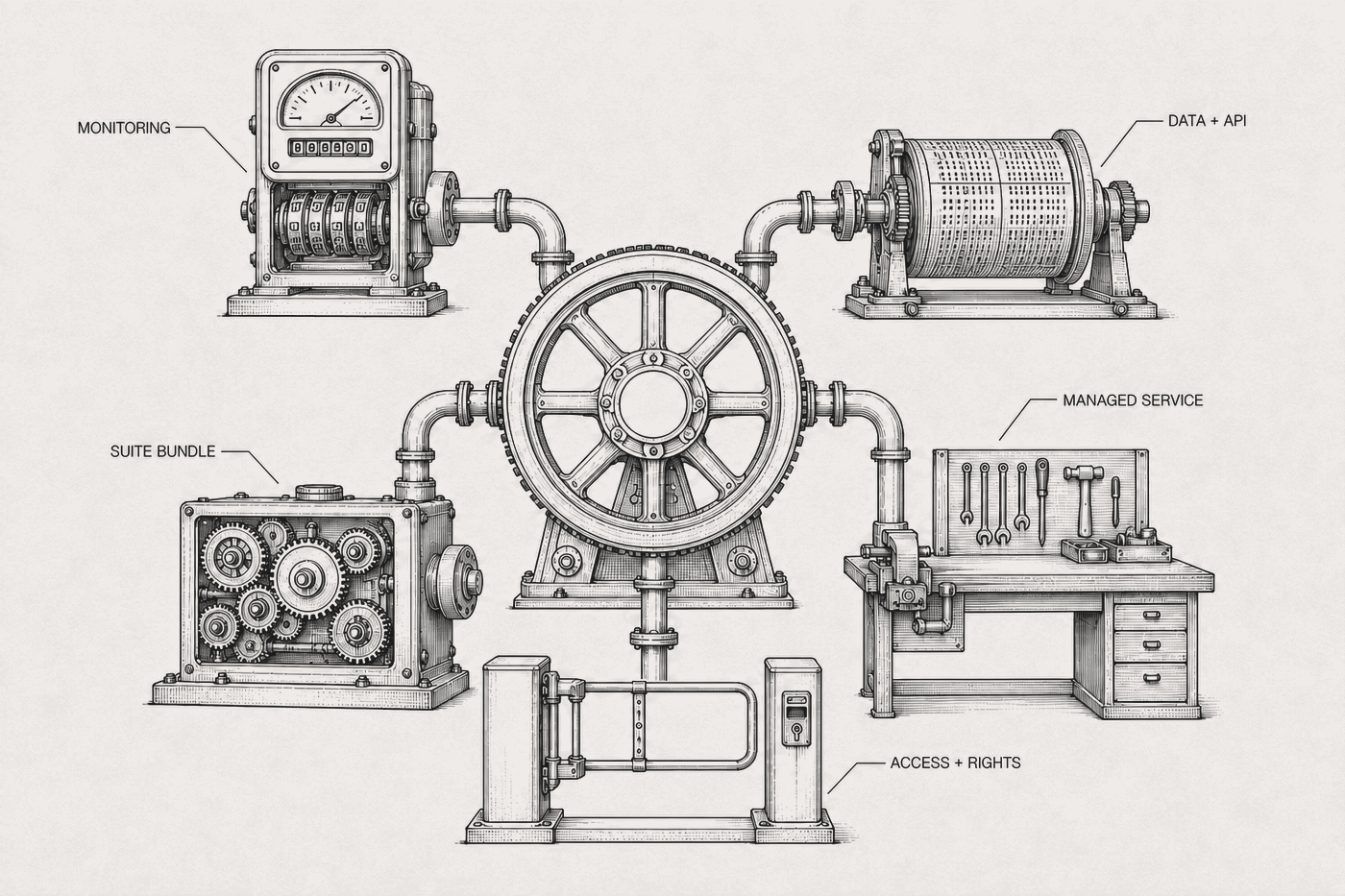

Figure 3.2. Five GEO business models capture different economics: monitoring subscription, data or intelligence, suite bundling, execution or managed service, and access or content rights. Categories may coexist within one company. Conceptual illustration.
M1 Monitoring SaaS. The most common usage equation is:
prompts × models × regions/languages × refresh frequency × projects/seatsHubSpot lists a stand-alone AEO product at $50 per month for 25 prompts across three engines. Similarweb lists $99 per month when billed annually, or $129 month-to-month. OtterlyAI lists monthly tiers of $29, $189, and $489, differentiated by prompt count. This confirms prompt and model sampling as the industry's most direct current billing basis. But final answers are relatively easy to reproduce, native platform reporting is entering the market, and pure dashboards will face continued low-price competition, bundling, and churn.
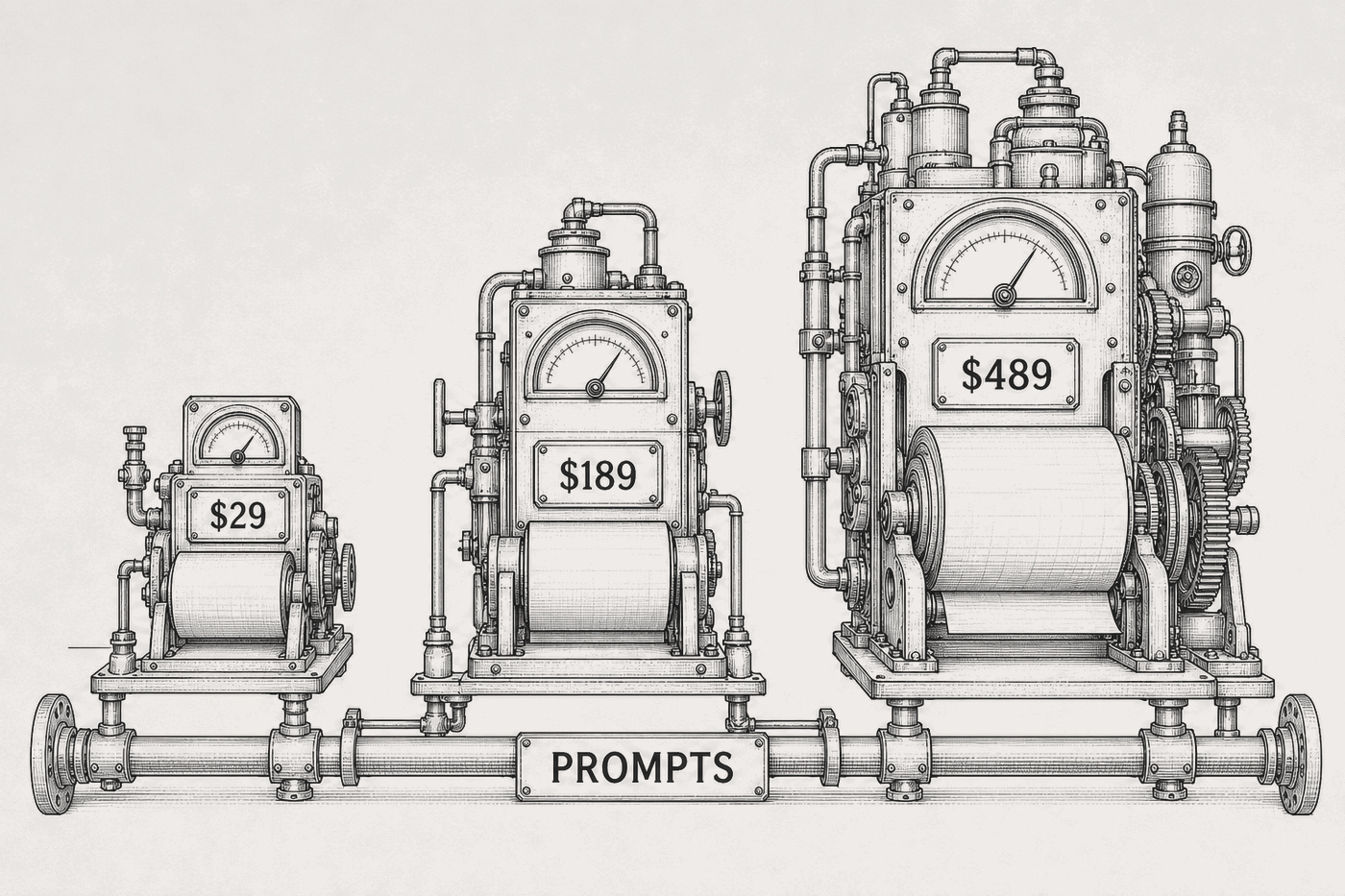
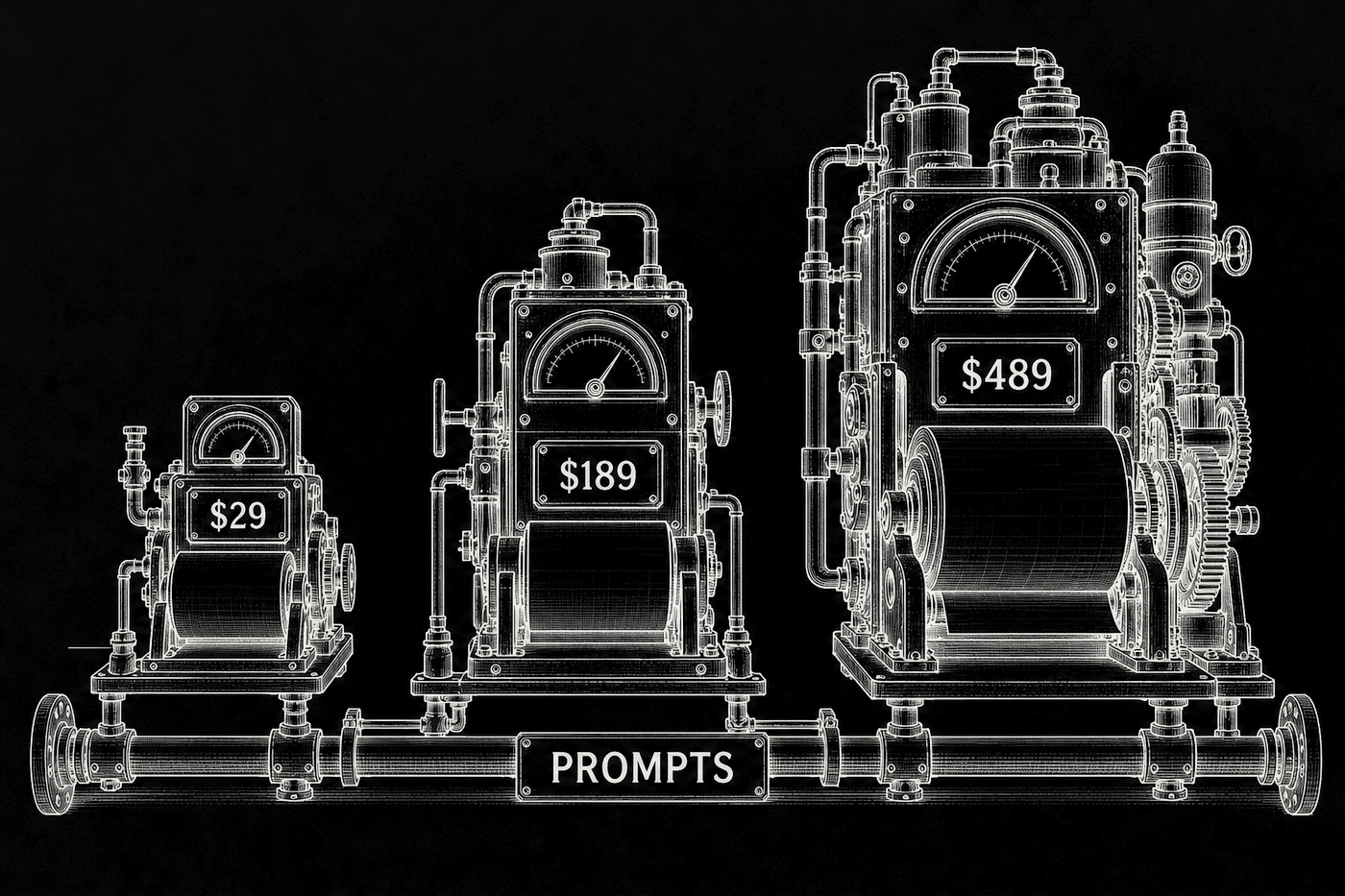
Figure 3.3. Engineering redraw of OtterlyAI's official monthly pricing tiers at $29, $189, and $489, with increasing prompt allowances.
M2 Enterprise data and intelligence platforms. The core product is a stand-alone data and analytics capability. Customers pay primarily to answer: Where is my brand visible? Why am I losing to competitors? Is the change real? What should I change next? They are not buying publishing or CRM functionality.
These platforms typically collect large sets of prompts, AI answers, cited sources, search results, or user behavior, then perform entity resolution, competitive benchmarking, historical trend analysis, and brand-semantic analysis. Yext begins with locations, entity relationships, and a publishing network; Similarweb with behavioral and traffic measurement; and Adobe/Semrush with linked search, content, and marketing data. M2 can stand on its own if the data provides differentiated market intelligence, even when customers do not use the vendor's CMS, CRM, or ad stack. Zeta Global owns identity, intent, and GEO-insight data, but public evidence confirms GEO only as an application within Zeta Answers and ZMP. The company has not shown that GEO can be purchased as a stand-alone intelligence product outside the suite. This report therefore classifies its primary model as M3 while retaining M2 as a possibility.
M2 defensibility comes mainly from sampling coverage, user, entity, or competitive data that customers cannot easily obtain themselves, historical continuity, first-party data connections, data rights, and API delivery—not the interface. Without material data differentiation, an intelligence platform still collapses into a price-competitive monitoring dashboard.
M3 Suite bundling and cross-sell. The core is not stand-alone proprietary GEO data but GEO embedded in a marketing, content, website, CRM, or commerce suite the customer already uses. The customer buys fewer vendors and direct execution after diagnosis: monitor AI visibility, edit content, update pages, reach customers, and observe conversions in one system.
Adobe can combine LLM Optimizer and Semrush data with Experience Cloud content and digital-experience workflows. HubSpot places AEO inside Marketing Hub. Wix can connect diagnostics directly to websites and commerce pages. Salesforce can connect CRM, customer data, and marketing execution. Zeta Global can send GEO insights into audience, messaging, paid media, loyalty, and attribution workflows. Suite vendors can charge more for a premium tier, sell an add-on, or use GEO as an entry point for cross-selling. They may also monetize indirectly through lower churn and higher NRR. Their advantage comes from installed customers, distribution, permissions, content systems, and conversion data—not necessarily from the best GEO measurement data.
M2 and M3 are not mutually exclusive. Adobe/Semrush and Yext can own intelligence products and suite distribution at the same time. The distinction is whether the specific revenue comes from a customer paying separately for proprietary data and insight, or from a price increase, add-on, or retention effect after GEO enters a broader contract.
M4 Execution and managed services. After diagnosis, customers still need technical remediation, content rewrites, data assets, third-party coverage, and site updates. Service providers charge by project or retainer; tool vendors can sell workflow or agent execution as an add-on. This model can generate revenue quickly, but is labor-intensive and usually less scalable and lower-margin than pure software. The software breakthrough is turning “approve a recommendation” into an auditable loop that updates the CMS, knowledge base, or commerce feed automatically.
M5 APIs, distribution, and content rights. Yext has exposed Scout intelligence through MCP and APIs, while Cloudflare provides crawler controls and is exploring Pay Per Crawl. These represent different profit pools. GEO applications sell “how to be discovered more effectively”; access infrastructure sells “who may access, how access is governed, and whether access is paid.” They are complementary but should not be combined into one revenue category.
Overall, M1 is easiest to replicate. M2's data rights and coverage, M3's execution and attribution loop, and M4's customer relationships and off-site distribution are harder to replace. Whether revenue should be counted as GEO still depends on disclosure level; apparent business-model relevance is not enough.
3.1.3 Business Origin and the Migration of Existing Resources
This research still finds no company-wide transformation that can be verified through segment and revenue reclassification. What can be verified is product-line migration, feature extension, direct internal launches, and acquisitions. The quality of a migration depends not on whether a press release uses the GEO label, but on whether existing resources actually reduce customer-acquisition, data, or execution costs for the new business—and whether post-migration commercialization has been demonstrated.
| Code and entry path | Transferable resources | Practical advantage after migration | Representative companies |
|---|---|---|---|
| O1 Native migration from SEO / search marketing | Crawlers, keyword and page graphs, content diagnostics and workflows, agency channels, and existing search budgets | Fastest understanding of queries, crawl and index mechanics, content execution, and the procurement logic of search budgets | Locafy, Semrush, Geocode, CINC, Faber Company, Nyle, Glad Cube, Orchestra Holdings |
| O2 Adjacent extension from enterprise software, entity data, and analytics | Content and publishing permissions in DXP/CMS; first-party CRM and event conversion data; local and entity graphs, clickstream, customer conversations, enterprise sales, and permission governance | Best positioned to connect monitoring with content publishing, customer workflows, and business attribution; proprietary entity or behavioral data can also support intelligence products | Adobe, HubSpot, Yext, Similarweb, Sprinklr, Amplitude, Wix, Salesforce, Zeta Global |
| O3 Migration from advertising, media, PR, and agency services | Customer retainers, creative and editorial teams, earned media, social distribution, industry relationships, and off-site execution | Can address third-party reputation and cross-site evidence, and can monetize early through projects and consulting | WPP, Omnicom, CyberAgent, Stagwell, NetMedia, CyberBuzz, Material Group, BlueFocus |
| O4 Direct launch of a GEO product, business unit, or subsidiary | Parent-company capital, customer access, back-office capabilities, and the organizational focus of a dedicated team | Clear organizational signal and rapid iteration; leadership, product launches, and contract progress are easier to observe | Onfolio/Pace, CyberAgent's AI Search Marketing unit, Rezolve AI's AEO module |
| O5 Capability acquired through M&A | Immediate access to the target's product, data, people, and customers, combined with the acquirer's distribution, suite, and attribution capabilities | Fastest way to close product and data gaps and create attach, upsell, and cross-sell entry points | Adobe/Semrush, HubSpot/XFunnel |
A company can follow more than one route. Adobe built LLM Optimizer internally and acquired Semrush for search data. CyberAgent migrated from advertising services and also created a dedicated AI Search Marketing business unit. The company map in Section 3.2 therefore records a primary path and important secondary paths rather than forcing each company into one category.
3.1.4 Business-Data Disclosure Levels
We define “stand-alone GEO revenue disclosure” as a monetary revenue, ARR, or MRR figure in a regulatory filing, periodic financial report, or formal investor-relations communication that can be clearly attributed to GEO, AEO, or LLMO and does not simultaneously include SEO, broader AI, ad spend, or other marketing services. Under this standard, the number of public companies worldwide with confirmed positive pure-GEO disclosure remains zero as of the research date.
Read the framework first by the D0–D4 major class, then by subclass. The major class answers what financial state public evidence can confirm. Subclasses distinguish the evidence behind mixed figures or commercialization signals. D0–D4 are status codes, not a linear ranking of company quality, revenue scale, or investment value. D4, in particular, means that a company explicitly reports zero revenue, no formed revenue, or no relevant business; it is not “higher” than D3.
| Major disclosure class | Subclass | Test | Current sample and data | What can be confirmed |
|---|---|---|---|---|
| D0|No usable financial disclosure | — | A product exists, but no usable GEO customer, ARR, revenue, attach, or upsell data are available | Adobe on its current consolidated basis, HubSpot, Yext, Similarweb, Sprinklr, Amplitude, Wix, Zeta Global, and others | Only product or feature existence—not revenue scale |
| D1|Positive pure-GEO figure | — | Stand-alone GEO/AEO/LLMO revenue, ARR, or MRR, with no other business mixed in | 0 companies | The global public-company screen found no qualifying example as of the research date |
| D2|A quantifiable figure exists, but pure GEO cannot be isolated | Three subclasses | — | — | — |
| ↳ | D2-A|Bundled product-level figure | The amount comes from a product containing GEO, but the product also contains SEO or other capabilities | Locafy's actively sold Localizer added more than A$156,000 in MRR in less than two months; nine-month subscription revenue was A$3.0M, with growth driven mainly by Localizer | A bundled SEO+AEO product has produced measurable commercial traction, but AEO-only revenue cannot be isolated |
| ↳ | D2-B|AI product portfolio containing GEO | The amount comes from a collection of AI products that includes GEO | Pre-acquisition Semrush: 2025 AI products ARR exceeded $38M; total ARR was $471.4M | AI products containing GEO reached material scale, but the figure is broader than pure GEO |
| ↳ | D2-C|Broad AI, agentic, or mixed segment | The amount includes GEO together with other AI, web, advertising, or marketing services | Weimob RMB116.1M; MiningLamp Agentic Services RMB100.224M; Marketingforce AI applications approximately RMB1.49B; Geocode and CINC disclose SEO, web, or consulting segments containing AIO/LLMO | GEO has entered paid products, contracts, or broader portfolios, but its actual contribution cannot be measured |
| D3|Positive commercialization signal, but no usable amount | Two subclasses | — | — | — |
| ↳ | D3-A|Formal revenue or performance-contribution signal | A statutory filing or formal company material confirms revenue, contracts, or a contribution to performance without a separate amount | Onfolio's 10-Q confirms that Pace generated incremental revenue; Faber reports dozens of orders and a contribution to performance | The business has moved beyond “product only,” but cannot enter revenue or valuation calculations |
| ↳ | D3-B|Weaker commercialization signal | An interactive response or qualitative description confirms subscriptions, business activity, or directional scale | HCR says subscriptions have been purchased but remain a small share; BlueFocus says the scale is not large | Business activity exists, but evidence is weaker than formal financial or operating disclosure |
| D4|Explicitly zero, not yet formed, or not involved | — | The company explicitly states that revenue is zero, has not formed, or the relevant business is not conducted | Borui Communication, Zhewen Interactive, Inly Media, Easy Click Worldwide, Tianlong Group, and others | No positive GEO revenue existed as of the relevant disclosure date |
Disclosure level measures verifiable data purity, not product maturity or company quality. A D2 amount may be larger than a D1 amount in absolute terms, but because it mixes other businesses it cannot be used to calculate a pure-GEO market size. A D0 company may already generate revenue; investors simply cannot isolate it from public materials.
Valuation must also remain separate from disclosure scope. Adobe's acquisition price for Semrush reflects control, SEO and competitive-intelligence data, customers, talent, synergies, and expected growth. It is not a GEO business valuation. Mixed-product ARR, group market capitalization, and acquisition consideration cannot be allocated mechanically into GEO revenue or value.
3.2 Unified Public-Company Map
| Company / group | Market | Value chain | Business model | Business origin | GEO disclosure | Current assessment |
|---|---|---|---|---|---|---|
| Alphabet, Microsoft | United States | L1 | M5 / platform ecosystem | Not applicable | D0 / not applicable | Rule setters and native-report providers, not GEO software investments |
| Cloudflare | United States | Adjacent L1 | M5 | O2 | D0 | Crawler-governance and access-rights infrastructure; should not be counted as GEO software revenue |
| Adobe/Semrush | United States | L2→L3 | M2+M3 | O2+O5 | Current Adobe D0; historical pre-acquisition Semrush D2 | Most complete product portfolio; historical Semrush AI products ARR included GEO but was not pure GEO. Adobe currently has no stand-alone GEO amount, and the acquisition price is not a GEO valuation |
| Yext | United States | L2→L3 | M2+M3 | O2 | D3 | Local and entity graph, Scout, API, and MCP create a differentiated entry point; only a qualitative expectation that it will become a meaningful ARR contributor |
| Similarweb | United States | L2 | M1+M2 | O2 | D0 | Stronger cross-site demand and visit data, weaker execution loop; product revenue undisclosed |
| Locafy | US-listed / Australian-incorporated | L3 | M1+M3 | O1 | D2 | Closest to product-level quantification, but the disclosed increment is MRR for a bundled SEO+AEO product—not AEO-only or total product MRR |
| HubSpot | United States | L3 | M1+M3 | O2+O5 | D0 | XFunnel acquisition adds product capability; CRM/CMS supports execution and attribution; no AEO revenue or attach data |
| Sprinklr, Amplitude | United States | L2→L3 | M3 | O2 | D0 | Depend respectively on CXM conversations and publishing, and first-party event attribution; neither discloses GEO separately |
| Wix, Salesforce | United States | L3 | M3 | O2 | D0 | Exists as website, commerce, or marketing-cloud functionality, mainly supporting suite differentiation and cross-sell |
| Zeta Global | United States | L2→L3 | M3; M2 pending stand-alone sales validation | O2 | D0 | GEO confirmed by product announcement and 10-K; identity and intent data plus marketing execution make Zeta a priority GEO-adjacent public-company coverage name, but GEO revenue, customers, pricing, and attach are undisclosed |
| Rezolve AI | United States | L3 | M3 | O4 / new feature | D2 | Product suite explicitly includes AEO, but revenue is disclosed only for the full platform |
| Onfolio/Pace | United States | L4 | M4 | O4 | D3 | Dedicated GEO agency is qualitatively confirmed in a 10-Q as a source of incremental revenue; no amount, and a proposed asset disposal could change ownership |
| WPP, Omnicom, Publicis, S4 Capital | UK / US / Europe | L4 | M4 | O3 | D0 | Audit, consulting, and execution exist, but revenue is mixed into group, segment, and retainer figures |
| Geocode, CINC, Faber Company, Nyle, Glad Cube, Orchestra Holdings | Japan | L2/L4 | M1+M4 | O1 | D2/D3 | Densest native migration from SEO; mixed segment revenue, pricing, contracts, or deployments exist, but no pure-GEO amount |
| CyberAgent | Japan | L4 | M4 | O3+O4 | D0 | Progressed from GEO Lab and consulting packages to a dedicated business unit; strong organizational signal, no financial signal |
| Informa TechTarget, Stagwell, NetMedia, CyberBuzz, Material Group | US / Europe / Japan | L2/L4 | M2+M4 | O3/O4 | D0/D3 | New product lines from media data, PR, social, or content services; mostly launch or adoption signals without amounts |
| Weimob, MiningLamp, Marketingforce | Hong Kong | L3/L4 | M3+M4 | O2/O3 | D2 | Broad AI or agentic business amounts exist, but GEO is only one direction within a larger scope |
| HCR, BlueFocus | China A-shares | L2/L4 | M1/M4 | O2/O3 | D3 | Subscription purchases or qualitative scale signals exist, but no formal stand-alone amount; broad AI revenue cannot substitute for GEO revenue |
| AppLovin | United States | Excluded | Paid advertising | Not GEO | Not applicable | AI-powered performance-ad auction and recommendation platform; should not be included in GEO TAM |
The qualitative matrix below highlights eight representative public-company groups from this table: Similarweb, Adobe/Semrush, Yext, Locafy, WPP/Omnicom, Japan SEO migrants, HubSpot, and Zeta Global. It is an interpretive classification of execution depth and disclosure identifiability, not a measured global score.
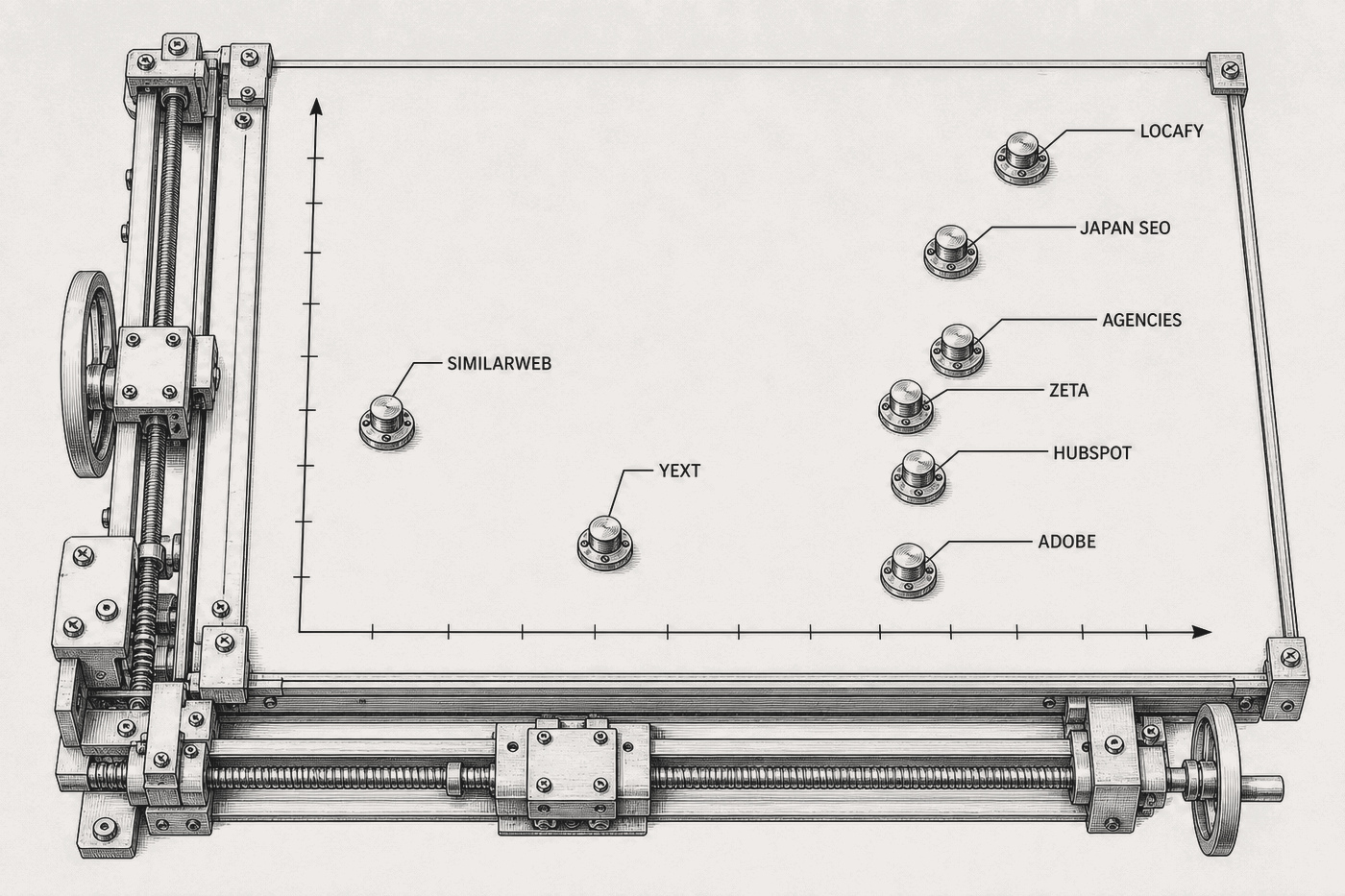
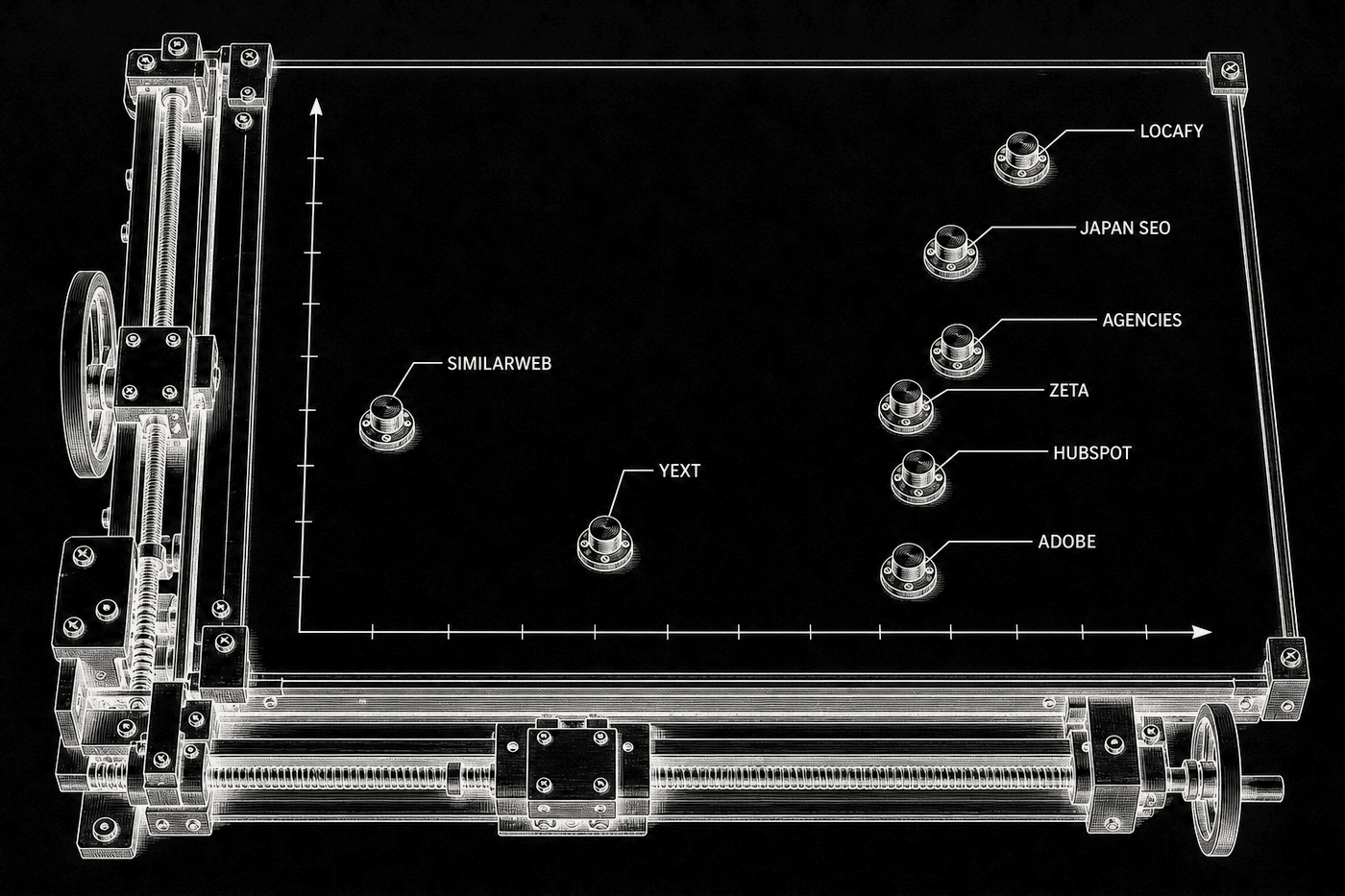
Figure 3.4. Eight representative public-company groups positioned by execution depth and the identifiability of GEO-related data or products. This is a qualitative classification of the report sample, not a measured global market map or score.
3.3 Recommended Public-Market Name: Zeta Global—Core Fundamentals Carry the GEO Option
Zeta Global is not a GEO pure play. It is a marketing-technology platform with meaningful revenue, positive operating cash flow, and a large-enterprise installed base. The recommendation does not attribute existing revenue to GEO. Rather, consumer identity and intent data, Zeta Answers, execution rights across paid and owned channels, and attribution capabilities may allow GEO to enter existing ZMP contracts as a new application. Relative to a point tool that sells prompt monitoring alone, Zeta has a better chance of connecting AI visibility to audiences, actions, and revenue.
The disclosure boundary must come first. Zeta reports one operating and reportable segment and provides no separate P&L for Messaging, CDP+, DSP, Zeta Answers, Athena, or GEO. It does not disclose GEO revenue, ARR, paying customers, pricing, contract count, attach rate, gross margin, or retention. The Q1 2026 10-Q and results release did not mention GEO separately. Public evidence can therefore confirm that the product exists, but it cannot attribute Answers, Athena, AI, or ZMP revenue and usage to GEO.
3.3.1 Why Zeta: Product Existence, Resource Migration, and a Commercial Entry Point
Zeta did not begin as a GEO point tool. It has progressively migrated marketing data, identity, channels, and enterprise customers toward AI decisioning and generative discovery.
| Time | Event | Capability migration |
|---|---|---|
| 2007 | Founded by David A. Steinberg and John Sculley | Began with data-driven marketing and customer acquisition |
| 2017 | Acquired machine-learning company Boomtrain | Strengthened personalization, prediction, and machine learning; related team members later moved into product and data leadership |
| 2021 | Listed on the NYSE | Gained capital for enterprise-software expansion, R&D, and acquisitions |
| 2024 | Acquired LiveIntent | Added publisher network, identity graph, email advertising, and first-party addressability |
| 2025 | Launched AI Agent Studio, Zeta Answers, and GEO Solution; acquired Marigold's enterprise-software business | Expanded into agents, answer-driven marketing, AI visibility, loyalty, and global messaging |
| Q1 2026 | Athena became generally available; OpenAI partnership announced | Made natural-language Q&A, insight, and action orchestration a common ZMP interaction layer |
| Jun./Jul. 2026 | Palantir partnership announced; “intelligent AI infrastructure company” narrative adopted | Plans to rebuild Zeta Data Cloud on Foundry and add ontology, governance, and enterprise distribution |
The 2026 “AI infrastructure” language remains a strategic and market narrative change. It does not mean Zeta has reorganized into a new infrastructure segment or created stand-alone infrastructure revenue. Management's statement that the Palantir partnership could generate more than $100M in annual revenue over the coming years is a forward-looking objective, not contracted ARR.
ZMP can be understood in four layers. GEO is not a fifth layer outside the platform; it is an application that spans data, decisioning, execution, and measurement.
| Layer | Core assets / products | Problem solved | Relationship to GEO |
|---|---|---|---|
| Data and identity | Zeta Data Platform, SuperGraph, CDP+ | Unifies first-party data, resolves identity, and adds behavioral and intent signals | Helps prioritize commercially valuable questions and audiences and supports downstream attribution; does not control external LLM search indexes or cited corpora |
| AI and decisioning | Zeta Answers, AI Studio, Agent Studio, Athena | Converts data into predictions, insights, natural-language answers, and workflows | GEO is a Zeta Answers application; Athena is an access and orchestration layer, not a synonym for GEO |
| Reach and execution | DSP, Messaging, loyalty, paid and owned channels | Executes across email, mobile, CTV, display, websites, and other channels | Can carry content, audience, and campaign actions after GEO diagnosis, but not every action affects AI citations |
| Measurement and optimization | Attribution, performance optimization, Zeta Answers | Connects media, visits, conversions, and customer value | Could theoretically connect AI visibility with downstream outcomes; no GEO-specific attribution method or results are disclosed |
Zeta says its data covers more than 245 million people in the United States and 535 million globally, with more than 2,500 attributes per person on average and more than one trillion content-consumption signals processed each month. These figures are company-reported and not independently audited. More importantly, scale is not the same as proprietary value, and these data do not necessarily enter ChatGPT, Gemini, or Claude retrieval and citation systems.
Zeta formally launched GEO Solution within ZMP on September 17, 2025. The 2025 10-K later listed Generative Engine Optimization as an application within the Prospects module of Zeta Answers, moving product existence beyond a press release and into regulatory disclosure. Confirmed capabilities include monitoring brand performance in ChatGPT, Gemini, and Claude; tracking visibility, sentiment, and AI share of voice; identifying citation gaps, hallucinations, and off-brand answers; applying Zeta Data; optimizing Q&A, summaries, and metadata; and coordinating PR, SEO, and content strategy. Zeta Answers can charge a license fee and/or additional fees as ZMP utilization increases, but the company has not said whether GEO is priced separately.
The public feature set supports an approximate seven-step workflow.
| Step | Workflow | Evidence boundary |
|---|---|---|
| 1 | Define the brand, category, competitors, and consumer question set | A research input required to operate the product; prompt count, geography, language, and refresh cadence are undisclosed |
| 2 | Sample ChatGPT, Gemini, and Claude | Confirmed direct GEO capability |
| 3 | Diagnose missing mentions, competitor substitution, factual errors, insufficient citations, and off-brand language | Confirmed visibility, sentiment, citation-gap, and hallucination diagnostics |
| 4 | Add consumer identity, interest, and intent data to prioritize questions and audiences | Potential differentiation; Zeta Data is not an answer engine's index, training corpus, or citation graph |
| 5 | Generate Q&A, summary, metadata, PR, SEO, and content recommendations | Confirmed recommendation layer; no proof that recommendations necessarily change external crawling, retrieval, synthesis, or citation |
| 6 | Use the insight in content, audience, media, messaging, or other ZMP workflows | Potential execution loop; automated trigger coverage and attach rate are undisclosed |
| 7 | Compare AI visibility and share of voice, and attempt to connect visits, conversions, and customer value | Potential measurement loop; no GEO-specific attribution method or incremental-revenue case is disclosed |
Connecting the publicly disclosed modules by function suggests the following potential resource-migration chain: Zeta Data Cloud → GEO insight → Answers/Athena/Agents → marketing execution → revenue feedback. This is not a production architecture disclosed by Zeta, and there is no evidence that GEO insights can directly trigger every downstream module or produce GEO-specific attribution.
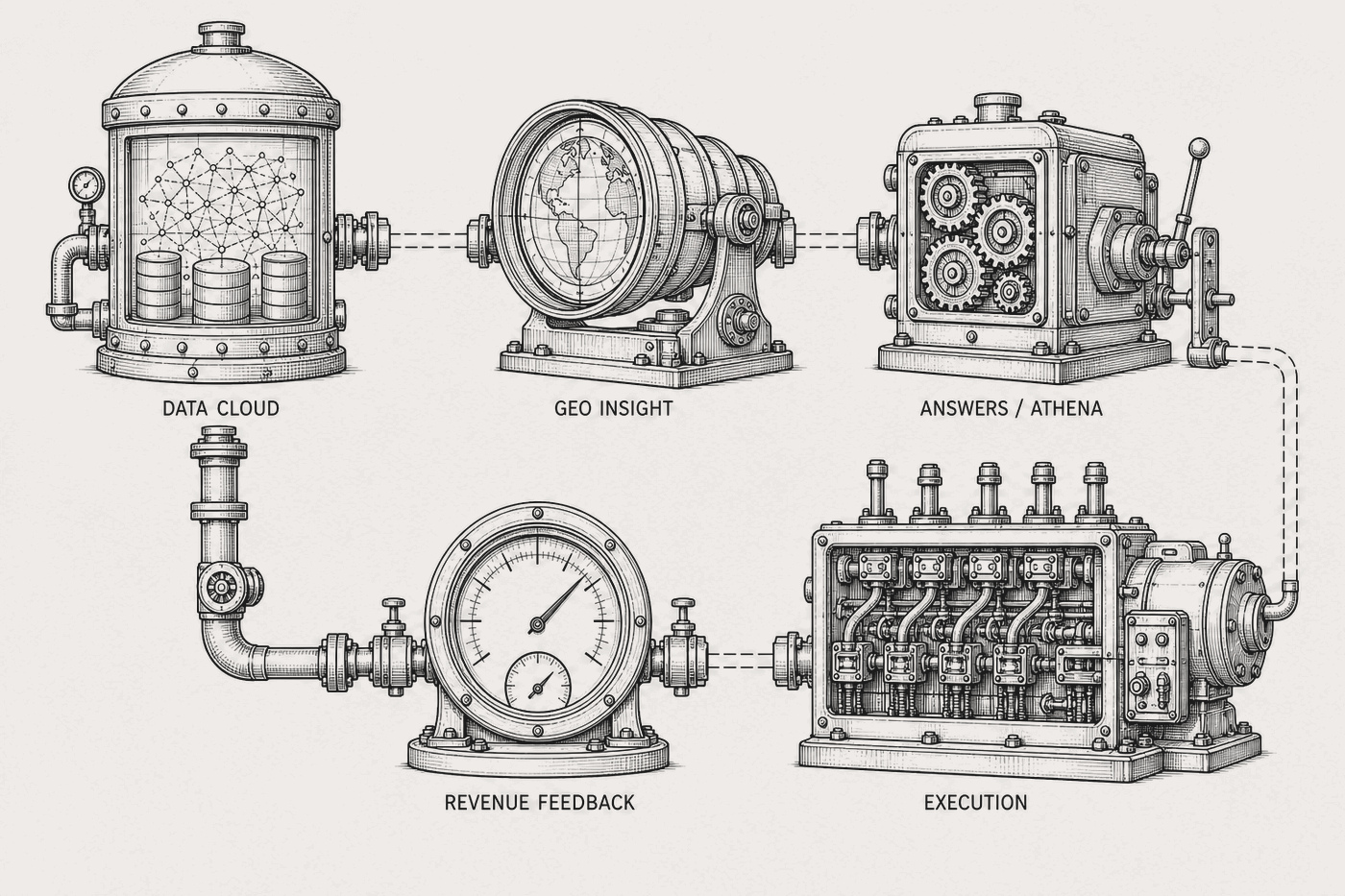
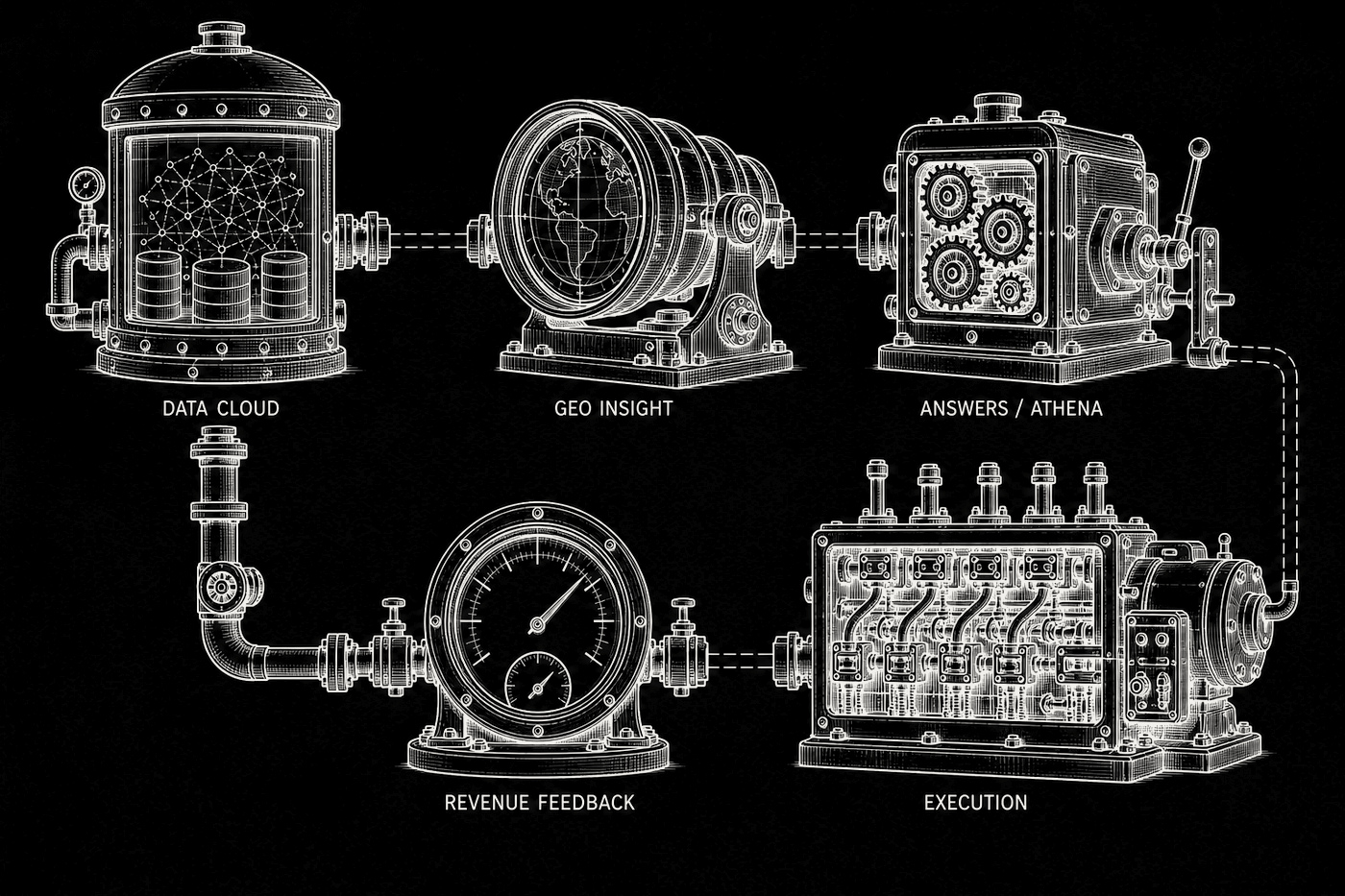
Figure 3.5. How Zeta's disclosed modules could connect data, GEO insight, decisions, marketing execution, and revenue feedback. Each module exists publicly, but the complete end-to-end chain is a research inference rather than a disclosed production architecture.
If this chain is fully connected, the value lies not in “having many consumer records,” but in using data within enterprise-authorized marketing actions. A new GEO point solution can copy a monitoring interface quickly, but cannot immediately obtain enterprise data access, identity systems, channel permissions, historical conversion records, and budget relationships. Conversely, public materials do not disclose the proprietary share, match rate, accuracy, freshness, or incremental lift of SuperGraph data versus customer first-party data, so SuperGraph cannot be described as an irreplaceable data network.
Aligning official product definitions, contract charging components, and observable costs clarifies how GEO sits inside ZMP—and which figures remain unavailable for each business.
| Saleable business / product | What the customer receives | Verifiable pricing and cost boundary | Financial visibility and relationship to GEO |
|---|---|---|---|
| Messaging / ESP | Email, SMS/MMS, push, forms, and on-site engagement orchestration | Fixed or minimum monthly fees, utilization fees, and professional services; costs include transmission, cloud, deliverability, and delivery personnel | Revenue and gross margin undisclosed; can support first-party engagement after GEO, but is not GEO revenue |
| CDP+, Identity & Data | Data ingestion, identity resolution, profile merging, consent, clean rooms, and audiences | Fixed or minimum monthly fees, utilization, data and advanced-reporting add-ons, and implementation; costs include third-party data, matching, storage, querying, and governance | Revenue, ARR, margin, and customers undisclosed; supports prioritization and attribution but does not control external answer engines |
| DSP / paid-media activation | Programmatic media, CTV, display, audience sync, and attribution | Fixed monthly fees, CPM, percentage of media spend, or self-service platform fees; media and publisher revenue share are major costs | Revenue and profit undisclosed; gross versus net recognition affects reported revenue and margin, so it is not pure SaaS |
| Zeta Answers | Converts consumer, customer, competitive, and campaign signals into Explore, Prospects, Customers, and Competitors insights | The 10-K confirms license fees and/or fees that increase with ZMP utilization, generally quarterly or annual; no public ACV or usage unit | GEO sits within Prospects; Answers revenue, ARR, customers, and attach are undisclosed and cannot all be classified as GEO |
| Athena, AI Studio, Agent Studio | Natural-language or voice access to ZMP, audience creation, insight retrieval, and agentic workflows | No public pricing by seat, interaction, token, or workflow; costs may include external models, inference, cloud, governance, and customer success | Usage is adoption, not revenue; Athena is not synonymous with GEO |
| LiveIntent / publisher products | Newsletter advertising, publisher monetization, identity, and addressability | No disclosed take rate, CPM, subscription, or data fee; publisher revenue share and media costs apply | 2025 revenue was $82.6M, with no separate profit or retention; not GEO revenue |
| Marigold enterprise software | Loyalty, enterprise messaging, personalization, and lifecycle engagement | Post-acquisition pricing by product is undisclosed; costs include software, cloud, global delivery, and intangible amortization | About five weeks of 2025 revenue were $18.6M; Q1 2026 revenue was $55.6M; no product profit or GEO split |
| GEO Solution | Monitors AI visibility, sentiment, citation gaps, and hallucinations, and provides content and competitive recommendations | Confirmed only as embedded in Answers license and utilization contracts; separate pricing and prompt, engine, or seat units are unknown | Revenue, ARR, customers, gross margin, renewal, attach, and customer incremental revenue are all undisclosed |
| Professional services | Onboarding, integration, campaign configuration, customization, and adoption support | Separate fees; direct costs are primarily implementation, consulting, account-management, and support personnel | Service revenue, utilization, and margin undisclosed; labor intensity limits blended steady-state margin |
This product decomposition shows that Zeta's GEO advantage comes from adjacent platform resources, but it does not allow any adjacent product revenue to be counted as GEO. SEC filings confirm four contract components—fixed or minimum monthly subscriptions, utilization fees, media-spend or CPM pricing, and professional services—with data and advanced reporting available as add-ons. No verifiable public dollar price list exists for ZMP, Answers, Athena, or GEO.
3.3.2 Core-Business Quality: Growth, Cash Flow, and Customer Expansion Support the GEO Option
US$M, except customer metrics.
| Metric | 2024 | 2025 | Q1 2026 | Investment implication |
|---|---|---|---|---|
| Revenue | 1,005.8 | 1,304.7 | 396.3 | 2025 growth approximately 29.7%; Q1 2026 growth 49.9%, but Marigold contributed to the quarter and the increase is not entirely organic legacy ZMP growth |
| GAAP net income (loss) | (69.8) | (31.5) | (13.2) | Loss narrowed, but adjusted metrics should not obscure SBC, amortization, and acquisition costs |
| Operating cash flow | 133.9 | 198.9 | 49.7 | The core business consistently generates cash, an important difference from early-stage GEO software companies |
| FCF | 92.3 | 164.7 | 41.7 | Company-defined non-GAAP FCF; should be assessed alongside capitalized development, acquisitions, and SBC |
| Adjusted EBITDA / margin | 193.0 / 19.2% | 278.7 / 21.4% | 66.1 / 16.7% | Margin improvement supports scale effects but cannot replace GAAP earnings quality; Q1 margin reflects acquisition and seasonality |
| SBC | 195.0 | 177.8 | 53.0 | Annual absolute SBC declined but remains material; Q1 2026 SBC exceeded quarterly FCF, leaving dilution as a central risk |
The four company-wide metrics visualized below are 2025 revenue of $1,304.7M, operating cash flow of $198.9M, company-defined FCF of $164.7M, and annual NRR of 128.0%.
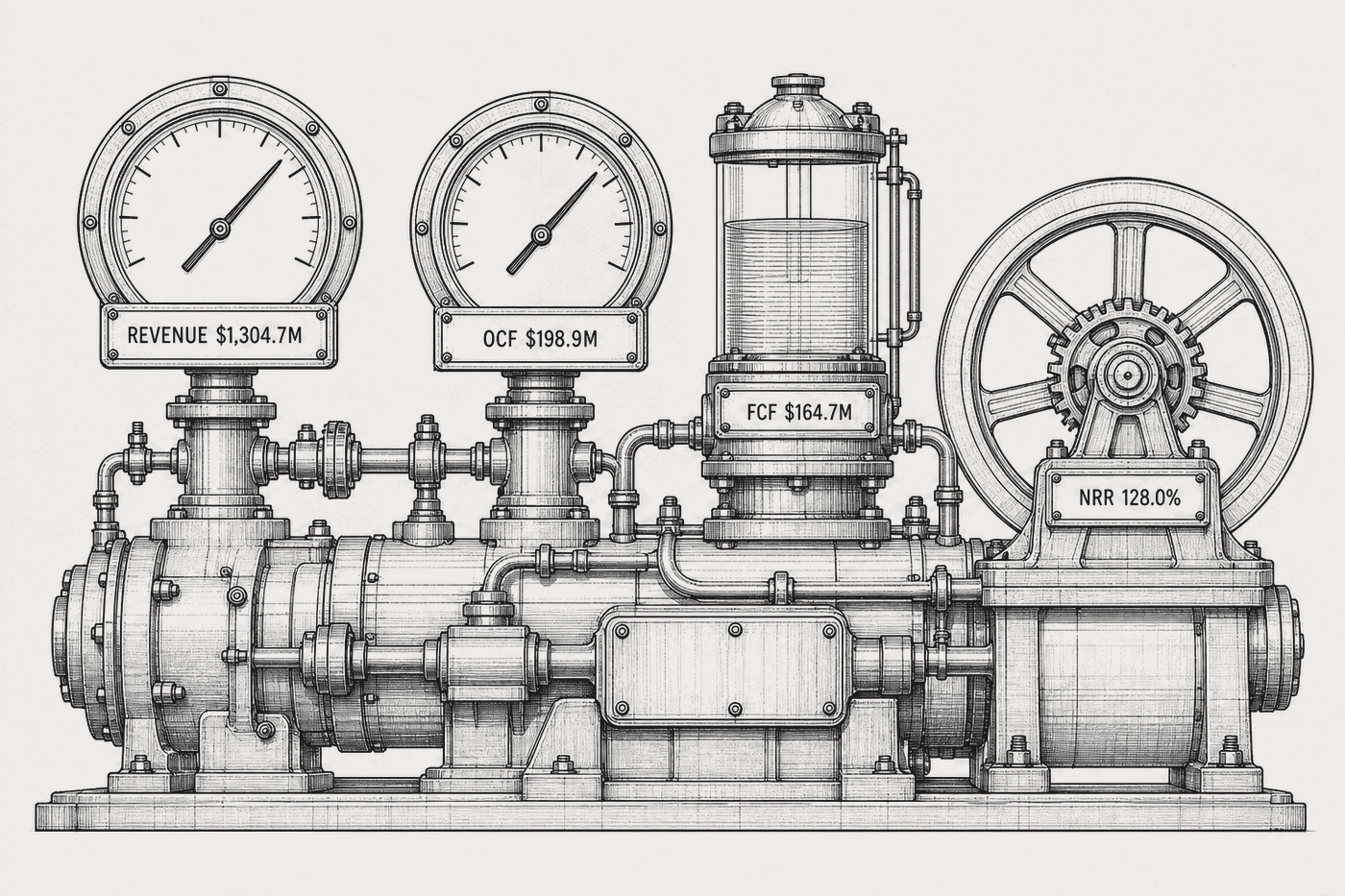

Figure 3.6. Zeta Global's 2025 company-wide revenue, operating cash flow, free cash flow, and annual NRR. These metrics show the carrying capacity of the core business; none is allocated to GEO. Data visualization.
Geography: Still US-Centric, with Marigold Increasing International Mix
| Period | US revenue (US$M) | US share | International revenue (US$M) | International share | International YoY |
|---|---|---|---|---|---|
| 2023 | 700.1 | 96.1% | 28.7 | 3.9% | — |
| 2024 | 974.9 | 96.9% | 30.8 | 3.1% | +7.5% |
| 2025 | 1,246.5 | 95.5% | 58.2 | 4.5% | +88.8% |
| Q1 2025 | 254.7 | 96.3% | 9.8 | 3.7% | — |
| Q1 2026 | 359.4 | 90.7% | 36.9 | 9.3% | +278.1% |
The United States still represented 95.5% of 2025 revenue, so Zeta is not yet a geographically diversified global software company. International share rose to 9.3% in Q1 2026, but Marigold's global messaging and loyalty business contributed $55.6M in the quarter, and the company did not further split that contribution by US versus international or subscription versus usage. The international acceleration cannot all be treated as organic overseas expansion by the legacy ZMP business.
Customer Industry: Budget Source, Not Product Revenue
| Industry | 2024 share | Approx. 2024 revenue (US$M) | 2025 share | Approx. 2025 revenue (US$M) | Approx. YoY |
|---|---|---|---|---|---|
| Consumer & retail | 22% | ≈221.3 | 24% | ≈313.1 | +41.5% |
| Travel & hospitality | 7% | ≈70.4 | 11% | ≈143.5 | +103.8% |
| Insurance | 10% | ≈100.6 | 11% | ≈143.5 | +42.7% |
| Telecommunications | 9% | ≈90.5 | 10% | ≈130.5 | +44.1% |
| Financial services | 8% | ≈80.5 | 8% | ≈104.4 | +29.7% |
| Other industries | 44% | ≈442.5 | 46% | ≈600.1 | +35.6% |
Travel and hospitality recorded the fastest approximate increase in 2025, while consumer and retail remained the largest named industry. The five named industries accounted for 54%, so the company does not depend on a single vertical; customer concentration is nevertheless greater than industry concentration because large enterprises exist within each vertical. The amounts are derived by multiplying total revenue by company-reported whole-number shares and therefore contain rounding error. They are not audited segment revenue and do not reveal how much each industry bought of ESP, CDP+, DSP, Zeta Answers, or GEO.
Customer Scale and Tenure: Revenue Concentrated in Large, Mature Accounts
| Metric | 2024 | 2025 | Change |
|---|---|---|---|
| Total customers | 1,793 | 2,651 | +47.9% |
| Scaled customers (TTM revenue ≥$0.1M) | 527 | 602 | +14.2% |
| Super-scaled customers (TTM revenue ≥$1.0M) | 148 | 184 | +24.3% |
| Scaled ARPU | $1.868M | $2.109M | +12.9% |
| Super-scaled ARPU | $5.713M | $6.156M | +7.8% |
| Channels per super-scaled customer | 3.0 | 3.3 | +10.0% |
| Annual NRR | 113.6% | 128.0% | +14.4 percentage points |
Super-scaled customers generated 87% of 2025 group revenue, approximately $1,135.1M; all other customers generated about $169.6M. Annual NRR increased from 113.6% to 128.0% and excludes political and advocacy customers, which represented 8% of revenue in 2024 and 1% in 2025 because of the election cycle. NRR, ARPU, and channels per customer collectively indicate that land, expand, extend is taking effect. But NRR is also influenced by media volume, message sends, and campaign intensity and should not be treated as contractual ARR retention.
| Customer tenure | Scaled customers / share of count | Scaled revenue share | Super-scaled customers / share of count | Super-scaled revenue share |
|---|---|---|---|---|
| More than 5 years | 209 / 34.7% | 64.2% | 90 / 49.0% | 68.2% |
| 3–5 years | 65 / 10.8% | 10.6% | 26 / 14.1% | 10.6% |
| 1–3 years | 217 / 36.0% | 19.0% | 56 / 30.4% | 16.7% |
| Less than 1 year | 111 / 18.5% | 6.2% | 12 / 6.5% | 4.5% |
Super-scaled customers with more than five years of tenure generated 68.2% of revenue within that tier, showing that retention and expansion depend mainly on long-term relationships. At the same time, the top ten customers generated more than one-third of group revenue and one customer exceeded 10%. A reduction in media volume, message sends, or module usage by a large customer would materially affect revenue. Zeta does not disclose GEO adoption, revenue, or attach among its 184 super-scaled customers.
Growth Sources: Existing-Customer Expansion, Acquisitions, and Pure New Logos Must Be Separated
Revenue increased by $298.9M in 2025. The company attributed $190.9M to existing customers and $108.0M to new customers, while approximately $84.2M of new-customer contribution came from acquisitions. This is management attribution, not a strict organic-revenue definition, because cross-selling between acquired and existing customer bases can cross categories.
| 2025 revenue growth bridge | Amount (US$M) | Share of $298.9M increase |
|---|---|---|
| Existing-customer increase | 190.9 | 63.9% |
| New-customer increase | 108.0 | 36.1% |
| Of which: acquisition contribution | 84.2 | 28.2% |
| New-customer increase after mechanically removing acquisitions | ≈23.8 | ≈8.0% |
| Revenue scope (US$M) | 2024 | 2025 | YoY |
|---|---|---|---|
| GAAP consolidated revenue | 1,005.8 | 1,304.7 | +29.7% |
| LiveIntent revenue | 16.9 | 82.6 | Not directly comparable; 2024 included approximately two months |
| Marigold revenue | — | 18.6 | 2025 included approximately five weeks |
| Excluding political-candidate, LiveIntent, and Marigold revenue | 944.5 | 1,203.5 | Approximately +27% |
The comparable scope is useful for observing underlying growth but is not a GAAP segment. Q1 2026 revenue was $396.3M, up $131.9M year over year. Marigold contributed $55.6M, or 14.0% of quarterly revenue and approximately 42.2% of the year-over-year increase. Mechanically excluding Marigold produces about $340.7M of revenue, up approximately 28.9%. Management attributed $87.0M of the quarterly increase to new customers and $44.9M to existing customers, but Marigold is already included in those customer categories; the two bridges cannot be added together.
Marigold's unaudited 2025 pro forma combined revenue was $1,515.8M versus $1,248.6M in 2024, assuming the transaction had closed on January 1, 2024. These figures describe the post-acquisition group scale and cannot be used to infer Marigold's stand-alone revenue or profit. Zeta likewise does not disclose separate gross margin, Adjusted EBITDA, retention, or GEO contribution for LiveIntent or Marigold.
3.3.3 Business Model: Not Pure SaaS, and Direct Does Not Mean Software Revenue
Zeta reports one operating and reportable segment and does not break out P&Ls for Messaging, CDP+, DSP, LiveIntent, Zeta Answers, Athena, or GEO. Group revenue consists of fixed or minimum monthly subscriptions, volume-based utilization, media spend or CPM, data and advanced-reporting add-ons, and professional services. The modules and pricing in each customer contract remain in the statement of work; no dollar price list is public for ZMP, Answers, Athena, or GEO.
Direct and Integrated are technical delivery paths. Revenue delivered entirely through Zeta's own platform is Direct; revenue requiring integration between ZMP and a third-party platform or delivery channel is Integrated. They are neither product lines nor conventional direct-versus-channel sales classifications.
| Period | Total revenue (US$M) | Direct share | Approx. Direct amount (US$M) | Integrated share | Approx. Integrated amount (US$M) |
|---|---|---|---|---|---|
| 2023 | 728.7 | 72% | ≈524.7 | 28% | ≈204.0 |
| 2024 | 1,005.8 | 70% | ≈704.0 | 30% | ≈301.7 |
| 2025 | 1,304.7 | 74% | ≈965.5 | 26% | ≈339.2 |
| Q1 2025 | 264.4 | 73% | ≈193.0 | 27% | ≈71.4 |
| Q1 2026 | 396.3 | 75% | ≈297.2 | 25% | ≈99.1 |
Both categories may include subscriptions, utilization, media, data, and services. The increase in Direct share means more revenue was delivered entirely within Zeta's platform; it does not prove that 74% of revenue was SaaS subscription, nor can it be used to estimate GEO revenue or software gross margin. Based on disclosed shares, Direct revenue grew approximately 37.1% in 2025 and Integrated approximately 12.4%; in Q1 2026, the estimated growth rates were 54.0% and 38.8%. These are delivery-path growth rates, not product growth rates.
3.3.4 Valuation: Current Multiples Already Require Continued Core Execution
As of July 15, 2026, third-party market data placed ZETA at approximately $22.53 per share and $5.62B of market capitalization. Adjusting roughly for Q1 2026 cash of $288.8M and long-term debt of about $197.3M yields an enterprise value of approximately $5.53B. This estimate excludes leases, acquisition-related liabilities, future earnouts, subsequent share-price changes, and potential dilution.
| Approximate valuation metric | Multiple | Boundary |
|---|---|---|
| EV / 2025 revenue | ≈4.2× | Revenue mixes software, utilization, media, data, and services and is not directly comparable with pure SaaS |
| EV / 2025 Adjusted EBITDA | ≈19.8× | The adjusted measure excludes some real economic costs and should be assessed alongside GAAP earnings and SBC |
| EV / 2025 FCF | ≈33.6× | Uses company-defined non-GAAP FCF and is not a 2026 forward multiple |
Because GEO revenue and unit economics are undisclosed, current multiples cannot reveal how much GEO expectation the market has priced in, and there is no financial basis for a stand-alone GEO valuation. The current valuation already requires continued revenue growth, NRR, margin progress, and acquisition integration. The case for coverage is not that GEO has been assigned no value, but that existing platform growth and cash flow can carry the waiting period. GEO, Athena, and Agent Studio remain unproven upside options for attach and retention.
3.3.5 Conditions, Catalysts, and Falsification Tests
| What to monitor | What strengthens the recommendation | What weakens or falsifies it |
|---|---|---|
| GEO commercialization | First disclosure of GEO or Answers customers, ARR, licenses, attach, usage, or customer-level incremental revenue | Product remains at demos, feature lists, and leaderboards without entering paid contracts |
| Large-customer expansion | Continued improvement in NRR, super-scaled customers, ARPU, and channels per customer | Material NRR decline, higher concentration, or reduced media and messaging utilization |
| Athena and agents | Usage corresponds to module purchases, workflow execution, customer savings, or revenue lift | Interactions increase without improvement in ARPU, NRR, or gross margin |
| Palantir / OpenAI | Foundry distribution produces identifiable new contracts and stronger data governance and action loops | Partnerships remain primarily technical narratives while increasing infrastructure, model, and channel dependence; management's >$100M annual-revenue statement remains a forward-looking target, not contracted ARR |
| Financial quality | Organic growth, gross margin, FCF, and GAAP earnings improve together while SBC/revenue continues to decline | Growth depends mainly on acquisitions such as Marigold, while SBC, amortization, restructuring, and earnouts continue to erode per-share value |
| Data and regulation | Opt-outs, deletion, match rates, and data costs remain controlled, with no major compliance event | Privacy regulation, data rights, or cybersecurity issues weaken SuperGraph coverage and customer trust |
The recommendation should retain two boundaries. First, Zeta is this report's priority GEO-adjacent public-company coverage name because it combines a data-to-insight-to-execution-to-attribution loop with proven core-business cash flow. Second, it is not yet a pure play that can be valued on GEO revenue. Any position or price target must rest on the ZMP core business, customer expansion, cash flow, and current valuation—not an undisclosed allocation of GEO TAM. Only after Zeta begins disclosing GEO or Answers customers, attach, or revenue, and demonstrates an improvement in NRR, ARPU, or profit, should it be upgraded from “core business plus GEO option” to a “GEO earnings beneficiary.”