F.F Research · AI · 15 July 2026
The GEO Value Chain
Discovery mechanics, search infrastructure, and public-market opportunities.
Executive summary
GEO is a workflow—not a permanent rank
- Upstream: search foundations remain necessary.
- Variable: backends and source selection change by engine and run.
- Commoditizing: prompt dashboards face native Google/Bing reporting.
- Durable: proprietary data, entity truth, execution, and attribution.
- Public markets: confirmed stand-alone GEO revenue disclosure remains zero.
Article architecture
Mechanics → infrastructure → investment
-
01
Discovery mechanics
Where selection happens, what brands can control, and why value multiplies.
-
02
Search infrastructure
How applications combine indexes, crawlers, APIs, feeds, and orchestration.
-
03
Public-market exposure
Which profit pools exist, what can be verified, and why Zeta is only an option.
Chapter 01
GEO mechanics and controllable execution
Follow the answer path from search eligibility to commercial value—then separate influence from control.
Chapter 1 · 1.1 What GEO optimizes
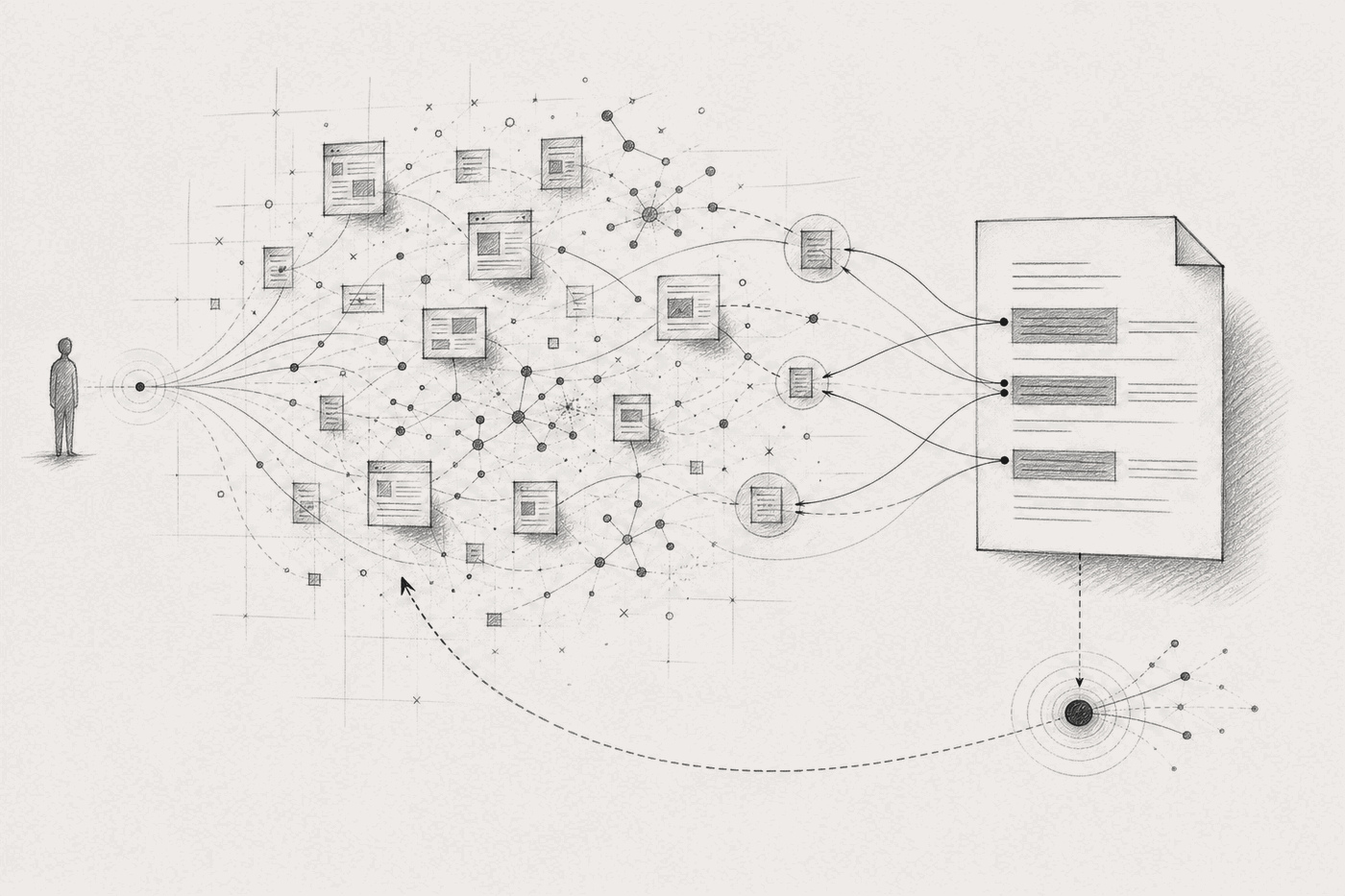
GEO extends the discovery chain
Chapter 1 · 1.2 How discovery works
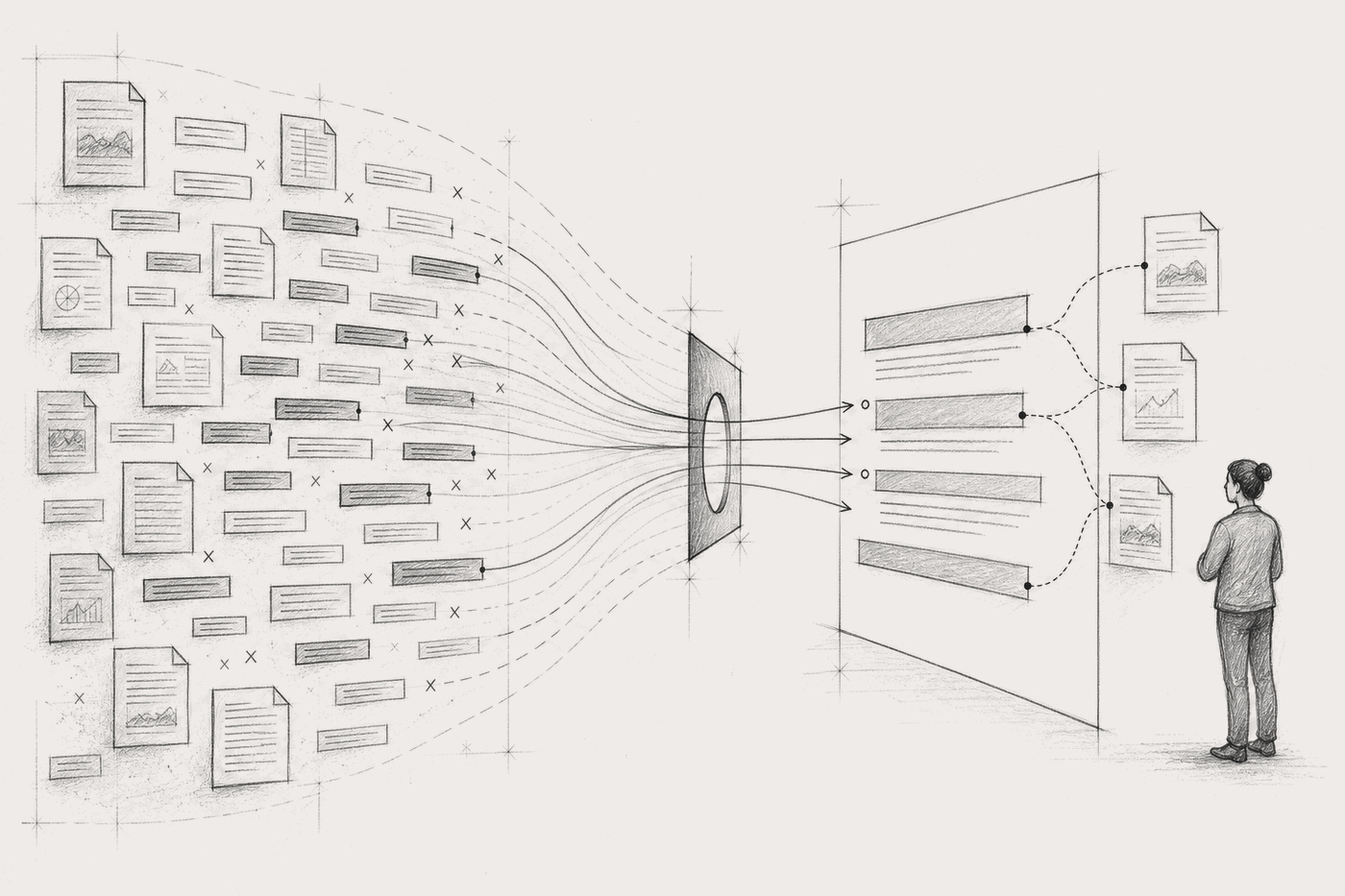
Five gates decide what reaches the answer
Chapter 1 · 1.2.1–1.2.2 Routing and fan-out
The first decisions belong to the platform
Chapter 1 · 1.2.3–1.2.4 Eligibility and grounding
Eligibility precedes request-time selection
No special “AI file” overrides weak crawl and index eligibility. Strong SEO is necessary infrastructure—not a citation guarantee.
Chapter 1 · 1.2.5–1.2.6 Synthesis and outcomes
Citation is not rank—and visibility is not value
- 01Retrieved evidence can disappear during filtering and compression.
- 02Cited evidence may not fully support the sentence or appear in backend rank order.
- 03Visible mentions can end in zero-click awareness rather than referral or revenue.
Chapter 1 · 1.3 Controllable levers
Every factor multiplies
Chapter 1 · 1.3 Influence versus control
Start upstream where control is real
Chapter 1 · 1.3.1 Measurement
Native reports expose different evidence
Both are sampled product reports. A stable benchmark still requires fixed prompts, region, model, web state, repeated runs, definitions, and attribution windows.
Chapter 1 · 1.4.1 Defensibility ladder
Defensibility rises as the loop closes
Chapter 1 · 1.4.2 Industry evolution
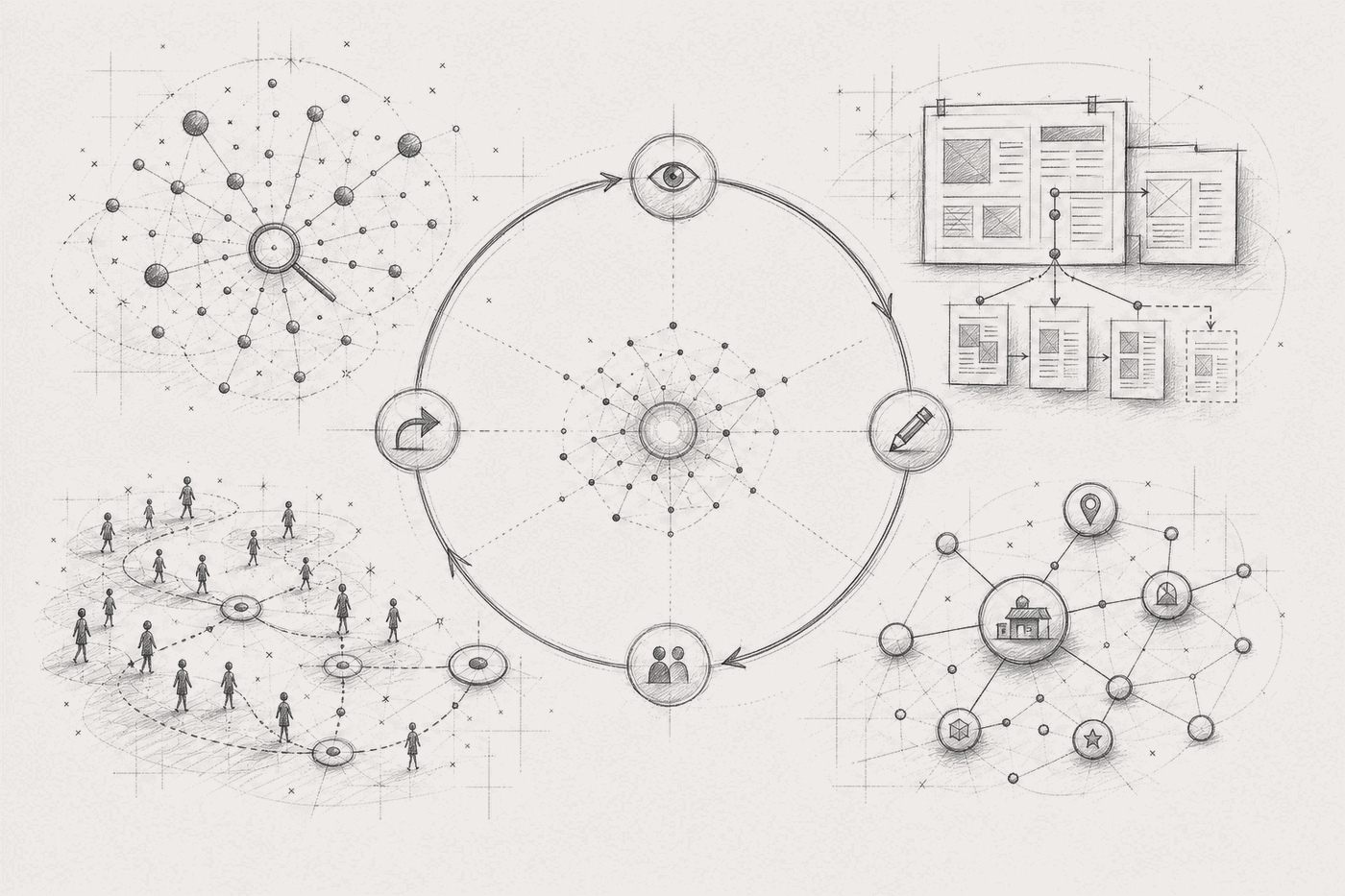
Incumbents already own the control points
- 01SEO intelligence owns demand and historical visibility.
- 02CMS / DXP owns publishing, experiments, and rollback.
- 03CRM / automation owns journeys, conversion, and attribution.
- 04Local / commerce owns authoritative entity facts and distribution.
Chapter 02
Search backends and grounding technology
A model, application, search supplier, and retrieval path are different layers—and the public evidence is uneven.
Chapter 2 · 2.1 International applications
One model can route through many supply paths
Chapter 2 · 2.2 Chinese applications
Orchestration is visible; default suppliers are not
Chapter 2 · 2.3 Infrastructure unbundling
Search is becoming a supply chain
Large-scale indexes
Broad retrieval and ranking infrastructure.
Independent APIs
Search, crawl, extraction, and reranking as separate services.
Direct + closed data
Publishers, commerce, enterprise systems, and vertical feeds.
The same application can assemble different components by mode, region, cost, freshness, and evidence requirements.
Chapter 03
The public-company GEO landscape
Separate product existence, resource adjacency, business-model economics, and financial disclosure before assigning investment value.
Chapter 3 · 3.1 Unified framework
A GEO label hides four separate questions
- 01Where in the value chain does it operate?
- 02By what unit and logic does the customer pay?
- 03Which resources migrated into GEO?
- 04What can investors actually verify?
Product relevance is not revenue purity. Revenue scale is not defensibility.
Chapter 3 · 3.1.1 Value-chain position
Four layers capture different profit pools
Chapter 3 · 3.1.2–3.1.3 Economics and origin
What customers buy is not where advantage came from
Business model · why customers pay
- M1Monitoring subscription
- M2Data, intelligence, API
- M3Suite bundling + cross-sell
- M4Managed execution
- M5Access + content rights
Business origin · resources transferred
- O1SEO / search marketing
- O2Enterprise software + entity data
- O3Advertising, media, PR, agency
- O4Direct product or business-unit launch
- O5Capability acquired through M&A
A company can occupy several value-chain layers, combine payment models, and follow more than one migration path.
Chapter 3 · 3.1.4 Disclosure levels
Pure-GEO financial disclosure is still zero
D0–D4 describe what public evidence can confirm. They do not rank product maturity, company quality, or absolute revenue scale.
Chapter 3 · 3.2 Unified company map
Public exposure clusters around adjacency
Chapter 3 · 3.3 Why Zeta
Zeta is an option—not a GEO pure play
Customer data, marketing execution, revenue growth, cash flow, and distribution.
GEO product attach, revenue, retention, and end-to-end attribution remain undisclosed.
Chapter 3 · 3.3.1 Resource migration
The option was assembled over time
Chapter 3 · 3.3.1 Potential resource loop
The loop is plausible—but not fully disclosed
Each named module or capability exists publicly.
The complete trigger path and GEO-specific attribution loop are not disclosed.
Chapter 3 · 3.3.2 Core-business quality
The core business carries the waiting period
2025 company-wide scale · US$M
2025 revenue-growth bridge · US$M
Q1 2026 growth also includes Marigold. All figures are company-wide; none is GEO revenue.
Chapter 3 · 3.3.3–3.3.4 Economics and valuation
Mixed revenue supports cash flow—not pure-SaaS math
One segment · several contract economics
“Direct” means delivery entirely through Zeta's platform. It does not mean software subscription or GEO revenue.
Approximate valuation multiples · July 15, 2026
Common 0–40× scale. None of the multiples isolates GEO value.
Chapter 3 · 3.3.5 Conditions and conclusion
Product proof must meet economics
Until then: value the core business; treat GEO as conditional upside.